Group characteristics + Periodic Trends
 Call Kai
 Learn
Learn Practice Test
 Spaced Repetition
 Match
Match Flashcards
 Knowt Play
1/35

There's no tags or description
Looks like no tags are added yet.
Name | Mastery | Learn | Test | Matching | Spaced | Call with Kai |
|---|
No analytics yet
Send a link to your students to track their progress
36 Terms
Alkali Metals
ionization
reactivity
what compounds do they form
Low melting point
Low ionization energies (easy to remove an electron from them) because they want to lose their outermost electron, so they can shift to the left and feel like the nearest noble gas. It’s a lot easier to shift left than right for elements in Group .
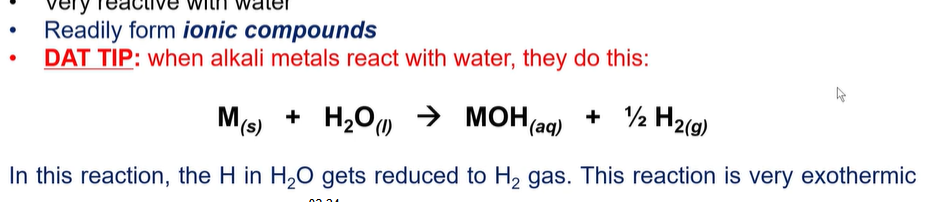
Very reactive with water
Readily form ionic compounds
LOW MELTING POINT
Alkaline Earth Metals
ionization
reactions
relationship with water
Alkaline earth metals (Group 2)
• Also have low ionization energies, but not as low as alkali metals
• Do react with H2O, but not as violently as the alkali metals
• Generally get more reactive with H2O as you go down the group
Halogens
Electronegativity
Electron Affinity
Reactivity with what
Halogens (Group VIIA)
• High electronegativities and electron affinities (they have a high “thirst” for electrons)
• They are only one valence electron away from having a full octet.
• Thus, they are easily reduced and really want to have an extra electron.
• Highly reactive with metals, good oxidizing agents
Noble Gases
On the periodic table, there are certain groups that you should definitely know.
Noble Gases (Group VIIIA)
• Inert (unreactive) gases; they have a full octet and are happy.
Transition Metals (d-block)
• Often form brightly-colored compounds, due to the funky way that d-orbitals’ shapes allow their electrons to absorb colored light and be promoted to higher-energy levels
• Can have multiple oxidation states
Chalcogens
Oxygen group (Group VIA) – also called the “chalcogens”
There are two forms of molecular oxygen: O2 and O3
O2 is a good oxidizing agent (oxidant), and O3 is an even better oxidizing agent. (likes to steal electrons from other substances)
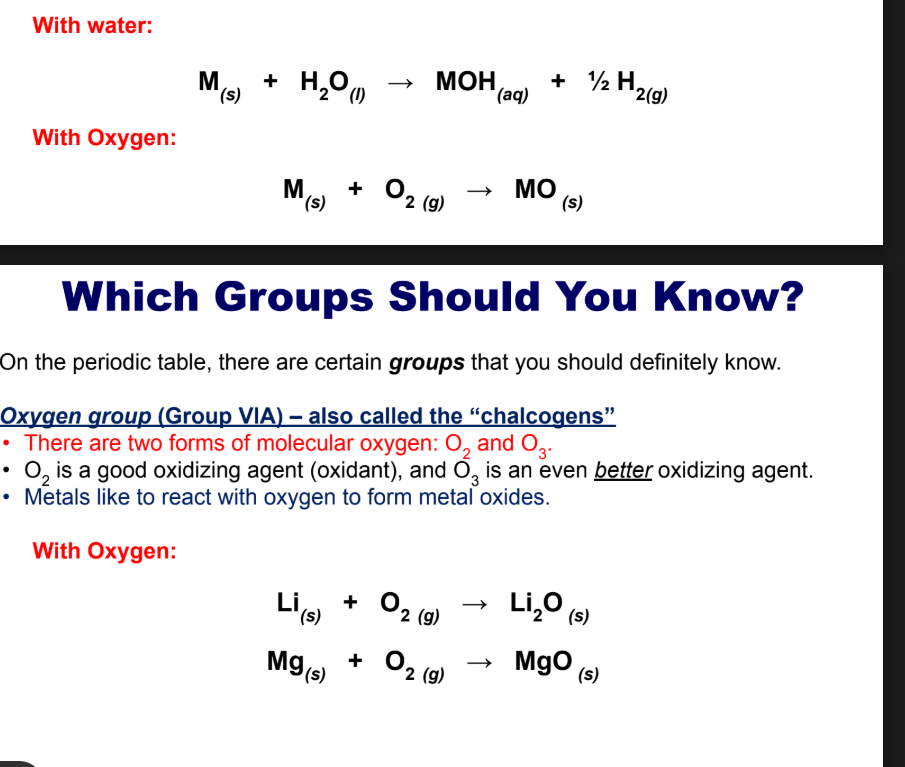
Metals like to react with oxygen to form metal oxides.
With water
Oxidant
An oxidant (also called an oxidizing agent) is a substance that causes another substance to lose electrons during a chemical reaction.
In terms of Redox reaction:
The oxidant gains electrons (so it is reduced).
The other substance loses electrons (so it is oxidized).
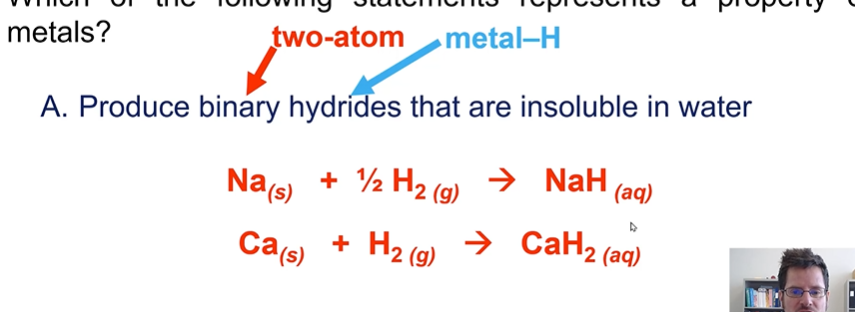
What is a binary hydride
NaH
1 of each. NOT THE SECOND OPTION
Electron Affinity
Exception
Energy released when an element accepts and electron
Cl IS MORE THAN F, which is odd, but an exception.
Bond Length vs Atomic Radius
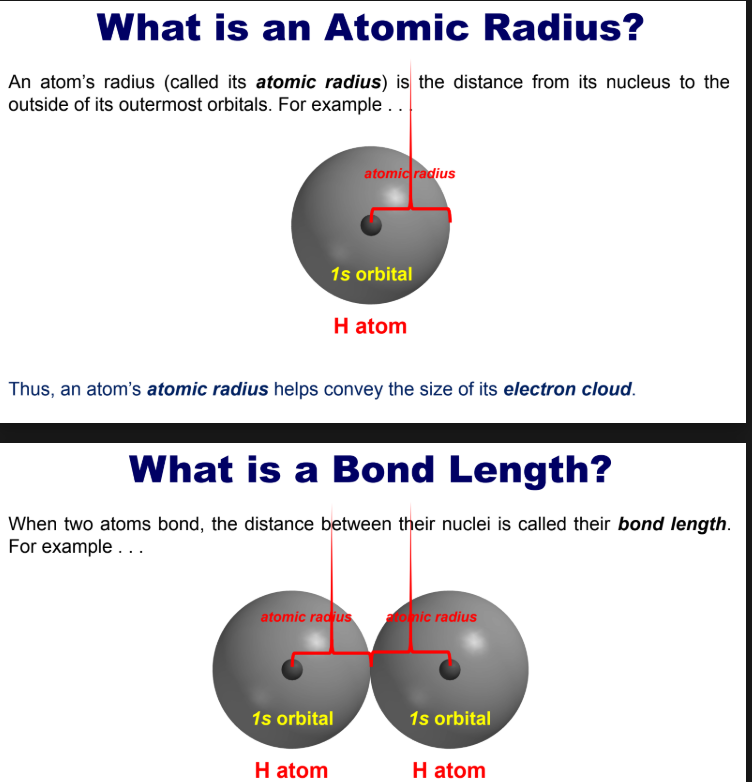
Atomic Radius
An atom’s radius (called its atomic radius) is the distance from its nucleus to the
outside of its outermost orbitals.
Thus, an atom’s atomic radius helps convey the size of its electron cloud.
When two atoms bond, the distance between their nuclei is called their bond length.
For example . . .
For an H2 molecule, you can hopefully see that bond length = atomic radius × 2.
Bond length with different atoms
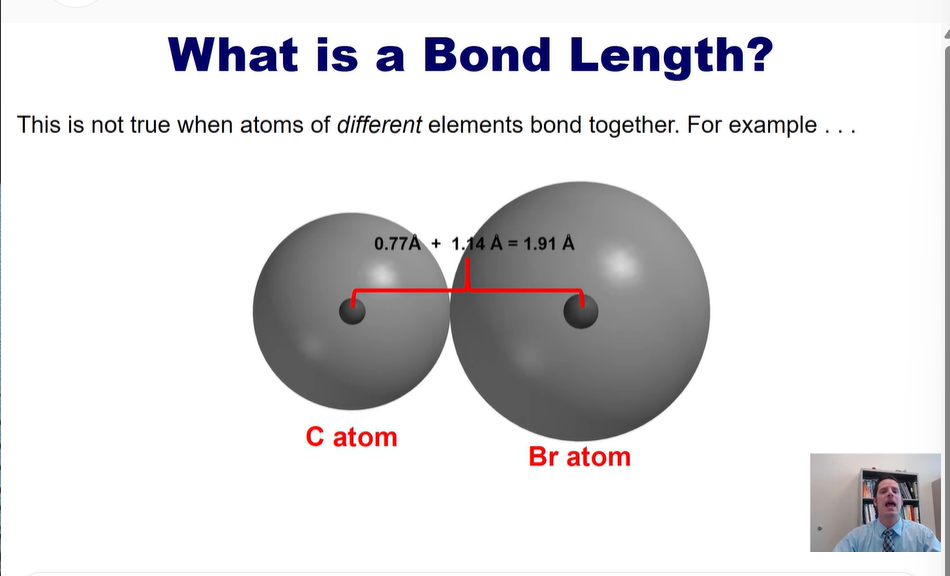
TREND FOR SIZE
SMALLER ON THE TOP RIGHT, BIGGER ON THE LEFT DOWN
RIGHT TO LEFT, more protons, more energy sucked in
Protons ability to bring in electrons is called the effective nuclear charge
UP TO DOWN, more shells
What is an isoelectronic Series
How to differentiate size between them
Atoms with the same number of electrons
AGAIN, the ones with the MOST PROTONS HERE, have the SMALLEST SIZE
Ionization Energy def + general trend
Exception
Ionization energy is the amount of energy required to strip an electron from an atom. Even for elements like Na, which really want to get rid of their outermost it still takes energy to remove that electron.
GOES FROM RIGHT TO LEFT (MOST to LEAST)
UP TO DOWN (MOST TO LEAST)
F WANTS to keep the electron more than Fr
EXCEPTIONS
successive ionization energy
Believe it or not, it’s possible to remove more than one electron from atoms. An atom’s first ionization energy is the amount energy required to remove its first electron; its second ionization energy is the amount energy required to remove its second electron; and so forth
Each successive ionization energy (first, then second, then third, etc.) is larger than the previous one. So an atom’s first ionization energy is smaller than its second; its second is smaller than its third; and so on..
Once an atom “feels” like a noble gas, the ionization energy after that is REALLY big. Why? Because it feels like a noble gas! Once there, it doesn’t want to lose more
electrons.
EN
Atoms thirst for electrons, Right to up (more EN)
Electron Affinity
EXCEPTIONS
If removing electrons costs energy, than adding electrons should produce
energy. And indeed, that is generally the case. The energy produced (or
given off) when an atom accepts an electron is called its electron affinity.
Electron affinity, then, is the opposite of ionization energy.
RIGHT TO UP.
exclude noble gases
BUT THERE IS EXCEPTIONS: F has the highest electron affinity, not Cl.
Be has a filled 2s subshell, so its electron affinity is around zero.
N has a half filled 2p subshell its electron affinity is around zero.
Melting Point Compounds
To determine a high melting point:
First thing
make sure they are both not nonmetals
Next
Make sure they have the widest margin of difference in EN
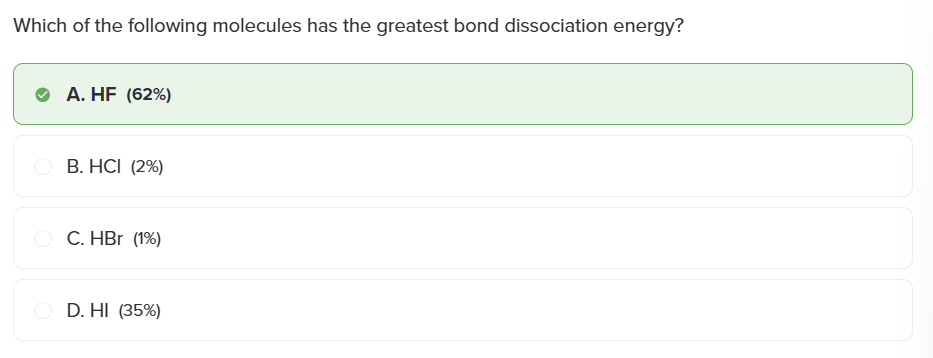
Bond dissociation - Binary Acids
Generally, it increases as the table goes up. The less likely a molecule wants to dissociate, the higher the bond dissociation energy.
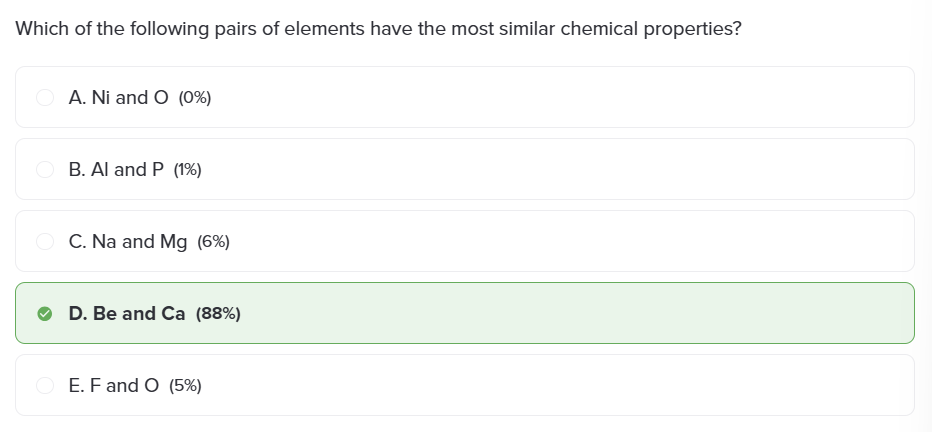
Generally, what makes a pair of elements have the most similar properties?
Usually, they must belong to the same group (NOT PERIOD).
Which compound releases a rotten egg smell.
NEGATIVLEY charged Sulfur compounds
Inert elements
They cannot undergo reactions, i.e. noble gases
Diatomic Elements (7)
Hydrogen
Nitrogen
Fluorine
Iodine
Chlorine
Bromine
Have no fear of ice cold beer
How to tell which element is most readily to undergo a ionic compound (when given a metal)
METAL: Usually you want the one that has the ability to donate its valence electron. LOW ionization energy.
Highest ionic character:
Ionic character refers to the extent to which a bond exhibits ionic properties, determined by the electronegativity difference between bonded elements. A greater electronegativity difference results in a bond with higher ionic character.
Size of atoms when the only difference is charge.
EX:
Fe-
Fe
Fe+
Fe2+
Fe3+
Generally, when there is more electrons, it is larger. The smaller one will have less electrons.
EX answer: Fe3+
How can you tell which element reacts most vigorously with water?
It depends on it’s first i
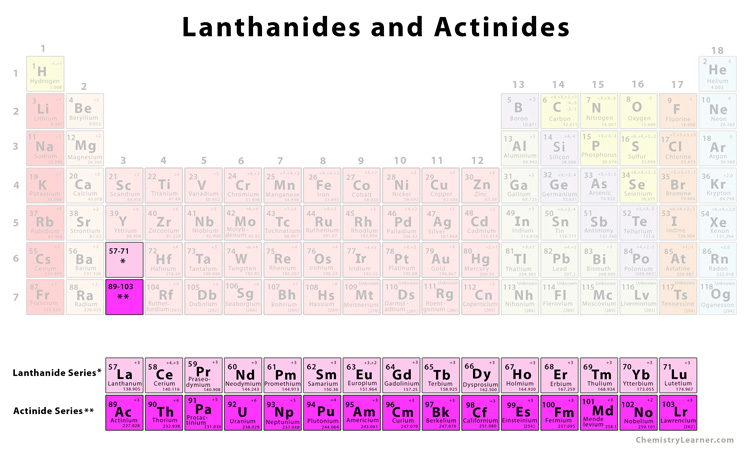
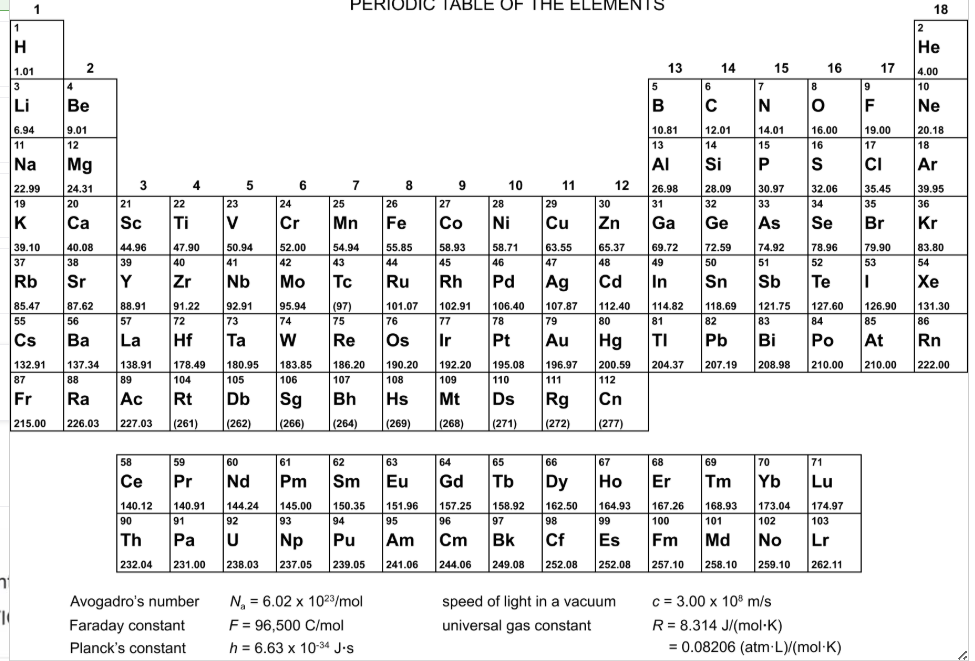
Actinide and Lanthinides
Lantanides on top
Actinides on the bottom
Why does a nonmetal have a smaller atomic radius across a period in the periodic table
Nonmetals have a higher effective nuclear charge
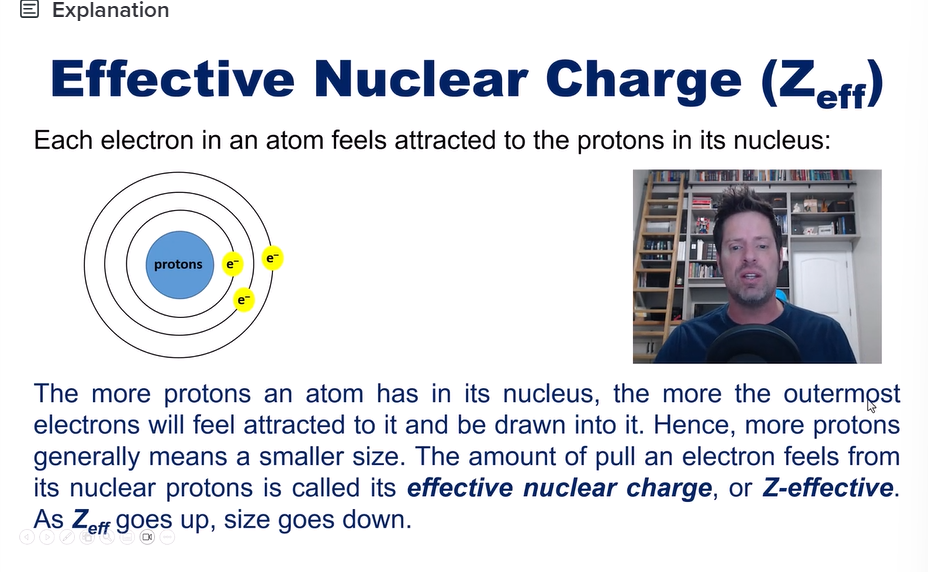
What is effective nuclear charge?
The more protons that an atom has in it’s nucleus, the more outermost electrons will feel attracted to it and be drawn to it.
Hence, more protons generally means a smaller size.
Zeff (Effective nuclear charge) goes up as more nuclear protons increase. When Zeff goes up, size goes down.
Metalloids
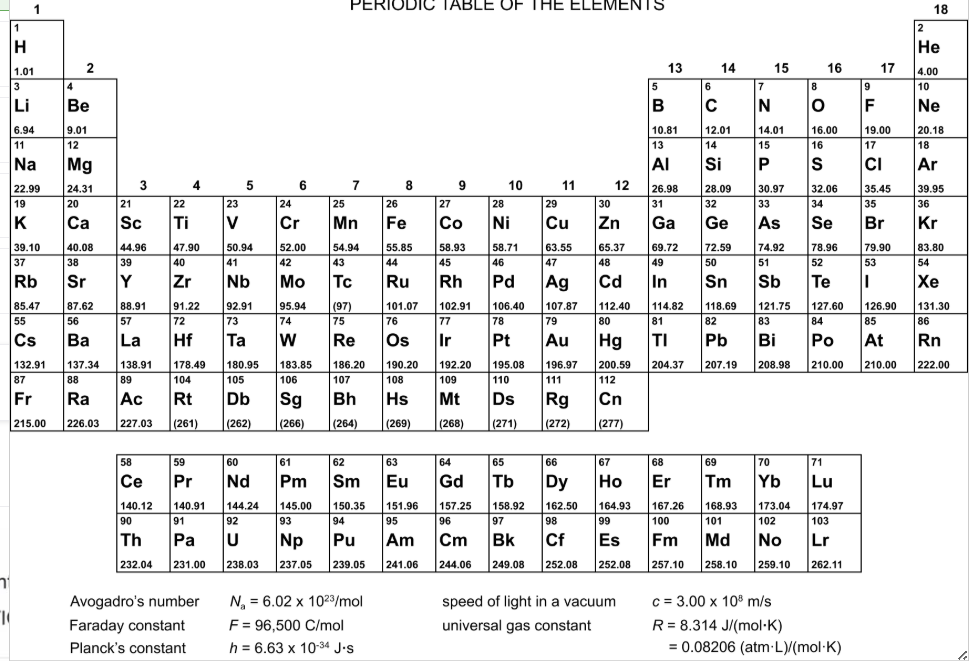
Which ones are they, list them
B
Si
Ge
As
Sb
Te
Po
Electron Shielding
Effect caused by the amount of shells. More electron shielding, means a higher size.
What do metals tend to form in aquesous solutions?
Cations
Nitrogen vs Phosphorus, who can form more pi bonds?
Nitrogen, it is smaller.
Can nitrogen bond to fewer or more atoms than phosphorus, and why?
Phosphorus can bond to MORE. Why?
The rule of anything below period 3, can have more than an octet.