Ecology & Social Sciences
 Call Kai
 Learn
Learn Practice Test
 Spaced Repetition
 Match
Match Flashcards
 Knowt Play
1/35

There's no tags or description
Looks like no tags are added yet.
Name | Mastery | Learn | Test | Matching | Spaced | Call with Kai |
|---|
No analytics yet
Send a link to your students to track their progress
36 Terms
Anthropocene
Geological era proposed by scientists define dby humans constraining planetary dynamics
Ernst Haeckel
Coined the term ecology in 1866
Haber-Bosch Process
1909 discovery that allowed for production of synthetic nitrogenous fertilizers
Montreal Protocol
Successful 1987 agreement to phase out products containing ozone depleting CFCs
successful in reversing the ozone hole
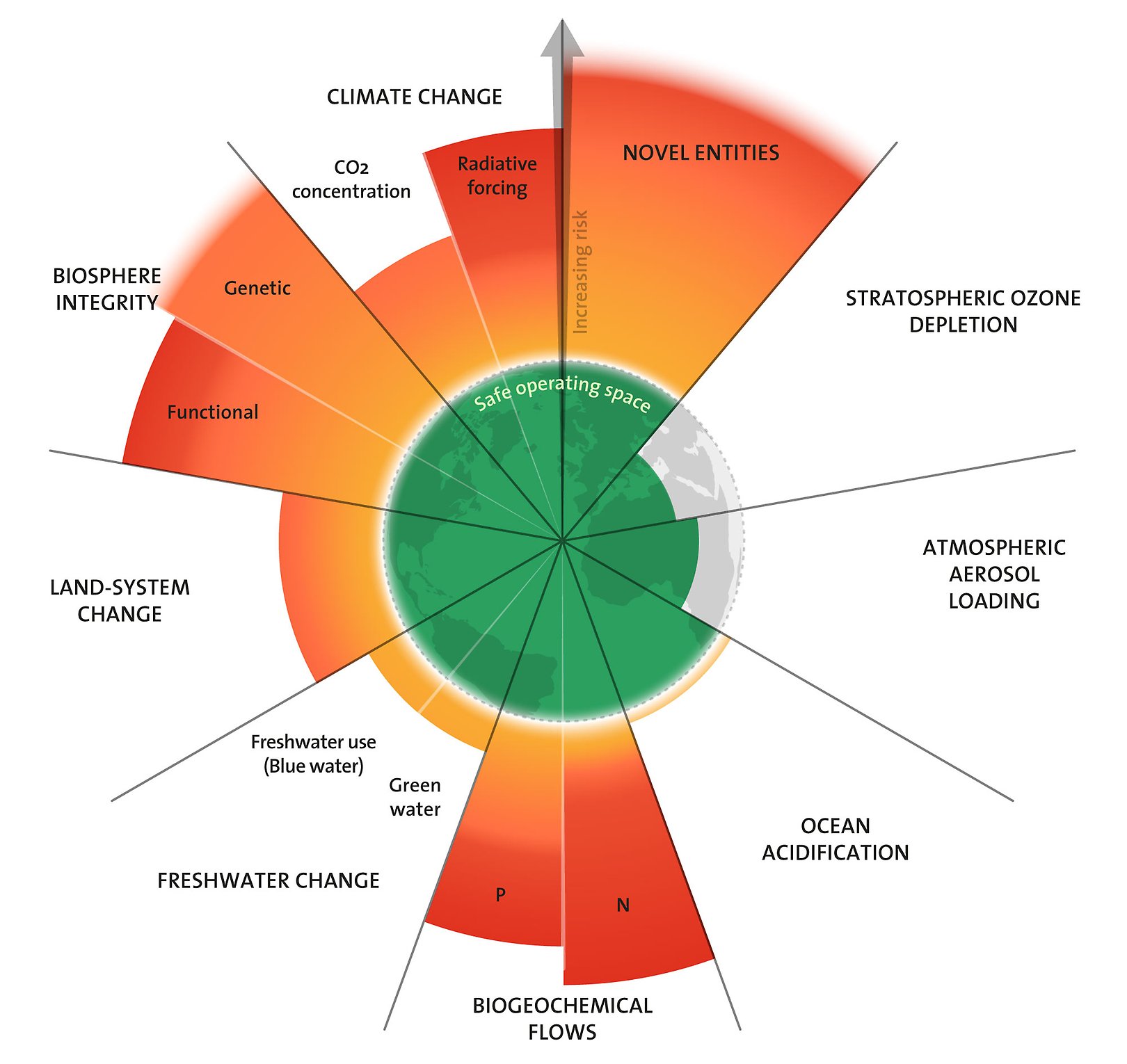
Planetary Boundaries
proposed by Steffen et al. in 2015
key domains that put the entire earth system at risk
Doughnut Economics
K. Rawroth
safe and just space for human activity between social foundation limits and environmental ceiling
Jared Diamond “Collapse”
2005 book
argues that demographics and ecological trends can explain civilization collapse
Stanley Jevons “The Coal Question”
1865
predicts the depletion of coal resources in 100 years b/c of growth in consumption + rebound effect (Jevon’s Paradox)
Rio Tinto Shooting (1888)
protest of mineworkers met with shooting from the Spanish civil guard
shows unrest in industrializing countries because of environmental and health hazards of extractive industries
mining on behalf of a British mining company
Jean Baptist Lamarck (1817) “New Dictionary of Natural History”
argued that man was destined to exterminate himself and make the planet uninhabitable
Charles Fourier (1821) “Material Deterioration of the Plant”
ecological criticism of civilized industry
George Perkins March (1864) “Man and Nature”
first global analysis of impact of humans on the planet
Rabindranath Tagere
Indian activist who criticized British imperialism in India
saw industrialization as a moral and ecological rupture
shouldn’t imitate the western techno-centric development
alternative environmentalist: emphasized relation between human and nature grounded in local ecosystems, rural livelihoods, education, and cultural autonomy
Modern Disinhibitions
idea from J.B. Fressoz
modern societies chose to ignore consequences of industrial production because of the promise of enrichment
they do so by externalizing pollution to the working class and to colonial peripheries
Baumol’s Cost Disease
Sectors with low productivity growth must still see wage increases to match inflation
will lead to increasing relative price of social services
Silent Spring
Book published by Rachel Carson in 1962
warned against DDT in pesticide leading to decline of bird population
led to their ban
seen as the birth of the modern environmental movement
Stockholm Conference
1972
first UN world conference on the human environment
The Stern Review
2006
found that damage costs of climat echange will reach 20% of global GDP
chooses 1.4% discount rate, criticized for being too low and leading to artificially high damages
Biden used a 2% discount rate
The Meadows Report
1972
one of the first integrated environment-economy model
predicted industrial and food production collapse by 2020 due to pollution
Nordhaus “The Economics of Climate Change” (??)
combined representations of environmental and economic systems
found that optimal path for global economy corresponds to 3.1C increase in global surface temps, saying it will only lead to a 3% drop in GDP (doesn’t account for MANY significant impacts)
Uses a high discount rate of 3%
Sterner Review
Sterner and Persson (2007)
critique modeling that assumes high substututability between sectors, underestimate the relative price effect, and use aggregate damage function
climate welfare losses likely grossly underestimated
Dasgupta Review
argument that there are losses we cannot monetize
discount rates and internalization of costs cannot account for everything
Kaya Identity
Emmisions = (Pop) x (GDP/Pop) x (Energy/GDP) x (Emissions/Energy)
no absolute decoupling of GDP growth and fossil energy use
Multiple Streams
Kingdon
Framework for policy change
Problem Stream, Politics Stream, and Policy Stream are constantly shifting, at some point they align and create a policy window where there is a possibility of policy agenda setting and eventual policy change
Diffenbaugh and Burke
quadratic model of economic impact
Hayek
believed that paradigm shifts are internalized through business think-tanks, intellectuals, and media
Gramsci
believed that paradigm shifts are internalized through culture
argues that the dominant group controls society by controlling ideology and common sense
The Bridgetown Innitative
an initiative that seeks to create a global financial structure that is compatible with mass climate action
proposes expanding the lending capacity of banks, lowering financing costs, providing debt relief, creating climate-resilient debt clauses, and mobilizing large-scale concessional finance
Collapsology
movement of depoliticization of environmental debates
an “enlightened few” see that the climate is beyond the point of prevent and we need to focus on coping
Weitzman
2007
argues that standard cost benefit models wrongly assume well behaved probability distribution/that extreme outcomes are unlikely
cost of extreme events likely even higher than projected
Gordon
argument that recent innovations are less transformative than those of the past
advanced economies face structurally slower growth
Niche Theory
paradigm shifts caused by critical mass of anomalies contradicting the dominant paradigm + the development of an alternate theory that better explains the evidence
Hall’s Three Orders of Change
first order change: adjustment to policy
second order change: change in policy
third order change: change in goal of policies
Kyoto Climate Conference
international climate conference that introduced the idea of “common but differentiated responsibilities” between countries ← certain countries are much more liable for their historical emissions
Treadmill of Production
Alan Schnaiberg
contradictory relations between economic expansion and environmental disruption
need to economic growth leads to stimulation of demand leading to expansion of impact on ecosystem until it exceeds physical limits, politicians react with policy that encourages further expansion
leads to environmental disorganization
Longo and York (2020): disruption that prohibits regeneration → complete instability
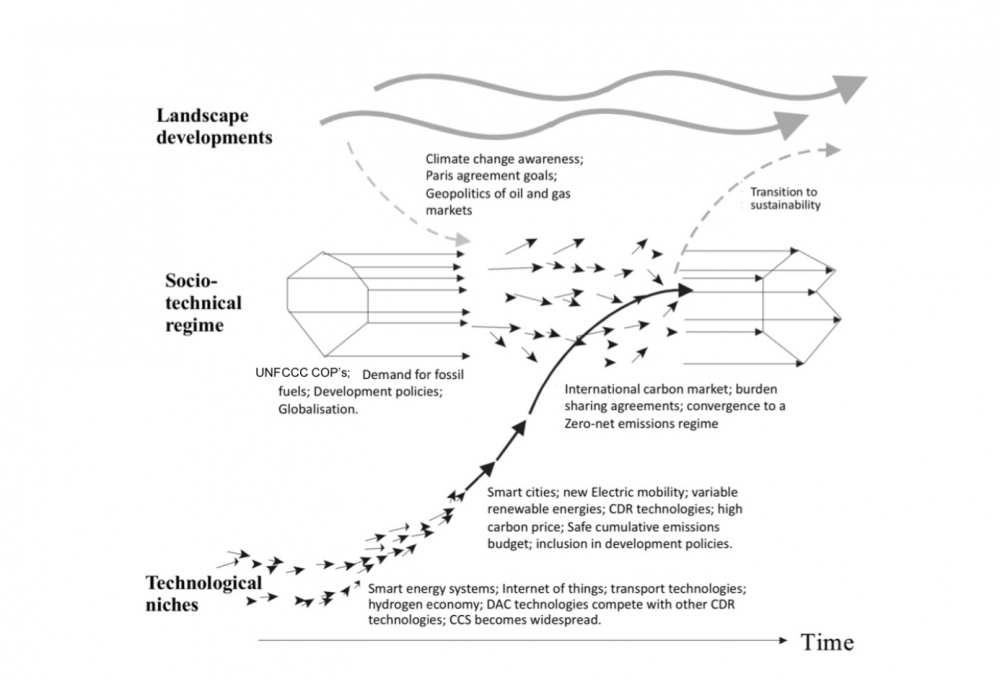
Multi-Level Perspective
Frank W. Geels
model for the socio-technical transition
niche innovations gradually build up internal momentum
create pressure on the system/regime
destabilize the regime and create windows of opportunity for niche-innovation
diffuse and disrupt the system