Alkyne Reactions MT2
 Call Kai
 Learn
Learn Practice Test
 Spaced Repetition
 Match
Match Flashcards
 Knowt Play
1/12

There's no tags or description
Looks like no tags are added yet.
Name | Mastery | Learn | Test | Matching | Spaced | Call with Kai |
|---|
No analytics yet
Send a link to your students to track their progress
13 Terms
RC≡CR + H2 with Pt
RCH2CH2R,
Turns alkyne into the alkane
RC≡RC + H2 with Lindlar catalyst
Turns alkyne into the alkene, forms the cis alkene
RC≡RC
1. liquid Na, NH3
2. H+, H2O
Trans alkene
RC≡RC + HX
(repeat process twice)
RCH2CX2R
Geminial dihaloALKANE,
first time adding HX adds a halogen onto one of the adjacent carbons
RC≡RC
+ Br2, Br-
trans haloalkene (BRs on opposite side)
RC≡RC
Hg2+, H2O
alkane where one of the carbons has an caarbonyl group
RC≡CH
HBr, ROOR
RCH=CHBr
Br attaches to the less substituted carbon,
H attaches to the more substitued reaction
Remember radical bromination!
RC≡RC
1. CH3CH2CH2CH2Li
2. epoxide
3. H+, H2O
RC≡CCH2CH2OH
One of the R groups gets replaced by the Li, the carbon attached to the Li is now nucleophilic and attacks the epoxide (attacks more substituted side), then the water is attacked by the oxygen, adding an alcohol
RC≡CR
1. CH3CH2CH2Li
2. R’ (C=O) R’’
3. H+, H2O
adds another C which has R’ and R’’ and an OH group
(still alkyne)
what is tautomerizing and when does it happen?
tautomerization happens when an alkyne reacts with a acid, water, and Hg2+. When the alcohol group is formed, the H on the OH attaches to the other carbon and the O forms a double bond with the carbon its attached to!
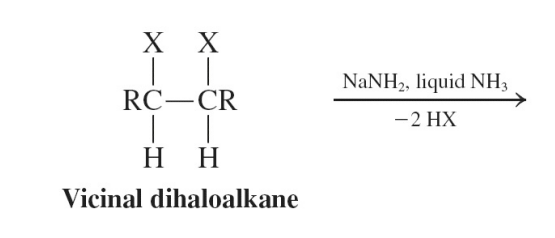
RC≡CR
RC≡CR
NaNH2, liquid NH3
R’X (R’X = primary)
RC≡CR’