3.9 The Method of Undetermined Coefficients
 Call Kai
 Learn
Learn Practice Test
 Spaced Repetition
 Match
Match Flashcards
 Knowt Play
1/3

There's no tags or description
Looks like no tags are added yet.
Name | Mastery | Learn | Test | Matching | Spaced | Call with Kai |
|---|
No analytics yet
Send a link to your students to track their progress
4 Terms
Method of Undetermined Coefficients
A method utilized for solving a specific class of non-homogenous differential equations whose forcing functions belong to a specific class of functions.
We look at the forcing function and then select a guess function, Yp(t), based on the forcing function of the non-homogenous equation.
Total Solution
Recall that for non-homogenous differential equations, the final solution is always the linear combination of the complementary solution and the guess function — Yp(t).
Tables of Forcing Functions
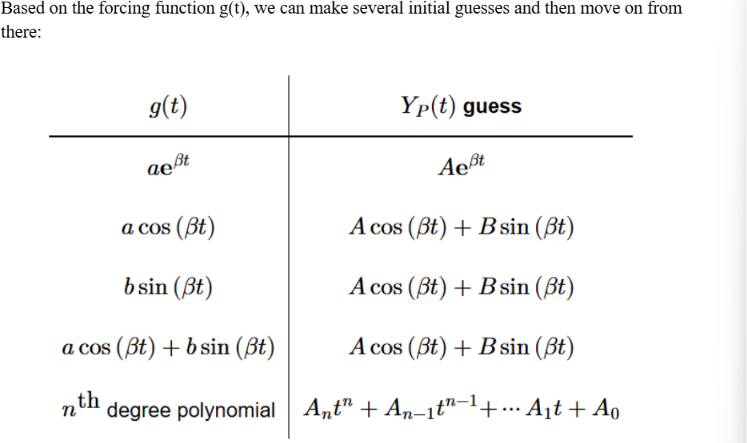
Linear Independence and Guess Functions
IF the complementary solution contains a term that is already present in the forcing function, then our guess function must be multiplied by the lowest factor of t that enables a difference to be had.
For example,
y” -3y’ + 2y = e^t
yc(t) = c1e^t + c2e²t
However, we already have e^t in our yc AND in our forcing function, so we need to change our original guess function.
Originally, our guess function (based on the table of forcing functions) is ae^t; however, because we already have an overlap with a term in the yc(t) and in the forcing function, we need to multiply our guess function by a factor of t in order to ensure linear independence. So, our guess function is now ate^t.