Attachment - Exam questions
 Call Kai
 Learn
Learn Practice Test
 Spaced Repetition
 Match
Match Flashcards
 Knowt Play
1/7

Earn XP
Description and Tags
Flashcard use only
Name | Mastery | Learn | Test | Matching | Spaced | Call with Kai |
|---|
No analytics yet
Send a link to your students to track their progress
8 Terms
Discuss Bowlby’s idea of the internal working model (8 marks)
AO1
Internal working model - cognitive framework formed that influences the way in which we understand relationships, thus forming the foundation for all future relationships
Formation of IWM based on relationship with primary caregiver
AO3
(+): Strong scientific research support: Harlow (1958) - study on monkeys who were raised without a proper attachment showed social and emotional difficulties - abused and killed children, and bullied by other monkeys
(+): Strong scientific research support: Bailey et al. (2007) - 99 mothers and their 1 year old infants. Those with poor attachments to their mothers likely to have insecurely attached infants
(-): Deterministic
Discuss Bowlby’s idea of the critical period (8 marks)
AO1
Critical period - Period of time in which attachments need to be made or else the child will find it difficult or impossible to form future attachments
If attachment isn’t formed, can lead to long-term social, emotional and intellectual deficits
2.5 years for humans
AO3
(+): Backed by scientific research: Lorenz (1930s) - study on geese which found that geese have critical period of 16 hours (-): animal study
(+): Genie case study - deprived until the age of 13 and suffered from cognitive deficits
(-): Czech twins - isolated from 18 months to 7 years by their abusive mother, later adopted and made a full recovery - Critical period later replaced by 5 year sensitive period
Outline Lorenz’s and Harlow’s animal studies of attachment. Discuss what these studies might tell us about human attachment (16 marks)
P1 - AO1
Outline Lorenz’s procedure
Outline Harlow’s procedure
P2 - AO3 (Lorenz’s results and links to attachment)
Imprinting - attachment is innate
16 hours to imprint - critical period
P3 - AO3 (Harlow’s results and links to attachment)
1 hour with wire, 17 hours with cloth - attachment favours comfort
Behaviour from fear conditions (secure base) - attachment figures promote curiosity and explorative behaviour
Behaviour with infants and other monkeys - IWM
P4 - AO3 (EV for both Lorenz and Harlow)
Animal studies - not generalisable but may be as monkeys and humans are both mammals
Harlow’s study is quite artificial so low ecological validity
One theory about how and why babies form attachments is Bowlby’s monotropic theory. Outline and evaluate Bowlby’s montropic theory of attachment (8 marks)
AO1
Monotropic theory - infants form one special primary attachment that is more important for emotional and psychological development. Usually the mother
Forms IWM
Babies’ use of social releasers to attract carer-reciprocity
Critical period
AO3
(+): Strong research support: Harlow and Lorenz
(-): Implications such as the role of the father - maternity vs paternity leave = wage gap
(-): Contradictiry research- Schaffer and Emerson (1964): Glasgow babies study, 60 babies observed monthly for 18months. Found that at around 10-11 months, infants begin to from multiple attachments and seek comfort and protection in them. As well as showing separation anxiety from multiple people
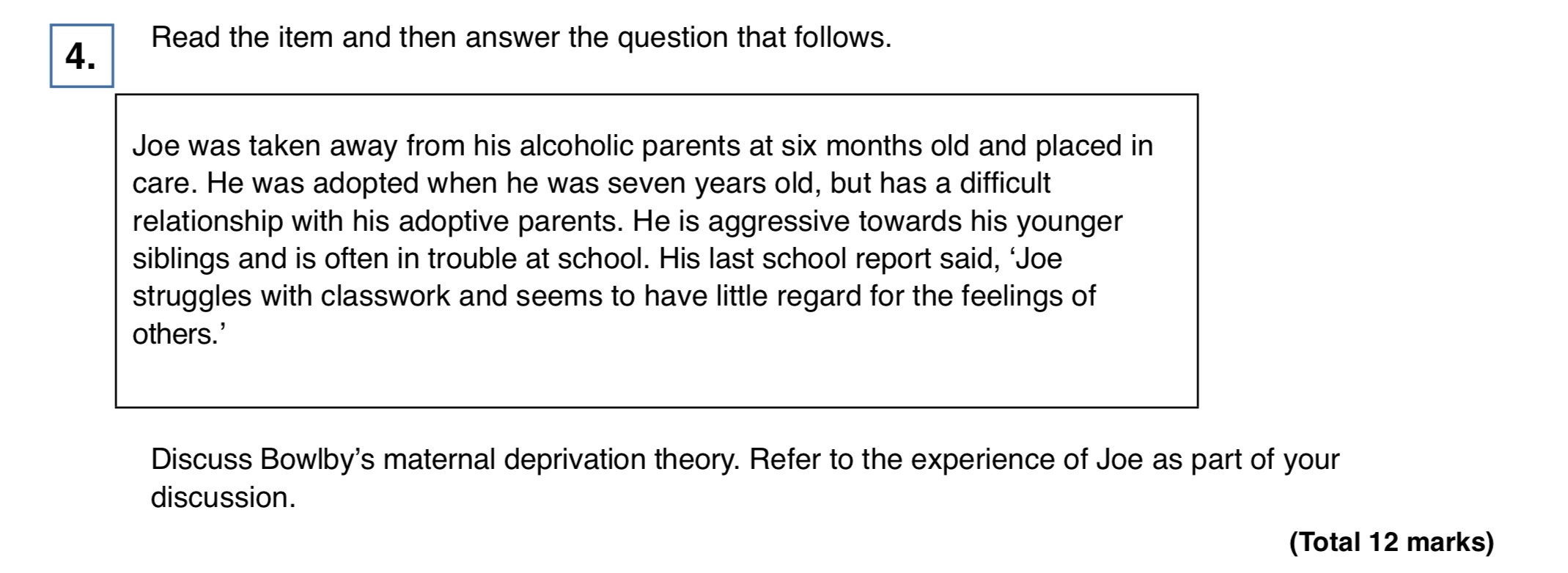
Discuss Bowlby’s theory of maternal deprivation (8 marks)
AO1
Maternal deprivation - loss of maternal element of care
Leads to inevitable and irreversible psychological damage
Delinquency, cognitive deficits, affectionless psychopathy, Inability to form future relationships
AO3
(+): Evidence from external research - Genie case study: deprived up the age of around 13 years old. Could understand and pick up basic language and use non-verbal communication, but had trouble with speaking grammatically (pronouns and umbrella terms) and move effectively
(+): Backed by scientific research - 44 thieves study: 14 affectionless psychopaths, 30 non-psychopaths. 85% of AP were deprived. 15% of N-AP were deprived
(-): Contradictory research - Czech twins study: twins deprived form 18 months to 7 years old. Later adopted and made a full recovery
Discuss learning theory as an explanation of attachment (16 marks)
AO1
Learning theory: attachments are formed due to the infant associating its primary caregiver with food - classical conditioning
Attachment is built upon and maintained through operant conditioning
Define operant conditioning and how negative reinforcement and positive reinforcement are both used in the formation of attachments
AO3
(-): Contradictory scientific research - Harlow’s (1958) - study on monkeys and found that comfort was favoured over food (wire and cloth mothers) (secure base behavaiour) (1hour vs 17hours)
(-): Contradictory scientific research - Schaffer and Emmerson (1964) - Glasgow babies study: observed once a month for 18 months and found that the infant’s primary attachment wasn’t the one who fed them in around half the cases
(-): Reductionist - the focus on basic processes like reinforcement is too simplistic to explain complex attachment behaviours
Discuss the Strange Situation as a way of assessing attachment type (16 marks)
AO1
Used to determine and asses the nature of the attachment between caregivers and their infants by testing different aspects of attachment such as secure base, stranger anxiety, separation anxiety, and reunion
0Done through putting the infant through 8 ‘episodes’ in a controlled environment
Outline the 8 episodes
Came to the agreement of 3 main attachment types: secure, insecure avoidant, and insecure ambivalent
AO3
(+): Strong scientific research support - Bick et al (2012): found that observers agreed on infants’s attachment type 94% of the time
(-): Cultural bias - designed and tested in the USA. Van Ijzendoorm and Kroonberg found that % are different in other countries e.g.German children frequently rated as insecure avoidant due to parents valuing independence.
(+): Real-world application as it is highly replicable - standardised procedure, high level of control, carried out successfully in many different cultures