habits
 Call Kai
 Learn
Learn Practice Test
 Spaced Repetition
 Match
Match Flashcards
 Knowt Play
1/37

There's no tags or description
Looks like no tags are added yet.
Name | Mastery | Learn | Test | Matching | Spaced | Call with Kai |
|---|
No analytics yet
Send a link to your students to track their progress
38 Terms
why does so much research focus on planned behaviour if most behaviour is automatic + habitual
researchers are susceptible to bias towards agentic accounts of behaviour → we prefer explanations of behaviour that give intentions/reasons to behaviour, when in actuality most actions are habitual
what is the definition of habits (Wood + Runger, 2016)
strong associations (in memory) between contexts + responses that have developed by repetition, that result in relatively automatic responses to contexts that are insensitive to changes in the value/intensity of response outcomes
context can be an environmental or internal (if i feel _ I will _)
habits can be behavioural or cognitive (e.g. pessimistic thinking patterns)
habits build due to being functional for us → behaviour is reinforced then persists even when it is no longer rewarding
what does Verplanken (2006) believe habits should not be associated with
frequency of occurrence → it is not enough to classify it as a habit based on how often/for how long someone has done something; we can habitually not perform an action
habits are specifically about associations between contexts + responses
how did Adriaanse et al. (2011) study whether habits are represented by strong associations between contexts + responses
assessed whether people who habitually snack do it context dependently
participants were asked what they would usually snack on at home (habitual response based on context), then were asked what it would be if this wasn’t available (alternative, non-habitual response)
performed a lexical decision task → primed with ‘home’ then presented their responses + filler items; if participants had a representation of these two concepts, ‘home’ would activate associated foods by spreading activation
what were Adriaanse et al. (2011)’s findings
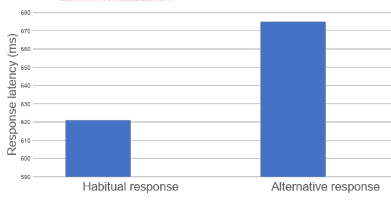
mean response latency for habitual response was much faster than the alternative response when priming the relevant context → confirms association between context + habitual response
how did Wood et al. (2002) study whether habitual associations develop through repetition
studied the proportion of which what we do is habitual → participants recorded what they were doing at the moment of a watch chime, as well as:
the frequency with which they had performed the behaviour in the last month
the extent to which they performed the behaviour in the same physical location each time
the involvement of other people in the behaviour (whether there are)
found around 43% of actions were performed almost daily + usually in the same context → lots of what we do is habitual due to instrumental learning
what are 4 criteria for establishing automaticity
does not require deliberation/cognitive resources → efficient
occur outside conscious awareness
insensitive to changes in the value of the response → not dependent on goals/rewards)
are difficult to control
through what 4 stages did Aarts et al. (1997) study whether strong habits remove the need for deliberation
measured the strength of cycling habits for students by deciding mode of transport for 9 trips (frequency of cycling mentions measured)
participants were given 16 possible descriptions of travel situations, each with 4 attributes:
weather conditions (rain/no rain)
weight of luggage (4/20kg)
departure time (9am/2pm)
distance to destination (2.5/5km)
measured favourability of using the bicycle in each travel situation (on 1-10 scale)
DV measured the number of attributes used to make a decision → operationalised how predictive attributes were of decision (depending on whether cycling is habitual)
what were Aarts et al. (1997)’s results + what does this imply
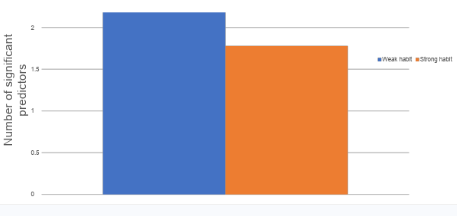
measured the number of predictors of choice for travel mode + found that those with strong cycling habits took into account 1.8 (in comparison to 2.2)
shows while there is some deliberation, having stronger habits means a smaller amount of deliberation is required
how did Wood et al. (2002)’s study extend to whether habitual responses occur without people being aware of them + what did they find
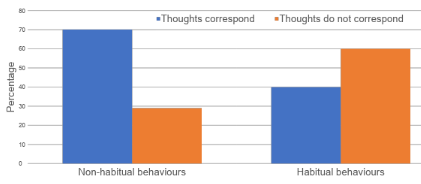
along with the watch chime, also asked participants what they were thinking about during this activity (if thinking about something else, more likely habitual) + whether they considered it a habit
found with non-habitual behaviours, thoughts didn’t correspond around 70% of the time + did around 40%, and this effect was flipped in non-habitual behaviours
suggests that the majority of habitual actions occur outside of conscious awareness
with what 3 variables did Neal et al. (2011) study whether habits are insensitive to changes in the value of the response
participants were told they were evaluating movie trailers or music videos → researchers manipulated 3 variables consistent/inconsistent with eating popcorn + gave each participant a bag to snack on:
habit strength → asked how frequently they eat popcorn in movie theatres
context → either in cinema room (movies → contextual cues of popcorn) or meeting room (music videos → not associated)
value of the response → whether popcorn was fresh or stale (should not reinforce eating)
what were Neal et al. (2011)’s results + what did this suggest
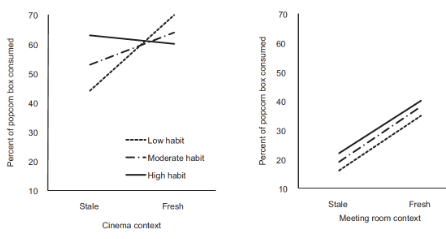
meeting room context → generally were less likely to eat popcorn, more likely to if it’s fresh (less cue dependent)
cinema context → behaviour more dependent on strength of habit; high habit were likely to eat the popcorn regardless
shows habitual behaviour = insensitive to value of response
what is a non-behavioural example + measure of habit (Verplanken et al., 2007)
mental (cognitive) habits, e.g. pessimistic thinking patterns → measured using the Habit Index of Negative Thinking (HINT)
what index can be used to assess whether habits are part of one’s identity (Verplanken + Orbell, 2003)
the self-report habit index → measures whether thought processes can have the same properties as behavioural responses
to what extent we are defined/we define ourselves by our habits, and how consistently do these behaviours need to be performed for it to become ‘who you are’
what did Martagh et al. (2012) find regarding whether habits are part of our self-concept
found a weak correlation (between .02-.07) between being a driver as part of who participants are + frequency with which they use other modes of transport → evidence against habits being part of who we are
what did Albini et al. (2018) find regarding whether habits are part of our self-concept
found a moderate correlation (.49) between participants seeing themselves as habitual vegetable eaters + eating them frequently, but not for fruit (.06) → provides some, but not clear evidence that habits are part of who we are
what did Verplanken + Sui (2018) find regarding whether habits are part of our self-concept
found a moderate correlation (.46) between general behaviours being part of one’s self concept + frequency they are performed → gives fairly strong evidence that habits are part of who we are
in summary, which of the following features characterise habits
strong associations between contexts + response → yes
develop through repetition → yes (though not as much as William James suggested)
are automatic → depends
don’t require deliberation → to some extent, have less deliberation
outside conscious awareness → mostly
insensitive to changes in response value → yes
are part of our self-concept → conflicting findings
what do Verplanken + Orbell (2022) state about the negative perception of habits
habits are often seen as negatives that must be overcome in order to create healthier, more sustainable societies, but this overlooks the important role habits have in regulating desirable everyday behaviour + consolidation long-term behavioural change
majority of habits = very functional + even beneficial
are motivations alone enough to break habits (Webb + Sheeran, 2006)
through a mega-analysis on effects of intentions to change behaviour on behavioural outcome, changes in intentions lead to larger changes (d = .74) in behaviours performed sporadically than behaviours that could be repeated into habits (d = .22) → shows limited efficacy of motivations alone
what are 3 reasons why do people fail to act on their intentions (Sheeran et al., 2005)
intention viability → it is impossible for some decisions to find expression
lack of resources/outside personal control
counter-intentional habits → intentions have smaller effects on behaviours performed frequently in similar situations (habits); key to understanding why habits are so hard to break
for what 5 reasons is it difficult to break habits
people may not be aware:
that habits drive behaviour
of the cues (environmental + internal) that trigger habits
of the habitual responses themselves
habits are insensitive to changes in the value of the response
habits may be part of one’s self-concept
what are 3 possible strategies for breaking habits
changing circumstances
vigilant monitoring
planning behaviour
what is the theory behind changing circumstances for breaking habits
if habits are cued by recurring stimuli, then changes in circumstances that remove these stimuli should disrupt habits
what method + at what timepoints did Wood et al. (2005) study whether changing circumstances could break habits
sampled young adults who were moving to a new university, so experienced naturally-occurring context (+ cue) change
4 weeks before moving → indicated the frequency of performance of exercising, reading newspapers + watching TV, and indicated whether this was performed at same location, with same people + whether others perform these behaviours (assessed stability of context)
4 weeks after moving → indicated frequency of performance of the behaviourism as well as the extent to which the context they perform each behaviour in was similar/different
tracked which behaviours persistent + whether the associated cues did also
what were Wood et al. (2005)’s findings regarding whether change in location affected the frequency of the habit being performed
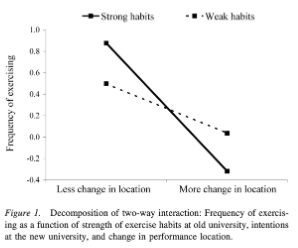
found when assessing frequency of exercising behaviour:
those with stronger habits were much more disrupted by changes in external (location) cues, so were much less frequently exercising on average → strength of habit associated with lack of flexibility + stronger ties to contextual cues
also perceived more change on average than those with weak habits
those with weaker habits were less disrupted by location change, so were more adaptable to new circumstances → habit less likely to be broken
what were Wood et al. (2005)’s findings regarding whether change in presence of others affected the frequency of the habit being performed + what do these findings suggest overall
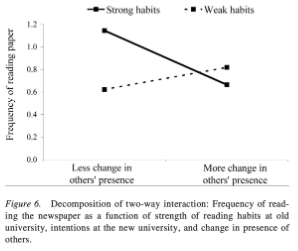
found for those with strong habits, more change in the presence of others (social external cue) lead to less frequently performing the behaviour, whether those with weak habits were slightly more likely to perform the behaviour with increased change
overall, changing contextual cues = an effective method to changing habits, especially if they are strongly held, but this isn’t always viable
what is vigilant monitoring
because habits are often below conscious awareness, this strategy involves effortfully paying attention to habits
using what 4 conditions did Quinn et al. (2010) study the efficacy of vigilant monitoring in breaking habits
instructed participants to identify behaviours that they tried to inhibit/change during a typical day + measured the strength of these habits (how often they were performed in the past + extent to which they were performed in the same location each time). at follow up, reported the strategy they used, which included:
vigilant monitoring, e.g. thinking ‘don’t do it’, watching carefully for mistakes
distraction
stimulus control (removing opportunity)
nothing
what were Quinn et al. (2010)’s findings + what does this suggest
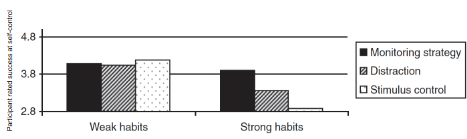
data suggests vigilant monitoring is most effective for breaking strong habits (over and above stimulus control + distraction)
at odds with Woods’ findings of changing circumstances → means if changing context isn’t viable, vigilant monitoring = effective strategy as people may not be able to identify cues that underlie habits
in what 2 main stages did Adriaanse et al. (2011) assess whether planning = an effective strategy of breaking habits
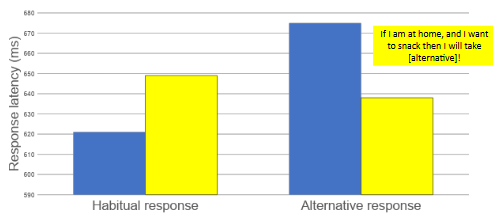
initially measured RT of habitual + non-habitual snack eating → found RT for habitual response was much shorter
formed an implementation intention → participants plan what they would snack on if at home + reinforce the non-habitual snack
what was Adriaanse et al. (2011)’s hypothesis behind forming implementation intentions to break habits
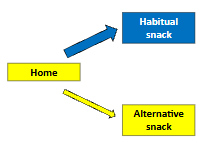
believed forming an implementation intention would create a new association with the critical cue (e.g. being at home) that is pitted against the habitual response
once the cue is activated, speed + strength of spreading activation of the habitual + alternative response (snack) will determine which response is activated first/more strongly
what were Adriaanse et al. (2011)’s findings + what does this suggest
found that participants who formed intention implementations were much faster at responding to the alternative snack + slower to respond to the habitual one
suggests that a new association had been formed, which partially inhibited the old association → suggests this is an effective strategy of breaking habits as it forges alternative associations
how did Holland et al. (2006) assess the efficacy of forming plans in order to break habits
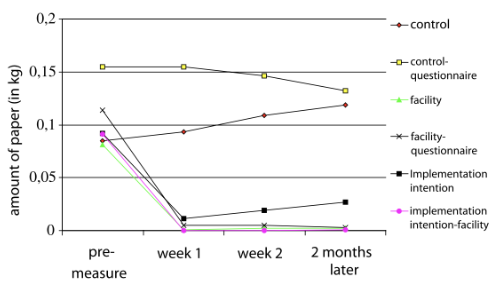
company installed recycling boxes for old paperwork + plastic cups, but the amount binned did not reduce (suggesting strong waste habits)
researchers instructed one group of employees to plan when, where + how they would recycle their paper/plastic cups
DV = weight of paper + cups in each participants’ dustbin at the end of the day (objective measure)
what were Holland et al. (2006)’s results
planning overall disrupted waste habits, resulting in less waste behaviour
how did Webb et al. (2009) study whether the physiological strength of the habit affects the effectiveness of planning reducing habitual behaviour
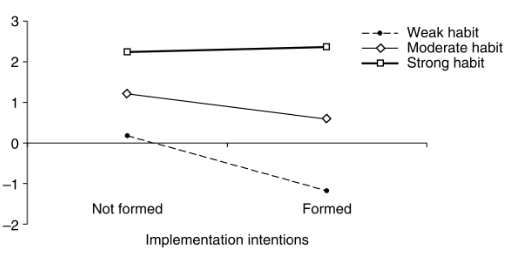
recruited regular smokers from high schools that wanted to quit → measured strength of smoking habits using test for nicotine dependence, number of months as a smoker + number of attempts to give up. assigned them to either:
implementation intentions condition → when I am stressed, instead of smoking I will _
control condition → completed control exercises concerning seatbelt use
measured smoking behaviour on 1 month’s follow up (no. of cigarettes a day)
what were Webb et al. (2009)’s findings + what does this suggest
found strength of habit moderated implementation intention efficacy in reducing smoking → heavy smokers found implementation intentions less effective
shows some strategies, e.g. changing environmental cues, may be more effective for stronger habits than weaker ones
overall if changing circumstances to reduce exposure to cues that trigger habits is not possible, what methods are effective at reducing habits
vigilant monitoring of behaviour → more useful for strong habits than other strategies
implementation intentions → linking cue with a new, alternative response