Chem 242 final
 Call Kai
 Learn
Learn Practice Test
 Spaced Repetition
 Match
Match Flashcards
 Knowt Play
1/20

There's no tags or description
Looks like no tags are added yet.
Name | Mastery | Learn | Test | Matching | Spaced | Call with Kai |
|---|
No analytics yet
Send a link to your students to track their progress
21 Terms
What factors favor borneol vs. isoborneol formation in camphor red.?
NaBH4 (bulky hydride) attacks the less hindered face → isoborneol; smaller reagents favor borneol
How do GC-MS and NMR confirm the major product of camphor reduction?
GC shows relative % of two peaks (borneol vs. isoborneol); NMR distinguishes them by the H chemical shifts and coupling patterns.
What are the ways to push Fischer esterification equilibrium toward product?
Excess alcohol or acid, remove water, or use a dehydrating agent like H2SO4.
Mechanism of Fischer esterification?
Protonation of carbonyl → nucleophilic attack by alcohol → proton transfers → loss of water → deprotonation → ester product.
How do IR, NMR, and GC-MS identify the unknown reactant in ester synthesis?
IR: carbonyl peak ~1710 (acid) or ~1735 (ester); NMR: carboxylic acid proton ~11–12 ppm; GC-MS: molecular ion gives MW to match possible structures
Role of extractions in purifying the ester product?
Aqueous base wash removes unreacted acid; aqueous wash removes catalyst (H2SO4) and alcohol; organic layer retains the ester
Mechanism of aldol condensation?
Base deprotonates α-carbon → enolate attacks carbonyl of second molecule → β-hydroxy carbonyl forms → dehydration gives α,β-unsaturated carbonyl
Mechanism of Diels-Alder reaction?
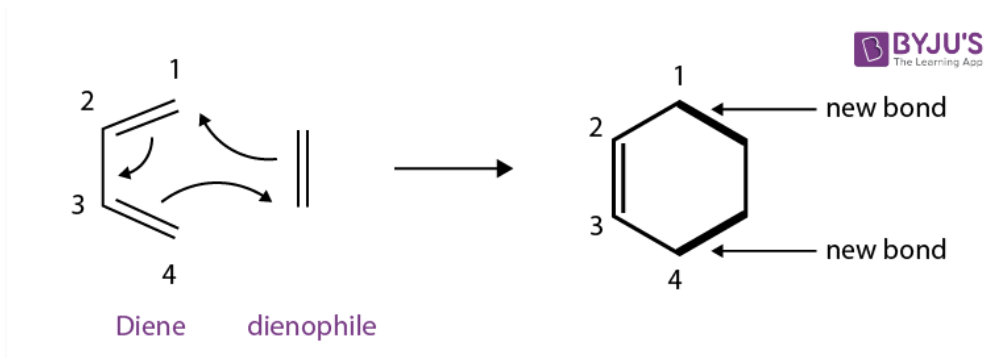
Why are all three steps of step 3 favorable (benzyne formation, Diels-Alder, loss of CO)?
Benzyne forms from anthranilic acid via diazotization + loss of N2/CO2; Diels-Alder is enthalpically favorable (new σ bonds formed); CO loss is driven by aromaticity restoration of the anthracene ring system.
Water solubility rules for amines, carboxylic acids, and phenols?
Amines dissolve in dilute HCl (protonated); carboxylic acids dissolve in NaOH and NaHCO3; phenols dissolve in NaOH but NOT NaHCO3 (too weakly acidic)
What does a positive Tollens' test indicate?
Aldehyde present — silver mirror forms as Ag+ is reduced to Ag0.
What does the oxime test identify?
Aldehydes and ketones — hydroxylamine reacts with the carbonyl to form an oxime (C=N), confirmed by a solid derivative with known mp.
What does nitrous acid (NaNO2/HCl) distinguish?
Primary amines → diazonium salt (azo dye test, or N2 gas); secondary amines → yellow N-nitroso compound; tertiary amines → no reaction.
Cerium ammonium nitrate test identifies what?
Alcohols and phenols — gives a red/orange color change
FeCl3 test identifies what?
Phenols (purple/violet) and esters of phenols; most simple alcohols give no color
Role of derivatives in unknown identification?
After narrowing by functional group tests, make a solid derivative (e.g., 2,4-DNP for carbonyls) and compare its melting point to known tables.
How is MS used to determine chemical formula?
High-res MS gives exact mass → match to molecular formula; isotope patterns help (e.g., Cl/Br patterns); fragmentation pattern gives structural clues.
How is IR used in unknown ID?
Identifies functional groups by characteristic absorptions: O-H ~3300 broad, C=O ~1700–1735, N-H ~3300–3500, C≡N ~2200.
How is NMR used to determine a compound's skeleton?
H NMR: chemical shifts show environment, integration gives H count, splitting gives adjacent H count
Why is WebMO useful in orgo lab?
Allows computational visualization of 3D molecular geometry, bond orders, partial charges, and energies — helps predict/explain experimental outcomes
Key practicalities for using WebMO effectively?
Choose the right theory level (e.g., HF vs. DFT) and basis set; optimize geometry before calculating properties; use energy comparisons for conformers/isomers, not absolute values.