Fetal Abdomen an Genitourinary System

0.0(0)
Studied by 0 people
call kaiCall Kai
learnLearn
examPractice Test
spaced repetitionSpaced Repetition
heart puzzleMatch
flashcardsFlashcards
GameKnowt Play
Card Sorting

1/24

encourage image

There's no tags or description

Looks like no tags are added yet.

Last updated 1:38 AM on 4/16/26
Name
Mastery
Learn
Test
Matching
Spaced
Call with Kai

No analytics yet

Send a link to your students to track their progress

25 Terms

1
New cards

stomach

  • in LUQ

  • seen by 16w

  • amniotic, fluid-filled structure

  • if no fluid seen, evaluate 20-30 minutes

  • used as a marker for taking AC measurement
<ul><li><p>in LUQ</p></li><li><p>seen by 16w</p></li><li><p>amniotic, fluid-filled structure</p></li><li><p>if no fluid seen, evaluate 20-30 minutes</p></li><li><p>used as a marker for taking AC measurement</p></li></ul><p></p>
2
New cards

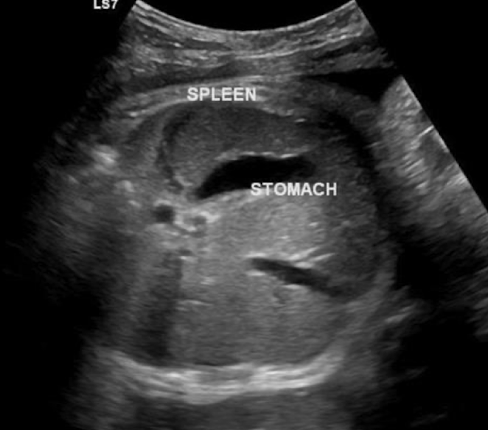
evaluating stomach

  • scanned in TRV plane (short axis)

  • anechoic (fluid-filled)

  • if stomach is empty, move on and come back later or have patient come back another day

  • can also image stomach and bladder together in LONG
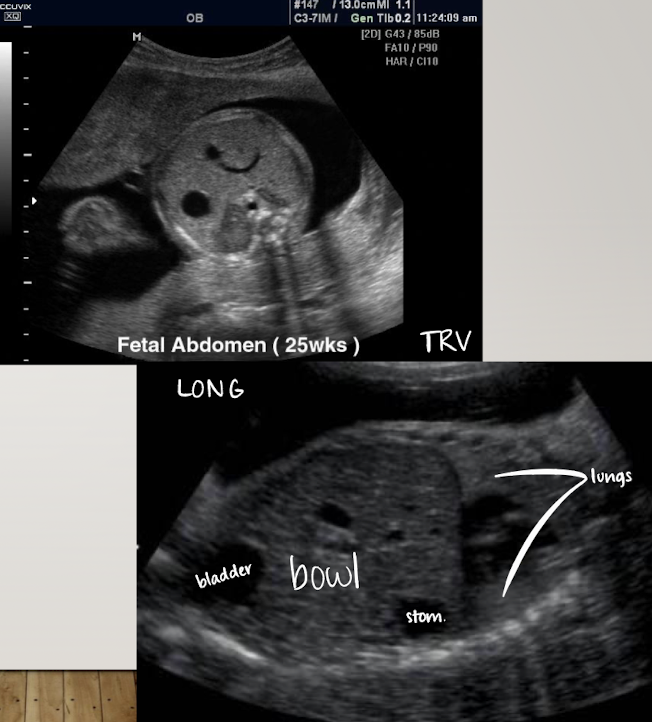
<ul><li><p>scanned in TRV plane (short axis)</p></li><li><p>anechoic (fluid-filled)</p></li><li><p>if stomach is empty, move on and come back later or have patient come back another day</p></li><li><p>can also image stomach and bladder together in LONG</p></li></ul><p></p>
3
New cards

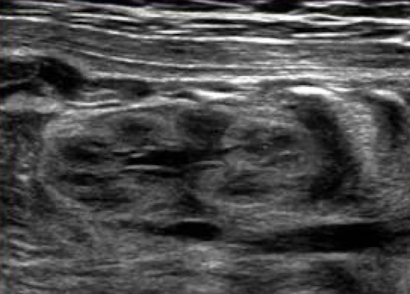
small bowel

  • mid-lower abdomen; centrally located echogenic areas inferior to liver

  • SONO: varies with menstrual age

    • mid gut herniation (<12wks)

    • early pregnancy=hypoechoic

    • late pregnancy=more echogenic

  • hyperechoic bowel is NOT normal

    • echogenicity should always be less than bone

  • may see peristalsis in 3rd trimester (normal)
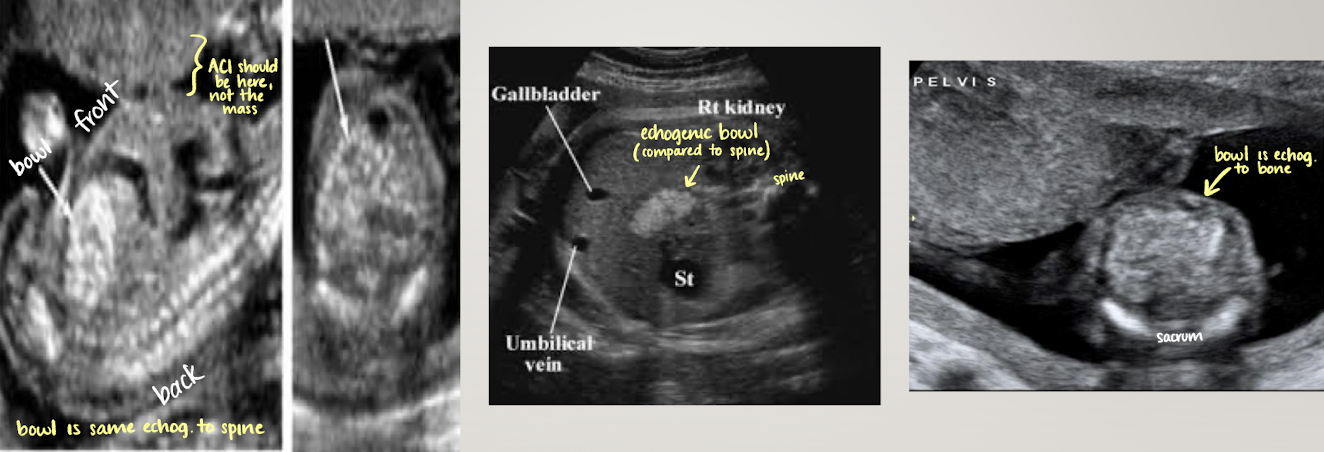
<ul><li><p>mid-lower abdomen; centrally located echogenic areas inferior to liver</p></li><li><p>SONO: varies with menstrual age</p><ul><li><p>mid gut herniation (&lt;12wks)</p></li><li><p>early pregnancy=hypoechoic</p></li><li><p>late pregnancy=more echogenic</p></li></ul></li><li><p><span style="color: red;">hyperechoic bowel is NOT normal</span></p><ul><li><p><span style="color: red;">echogenicity should always be less than bone</span></p></li></ul></li><li><p>may see peristalsis in 3rd trimester (normal)</p></li></ul><p></p>
4
New cards

abnormality?

5
New cards

large bowel

  • seen after 22w (can discern between small and large)

  • more peripherally than small bowel

  • hypoechoic tubular structure (meconium)

    • meconium=baby stool

  • well-defined walls

  • haustral folds appear as thin linear echoes within lumen
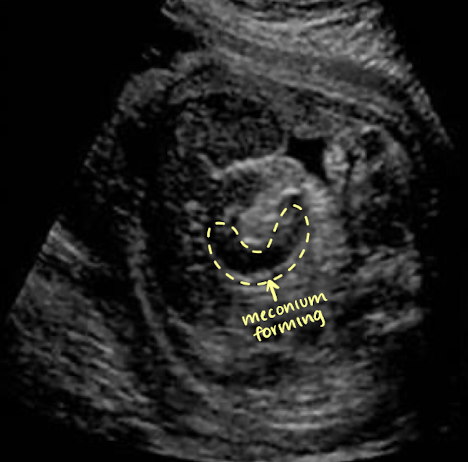
<ul><li><p>seen after 22w (can discern between small and large)</p></li><li><p>more peripherally than small bowel</p></li><li><p>hypoechoic tubular structure (meconium)</p><ul><li><p>meconium=baby stool</p></li></ul></li><li><p>well-defined walls</p></li><li><p>haustral folds appear as thin linear echoes within lumen</p></li></ul><p></p>
6
New cards

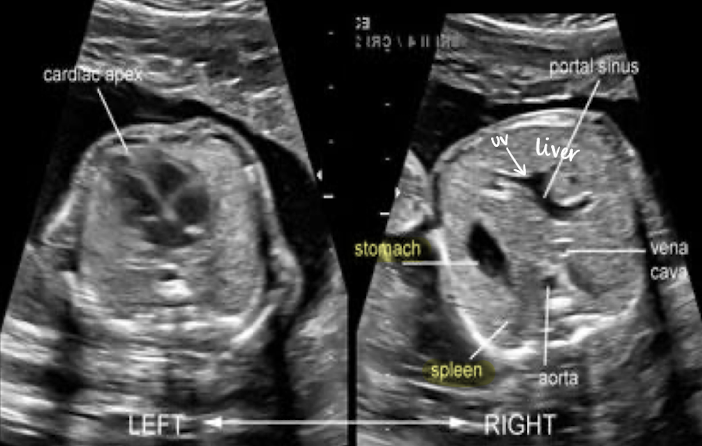
liver

  • large compared to other abdominal organs

  • occupies upper right abdomen

  • left lobe is larger in utero

  • SONO:

    • homogeneous, moderate echogenicity

    • helpful for determining situs and obtaining AC measurement
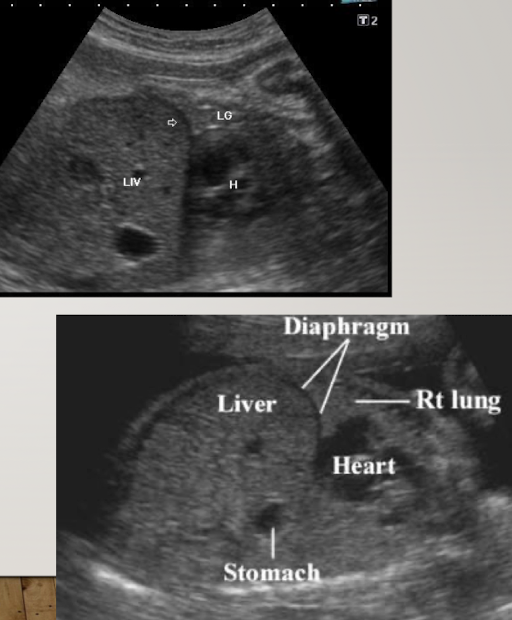
<ul><li><p>large compared to other abdominal organs</p></li><li><p>occupies upper right abdomen</p></li><li><p><span style="color: red;">left lobe is larger in utero</span></p></li><li><p>SONO:</p><ul><li><p>homogeneous, moderate echogenicity</p></li><li><p>helpful for determining situs and obtaining AC measurement</p></li></ul></li></ul><p></p>
7
New cards

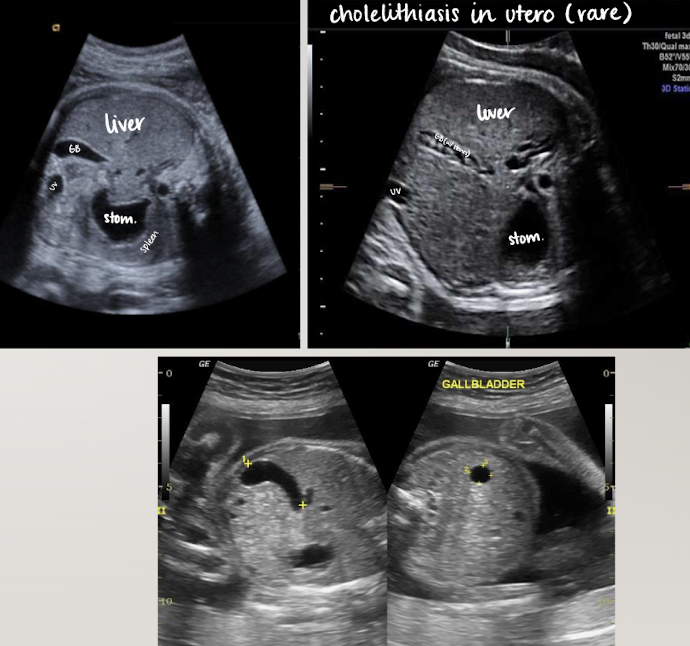
gallbladder

  • seen after 20 weeks

  • SONO: elongated anechoic structure in long-axis; circle in short-axis

  • in right abdomen near liver

  • more oval than intrahepatic umbilical vein

  • document presence

<ul><li><p>seen after 20 weeks</p></li><li><p>SONO: elongated anechoic structure in long-axis; circle in short-axis</p></li><li><p>in right abdomen near liver</p></li><li><p>more oval than intrahepatic umbilical vein</p></li><li><p>document presence </p></li></ul><p></p>
8
New cards

spleen

  • in LUQ

  • increases in size during gestation (biggest in 3rd trimester)

  • best images in TRV plane; to left of stomach

  • SONO:

    • homogeneous

    • similar echogenicity to kidney

    • less echogenic than liver

<ul><li><p>in LUQ</p></li><li><p>increases in size during gestation (biggest in 3rd trimester)</p></li><li><p>best images in TRV plane; to left of stomach</p></li><li><p>SONO: </p><ul><li><p>homogeneous </p></li><li><p>similar echogenicity to kidney</p></li><li><p>less echogenic than liver</p></li></ul></li></ul><p></p>
9
New cards

abdominal cord insertion (ACI)

  • becomes belly button after born

  • umbilical cord seen entering fetal abdomen just above level of bladder

  • UV courses to liver within falciform ligament

  • UAs course on either side of bladder

    • 2VC can cause IUGR or is an indication of chromosomal abnormality

  • SONO:

    • image ACI with and without color Doppler

    • ensure smooth abdominal cord insertion (should be nothing “pooching” out)

    • rule out gastroschisis and omphalocele
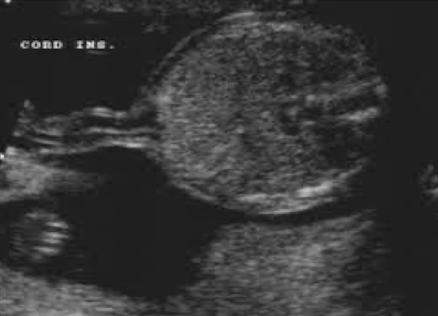
<ul><li><p>becomes belly button after born</p></li><li><p><span style="color: red;">umbilical cord seen entering fetal abdomen just above level of bladder</span></p></li><li><p>UV courses to liver within falciform ligament</p></li><li><p>UAs course on either side of bladder</p><ul><li><p>2VC can cause IUGR or is an indication of chromosomal abnormality</p></li></ul></li><li><p>SONO:</p><ul><li><p>image ACI with and without color Doppler</p></li><li><p><span style="color: red;">ensure smooth abdominal cord insertion (should be nothing “pooching” out)</span></p></li><li><p><span style="color: red;">rule out gastroschisis and omphalocele</span></p></li></ul></li></ul><p></p>
10
New cards

gastroschisis

  • “loose bowel pooching out—floating outside abdomen”
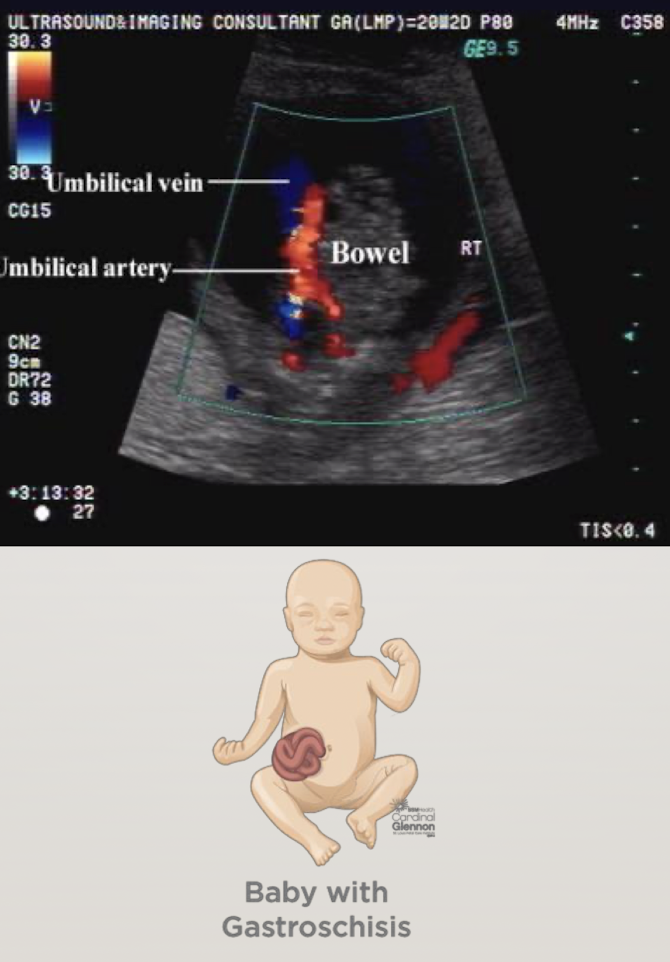
<ul><li><p>“loose bowel pooching out—floating outside abdomen” </p></li></ul><p></p>
11
New cards

omphalocele

  • bowl or other organs come out, BUT difference is… it will be encased in a membrane

    • looks like a contained mass with smooth borders b/c of membrane
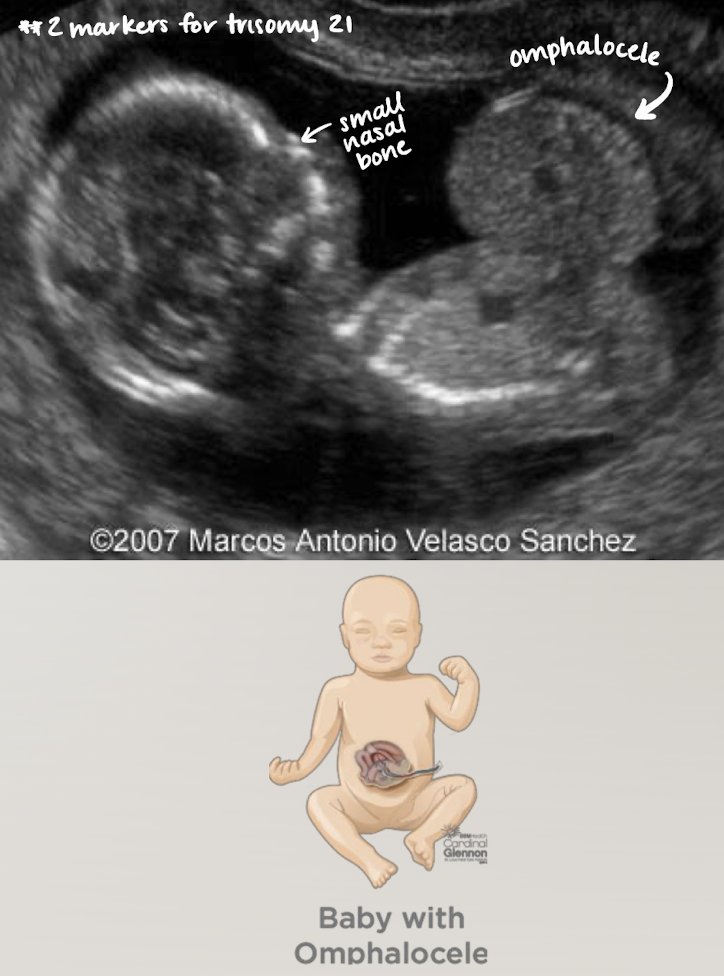
<ul><li><p>bowl or other organs come out, BUT difference is… it will be <span style="color: yellow;">encased in a membrane</span></p><ul><li><p>looks like a contained mass with smooth borders b/c of membrane </p></li></ul></li></ul><p></p>
12
New cards

kidneys

  • kidneys form in pelvis and ascent into abdomen

  • urine formation around 11-2 weeks

    • excrete into amniotic cavity (component of amniotic fluid)

  • visible by 12-13wks

  • by 25wks distinction between renal cortex and sinus

  • must evaluate both kidneys

    • presence, number, position

    • size (is one bigger than the other?)

    • collecting system dilation (??hydro)

    • appearance (echogenicity; compared to liver and spleen)

**if hydro seen, measure renal pelvis (AP) in TRV plane
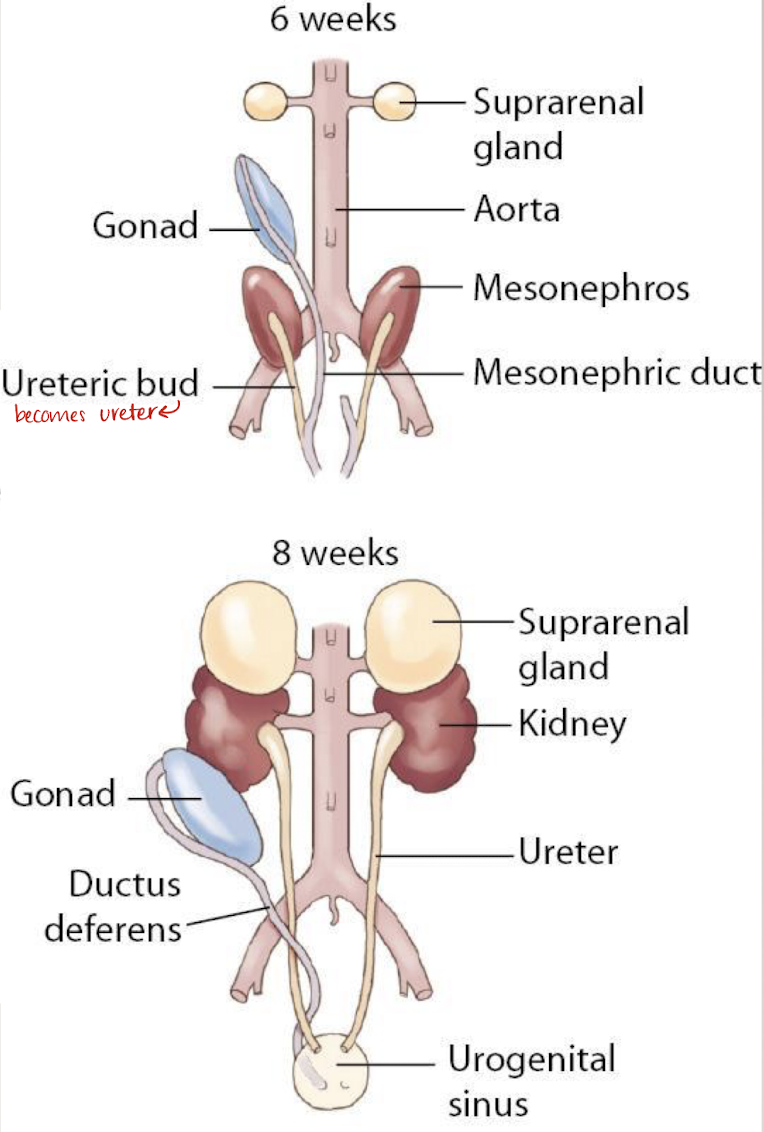
<ul><li><p><span style="color: red;">kidneys form in pelvis and ascent into abdomen</span></p></li><li><p>urine formation around 11-2 weeks</p><ul><li><p>excrete into amniotic cavity (component of amniotic fluid)</p></li></ul></li><li><p>visible by 12-13wks</p></li><li><p>by 25wks distinction between renal cortex and sinus</p></li><li><p><span style="color: red;">must evaluate both kidneys</span></p><ul><li><p><span style="color: red;">presence, number, position</span></p></li><li><p><span style="color: red;">size (is one bigger than the other?)</span></p></li><li><p><span style="color: red;">collecting system dilation (??hydro)</span></p></li><li><p><span style="color: red;">appearance (echogenicity; compared to liver and spleen)</span></p></li></ul></li></ul><p>**if hydro seen, measure renal pelvis (AP) in TRV plane</p><p></p>
13
New cards

kidneys develop from what 3 excretory organs in embryo?

  • pronephros

  • mesonephros

  • metanephros

14
New cards

SONO: kidneys

  • homogeneous cortex

  • hypoechoic pyramids

  • anechoic collecting system

<ul><li><p><span style="color: red;">homogeneous cortex</span></p></li><li><p><span style="color: red;">hypoechoic pyramids</span></p></li><li><p><span style="color: red;">anechoic collecting system</span></p></li></ul><p></p>
15
New cards

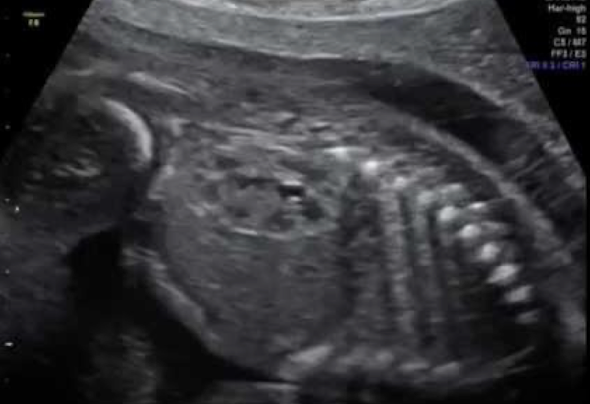
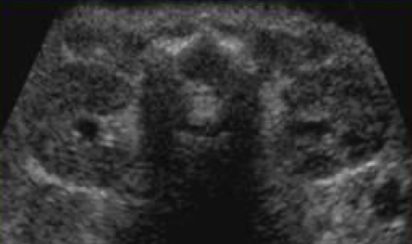
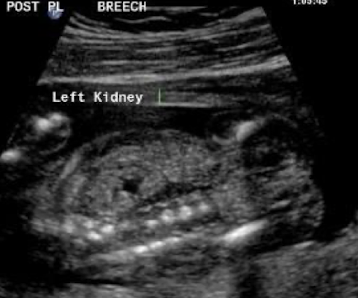
imaging the kidneys (TRV, SAG, coronal)

transverse (easiest plane)

  • kidneys visualized on either side of spine

  • measure AP diameter of renal pelvis

sagittal

  • long axis of kidney

coronal

  • demonstrates a longer axis image of both kidneys

**always throw color Doppler on
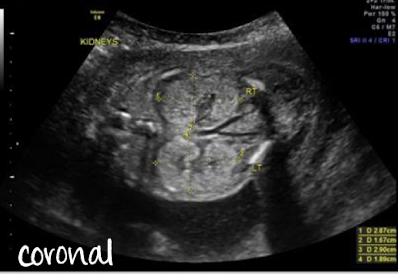
<p><span style="color: red;"><strong>transverse</strong></span> (easiest plane)</p><ul><li><p><span style="color: red;">kidneys visualized on either side of spine</span></p></li><li><p><span style="color: red;">measure AP diameter of renal pelvis</span></p></li></ul><p><strong>sagittal</strong></p><ul><li><p>long axis of kidney</p></li></ul><p><strong>coronal</strong></p><ul><li><p>demonstrates a longer axis image of both kidneys</p></li></ul><p>**always throw color Doppler on</p>
16
New cards
<p>what plane was this taken in?</p>

what plane was this taken in?

transverse
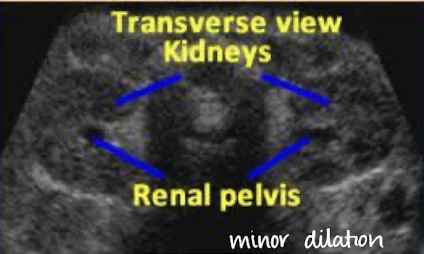
<p>transverse</p>
17
New cards
<p>what plane was this taken in?</p>

what plane was this taken in?

coronal
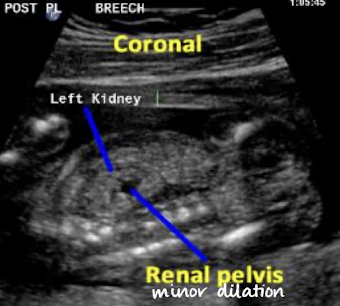
<p>coronal</p>
18
New cards
<p>what plane was this taken in?</p>

what plane was this taken in?

longitudinal
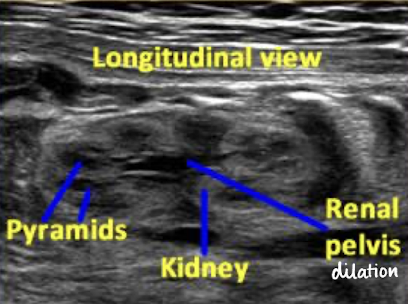
<p>longitudinal </p>
19
New cards

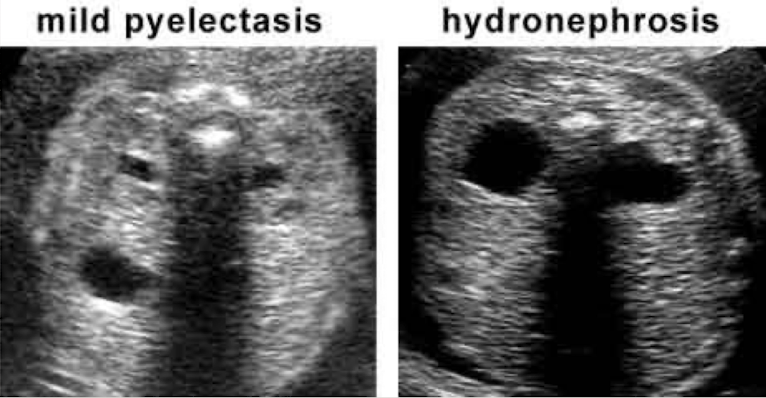
mild pyelectasis (dilation) vs. hydronephrosis in utero

  • before 27w = >4mm is abnormal

  • after 27w = >7mm is abnormal

<ul><li><p><span style="color: red;">before 27w = &gt;4mm </span><span>is abnormal </span></p></li><li><p><span style="color: red;">after 27w = &gt;7mm</span><span> is </span>abnormal</p></li></ul><p></p>
20
New cards

renal pelvis measurement for hydro

>4mm = hydro
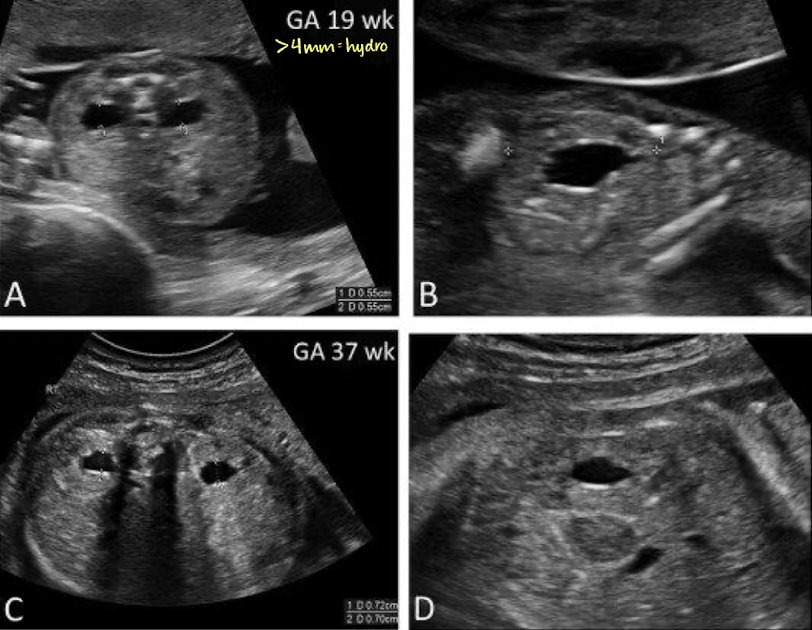
<p><span style="color: yellow;">&gt;4mm </span>= hydro</p><p></p>
21
New cards
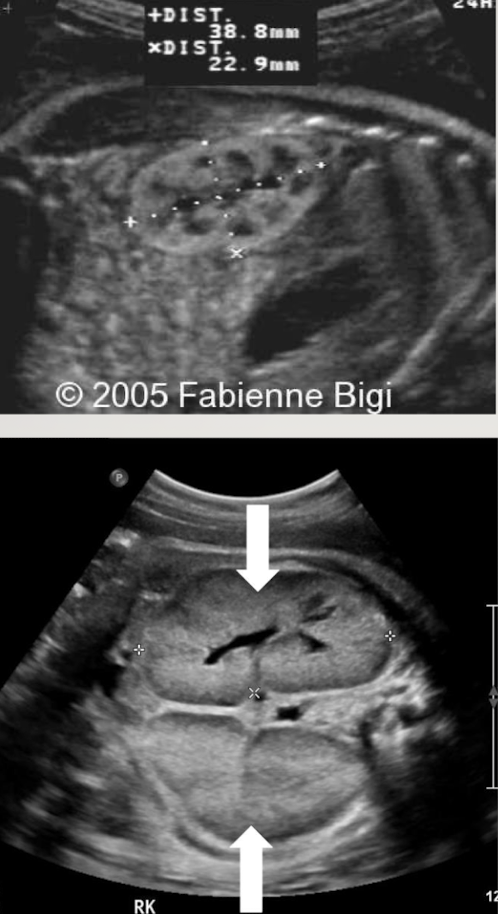
<p>what is the pathology?</p>

what is the pathology?

ARPKD (autosomal recessive polycystic kidney disease)
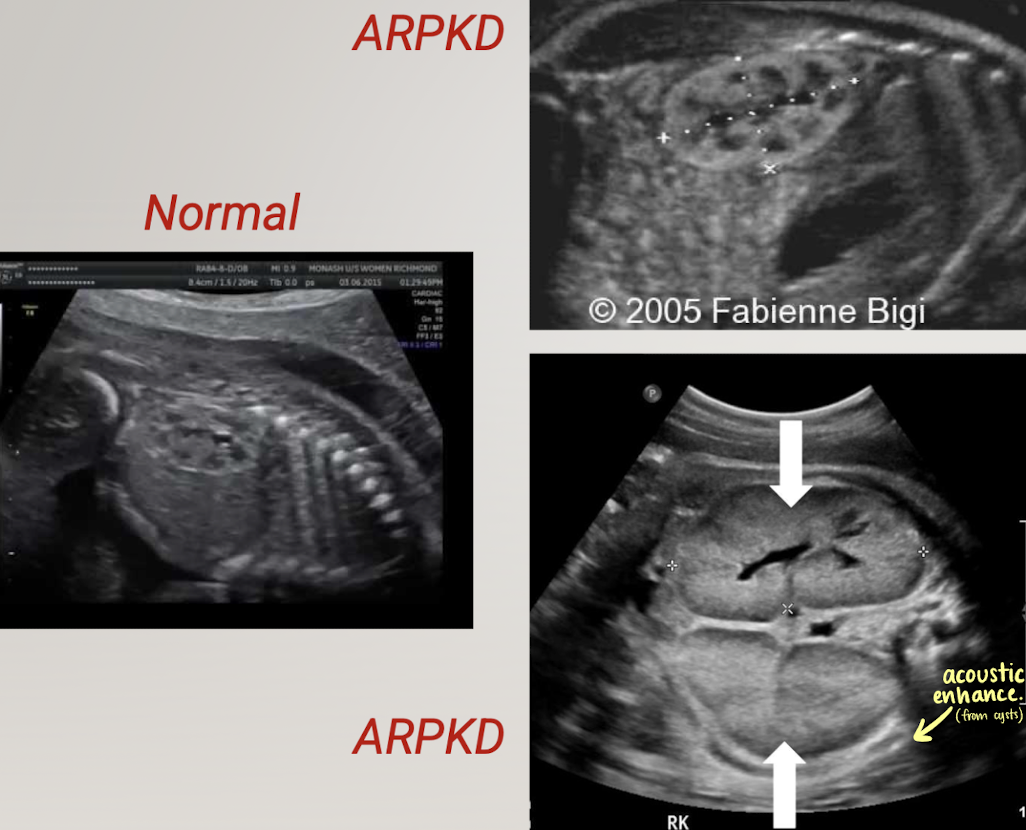
<p>ARPKD (autosomal recessive polycystic kidney disease)</p>
22
New cards

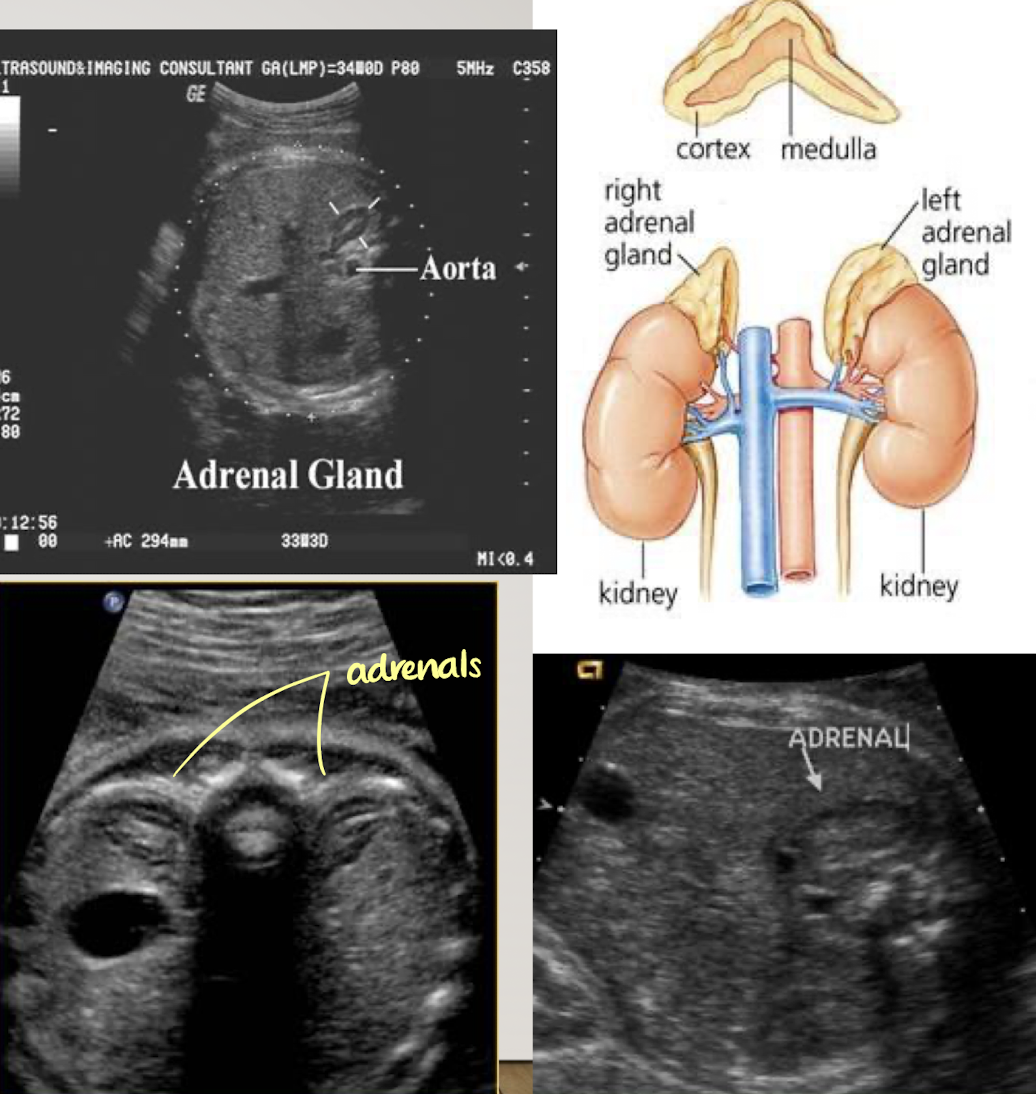
adrenals

  • adrenal glands can be prominent in fetus and neonate

  • located medially and superior to fetal kidneys

  • SONO:

    • best seen in TRV

    • superior pole of kidneys

    • hypoechoic cortex

    • echogenic medulla

<ul><li><p>adrenal glands can be prominent in fetus and neonate</p></li><li><p>located medially and superior to fetal kidneys</p></li><li><p>SONO:</p><ul><li><p>best seen in TRV</p></li><li><p>superior pole of kidneys</p></li><li><p><span style="color: red;">hypoechoic cortex</span></p></li><li><p><span style="color: red;">echogenic medulla</span></p></li></ul></li></ul><p></p>
23
New cards

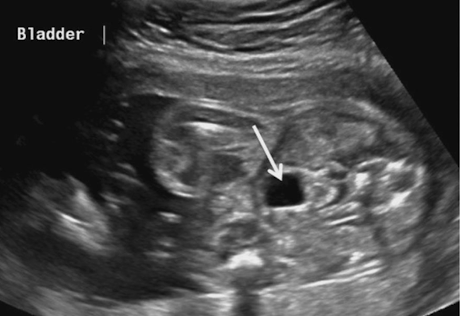
bladder

  • distended bladder should be seen by 13wks

  • empties and fills at least once every 30 minutes

  • if not identified on exam; exam must be repeated within 24 hours

  • empty bladder is an indication of abnormality

  • SONO:

    • anechoic (fluid-filled)

    • document in LONG and TRV

<ul><li><p>distended bladder should be seen by 13wks</p></li><li><p><span style="color: red;">empties and fills at least once every 30 minutes</span></p></li><li><p>if not identified on exam; exam must be repeated within 24 hours</p></li><li><p>empty bladder is an indication of abnormality</p></li><li><p>SONO:</p><ul><li><p><span style="color: red;">anechoic (fluid-filled)</span></p></li><li><p>document in LONG and TRV<br></p></li></ul></li></ul><p></p>
24
New cards

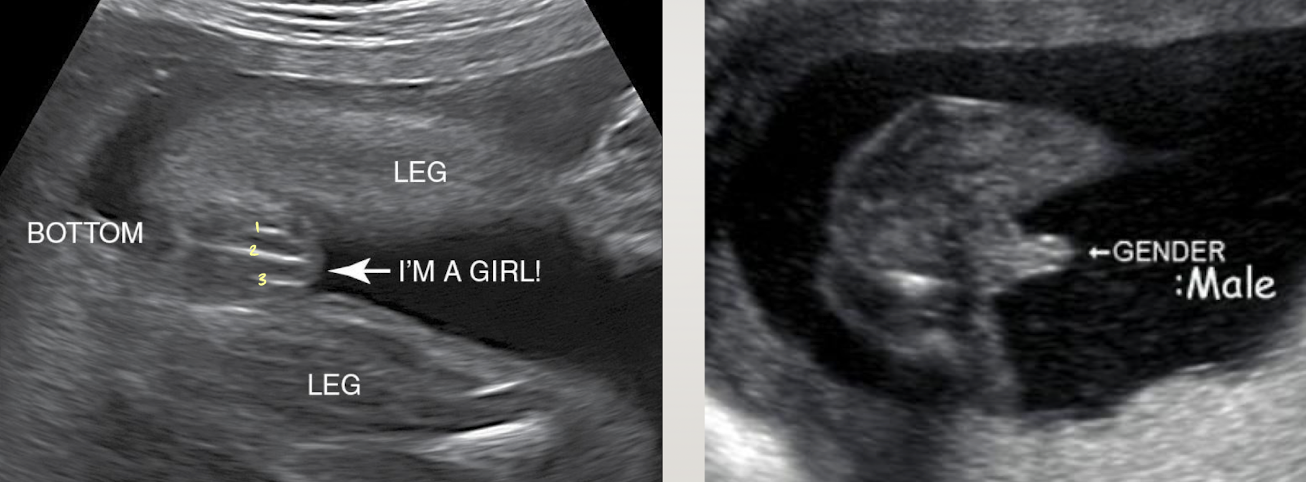
genitalia

  • sexual characteristics develop between 9-12 weeks

  • fetal testes produce androgens that cause masculinization of external genitalia (baby start as a girl)

  • fetal external genitalia can be definitively identified with US after 18wks

25
New cards

SONO: genitalia (male vs. female)

male

  • both scrotum and penis identified

  • “turtle sign”

female

  • vulva/labia lips identified

  • “three-line sign”

  • “hamburger sign”

<p>male</p><ul><li><p>both scrotum and penis identified</p></li><li><p><span style="color: red;">“turtle sign”</span></p></li></ul><p>female</p><ul><li><p>vulva/labia lips identified</p></li><li><p><span style="color: red;">“three-line sign”</span></p></li><li><p><span style="color: red;">“hamburger sign”</span></p></li></ul><p></p>