Computer Programming
 Call Kai
 Learn
Learn Practice Test
 Spaced Repetition
 Match
Match Flashcards
 Knowt Play
1/36

There's no tags or description
Looks like no tags are added yet.
Name | Mastery | Learn | Test | Matching | Spaced | Call with Kai |
|---|
No analytics yet
Send a link to your students to track their progress
37 Terms
Answer: c
Explanation: A data structure is a way to store and organize data efficiently, enhancing access and manipulation, unlike programming languages, algorithms, or computer hardware.
What is a data structure?
a) A programming language
b) A collection of algorithms
c) A way to store and organize data
d) A type of computer hardware
Answer: d
Explanation: Arrays are of fixed size. If we insert elements less than the allocated size, unoccupied positions can’t be used again. Wastage will occur in memory.
What are the disadvantages of arrays?
a) Index value of an array can be negative
b) Elements are sequentially accessed
c) Data structure like queue or stack cannot be implemented
d) There are chances of wastage of memory space if elements inserted in an array are lesser than the allocated size
Answer: a
Explanation: Stacks are used for the implementation of Recursion.
Which data structure is used for implementing recursion?
a) Stack
b) Queue
c) List
d) Array
Answer: b
Explanation: The stack is a simple data structure in which elements are added and removed based on the LIFO principle. Open parenthesis is pushed into the stack and a closed parenthesis pops out elements till the top element of the stack is its corresponding open parenthesis. If the stack is empty, parenthesis is balanced otherwise it is unbalanced.
The data structure required to check whether an expression contains a balanced parenthesis is?
a) Queue
b) Stack
c) Tree
d) Array
Answer: a
Explanation: Data transfer between the two asynchronous process uses the queue data structure for synchronisation. The rest are all stack applications.
Which of the following is not the application of stack?
a) Data Transfer between two asynchronous process
b) Compiler Syntax Analyzer
c) Tracking of local variables at run time
d) A parentheses balancing program
Answer: c
Explanation: The Stack data structure is used to convert infix expression to postfix expression. The purpose of stack is to reverse the order of the operators in the expression. It also serves as a storage structure, as no operator can be printed until both of its operands have appeared.
Which data structure is needed to convert infix notation to postfix notation?
a) Tree
b) Branch
c) Stack
d) Queue
Answer: a
Explanation: In recursive algorithms, the order in which the recursive process comes back is the reverse of the order in which it goes forward during execution. The compiler uses the stack data structure to implement recursion. In the forwarding phase, the values of local variables, parameters and the return address are pushed into the stack at each recursion level. In the backing-out phase, the stacked address is popped and used to execute the rest of the code.
What data structure would you mostly likely see in non recursive implementation of a recursive algorithm?
a) Stack
b) Linked List
c) Tree
d) Queue
Answer: b
Explanation: Stack follows LIFO.
Which of the following statement(s) about stack data structure is/are NOT correct?
a) Top of the Stack always contain the new node
b) Stack is the FIFO data structure
c) Null link is present in the last node at the bottom of the stack
d) Linked List are used for implementing Stacks
Answer: d
Explanation: In Breadth First Search Traversal, BFS, starting vertex is first taken and adjacent vertices which are unvisited are also taken. Again, the first vertex which was added as an unvisited adjacent vertex list will be considered to add further unvisited vertices of the graph. To get the first unvisited vertex we need to follows First In First Out principle. Queue uses FIFO principle.
The data structure required for Breadth First Traversal on a graph is?
a) Array
b) Stack
c) Tree
d) Queue
Answer: a
Explanation: Infix Expression is A-B/(C*D^E)
This can be written as: A-(B/(C*(D^E)))
Thus prefix expression is -A/B*C^DE.
The prefix form of A-B/ (C D ^ E) is?
a) -A/BC^DE
b) -A/BC*^DE
c) -ABCD*^DE
d) -/*^ACBDE
Answer: b
Explanation: Postfix Expression is (6*(3-(2+4))) which results -18 as output.
What is the value of the postfix expression 6 3 2 4 + – *?
a) 74
b) -18
c) 22
d) 40
Answer: b
Explanation: To access an element in a linked list, we need to traverse every element until we reach the desired element. This will take more time than arrays as arrays provide random access to its elements.
Which of the following points is/are not true about Linked List data structure when it is compared with an array?
a) Random access is not allowed in a typical implementation of Linked Lists
b) Access of elements in linked list takes less time than compared to arrays
c) Arrays have better cache locality that can make them better in terms of performance
d) It is easy to insert and delete elements in Linked List
Answer: c
Explanation: The data structure that follows the Last In First Out (LIFO) principle is the Stack. It operates like a stack of objects, making it suitable for specific-order management.
Which data structure is based on the Last In First Out (LIFO) principle?
a) Tree
b) Linked List
c) Stack
d) Queue
Answer: d
Explanation: Generally, round robin fashion is employed to allocate CPU time to resources which makes use of the circular linked list data structure. Recursive function calls use stack data structure. Undo Operation in text editor uses doubly linked lists. Hash tables uses singly linked lists.
Which of the following application makes use of a circular linked list?
a) Recursive function calls
b) Undo operation in a text editor
c) Implement Hash Tables
d) Allocating CPU to resources
Answer: a
Explanation: It compactly stores bits and exploits bit-level parallelism.
What is a bit array?
a) Data structure that compactly stores bits
b) Data structure for representing arrays of records
c) Array in which elements are not present in continuous locations
d) An array in which most of the elements have the same value
Answer: b
Explanation: All the tree data structures given in options are balanced, but B-tree can have more than two children.
Which of the following tree data structures is not a balanced binary tree?
a) Splay tree
b) B-tree
c) AVL tree
d) Red-black tree
Answer: c
Explanation: Queue always has two ends. So, single ended queue is not the type of queue.
Which of the following is not the type of queue?
a) Priority queue
b) Circular queue
c) Single ended queue
d) Ordinary queue
Answer: d
Explanation: For every opening brace, push it into the stack, and for every closing brace, pop it off the stack. Do not take action for any other character. In the end, if the stack is empty, then the input has balanced parentheses.
Which of the following data structures can be used for parentheses matching?
a) n-ary tree
b) queue
c) priority queue
d) stack
Answer: b
Explanation: Top tree is a type of data structure which is based on unrooted dynamic binary tree and is used to solve path related problems. It allows an algorithm called divide and conquer.
Which algorithm is used in the top tree data structure?
a) Backtracking
b) Divide and Conquer
c) Branch
d) Greedy
Answer: c
Explanation: In a linear queue, dequeue operation causes the starting elements of the array to be empty, and there is no way you can use that space, while in a circular queue, you can effectively use that space. Priority queue is used to delete the elements based on their priority. Higher priority elements will be deleted first whereas lower priority elements will be deleted next. Queue data structure always follows FIFO principle.
What is the need for a circular queue?
a) easier computations
b) implement LIFO principle in queues
c) effective usage of memory
d) to delete elements based on priority
Answer: a
Explanation: In external memory, the data is transferred in form of blocks. These blocks have data valued and pointers. And B-tree can hold both the data values and pointers. So B-tree is used as an external memory data structure.
Which of the following is the most widely used external memory data structure?
a) B-tree
b) Red-black tree
c) AVL tree
d) Both AVL tree and Red-black tree
Answer: d
Explanation: Array is a linear data structure. Strings are a collection and sequence of codes, alphabets or characters. Linked List is a linear data structure having a node containing data input and the address of the next node. The cord is also known as the rope data structure.
Which of the following is also known as Rope data structure?
a) Linked List
b) Array
c) String
d) Cord
Answer: a
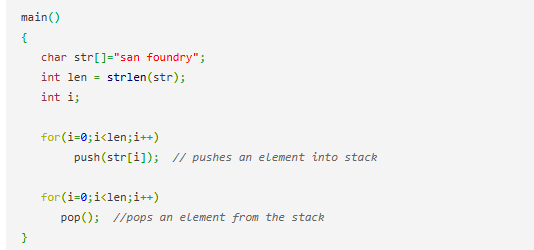
Explanation: First, the string ‘san foundry’ is pushed one by one into the stack.
When it is popped, the output will be as ‘yrdnuof nas’.
What will be the output of the following program?
a) yrdnuof nas
b) foundry nas
c) sanfoundry
d) san foundry
Answer: c
Explanation: The average case time for lookup in a binary search tree, treap and 2-3 tree is O(log n) and in unordered lists it is O(n). But in the worst case, only the 2-3 trees perform lookup efficiently as it takes O(log n), while others take O(n).
Which of the following data structure can provide efficient searching of the elements?
a) binary search tree
b) unordered lists
c) 2-3 tree
d) treap
Answer: b
Explanation: It is a self balancing tree with height difference atmost 1.
What is an AVL tree?
a) a tree which is unbalanced and is a height balanced tree
b) a tree which is balanced and is a height balanced tree
c) a tree with atmost 3 children
d) a tree with three children
Answer: c
Explanation: In order to search a key or integer in the Van Emde Boas data structure, the operation can be performed on an associative array. Hence, the time complexity for searching a key or integer in Van Emde Boas data structure is O (log (log M)).
What is the time complexity for searching a key or integer in Van Emde Boas data structure?
a) O (M!)
b) O (log M!)
c) O (log (log M))
d) O (M2)
Answer: d
Explanation: The Tower of Hanoi involves moving of disks ‘stacked’ at one peg to another peg with respect to the size constraint. It is conveniently done using stacks and priority queues. Stack approach is widely used to solve Tower of Hanoi.
The optimal data structure used to solve Tower of Hanoi is _________
a) Tree
b) Heap
c) Priority queue
d) Stack
Answer: b
Explanation: Bin data structure allows us to have efficient region queries. A frequency of bin is increased by one each time a data point falls into a bin.
What is the use of the bin data structure?
a) to have efficient traversal
b) to have efficient region query
c) to have efficient deletion
d) to have efficient insertion
Answer: a
Explanation: Stack is the most appropriate data structure for reversing a word because stack follows LIFO principle.
Which is the most appropriate data structure for reversing a word?
a) stack
b) queue
c) graph
d) tree
Answer: a
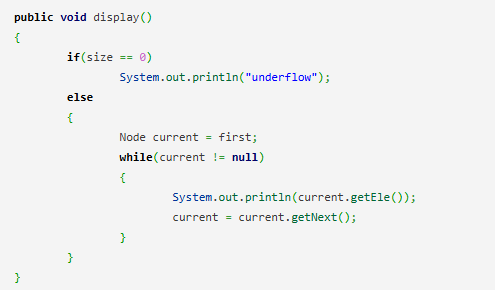
Explanation: An alias of the node ‘first’ is created which traverses through the list and displays the elements.
What is the functionality of the following piece of code?
a) display the list
b) reverse the list
c) reverse the list excluding top-of-the-stack-element
d) display the list excluding top-of-the-stack-element
Answer: b
Explanation: K-d trees are the simplest data structure that supports range searching and also it achieves the respectable running time.
Which of the following is the simplest data structure that supports range searching?
a) AA-trees
b) K-d trees
c) Heaps
d) binary search trees
Answer: b
Explanation: Hash table is a data structure that has an advantage that it allows fast access of elements. Hash functions are used to determine the index of any input record in a hash table.
What is the advantage of a hash table as a data structure?
a) easy to implement
b) faster access of data
c) exhibit good locality of reference
d) very efficient for less number of entries
Answer: d
Explanation: Ternary heap is a type of data structure in the field of computer science. It is a part of the Heap data structure family. It is a priority queue type of data structure that follows all the property of heap.
Which type of data structure is a ternary heap?
a) Hash
b) Array
c) Priority Stack
d) Priority Queue
Answer: c
Explanation: A deque or a double ended queue is a queue with insert/delete defined for both front and rear ends of the queue.
What is a deque?
a) A queue implemented with both singly and doubly linked lists
b) A queue with insert/delete defined for front side of the queue
c) A queue with insert/delete defined for both front and rear ends of the queue
d) A queue implemented with a doubly linked list
Answer: b
Explanation: In deque, we can insert or delete elements from both the ends. In queue, we will follow first in first out principle for insertion and deletion of elements. Element with least priority will be deleted in a priority queue.
A data structure in which elements can be inserted or deleted at/from both ends but not in the middle is?
a) Priority queue
b) Deque
c) Circular queue
d) Queue
Answer: d
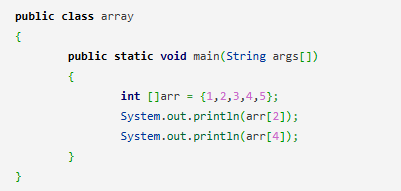
Explanation: Array indexing starts from 0.
What is the output of the following Java code?
a) 4 and 2
b) 2 and 4
c) 5 and 3
d) 3 and 5
Answer: a
Explanation: Deletion becomes easier with doubly linked list, hence it is appropriate.
In simple chaining, what data structure is appropriate?
a) Doubly linked list
b) Circular linked list
c) Singly linked list
d) Binary trees