Genetic information, variation & relationships between organisms
 Call Kai
 Learn
Learn Practice Test
 Spaced Repetition
 Match
Match Flashcards
 Knowt Play
1/35

There's no tags or description
Looks like no tags are added yet.
Name | Mastery | Learn | Test | Matching | Spaced | Call with Kai |
|---|
No analytics yet
Send a link to your students to track their progress
36 Terms
What are the differences [4] & similarities [2] between EUKARYOTIC & PROKARYOTIC DNA?
In the nucleus ; in the cytoplasm
longer ; shorter
histones ; not associated with proteins
double helix ; circular loop
BOTH are polymers of nucleotides & are joined by phosphodiester bonds
Define: GENE [2] & LOCUS
Gene = the sequence of DNA that codes for the amino acid sequence of a polypeptide & the base sequence for a functional RNA.
Locus = the location of the gene on a DNA molecule.
What are INTRONS & EXONS?
Introns = the non-coding base sequences. (Only found in eukaryotes as majority of their DNA don't code for polypeptides).
Exons = the sequence that codes for the amino acid sequences.
What is the GENETIC CODE? And is properties [3]?
The sequence of bases determining the order of amino acids.
Degenerate - multiple triplet codes can code for the same amino acid.
Non-overlapping - no single base is read more than once.
Universal - the code is the same in all living organisms.
What is the GENOME & PROTEOME?
Genome = the complete set of genes in a cell.
Proteome = full range of proteins that a cell is able to produce.
What is the aim & process [5] of TRANSCRIPTION?
AIM: produces mRNA from DNA.
Double helix is split by RNA polymerase, one strand is used as a template strand.
Free nucleotides are attracted and bind to the template by complementary base pairing.
RNA polymerase uses Uracil instead of Thymine, to ptoduce pre-mRNA.
RNA polymerase joins the free nucleotides by creating phosphodiester bonds.
The pre-mRNA undergoes splicing to remove introns.
What is the aim & process [5] of TRANSLATION?
AIM: production of polypeptides from mRNA.
mRNA leaves through the nuclear pores & binds to the ribosome.
tRNA brings the complementary anticodon to the codon.
tRNA is released leaving a chain of polypeptides.
ATP is hydrolysed, the energy produced creates peptide bonds between amino acids.
The ribosome moves along the mRNA from the start to stop codon forming the polypeptide chain.
What are the differences [5] between mRNA & tRNA?
codons ; anticodons
NO hydrogen bonds ; has hydrogen bonds
NO amino acid binding spot ; has amino acid binding spot
linear & not folded ; folded into a clover shape
made of many nucleotides ; made of fewer nucleotides
What are the different types of MUTATIONS [3]?
Addition: extra nucleotides is added in the sequence.
Deletion: nucleotide is removed from the sequence.
Substitution: nucleotide is replaced with a different nucleotide in the sequence.
What are the types of SUBSTITUTION mutations [2]?
Nonsense: when the mutation codes for a stop codon.
Silent: when the mutation codes for the same amino acid (this is due to the code being degenerate).
What is the process of MEIOSIS [4]?
DNA replication occurs in interphase.
Meiosis I → the homologous chromosomes are seperated.
Meiosis II → the seperation of the sister chromatids.
This produces 4 haploid daughter cells.
What happens in MEIOSIS I? (Pro [3], meta [2], ana & telophase [2] AND cytokinesis [2]).
Chromosomes condense, maternal + paternal homologous chromosomes pair up. CROSSING OVER occurs at the chiasmata.
Homologous pairs randomally line up at the equator - INDEPENDENT SEGREGATION. Centroile's spindle fibres form.
Spindle fibres pull the chromosome pairs to seperate poles of the cell.
Nuclear envelop forms around each set of chromosomes. Chromosomes decondense.
Cytoplasm divides. Two daughter cells are made.
What happens in MEIOSIS II? (Pro, meta [2], ana & telophase AND cytokinesis [2]).
Chromosomes condense.
Chromosomes line up at the equator. Centroile's spindle fibres form.
Sprindle fibres pull the sister chromatids apart onto seperate poles of the cell.
Nuclear envelop forms around each set of chromosomes.
Cytoplasm divides. Four genetically different daughter cells are made.
How does MEIOSIS create diversity [3]?
Independent segregation (Metaphase I) = the maternal + paternal chromosomes could end up on either side of the cell.
Crossing over (Prophase I) = the chromosome pairs cross over (exchange DNA) at the chiasmata.
Random fertilisation = any sperm can fertilise any egg.
ALL of these create new and a larger possible combination of alleles.
What are the expressions to find: the different combinations of chromosomes & the combinations in random fertilisation, for humans.
2^n = 2²³
2^(2n) = 2²³ x 2²³
What are the differences [7] between MITOSIS & MEIOSIS?
1 division ; 2 divisions
2 identical daughter cells ; 4 genetically different daughter cells
diploid ; haploid
growth & repair in somatic cells, asexual reproduction ; production of gametes (sexual reproduction)
NO genetic variation ; YES genetic variation
N/A ; crossing over
N/A ; independent segregation
Define GENETIC DIVERSITY [2] & EVOLUTION:
Genetic diversity = the number of different alleles of genes in a population, which allows for natural selection to occur.
Evolution = the change in allele frequencies within a population over generations.
What are the principles [4] of NATURAL SELECTION?
Members of species differ by variation, due to a random mutation resulting in new alleles.
There is competition between individuals, those with advantageous alleles are more likely to survive.
This leads to an increased reproductive success, the advantageous allele is inherited by the next generation.
Over many generations the advantageous allele increases in frequency in the population.
What are the types of NATURAL SELECTION [2]?
Directional selection = selects individuals with extreme characteristics.
Stabilising selection = selects individuals with characteristics in the middle range.
What is an example of DIRECTIONAL SELECTION [4]?
Antibiotic resistance.
Bacteria differs by genetic variation, which is caused by a random mutation which results in new alleles.
Bacteria with the resistant allele survive antibiotics.
They rapidly divide by binary fission passing the advantageous resistant allele to their offspring.
Over many generations this advantageous allele increases in frequency in the population.
What is an example of STABILISING SELECTION [4]?
Human birth weights.
Low weight babies are more likely to die.
High weight babies are more likely to face complications during birth.
So babies with a medium weight are more likely to survive and pass their alleles to their offspring.
Increasing the frequency of the advantageous medium weight babies.
What is an ADAPTATION? And what are the different types of adaptations [3]?
Adaptation = when natural selection results in species that are better adapted to their environment.
ANATOMICAL (physical features of an organism)
PHYSIOLOGICAL (internal processes of an organism)
BEHAVIOURAL (how the organism acts)
Finish the sentence:
Two organisms belong to the same species if …
They can produce fertile offspring.
What is courtship behaviour [3]? And what role does it play [2]?
The series of actions by an organism to attract a mate of the same species. This is necessary in order for successful mating. Each specie has their own unique courtship behaviours so that organisms can recognise members of their own species.
Ensures specie recognition - so organisms mate with their own species.
Synchronising their mating behaviour - so that they're ready to mate at the same time.
How does the PHYLOGENIC classification system arrange species into taxa [2]?
Based on their evolutionary origins (common ancestry) and relationships (how closely related they are).
What taxas make up the HIERARCHY [8]?
Domain
Kingdom
Phylum
Class
Order
Family
Genus
Species
What processes help to clarify evolutionary relationships between organisms [2]? And how [3 & 2]?
Immunology - organisms have different antigens on their cells, antibodies are used to test how similary the proteins are to another organisms proteins, if the antibody binds to the protein the closer the organisms relationship is.
Genome sequencing - DNA base sequences, genes or amino acids in proteins can be compared, the more similar the DNA the more recent the common ancestor.
What is BIODIVERSITY [2]?
The variety of living organisms in a given area, from a small local habitat to the earth.
What is SPECIES RICHNESS [2]?
The measure of the number of different species in a community. This measure doesn't show the number of individuals of a specie.
What is an INDEX OF DIVERSITY [3 & 2]?
It describes the relationship between the number of different species in a community and the number of individuals in each specie, by a numerical value.
High index of diversity = many species with a similar number of individuals in each.
Low index of diversity = few/one specie dominates.
What is the equation for the INDEX OF DIVERSITY?
N = total number of organisms of all species.
n = total number of organisms of each species.
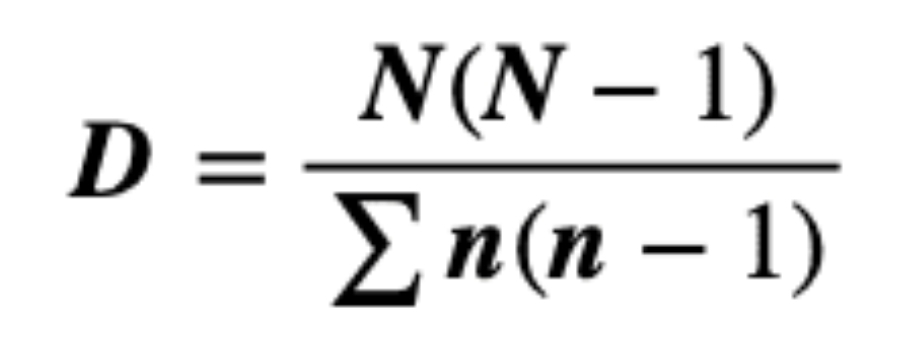
How do farming techniques reduce biodiversity [6]?
Removing habitats.
Monoculture - reduces specie richness.
Pesticides & herbicides - reduces insect & plant populations and organisms higher up the food chain.
Fertilisers - runs off into water (eutrophication) harming aquatic life and water supplies.
Selective breeding of farm animals.
Removal of hedgerows - loss of habitats and plant species.
How does hedgerows benefit farmers? [2]
Increased biodiversity, so there are predators for pests.
How do you maintain a balance between conservation and farming [3]?
Conservation of headlands - leave the edges of fields untreated with chemicals to allow plants and insects to survive OR leave edges of fields untreated with fertiliser to prevent run off (eutrophication).
Hedgerows - provides habitats.
Reduce chemical usage.
How can you compare GENETIC DIVERSITY within or between species [4]? How have we been able to do this?
Compare:
The frequency of observable characteristics (phenotypes).
The base sequence of DNA.
The base sequence of mRNA.
The amino acid sequence of the proteins encoded by DNA or mRNA.
Gene technology allows for direct analysation of DNA sequences instead of only relying on phenotypes.
Plan a quantitative investigation of variation within species [6]:
Collect data from random samples (to avoid bias) and take large samples.
Calculate a mean value.
Calculate a standard deviation of the mean (how spread out the data is around the mean).
Interpret the mean value and standard deviation.
Small sd = values close to the mean = low variation.
Large sd = values are more spread out = high variation.