PHA 373 - Bringing New Drugs to Market L2
 Call Kai
 Learn
Learn Practice Test
 Spaced Repetition
 Match
Match Flashcards
 Knowt Play
1/84

There's no tags or description
Looks like no tags are added yet.
Name | Mastery | Learn | Test | Matching | Spaced | Call with Kai |
|---|
No analytics yet
Send a link to your students to track their progress
85 Terms
New drug
A drug not generally recognized by qualified experts as safe and effective for use under the conditions recommended in the drug’s labeling.
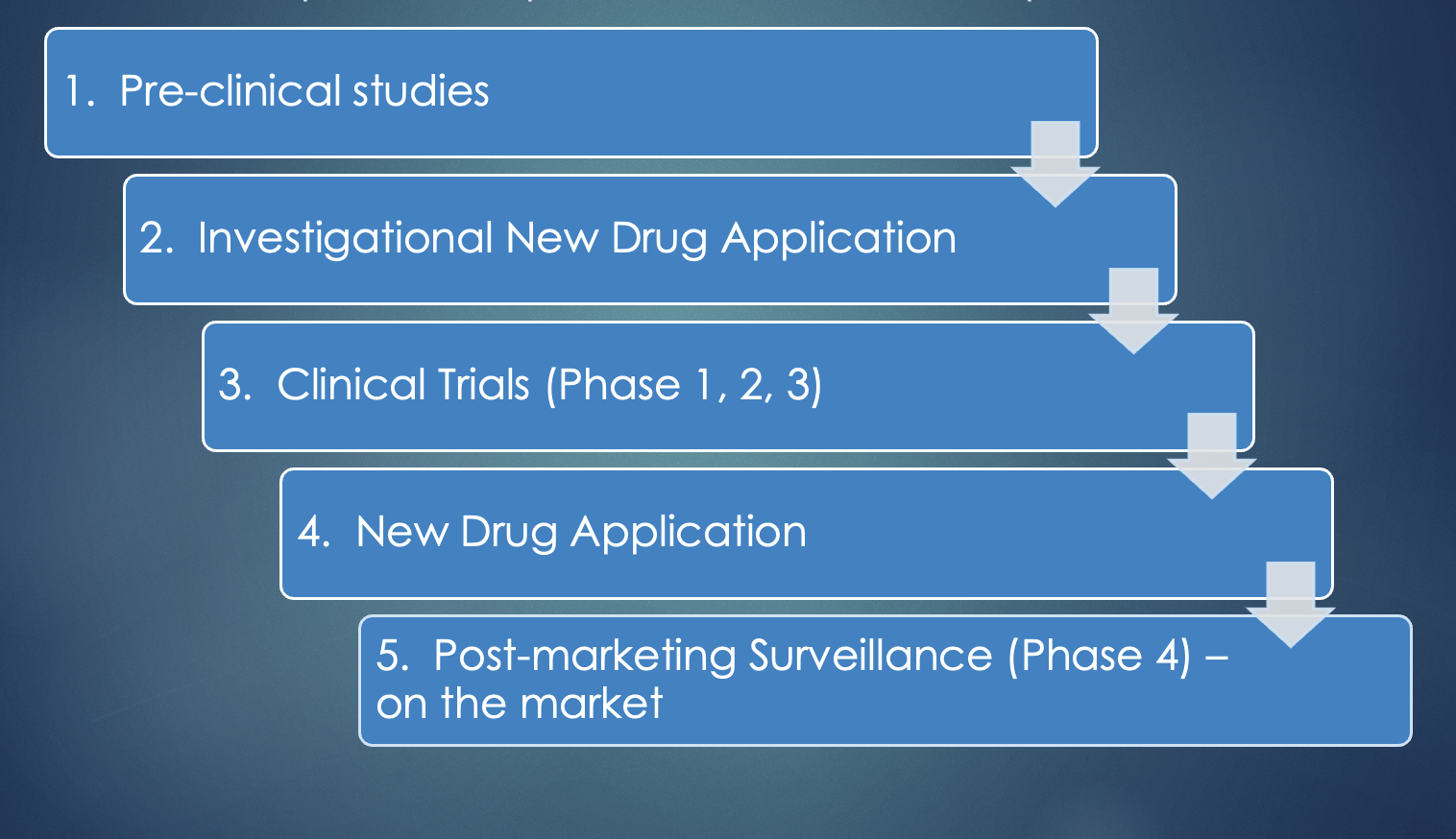
5 steps of the FDA approval process
Pre-clinical studies 2. Investigational New Drug (IND) Application 3. Clinical Trials (Phases 1–3) 4. New Drug Application (NDA) 5. Post-marketing surveillance (Phase 4).
Pre-clinical studies purpose
Assess therapeutic effects and safety on animal subjects before human testing.
FDA approval before pre-clinical studies
FDA approval is NOT required before pre-clinical studies.
Subjects used during pre-clinical studies
Animal subjects.
Requirement during pre-clinical studies
Must follow Good Laboratory Practices (GLP).
Investigational New Drug (IND)
Application submitted to the FDA before a new drug can be administered to humans.
Purpose of the IND
Protect the rights and safety of humans.
Illegal action involving IND
It is illegal to distribute a drug without an approved IND.
Information included in an IND
Information from pre-clinical studies and a complete description of methodology for human testing.
Clinical trials definition
Human studies used to evaluate the safety and efficacy of a new drug.
Requirement before moving to next clinical phase
Drug must satisfactorily complete each phase before progressing.
FDA authority during clinical trials
FDA may terminate an IND clinical trial at any time if necessary.
Requirement for patients during clinical trials
Informed consent must be provided by the patient or representative.
Amendment associated with informed consent
Kefauver-Harris Amendment.
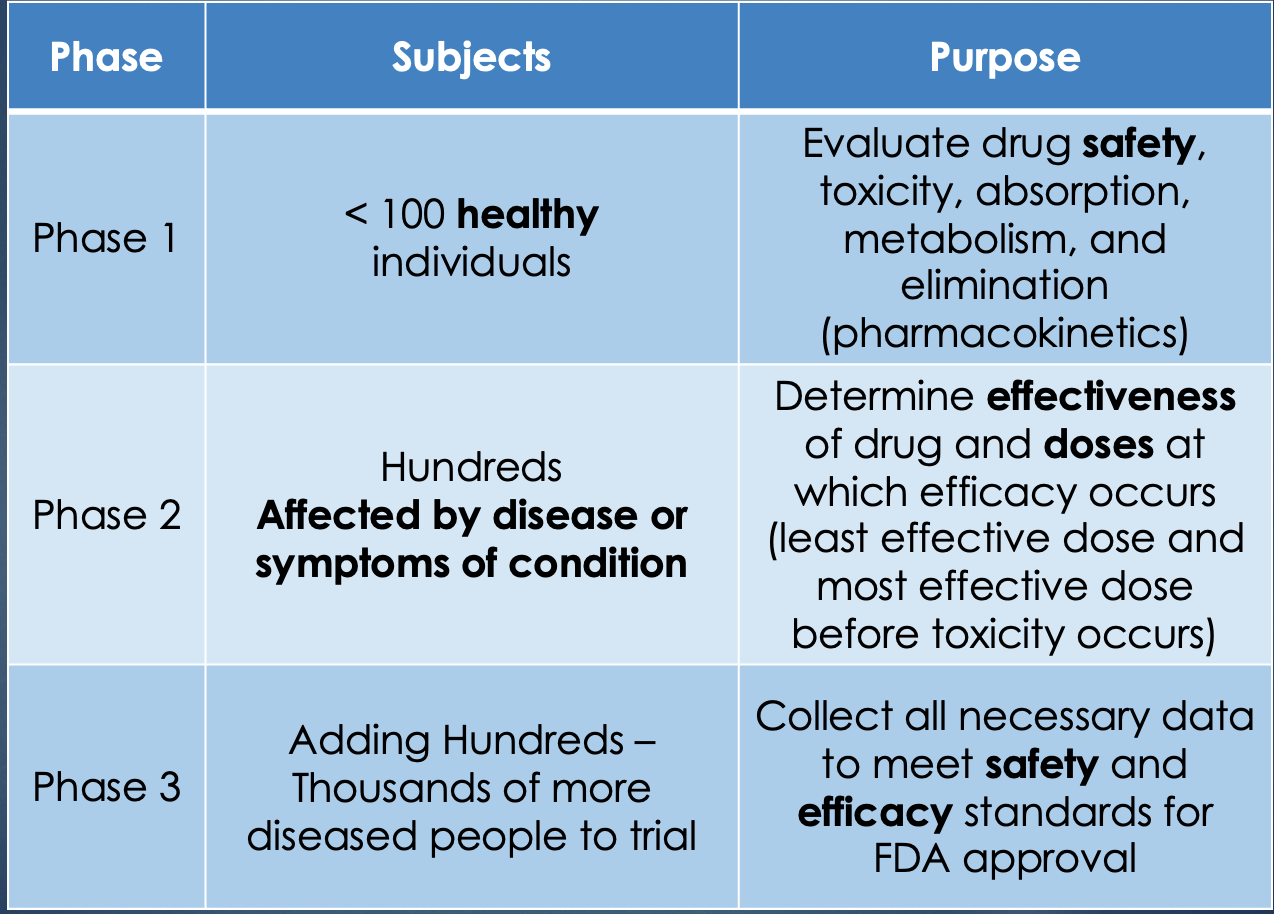
Phase 1 clinical trial subjects
Less than 100 healthy individuals.
Purpose of Phase 1
Evaluate safety, toxicity, absorption, metabolism, and elimination.
Main focus of Phase 1
Pharmacokinetics and safety.
Phase 2 clinical trial subjects
Hundreds of patients affected by disease or symptoms.
Purpose of Phase 2
Determine effectiveness and dosing range.
Important Phase 2 dosing concepts
Least effective dose and most effective dose before toxicity occurs.
Phase 3 clinical trial subjects
Hundreds to thousands of diseased patients.
Purpose of Phase 3
Collect all data necessary to meet FDA safety and efficacy standards.
Main purpose of Phase 3
Provide evidence for FDA approval (safety and efficacy).
Phase 4 clinical trial subjects
All patients receiving the drug.
Purpose of Phase 4
Report adverse effects in a widespread population.
Post-marketing surveillance
Monitoring of long-term safety after the drug reaches the market.
Primary concern of post-marketing surveillance
Long-term safety profile in a larger patient population.
Manufacturer responsibilities during Phase 4
Maintain post-marketing records and provide annual reports.
Purpose of FDA MedWatch Program
Allows healthcare professionals to report drug problems and adverse effects.
Treatment IND
Allows investigational drugs to be administered to patients not enrolled in clinical trials.
When can a Treatment IND be used?
For imminent life-threatening illnesses with no cure or when current drugs are ineffective.
Examples where Treatment IND may apply
AIDS, cancer, Alzheimer’s disease.
Requirements for Treatment IND
Must have safety and efficacy data and be in Phase II or III clinical trials.
Additional requirement for Treatment IND
Must submit treatment protocol to the FDA.
New Drug Application (NDA)
Application requesting FDA approval to market a new drug.
Information included in an NDA
Reports proving safety and efficacy, drug composition, manufacturing methods, drug samples, and proposed labeling.
NDA approval timeline
Approximately 6 months to 1 year.
FDA classification system
System based on chemical and therapeutic characteristics of drugs.
Purpose of FDA classification system
Affects how quickly a drug moves through the NDA process.
Type P therapeutic classification
Priority drug providing major therapeutic gain or significant advantages over current therapy.
Type S therapeutic classification
Standard or similar drug compared to drugs already on the market.
Type O therapeutic classification
Orphan drug.
Orphan drug
Drug intended to treat rare diseases or conditions.
Purpose of orphan drugs
Encourage development of drugs for rare diseases.
Fast Track products
Products eligible for accelerated FDA review.
Law that created Fast Track products
FDA Modernization Act of 1997.
Requirements for Fast Track review
Drug treats serious/life-threatening conditions, fulfills unmet medical need, and likely provides clinical benefit.
Requirement after Fast Track approval
Sponsor must conduct additional post-approval Phase 4 studies.
Abbreviated New Drug Application (ANDA)
Application used to approve generic versions of innovator drugs after patent expiration.
Purpose of ANDA
Allow secondary companies to market generic or brand-name equivalents.
Requirements of ANDA
Must demonstrate pharmaceutical equivalence and bioequivalence.
Bioequivalence
Same active ingredient, same dosage form, and similar performance as innovator drug.
Advantage of ANDA
Requires less data than an IND or NDA.
180-day exclusivity
First generic company approved through ANDA receives 6 months exclusivity rights.
Supplemental New Drug Application (SNDA)
Application used to make changes to an already approved drug product.
Purpose of SNDA
Allows manufacturers to modify existing approved drugs.
Changes requiring an SNDA
Synthesis, labeling, production procedure, dosage form, strength, manufacturing location, packaging, or therapeutic indication.
FDA Modernization Act and SNDA
Encouraged research for new uses of existing drugs. (fast track process)
Difference between IND and NDA
IND allows human testing; NDA requests permission to market the drug.
Difference between NDA and ANDA
NDA is for brand-new drugs; ANDA is for generic versions.
Difference between ANDA and SNDA
ANDA is for generic approval; SNDA is for changes to existing approved drugs.
Which clinical phase uses healthy volunteers?
Phase 1.
Which clinical phases use diseased patients?
Phases 2 and 3.
Which phase occurs after FDA approval?
Phase 4.
Which phase focuses on adverse effect reporting in large populations?
Phase 4.
Which phase primarily evaluates pharmacokinetics?
Phase 1.
Which phase determines effective dosing?
Phase 2.
Which phase provides the main evidence for FDA approval?
Phase 3.
Which phase monitors long-term safety?
Phase 4.
What can cause the FDA to terminate a clinical trial?
Safety concerns or if deemed necessary by the FDA.
What must patients provide before participating in clinical trials?
Informed consent.
Main purpose of Phase 1
Safety.
Main purpose of Phase 2
Efficacy and dosing.
Main purpose of Phase 3
Safety and efficacy data for FDA approval.
Main purpose of Phase 4
Long-term safety and adverse effect monitoring.
What is required before a drug can be tested in humans?
An approved IND.
What is required before a drug can be marketed?
An approved NDA.
When is an ANDA submitted?
After the innovator drug patent expires.
What does ANDA stand for?
Abbreviated New Drug Application.
What does SNDA stand for?
Supplemental New Drug Application.
What does NDA stand for?
New Drug Application.
What does IND stand for?
Investigational New Drug.
What does GLP stand for?
Good Laboratory Practices.
What does FDA MedWatch monitor?
Adverse drug events and safety problems.