Chemistry of beta lactams
 Call Kai
 Learn
Learn Practice Test
 Spaced Repetition
 Match
Match Flashcards
 Knowt Play
1/28

Earn XP
Description and Tags
Name | Mastery | Learn | Test | Matching | Spaced | Call with Kai |
|---|
No analytics yet
Send a link to your students to track their progress
29 Terms
What is the name for the bacterial splitting pattern?
binary fission,
When does bacterial replication stop?
when there are too many bacteria for the resources availible, when diseased cells die due to accumulating toxic levels of bacteria
What are the bacterial growth phases?
lag, exponential, stationary and death
Why is there a lag phase in bacterial growth?
when the bacteria is adapting to the environment, nutrients are plentiful, bacteria grow without dividing
What are the two actions on bacteria antibiotics can have?
bacterialcidal - kills bacteria (beta lactams), bacterostatic - stops bacteria deviding,
What does the beta lactam ring look like (basic form)? (describe it)
4 carbon ring but with a nitrogen in the bottom right (1), double bonded oxygen substituted on the bottom left carbon (4)
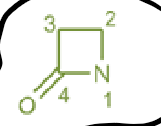
What is the structure activity relationship of beta lactams?
the side chain to the left of the ring is changeable, but resistant to beta lactamases if use too large group, there is a carboxylic acid on a side chain attached to the nitrogen - this is needed as is negatively charged when ionised so has electrostatic interactions
What is the problem with beta lactam antibiotic structure? What is changed?
there left (blue) side chains can act against themselves so some are electron withdrawing to prevent this
How were beta lactam antibiotics developed?
started with penicillin G, penicillin V was naturally occuring and an oral formulation, resistance means semi-synthetic penicillns were developed
What are the segnificant penicillins?
oxacillin, cloxacillin, ampicillin, nafcillin, amoxicillin, carbenicillin, ticarcillin, piperacillin, termocillin, and mecillinam
What is siderophore-substituted cephalosporin?
cefiderocol, contains a catechol segment which facilitates entry into bacterial cells through iron transportation system, it is stable agains several carbapenemases
Why are beta lactam antibiotics able to trick PBP?
high structural homoginty
What are PBPs and why are we concerned about them?
penicillin-binding proteins, although efflux pumps are found in almost all bacterial species, the beta lactamase production is the most efficent of the three mechanisms
What is the beta lactam mechanism of action?
looks like D-alanine, the enzyme binds to beta lactam instead of D-alanine, this is blocked forever as it is an increadibly stable intermediate, different beta lactams act on different proteins, can take more than one, may antagonise each other, burst cells due to osmotic pressure
How does beta lactam antibiotic resistance comes about?
patients that have spent more then 3 days in hospitals and who have been treated previously with beta lactam antibiotics is a risk factor, so is being exposed to invase procedures,
What are serine-beta-latamases? (resistance)
they comprmise the extended beta lactamases and carbapenemases that hydrolyse carbapenem antibiotics and cephalosporins, penicillin, A and D enzymes that have serine-based hydrolytic mechanisms
What are B carbapenemases known as?
Metallo-beta- lactamases
What is the mechanism of the most serious type of beta-lactamase resistance?
many bacteria synthesze beta-lactamases that degrade beta-lactam antibiotics before they reach the cell wall, gram-positive bacteria excrete these into the extracellular space - production only when antibiotics are present, gram-negative bacteria excrete into the peroplasmic space production is consant
Where is the periplasmic space?
between the cytoplasmic memebrane and the outer membrane, where the cell wall is located
What is the beta-lactamase enzyme inhibitor mechanism?
clavulanic acis acts as a suicide inhibitor by forming a covelent bond with a serine residue located in the active site of the beta-lactamase enzyme
the interaction leads to a stuctural change in the clavulanic acid molecule, resulting in the formation of highly reactive species
the reactive species is then attacked by another amino acid within the active site, leading to permanent inactivation of the enzyme
How does resistance spread in bacteria?
channels between bacteria allows resistant plasmids to transfer over
What are the hypersensitivies of beta-lactams?
most known cause of drug-induced fevers, neurotoxic, nephrotoxic, genotoxic, some reproductive toxic, toxicity on CNS - disorinentation, twitching, somnolence, and myoclonus, imipenem and cephaloridine have been reported to cause an irreversible injury to the renal anionic substrate uptake and respiration,
What are the problems with metabolites of beta-lactams?
can stay in the body a little while, Sh group can make sulfide bridges with anything else
How can beta-lactam antibiotics trigger epilepsy or seizures?
their chemical structures make them able to bind to gamma-aminobutyric acid (GABA) receptors in the brain, some of them are GABA receptor antagonists
What happens with beta-lactams and renal failure?
neurotoxicity due to increased amount antibiotic in the blood
What is the benifical effects beta-lactams can have neurologically?
neuroprotective roles in some circumstances, antagonise other receptors so can be good
What are the solutions for beta-lactam resistance and toxicity?
allergy tests, replacing the toxic beta-lactam with a non-allergic/toxic one, use phage therapy instead of chemicals, use beta-lactamase inhibitors, using other chemicals in combanation, dialysis for severe cases to get rid of accumulated drug, rational drug prescribing and treatment monitoring
What is dual beta-lactam therapy?
combanation of two beta-lactams as long as they don’t antagonise themselves, useful if bacteria is resistant to aminoglycosides, it has comparable efficacy with less nephrotoxicity, synergism exists between the drugs, when ceftriaxone binds nonessential penicillin binding proteins 2 and 3, allows for higher concentrations of ampicillin to exert theraputic effect.
What binding sites do penacillins mainly bind to?
PBP3 and PBP4, with modest binding to PBP1a and PBP1b, binding to PBP2 and PBP5/6 is barely observed