BIO EXAM 3 STUDY GUIDE
 Call Kai
 Learn
Learn Practice Test
 Spaced Repetition
 Match
Match Flashcards
 Knowt Play
1/23

Earn XP
Description and Tags
so you like plants
Name | Mastery | Learn | Test | Matching | Spaced | Call with Kai |
|---|
No analytics yet
Send a link to your students to track their progress
24 Terms
What are the unique features of angiosperms and why are they an important group of plants?
pollination for sexual reproduction, flowering plants, fruits/seeds, animal dispersed, 80% of all plants.
Important because of its abundant presence, the coevolution between plants and their pollinators, fruit acts like a food source, ect.
How are the major groups of plants related evolutionarily?
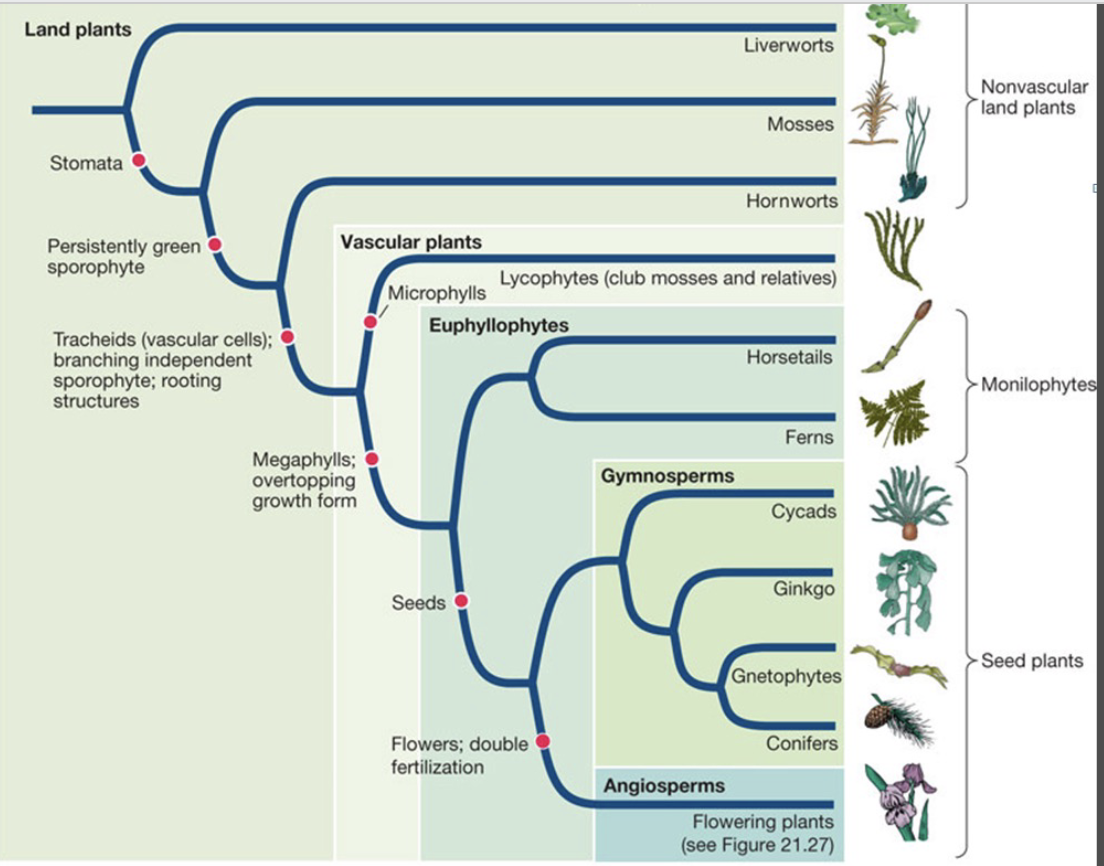
What are the other major groups of plants outside of angiosperms?
Gymnosperms (conifers, spruces, redwoods,
most volume-ous, needle or scale like leaves, wind pollinators, cones as reproduction structure, naked seeds, simple vascularization, was the most dominant in mesozoic
Horse tail and ferns (euphylophytes):
seedless (spores, complex leaves w/ branching stems, underground growyj (rhizomes), dominant during palaeozoic
Bryophytes: (Mosses, Liverworts, Hornworts)
Non Vascular, gametophyte dominant, swimming sperm, can desiccate and rehydrate
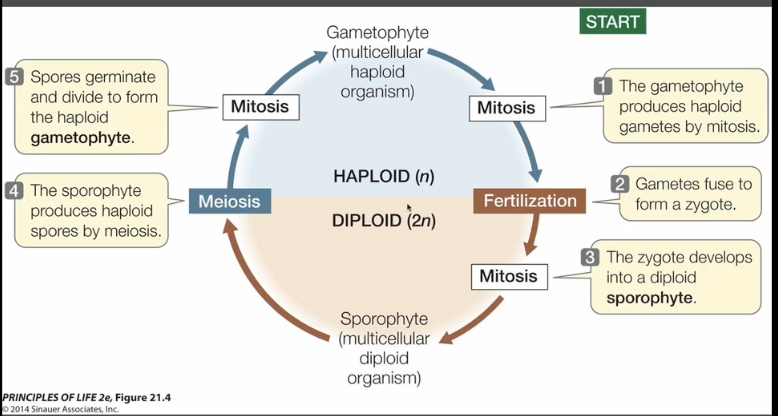
What is alternation of generations in the context of the plant life cycle?
In a plants: A diploid adult organism that undergoes meiosis, and some part of that adult organism produces haploid spores. Those spores undergo division (mitosis) turning into a gametophyte.
Then after that gametophyte been there for a while some cells will break off though mitosis and form plant sperm or egg, and fertilize each other. (from different plants) and produce an adult plant. (Diploid sporophyte)
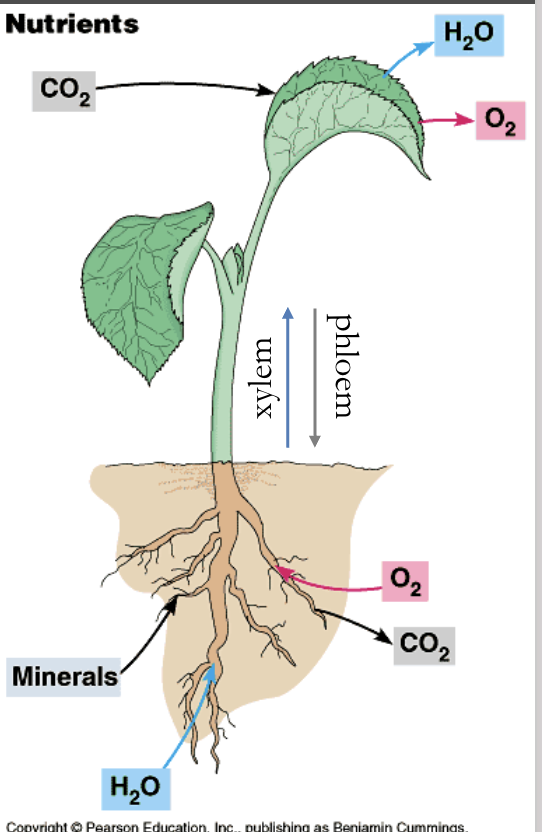
What are the major plant organs and how do they work?
1) Leaf- Primary site of photosynthesis, containing chloroplasts that capture light enegry. to produce sugars, they require gas exchange through the stomata, allowing CO2 in and O out, while controlling water loss through transpiation.
2) Steam- structural support and serve as transport system using vascular tissue (xylem to move water and minerals upward, phloem distributes sugar through out the plant). They also store nutrients and help positon leaves.
3) Root- Anchor plant to soil, absorb water and minerals, and often store carbohydrates. They also increase surface area through root hairs and may form symbiotic relationships with fungi for enhanced nutrient uptakes.
What is the role of meristematic tissue in plant growth?
composed of undifferentiated stem cells that undergo rapid mitotic division to create new cells. Located at the tips of roots and shoots (apical) and along the sides of stems (lateral), these tissues drive both vertical lengthening and increase in girth (thickness), facilitating continuous growth, organ formation (leaves/flowers), and structural development throughout a plant's life.
What are the general functions of plant hormones, pigments, and secondary metabolites?
Hormones- Signaling molecule that regulates and controls physiology, growth, or behavior.
EX: Gibberellin: causes growth. Auxin: Growth. Ethylene: promotes ripening, Cytokinins: delays senescence (age/death) promotes cell division, Abscisic acid: maintains seed dormancy/closes stomata, Brassinosteroids; growth and tissue differentiaion
Pigments- A compound that has a distinctive color due to selective color absorption.
EX: Chlorophyll: green, Carotenoids and flavonoids: yellow, Carotenoids: orange, Anthocyanins and Carotenoids: red
Secondary metabolites-Organic compounds that are not directly involved in the normal growth, development, or reproduction of an organism. Often, they contribute to a “secondary” function such as defense against herbivory.
Ex: taste of tabacco plant, that weird green worm Manduca sexta that if a animal eats it, can be bad, spicyness in peppers
Where do the essential materials, elements, and energy necessary to grow a plant come from?
C, H, O ~96% dry weight Most from CO2 from atmosphere. Other minerals absorbed from soil (nutrient uptake from soil)
Photosynthesis:
6CO2 + 6H2O → C6H12O6 + 6O2
Cell respiration:
C6H12O6 + 6O2 → 6CO2 + 6H2O + Chemical energy (ATP)
elements: COH, N, P, S. K, Cu, CL, Fe, Mn, Ze
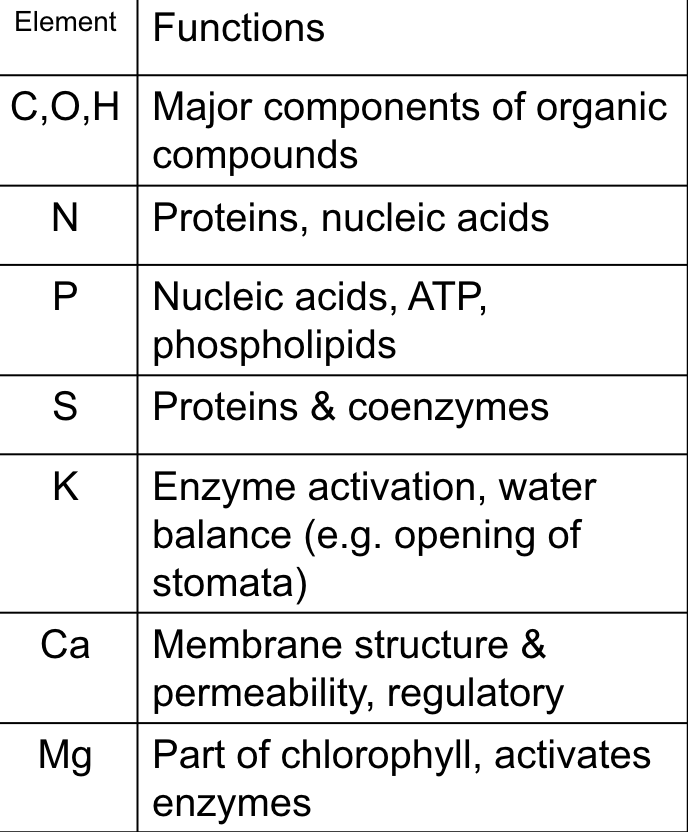
What are the major macronutrients plants need to grow?
Macroelements: element required by plants in relatively large amounts.
EX: COH, N, P, S. K
Some Microelements example (in case): Cu, CL, Fe, Mn, Ze
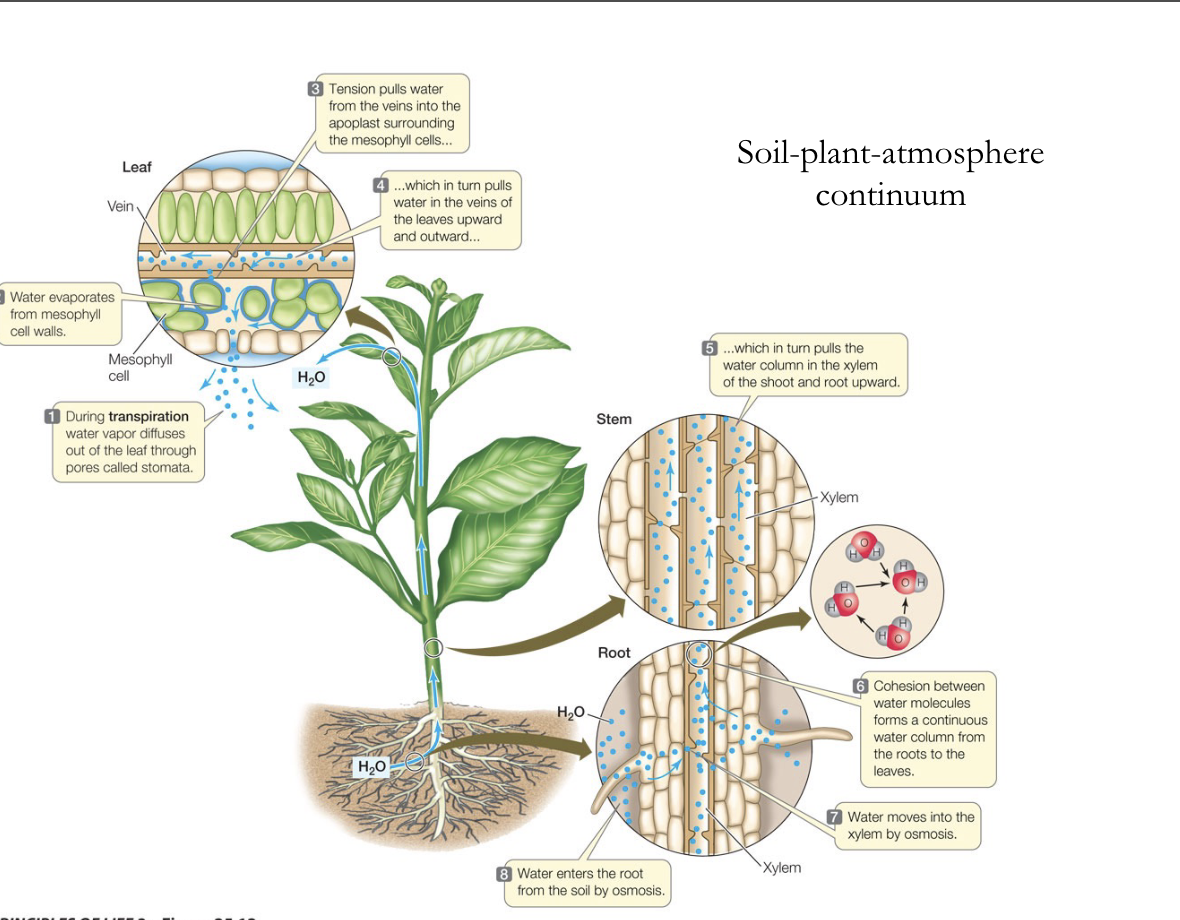
How does water flow through plants?
Water enters the root from soil through osmosis, water moves into xylem by osmosis, cohesion between molecules forms a continuous water column from root to leaves, which in turn pulls water column in the xylem of the shoot and root upward, which pulls water in veins of leaves upward and outward, tension pulls water from veins into the apoplast surrounding the mesophyll cells, water evaporates from mesophyll cell walls, during transpiration water vapors diffuses out leaf through pores called stomata
SHORT ANSWER. xylem (in vascular tissue system. Plant tissue that transports water and minerals, typically from roots to leaves)
What is ecology?
The study of the abundance and distribution of organisms, as well as the interactions among organisms and their environment.
What is the difference between conditions and resources and what are some examples of each?
Explain the snowshoe hare and Canada lynx cycles
Understand the mathematics underlying exponential and logistic population models
Why is intraspecific competition important?
What are the various types of possible interspecific interactions? Give examples
What is an ecological niche
What are the key features of food webs?