Unit 4 SEHS IB HL
 Call Kai
 Learn
Learn Practice Test
 Spaced Repetition
 Match
Match Flashcards
 Knowt Play
1/129

There's no tags or description
Looks like no tags are added yet.
Name | Mastery | Learn | Test | Matching | Spaced | Call with Kai |
|---|
No analytics yet
Send a link to your students to track their progress
130 Terms
kinematics
study of motion of bodies and objects without forces
kinetics
study of motion with forces
linear motion
motion in a straight line
curvilinear motion
motion in a curve
angular motion
motion around an axis
general motion
linear and angular motion together
linear motion sports example
ice puck across the floor
curvilinear motion sports example
javelin through the air
angular motion sports example
gymnast rotating on a high bar
general motion sports example
running in a stright line as our limbs rotate
Vector
measurement that has magnitude and direction
Scalar
measurement that only has magnitude
distance
path travelled from A to B
Displacement
change of position of a body
speed definition
time taken to cover a certain distance
speed formula
distance/time
Velocity definition
the time taken to change position
velocity formula
change in displacement / time
acceleration definition
a change in velocity in a given period of time
acceleration formula
change in velocity/change in time
force
the push or pull acting on an object
resultant motion
the sum of the forces acting on an object
Force formula
Force = Mass x Acceleration
weight formula
mass x gravity
Newton's first law (inertia)
an object will remain at rest or in constant motion unless acted upon by an external force
Newton's second law (acceleration)
F=MxA
Newton's third law
for every action there is an equal and opposite reaction
the centre of mass
a mathematical point around which the mass of an object is evenly distributed
base of support
the larger the base of support the greater the stability
principle of summing joint forces
when the forces from your muscles add up in the same direction, they make your movements more powerful
linear impulse formula
force x time
Moment of Inertia
the resistance to rotation
Angular Momentum formula
moment of inertia x angular velocity
collisions
when two or more objects collide
conservation of linear momentum during collisions
During a collision, the total linear momentum of the objects are conserved
coefficient of restitution
measures from 0-1 how much energy is retained after impact
1 coefficient of restitution
perfectly elastic no energy lost
0 coefficient of restitution
inelastic, no bounce
friction
a force that opposes motion between two surfaces in contact
coefficient of friction
The ratio of the force of friction
low coefficient of friction example
steel on ice
high coefficient of friction example
rubber sole on ground
static friction
friction that occurs on objects that are not moving
dynamic friction
friction that opposes the movement of an object
friction force and applied force on an object
when the force applied to a static object is enough to overcome static friction, the object begins to move
work formula
force x distance
power formula (Change)
change in work done/change in time
power formula (product of)
P= force x velocity
muscular power
application of strength and speed of a movement
projectile motion
an object dropped or thrown in the air that is acted upon by only the forces of gravity and air resistance
what is air resistance being negligible
air resistance has no effect, gravity is the only force and only vertical velocity changes
when would air resistance be negligible
when objects are small, dense and smooth or travelling at low speeds in thin air, or in short distances
three initial conditions of projection
initial velocity, angle of projection and height of release
when projection height is same as landing height
throw at 45 degree angle
when projection height is below landing height
throw above 45 degree angle
air resistance on fast-moving objects
high air resistance, faster deceleration
environmental conditions that impact forces acting on an object
temperature, humidity, wind, salinity of water and altitude
at high altitudes, objects...
travel faster and farther as there is less drag
buoyancy
the force acting vertically on objects partially immersed in fluid
archimedes' principle
the buoyant force is equal to the weight of the fluid displaced
for an object to float...
the buoyancy force must be greater than equal to the weight of the object
Drag force
a force that opposes the motion of an object through a fluid
surface drag
as a body moves through a fluid, outer surface of the body catches a layer of fluid nearby
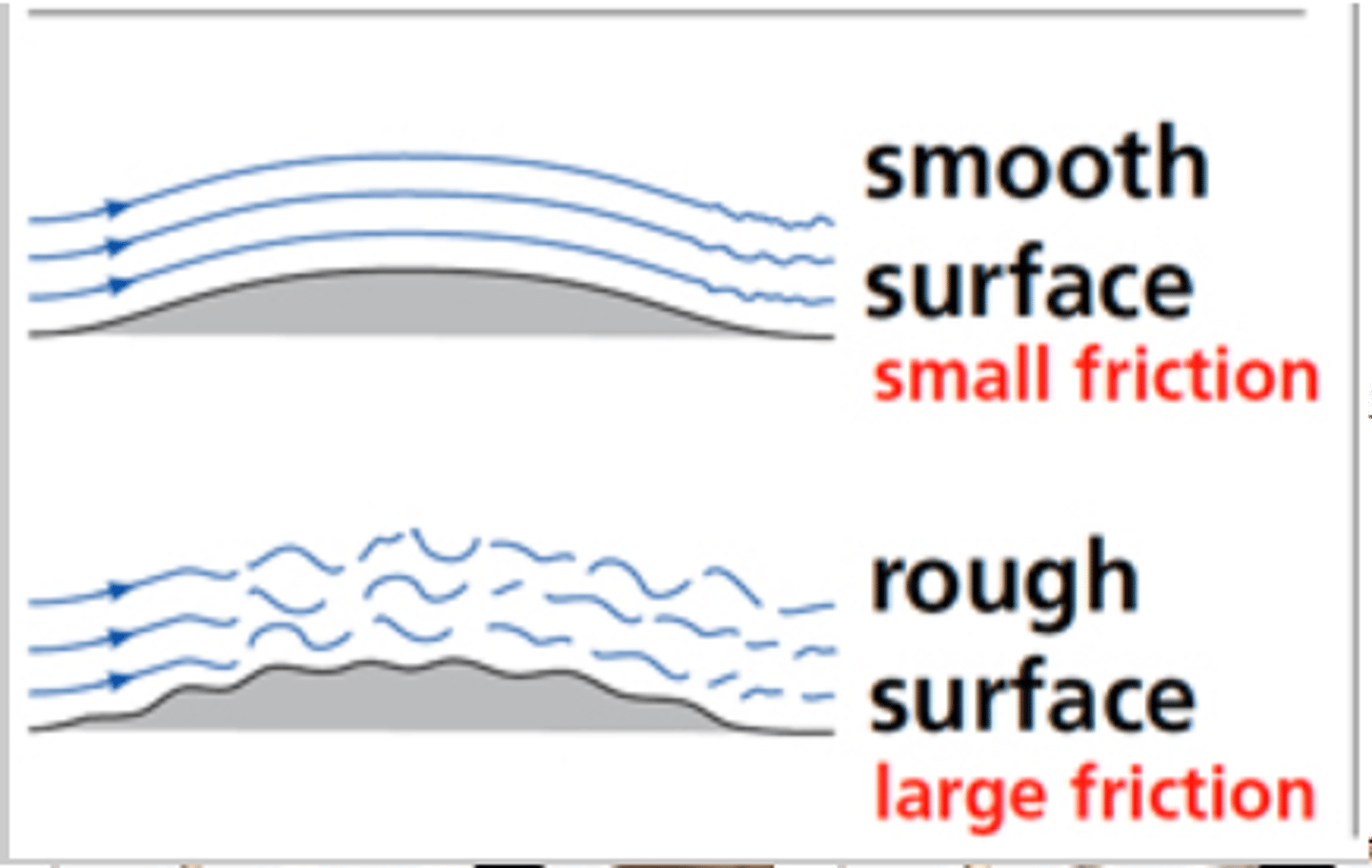
how to minimize surface drag
wearing smooth things to reduce the interaction
surface drag is affected by
velocity, surface area and nature of the surface
form drag
when a body pushes against a fluid, a fluid pushes back
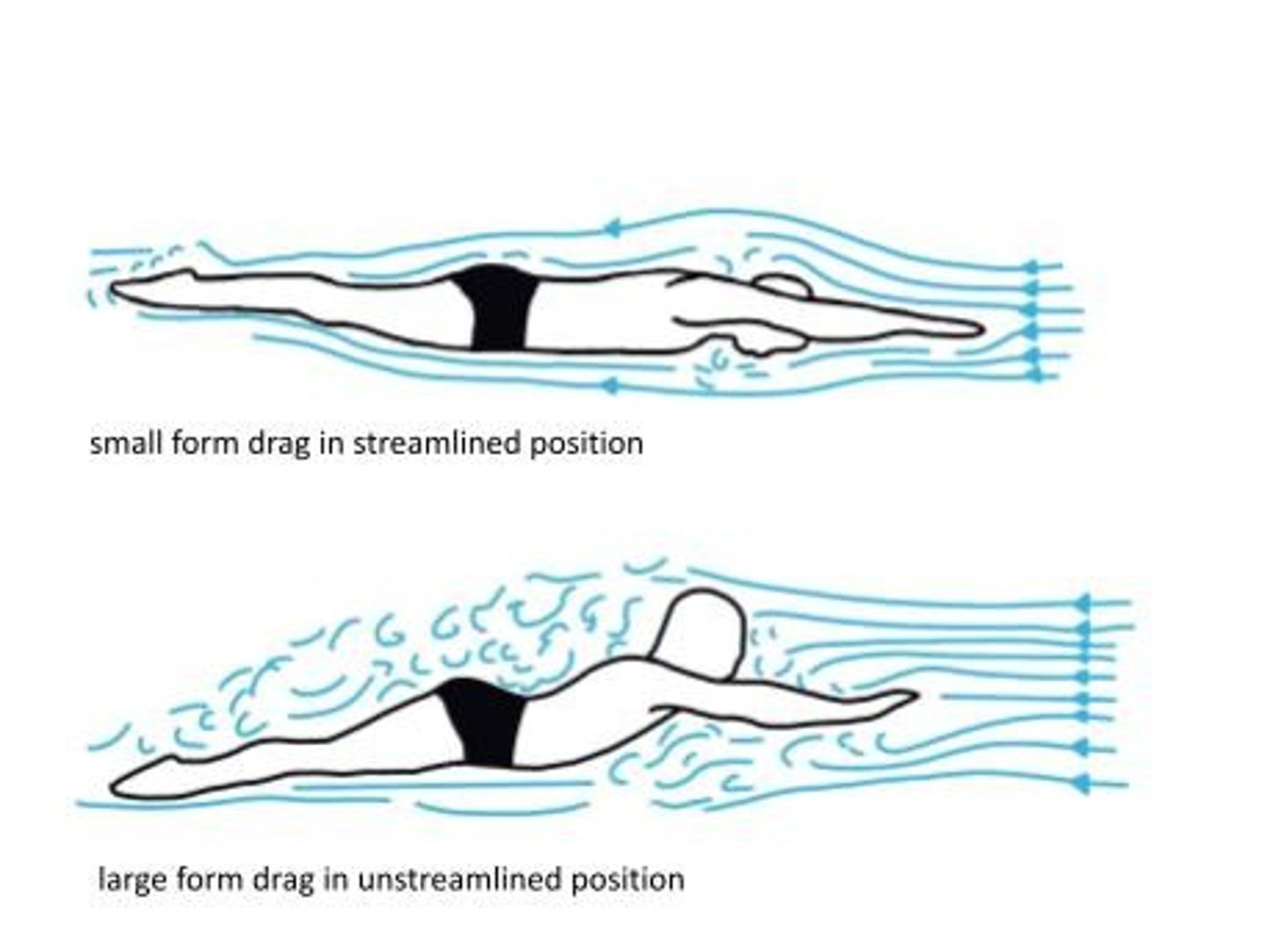
form drag is affected by
frontal area, shape and velocity
wave drag
when a body moves along the surface of a fluid, fluid is displaced to form a wave and swimmers loose kinetic energy
laminar boundary layers
boundary layer with molecules smoothly moving in same direction
turbulent boundary layer
boundary layer interacting with rough surfaces
Bernoulli's Principle
as the velocity of a fluid increases, the pressure exerted by the fluid decreases and a pressure difference is created
Bernoulli's principle in a ball
ball rotates towards the lower pressure, the pressure difference causes the ball to curve as lift is also created
Magnus force
lift force created by spin
define skill
consistent production of goal-oriented movements which are learned and specific to a task
four types of skills
motor, cognitive, perceptual and perceptual motor
motor skills
movements with barely any thinking
cognitive skills
requiring heavy thinking
perceptual skills
involving interpreting sensory information
perceptual-motor skills
combination of perception and movement
ability
traits a person is born with that enables one to perform skills
skill is..
ability + a selection of an appropriate technique
performance in skill learning
a temporary occurrence fluctuating
learning in skill learning
the process of acquiring consistency
transfer of learning (positive, negative or zero)
the effect that practice of one task has on the learning or performance of another
skill to skill transfer
throwing a ball to throwing a javelin
practice to performance transfer
batting against a machine to batting against an opponent in a game
abilities to skills transfer
improving dynamic strength to start races better
bilateral transfer of skills
learning to kick with a non-dominant side
stage to stage transfer of skills
from 3v3 to team v team
principles to skills transfer
learning that long levers aid throwing to throwing a javelin
information processing theory
the system that we take in information and use it to make a decision and produce a response
three phases of learning
cognitive, associative, autonomous
cognitive phase of learning
lots of thinking and mistakes, movements are inconsistent
associative phase of learning
practices movements, fewer errors and uses feedback
autonomous phase of learning
skill becomes automatic, consistent with low attention
traditional linear pedagogy
based on information processing theory and cognitive stages, teacher centred, movements should be broken down
nonlinear pedagogy
based on ecological dynamics approach, teachers modify constraints, learner centered approach
Exteroceptors
provide information from outside the body
interoceptors
provide information from inside the body
noise
nonessential information