Chapter 45 Hormones and the Endocrine System
 Call Kai
 Learn
Learn Practice Test
 Spaced Repetition
 Match
Match Flashcards
 Knowt Play
1/25

Earn XP
Description and Tags
Bio 1270 Molloy University
Name | Mastery | Learn | Test | Matching | Spaced | Call with Kai |
|---|
No analytics yet
Send a link to your students to track their progress
26 Terms
Define hormone
A hormone is a secreted chemical signal that travels through the bloodstream and acts on specific target cells to regulate physiology and behavior.
List the five types of intercellular communication by secreted molecules
Endocrine → long distance (bloodstream)
Paracrine → nearby cells
Autocrine → same cell
Synaptic → neurons → target cell via synapse
Neuroendocrine → neuron → bloodstream
Define local regulators and list two examples
are molecules that act over short distances, reaching target cells solely by diffusion
ex:
Paracine
Autocrine
Both play a role in process such as blood pressure and regulation, nervous system function, and reproduction
Specify nitric oxide signaling
Nitric oxide (NO) is a gas molecule that acts as a signaling molecule (a gas hormone).
When oxygen levels in the blood drop (low O₂), cells in the blood vessel walls (endothelium) release NO.
NO quickly diffuses into nearby smooth muscle cells in the blood vessel wall.
Inside these smooth muscle cells, NO activates an enzyme called guanylyl cyclase.
This increases levels of cGMP (cyclic guanosine monophosphate), an important signaling molecule.
cGMP causes smooth muscle relaxation, which leads to:
Vasodilation (widening of blood vessels)
Increased blood flow to tissues that need more oxygen
Define synapses, neurotransmitters and neurohormones
Synapses: Neurons communicate with target cells via specialized junction
Neurotransmitters: secrete molecule at synapses that diffuse short distances and bind to receptors on target cells
Neurohormones: secreted by specialized neurosecretory cells; diffuse from nerve endings to the bloodstream.
Specify pheromones
Members of some animal species use it to communicate
Chemicals that are released into the environment
List the three major chemical classes of hormones and specify the solubility of each
Class | Solubility | Examples |
Peptide/Protein | Water-soluble | Insulin, glucagon |
Amine | Usually water-soluble (some lipid-soluble) | Epinephrine, thyroid hormones(lipid soluble) |
Steroid | Lipid-soluble | Cortisol, estrogen, testosterone |
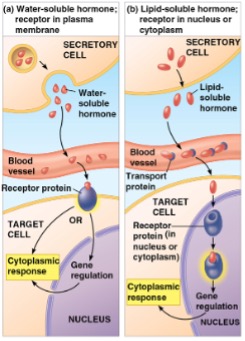
Specify the cellular hormone response pathways for water-soluble and lipid-soluble hormones
Water-Soluble Hormones
Travel freely in blood
Bind to receptors on cell membrane
Use second messengers (like cAMP)
Cause quick, short-term responses
Lipid-Soluble Hormones
Travel bound to proteins
Enter the cell and bind inside
Act on DNA to control gene expression
Cause slow, long-lasting responses
Define signal transduction
the process by which a signal from a hormone is converted into a cellular response
Specify multiple responses to a single hormone
one hormone can trigger different effects in different target cells
Ex: epinephrine increases heart rate, dilates airways, and breaks down glycogen in liver cells.
Define endocrine and exocrine glands
Endocrine glands:
- Endocrine cells are often grouped in ductless organs, such as the thyroid and parathyroid glands and testes or ovaries. secrete hormones directly into blood (no ducts).
Exocrine glands:
Such as salivary glands, have ducts to carry secreted substances onto body surfaces or into body cavities secrete substances through ducts to the outside or digestive tract.
Endocrine → no ducts
Exocrine → ducts (sweat, saliva, digestive enzymes)
List human endocrine glands
Hypothalamus
Pituitary gland
Pineal gland
Thyroid gland
Parathyroid glands
Adrenal glands
Pancreas
Ovaries (female)
Testes (male)
Thymus
Specify simple emdocrine pathway
Simple Endocrine Pathway
Stimulus → endocrine cells detect a change
Endocrine cells secrete a hormone
Hormone travels through the bloodstream
Hormone binds to specific receptors on target cells
Signal transduction occurs inside the target cells
Leads to a physiological response
Example: Secretin Pathway
Stimulus: Acidic chyme enters the duodenum (low pH)
Response: Endocrine cells in the duodenum release secretin
Target: Pancreas
Effect: Pancreatic cells secrete bicarbonate (HCO₃⁻) into ducts
Result: Bicarbonate neutralizes acid → pH in the duodenum increases
Specify simple neuroendocrine pathway
Simple Neuroendocrine Pathway
Stimulus is detected by a sensory neuron
Signal is sent to a neurosecretory cell (in the brain)
Neurosecretory cell releases a neurohormone into the bloodstream
Hormone travels to target cells
Leads to a physiological response
Example: Oxytocin & Milk Release
Stimulus: Infant suckling
Detection: Sensory neurons send signals to the hypothalamus
Response:
Hypothalamus sends nerve impulses to the posterior pituitary
Posterior pituitary releases oxytocin
Target: Mammary glands
Effect: Milk is ejected (released)
Define negative and positive feedback
- In a negative feedback loop, the response reduces the initial stimulus
Negative feedback = most common in homeostasis
- For example, the increase in pH in the intestine caused by secretin release shuts off further secretin release
- Positive feedback reinforces a stimulus to produce an even greater response
- For example, in mammals oxytocin causes the release of milk, causing greater suckling by offspring, which stimulates the release of more oxytocin
List the functions of hypothalamus, posterior pituitary and anterior pituitary
Hypothalamus
Coordinates the endocrine system
Receives input from the nervous system
Sends signals to the pituitary gland
Produces releasing and inhibiting hormones (control anterior pituitary)
Produces hormones stored in the posterior pituitary (ADH & oxytocin)
Posterior Pituitary
Does NOT make hormones
Stores and releases hormones made by the hypothalamus
Releases hormones into the bloodstream when stimulated by nerve signals
Posterior pituitary = controlled by nerves
Anterior Pituitary
Makes and secretes its own hormones
Controlled by hormones from the hypothalamus
Regulates many body processes:
Growth
Metabolism
Reproduction
Osmoregulation
Secretes tropic hormones (control other endocrine glands)
Anterior pituitary = controlled by hormones
List the two posterior pituitary hormones
Antidiuretic Hormone (ADH)
Promotes water reabsorption in kidneys
Helps control blood pressure and hydration
Oxytocin
Stimulates milk ejection from mammary glands
Triggers uterine contractions during childbirth
Extra: Anterior Pituitary Example
Hypothalamus releases prolactin-releasing hormone (PRH)
→ Stimulates anterior pituitary
→ Releases prolactin (PRL)
→ Promotes milk production
Define tropic hormones
- Set of hormones from the hypothalamus, anterior pituitary, and a target endocrine gland are often organized into a hormone cascade
- Hormones that stimulate other endocrine glands to release their hormones.
Example: TSH → thyroid gland
Specify growth hormone
Growth Hormone (GH)
Secreted by: Anterior pituitary gland
Functions: Has both tropic and nontropic effects
How GH Works
GH targets many tissues, especially the liver
The liver releases insulin-like growth factors (IGFs)
GH also increases protein synthesis and fat breakdown
IGFs stimulate:
Bone growth
Cartilage growth
Effects of GH Imbalance
Too much GH (childhood): → Gigantism (excessive growth)
Too little GH: → Dwarfism (stunted growth)
Specify control of blood calcium
Homeostatic Regulation of Blood Calcium (Ca²⁺)
Maintaining stable blood Ca²⁺ levels is essential for:
Muscle contraction
Nerve function
Bone health
Parathyroid Hormone (PTH)
Released by: Parathyroid glands
Trigger: Low blood Ca²⁺ levels
Overall effect: Raises blood Ca²⁺
How PTH works:
Bone: Stimulates release of Ca²⁺ into the blood
Kidneys: Increases reabsorption of Ca²⁺ (less lost in urine)
Indirect effect: Promotes activation of vitamin D, which increases Ca²⁺ absorption from the intestines
PTH is more important than calcitonin in humans (often asked)
Calcitonin
Released by: Thyroid gland
Trigger: High blood Ca²⁺ levels
Overall effect: Lowers blood Ca²⁺
How Calcitonin works:
Bone: Promotes Ca²⁺ deposition (storage in bone)
Kidneys: Increases Ca²⁺ excretion
List the two hormones produced in the adrenal medulla and their major functions
Adrenal Medulla Hormones
Secreted by: Adrenal medulla
Hormones:
Epinephrine (adrenaline)
Norepinephrine (noradrenaline)
These are catecholamines
Function: Control the “fight-or-flight” response
Fight-or-Flight Effects
Epinephrine and norepinephrine:
Epinephrine = more dominant than norepinephrine in humans
Increase glycogen breakdown in the liver
Increase release of glucose and fatty acids into the blood
Increase oxygen delivery to cells
Redirect blood flow:
Toward: heart, brain, skeletal muscles
Away from: skin, digestive system, kidneys
Epinephrine’s Multiple Effects
Epinephrine acts on different cells in different ways:
1. Liver Cells
Binds to a receptor → activates protein kinase A (PKA)
→ Stimulates glycogen breakdown → glucose release
2. Blood Vessels (Skeletal Muscle)
Causes vasodilation (widening of blood vessels)
→ Increases blood flow to muscles
3. Blood Vessels (Intestines)
Causes vasoconstriction (narrowing of blood vessels)
→ Reduces blood flow to the digestive system
Specify the role of the adrenal cortex
Adrenal Cortex
Activated by: Stressful conditions such as:
Low blood sugar
Decreased blood volume or pressure
Shock
Produces a group of steroid hormones called corticosteroids
Controlled by ACTH (from anterior pituitary)
Types of Corticosteroids
1. Glucocorticoids (e.g., cortisol)
Regulate glucose metabolism
Help the body respond to stress
Affect the immune system (often suppress inflammation)
2. Mineralocorticoids (e.g., aldosterone)
Control salt (Na⁺) and water balance
Increase:
Sodium reabsorption in kidneys
Water retention
Help maintain blood volume and blood pressure
Specify Sex Hormones
Sex Hormones (Gonads)
Produced by:
Testes (males)
Ovaries (females)
Main hormones:
Androgens (e.g., testosterone)
Estrogens (e.g., estradiol)
Progesterone
All three are present in both males and females, but in different amounts
Androgens (Testosterone)
Produced mainly by the testes
Functions:
Promote development of male reproductive organs
Responsible for male secondary sex characteristics
Deep voice
Facial hair
Increased muscle mass
Estrogens (Estradiol)
Produced mainly by the ovaries
Functions:
Maintain the female reproductive system
Promote female secondary sex characteristics
Breast development
Wider hips
Progesterone
Primarily involved in:
Preparing and maintaining the uterus
Supporting pregnancy
Hormonal Control Pathway
Hypothalamus → Pituitary → Gonads
Hypothalamus releases GnRH (gonadotropin-releasing hormone)
→ Stimulates anterior pituitary
→ Releases gonadotropins:
FSH (follicle-stimulating hormone)
LH (luteinizing hormone)
→ Act on gonads to produce sex hormones
Define endocrine disruptor
A chemical that interferes with the normal function of hormones or hormone pathways.
It can mimic, block, or alter hormone signals.
Example:
Diethylstilbestrol (DES) is a synthetic estrogen.
It disrupted estrogen signaling, leading to reproductive abnormalities and increased cancer risk in daughters of women who took it.
Specify pineal gland
A small gland in the brain that secretes melatonin
Function of melatonin:
Regulates biological rhythms (sleep–wake cycle)
Influences daily activity patterns and reproduction
Controlled by the Suprachiasmatic Nucleus (SCN) in the hypothalamus
The SCN acts as the body’s biological clock
Melatonin is secreted mostly at night
Specify melanocyte-stimulating hormone (MSH)
Produced by the pituitary gland
Function varies across species:
In amphibians, fish, and reptiles
Controls skin color
Works by regulating pigment in melanocytes
In mammals
Plays roles in:
Appetite (hunger)
Energy balance (metabolism)
Minor role in pigmentation