Chapter7: Polysaccharides Structure and Analysis
 Call Kai
 Learn
Learn Practice Test
 Spaced Repetition
 Match
Match Flashcards
 Knowt Play
1/57

There's no tags or description
Looks like no tags are added yet.
Name | Mastery | Learn | Test | Matching | Spaced | Call with Kai |
|---|
No analytics yet
Send a link to your students to track their progress
58 Terms
What are the two kinds of polysaccharides?
Homopolysaccharides: one kind of sugar
Heteropolysaccharides: multiple kinds of sugar
What is glycogen’s function in animals?
Energy (carbohydrate) storage
Describe the structure of glycogen
Glc(alpha1→4)Glc chains
Alpha1→6 branches (about every 8-12 units of glucose)
Reducing end connected to a protein in the middle (glycogenin)
Where do we find glycogen stores?
Muscles and liver cells
Why is glycogen being insoluble a good thing?
Prevents excess intracellular glucose solutes from drawing in water and causing high osmotic pressure
What is the function of starch?
Energy (carbohydrate) storage in plants
Describe the structure of starch
Still all glucose
Amylose and amylopectin strands
Amylose: only alpha 1→4, LINEAR, but can cause helices to form
Amylopectin: Alpha 1→4 chain and alpha 1→6 branches
Secondary structure can make H-bonded double helix
What kind of linkage does cellulose have?
Glc(Beta 1→4) Glc
Is cellulose branched?
No! All linear
What chemical properties allow cellulose to be used as structural support in plant cell walls, for example?
Since cellulose is unbranched and flat, they can form sheets
What’s the sugar making up chitin?
N-acetylglucosamine (glucose molecule modified with amide group)
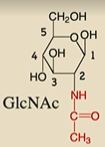
What is the function of chitin?
Composes insect exoskeletons
Chitin linkages
GlcNAc (Beta 1→4)GlcNAc
Enzymes recognize the glycosidic bonds they are made to cleave by…
Recognizing the specific monomers AND the linkagethey form
Give two examples of glycosidic bond cleaving enzymes

The enzyme alpha amylase is present where in our body? What polymer does it hydrolyze?
Saliva, starch alpha1→4 linkages
Endo versus exo enzymes
Endo: can cut anywhere in the polysaccharide with the right substituents, like in between monomers
Exo: can only cut at terminal, non-reducing end, chops one at a time
Is glycogen phosphorylase an endo or exo enzyme?
Exo! Cuts terminal non-reducing glucose in glycogen(alpha 1→4) and adds a phosphate group
Alpha amylase can cleave both…
Glycogen and starch because they both have alpha 1→4 glucose linkages
What cleaves the alpha 1→6 glucose linkages in glycogen and starch?
Isomaltase
What is cellulose cut by?
Cellulase
Why can cows digest cellulose?
Their gut microbiome harbors a microbe (rumen) that produces cellulase
What are our 4 major classes of heteropolysaccharides?
Glycosaminoglycans- repeating disaccharides (DOESN’T contain proteins!!!)
Peptidoglycan- bacterial cell wall
Proteoglycan- protein + glycosaminoglycans
Glycoproteins- proteins with polysaccharides attached
Is peptidoglycan found in mammals?
No!
Describe glycosaminoglycans
Repeating disaccharides: ABABABA…
A= GlcNAc or GalNAc
B= a uronic acid
Linear heteropolysaccharide
What is GlcNAc? What is GalNAc? What is a uronic acid?
GlcNAc= N-acetylglucoseamine
GalNAc= N-acetylgalactoseamine
Uronic acid= a monosaccharide with a carboxylic acid functional group instead of -OH
Why are glycosaminoglycans usually very negatively charged?
Carboxylic acid group in uronic acid can be deprotonated
The amino sugar can sometimes be sulfated (-OSO3- )
What is the longest glycosaminoglycan?
Hyaluronic acid
What monomers comprise hyaluronic acid?
D-glucuronic acid and N-acetylglucosamine
Describe hyaluronic acid
Strongly negative at pH=7
Long, linear chains of repeating D-glucuronic acid and N-acetylglucosamine
High viscosity because hydrophilic
Found in our eyeballs as a lubricant, also eye structure and protection. Can also be found in cartilage and tendons
How might other glycosaminoglycans differ from hyaluronic acid?
Can be shorter
Can be linked to specific proteins
One or both monosaccharides might be different than hyaluronic acid
Name Three other pertinent glycosaminoglycans and their functions
Chondroitin sulfate: tensile strength of cartilege, tendoms, ligaments, etc, highly negatively charged bc the GlcNAc is sulfate at C4
N-acetylglucosamine-4-sulfate
Keratan sulfate: nails, hair, hoofs, no uronic acid present, GlcNAc is also sulfated so highly negatively charged
N-acetylglucosamine-6-sulfate
Heparan sulfate: Inhibit coagulation of blood through its activation of anti-thrombin, made of a uronic acid and amino sugar
What is peptidoglycan made of?
N-acetylglucosamine and N-acetylmuramic acid(B1→4)
Peptidoglycan is connected to…
Proteins that have alternating chirality amino acids.
Connected by pentaglycine cross-links
What enzyme degrades peptidoglycan to help prevent infections?
Lysozyme
What are three examples of glycoconjugates?
Glycoproteins
Glycolipids
Proteoglycans
Glycoconjugates are usually found where in the cell?
Surface
Proteoglycan def
Macromolecules at the cell surface in which one or more sulfated glycosaminoglycan chains are joined covalently to membrane protein or secreted protein
Glycoproteins def
Protein that has one or several oligosaccharides of varying complexity joined covalently to a protein
Glycolipid def
Plasma membrane components in which the hydrophilic head groups are oligosaccharides
Glycoproteins can have very a very __ array of sugars
Complicated
What is the backbone of proteoglycans
Hyaluronate →NOT a protein
Many smaller glycosaminoglycans are bundled up in…
Large proteoglycans
Where are proteoglycans mostly found?
Extracellular matrix (ECM)
What is the ECM?
Gel-like region around the cell that holds cells together and provides a porous pathway for the diffusion of nutrients and oxygen to other cells
Describe the structure of proteoglycans
Hyaluronate backbone
Link protein attached to backbone, which attach to Aggrecan core proteins
Many smaller glycosaminoglycans conjugate with the aggrecan, creating a feather-like structure. Glycosaminoglycans conjugate with Serine residues!!
Where are glycoproteins primarily found?
Cell membrane and membrane proteins, and on secreted proteins, important in cell-signaling
What is the role of carbohydrate moieties in glycoproteins
Can target proteins for transport to specific organelles
Protect proteins from proteolysis (like COVID spike protein)
Aiding folding and stability
Provide point of recognition
Restrict access to substrate, etc
There are a lot of glycoproteins in what organ?
Intestines!
Pointed on the outside where digested food is passing through. Protects intestinal cells and helps with absorption a bit
Oligosaccharides on glycoproteins can form two kinds of linkages, what are they?
O linkages on Ser and thr
N linkages on Asn
Where is the glycoprotein glycophorin found?
On the surfaces of RBCs
What special sugar is on the surface of RBCs and what is its function?
Sialic acid: 9 C sugar
Highly negatively charged to prevent RBCs from clumping together
Once a protein is made by a ribosome, they are __ so they can be sent to a specific location
Tagged
Oligosaccharides are tagged onto proteins in what cellular organelle?
Endoplasmic reticulum
Where are glycoproteins further processed?
Golgi apparatus
Oligosaccharides can dictate the __ of __ of a protein
Function or location
What is the role of Mannose 6-Phosphate?
Targets enzymes to lysosomes
What is I-Cell disease?
Autosomal recessive
Cant put a phosphate group of the mannose sugar that targets proteins for the lysosome
Leads to 8 enzymes missing from the lysosomes → instead they get secreted into the blood
Severe effects