Ch 4 + 5 : Communication Within the Nervous System
 Call Kai
 Learn
Learn Practice Test
 Spaced Repetition
 Match
Match Flashcards
 Knowt Play
1/29

There's no tags or description
Looks like no tags are added yet.
Name | Mastery | Learn | Test | Matching | Spaced | Call with Kai |
|---|
No analytics yet
Send a link to your students to track their progress
30 Terms
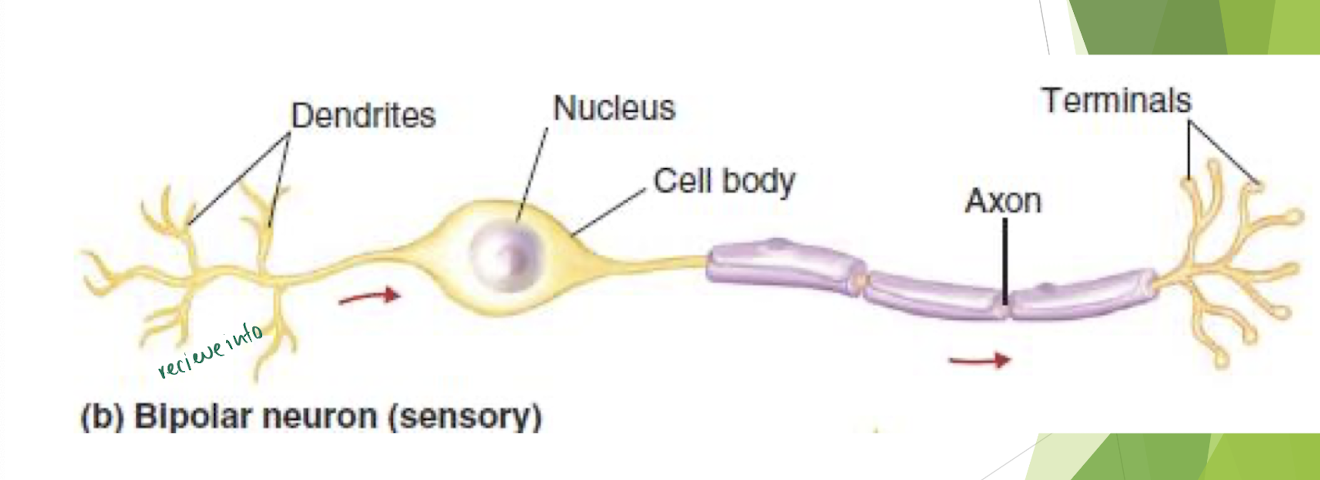
Neurons
= cells that convey sensory info to the brain, do operations within the brain & transmit commands to the body
polarized
movement, thoughts, memory, sensations
diff. shapes based on fxn
have cell membrane?
structure:
cell body
nucleus
dendrites - RECIEVE INFO
axon
axon terminals - SEND INFO TO NEXT NEURON
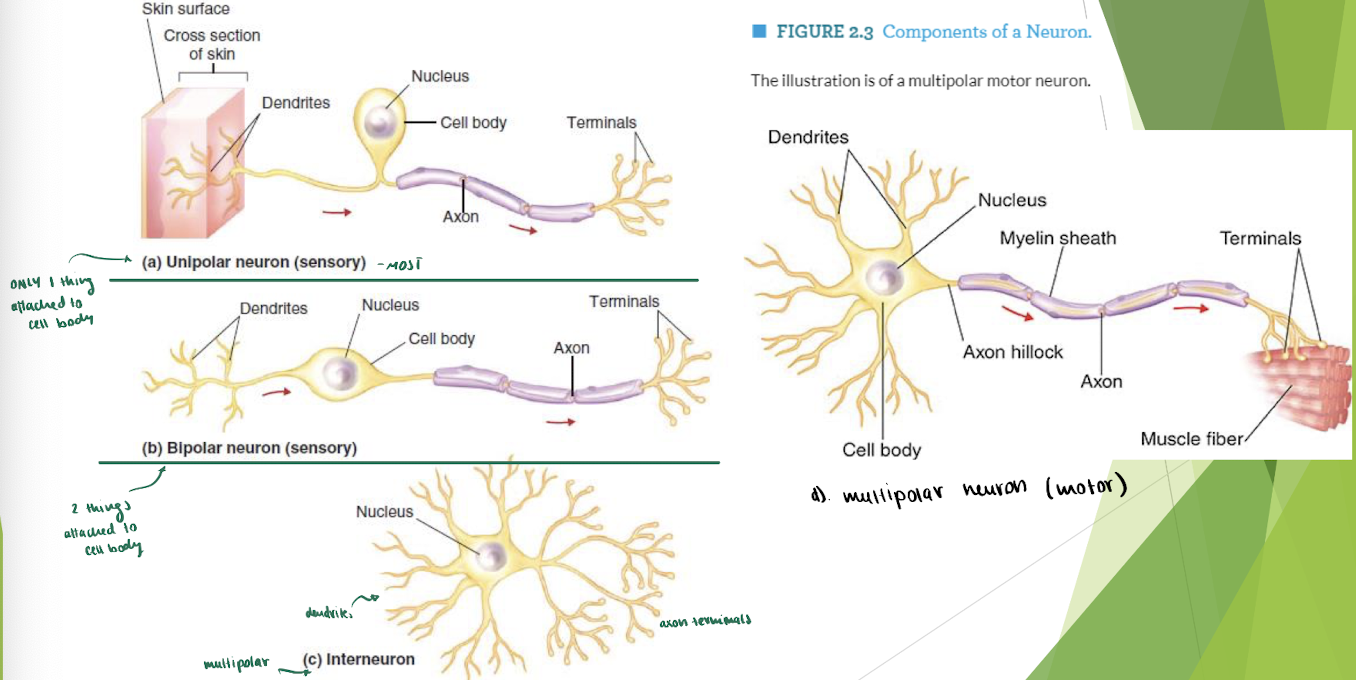
Neurons : Types (3)
motor neuron = carry commands to muscles & organs
bi/multipolar
PNS
sensory neuron = carry info from body/outside world (senses) to brain & spinal cord
uni/bipolar
PNS
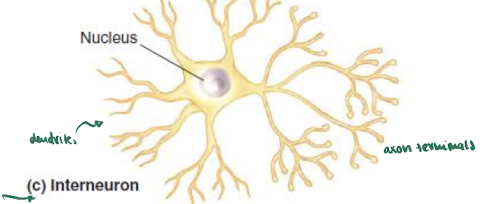
interneurons = connect neuron in same are of brain or spinal cord
the majority of our neurons
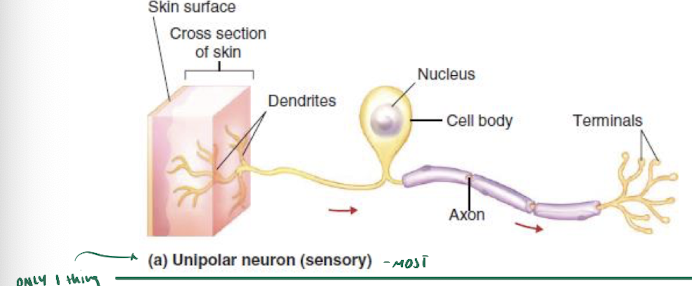
unipolar neuron
= only 1 thing is attached to cell body
sensory
most
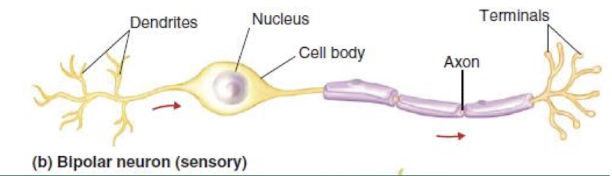
bipolar neuron
= 2 things attached to the cell body
sensory
multipolar neuron
= multiple things attached to cell body
motor
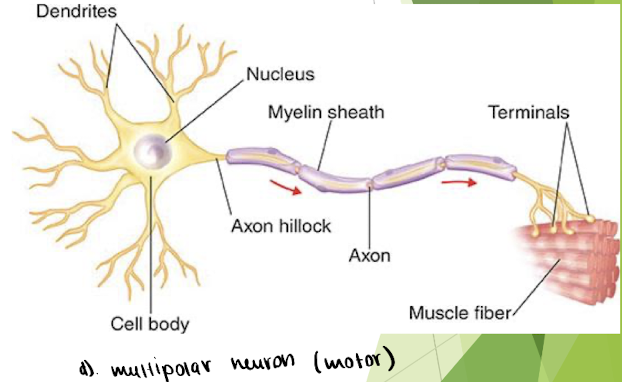
interneuron
multipolar neuron
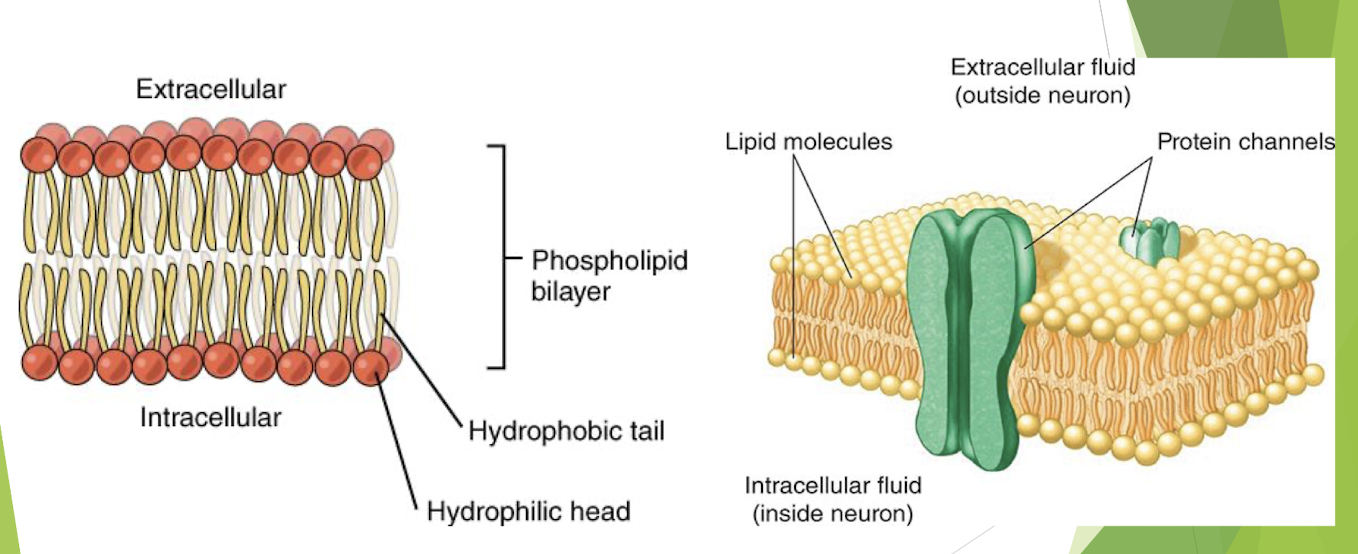
Cell membrane
Energy & the Cell membrane
Polarization = a difference in electrical charge b/w the inside & outside of the neuron
Voltage = difference in electrical charge b/w 2 points
Resting Potential = difference in charge b/w inside & outside of a neurons membrane at rest
neurons : -70mv (inside is MORE (-), than outside the cell)
a result of ions (atoms that lose/gain electrons)
NOTE: size of anions is responsible for the -70mv
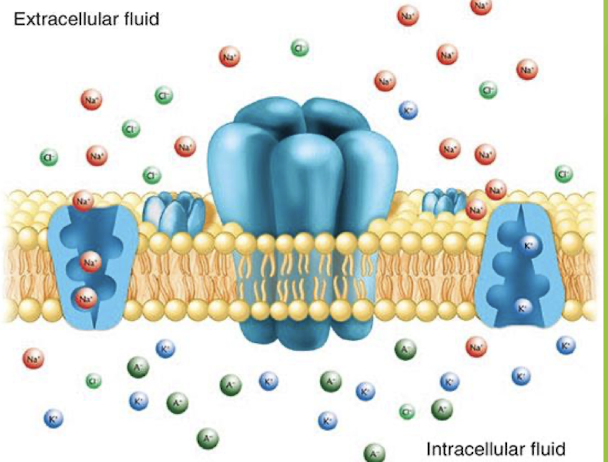
Resting Potential : What moves the Ions?
force of diffusion = tendency of ions to move thru membrane to less [ ] side
electrostatic pressure = force where ions are repelled from similar charges & attracted to oppositely charged
allowed with channels
Sodium potassium pump = protein molecule that moves 3 sodium ions outside the cell & 2 potassium ions inside the cell
against [ ] gradient
maintains -70mv
![<ol><li><p>force of diffusion = tendency of ions to move thru membrane to less [ ] side</p></li></ol><p></p><ol start="2"><li><p>electrostatic pressure = force where ions are repelled from similar charges & attracted to oppositely charged </p></li></ol><ul><li><p>allowed with channels</p></li></ul><p></p><ol start="3"><li><p>Sodium potassium pump = protein molecule that moves 3 sodium ions outside the cell & 2 potassium ions inside the cell</p></li></ol><ul><li><p>against [ ] gradient</p></li><li><p>maintains -70mv</p></li></ul><p></p>](https://assets.knowt.com/user-attachments/3c73bcaa-aa25-44a2-9a08-c180d247347c.png)
Ion Channels
= gated pores in the membrane, formed by proteins, that limit the flow of ions in/out of cell
found along ENTIRE neuron (chemically gated more common on dendrites)
chemically OR electrically gated
Chemically = by neurotransmitters or hormones
Electrically = by a change in electrical potential of the membrane
ex. closed at -70mv → must create a local potential to open
Depolarization : Local Potential
Local potential = partial depolarization, where an area’s polarity shifts twd 0
a graded potential → thus varies in magnitude w the strength of stimulus that produces it
THUS: more neurotransmitters → stronger signal → MORE depolarization
→ MUST meet threshold (ex. -60mv) to open ion channel
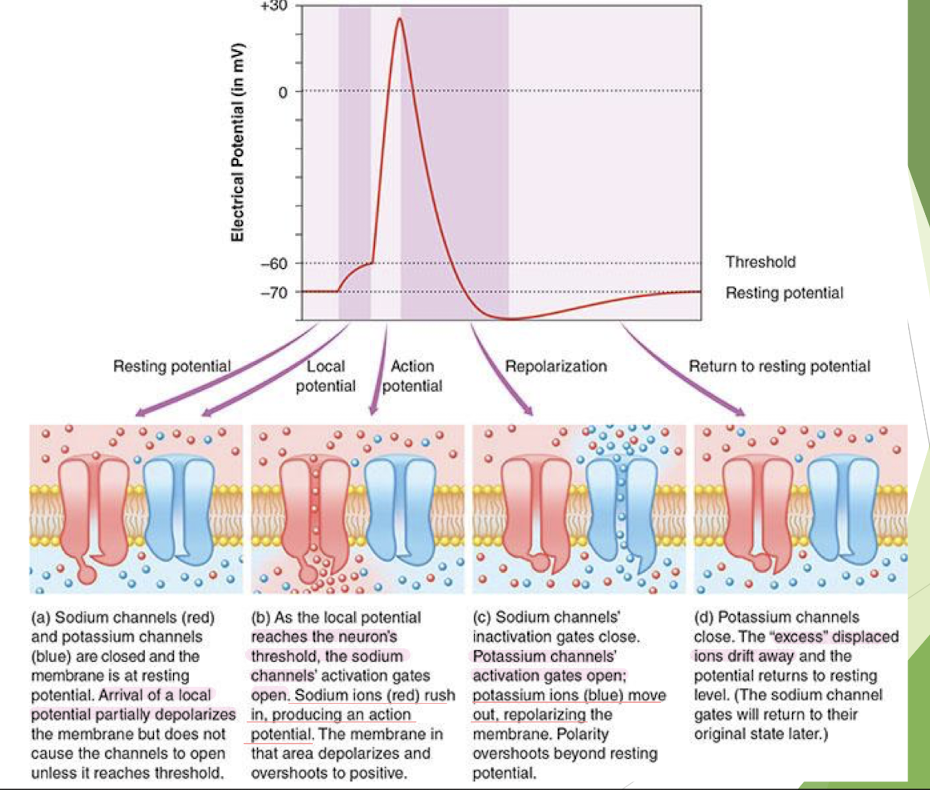
Depolarization : Action Potential
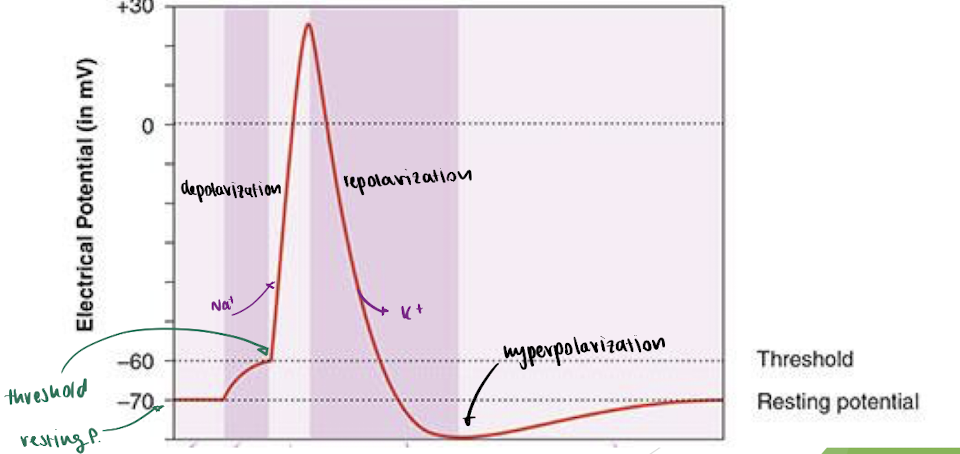
= abrupt depolarization of membrane, allowing neurons to communicate
occurs when the local potential (partial depolarization) exceeds the threshold for an electrically-gated channel
ex. Na+ floods cell, K+ leaves cell
an UNGRADED potential = occurs at full strength, or NOT at all (all-or-none law)
nondecremental → thus potential travels down axon w/o any decrease in size + is propagated at points along the way
Refractory Periods
Absolute refractory period = Na+ channels are Unresponsive to further stimulation → a new action potential CANT occur
Relative refractory period = Na+ channels could support another action potential, BUT the K+ channels are still open
a new action potential CAN occur, if the stim. can overcome the charge
Rate law
= axons encode the stimulus intensity by its FIRING RATE, NOT by the size of its action potential
HIGHER # of signals = higher intensity/ importance of signal
HIGHER rate = higher importance
Neurons : Myelination & conduction speed
Myelin = fatty tissue around axon to insulate it (faster)
keeps cells separate from extracellular fluid & other neurons
created by glial cells
Nodes of Ranvier = gaps in myelin sheath
Saltatory conduction = transmission of action potentials appearing to jump b/w nodes
Neurons : Benefits of Myelin Sheath
reduces capacitance (resistance) → makes it faster
capacitance slows down movement of ions across axon
signal regeneration at nodes
use less energy
Glial Cells
= NONneuronal cells that support neurons functioning
makes myelin
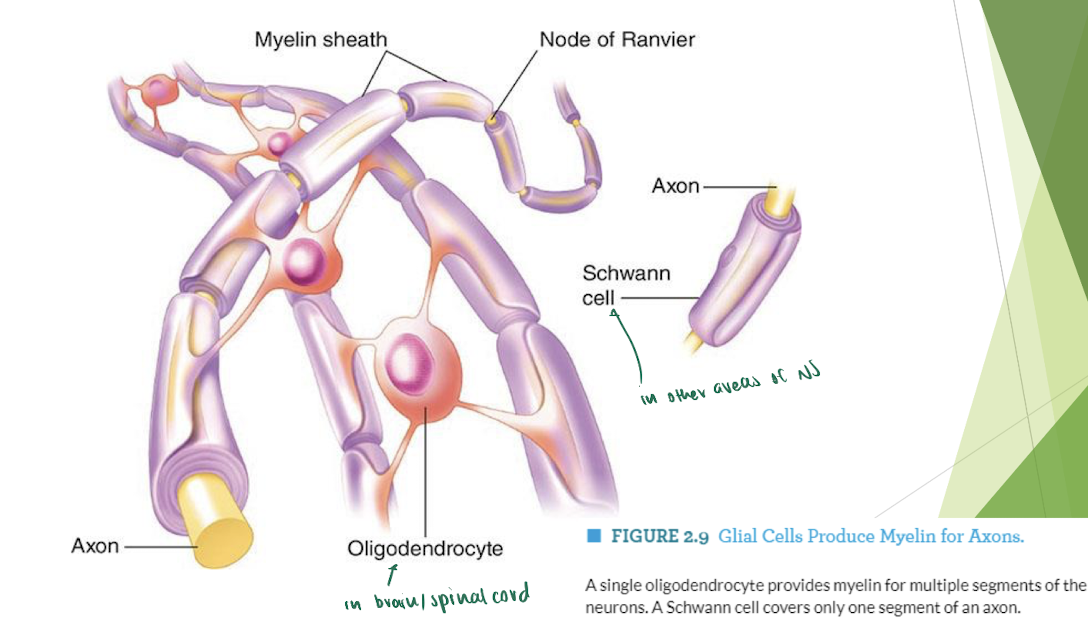
Glial Cells : Myelin-producing Glial Cells
2 types:
Oligodendrocytes = produce myelin in the brain & spinal cord (CNS)
can make multiple myelin sheaths
Schwann cells = produce myelin in the rest of neurons (PNS)
only makes one myelin sheath
Glial Cells : other functions - KNOW
Radial Glia = form scaffold that guide new neurons to their destinations - DURING fetal development
Microglia = provide energy to neurons + respond to injury and diseases by removing cellular debris
“brain immune system”
Astrocytes = trigger the formation of 7x as Manny connections in neurons
How neurons communicate
Synapse = connection b/w 2 neurons
Synaptic cleft = gap separating neurons, so they’re not in direct contact
Presynaptic = transmitting neurons (w axon terminals)
Postsynaptic = receiving neuron (w dendrites)
via : chemical transmission at the synapse → changes behaviour of another cell
1st shown by Lower in 1900s using a frogs vagus nerve
→ neurons release at least 2 diff. chemicals that have opposite effects
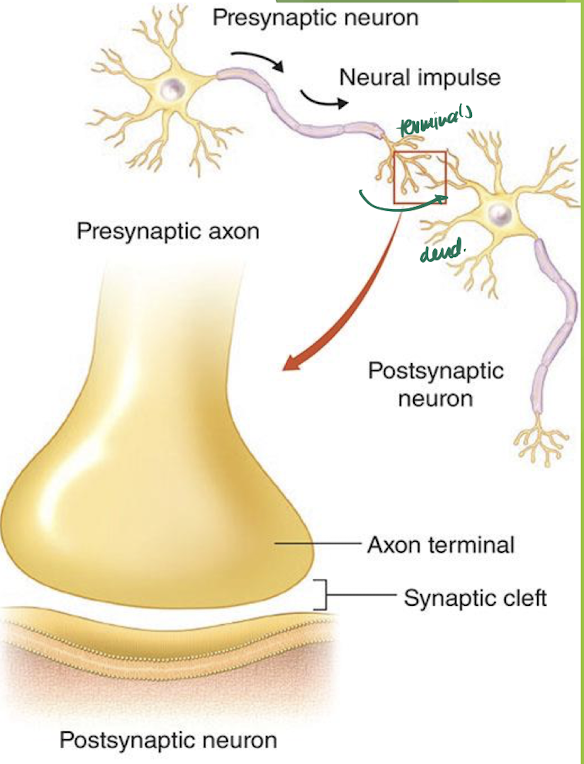
Neurons: Chemical transmission at the synapse
Vesicles = membrane-enclosed bubbles at axon terminals that store neurotransmitters
Ionotropic receptors = form the ion channel + open quickly to produce IMMEDIATE reactions
chemically-gated ion channel
opened by neurotransmitters - thus ions can enter/exit
Metabotropic receptors = open channels INDIRECTLY thru a second messenger
NOT ion channels
Neurons : Excitation & Inhibition
Excitatory Postsynaptic Potential (EPSP) = when receptors open Na+ channels to produce a partial depolarization of the dendrites & cell body
more (+) than resting
Partial depolarization = excitatory → facilitates occurrence of an action potential
Inhibitory Postsynaptic Potential (IPSP) = when receptors open K+ channels, Cl- channels or both to produce a hyperpolarization of the dendrites & cell body
more (-) than resting
Hyperpolarization = inhibitory → makes an action potential LESS likely to occur
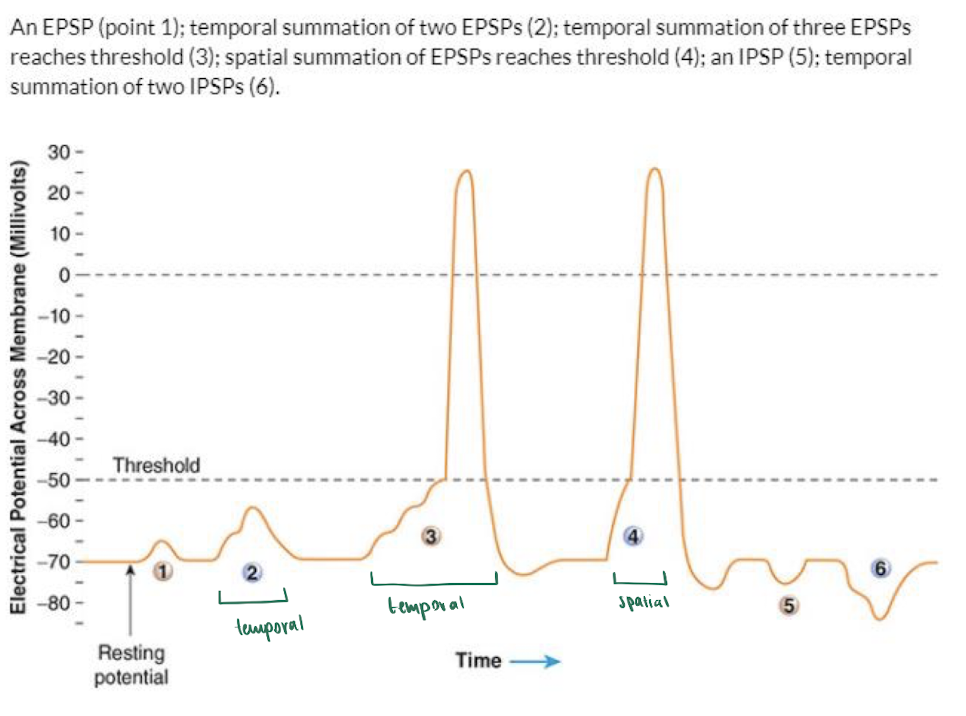
Neurons : Postsynaptic Integration
Spatial Summation = combines potentials occuring simultaneously @ different locations on the dendrites & cell body
Temporal Summation = combines potentials arriving a short time apart from the same/separate inputs
→ for both excitatory & inhibitory
Removing Neurotransmitters : Reuptake
Reuptake = transporter proteins take transmitters back into the axon terminals → repackaged into vesicles for reuse
NOTE: sometimes done by astrocytes (glial cell) instead
Regulating Synaptic Activity
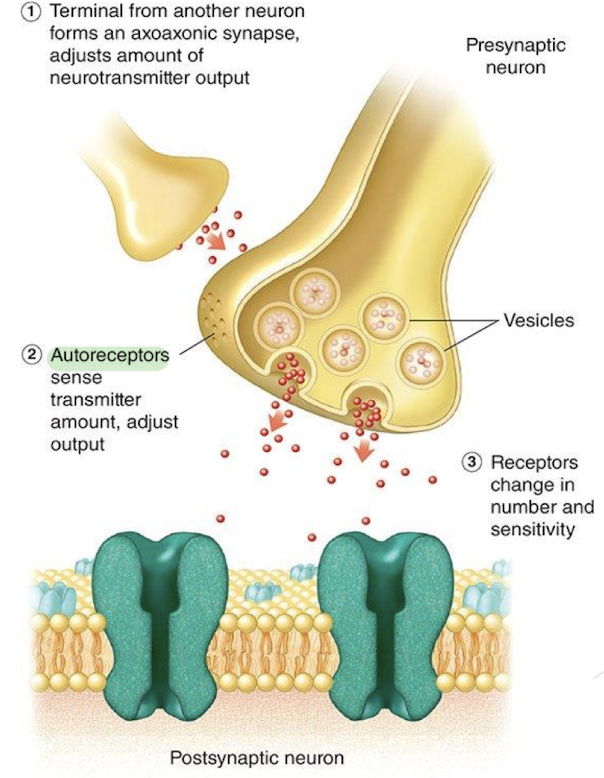
Presynaptic excitation = increases the presynaptic neuron’s release of neurotransmitters to the postsynaptic
Presynaptic inhibition = decreases the presynaptic neuron’s release of neurotransmitters to the postsynaptic
Autoreceptors = receptors on presynaptic terminals, that sense the amount of transmitter in cleft
Neurotransmitters : false beliefs
Dale’s principle = FALSE belief that a neuron could ONLY release one transmitter
Neurotransmitters: Release
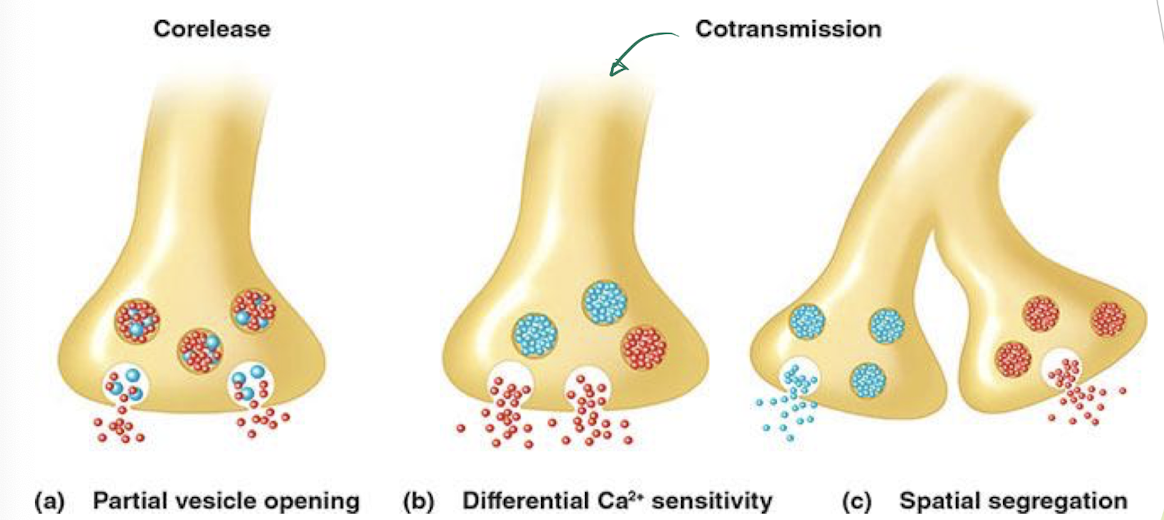
Corelease = SAME vesicle of a terminal + MULTIPLE transmitters
Cotransmission = multiple transmitters in SEPARATE vesicles of a terminal
Spatial Segregation = multiple transmitters in SEPARATE vesicles are released from DIFF terminals
→ multiple neurotransmitters can be released from a neuron
Neurotransmitters: Differential Ca2+ sensitivity
Ca2+ enters terminal → neurotransmitters are released
diff amounts of Ca2+ = diff neurotransmitters released
Neural Codes + Neural networks
Neural code = varied intervals b/w spikes in nerve signals
timing of signals + differ b/w pathways
Neural network = groups of neurons that function together
Human Connectome project = effort to map the brain’s circuits
In perspective
impossible to understand the brain, or the behaviour it produces w/o understanding a neurons limitations & capabilities
modern tools + cooperative efforts are the key to moving fwd in biological-psych research