componets of a computer system
 Call Kai
 Learn
Learn Practice Test
 Spaced Repetition
 Match
Match Flashcards
 Knowt Play
1/24

There's no tags or description
Looks like no tags are added yet.
Name | Mastery | Learn | Test | Matching | Spaced | Call with Kai | Chat |
|---|
No analytics yet
Send a link to your students to track their progress
25 Terms
What’s the purpose of a computer?
It takes data, processes it then outputs it
(Created to help complete tasks more efficiently than humans)
What’s hardware?
Physical stuff that makes up your computer
What’s softwear?
The programs or applications that the computer runs
General purpose vs dedicated systems (list their definitions)
general purpose: designed to perform many tasks
Dedicated systems: one peculiar function
What are embedded systems? &
they are computers built into other devices (eg dishwashers)
Usually dedicated systems
Used as control systems: monitor & control machinery for desired result
what are the benefits of embedded systems?
Since they are dedicated to a single task, they are :
easier to design
Cheaper to make
More efficient at doing task
List 3 system softwares
encryption
Compression
Encryption
CPU full name & list it’s function
brain of computer system
Carries out instructions
Fetch-execute cycle
What is CPU architecture? & list example
main components of CPU & how they interact with each other
Example: Avon Neumann
What are the components of the CPU?
control unit
Cache
Registers
ALU
Register function & characteristics
def: holds tiny bits of data needed by the CPU
Super quick to read/write to
List all registers in the CPU
program counter
MAR
MDR
accumulator
Function & full name of the CU
control unit
Mange the fetch-execute cycle
Control flow of data inside CPU to registers
& outside to main memory
Function & full name of the ALU
arithmetic logic unit
Does all calculations & makes decisions
Contains accumulator
Function of the cache
Provides fast access to frequently used instructions and data (memory) (in CPU)
slower than registers & faster than RAM
Low capacity & expensive
Check cache first before RAM
Located near CPU
What is the von Neumann’s architecture?
where the CPU runs programs stored in memory
Programs: instructions and data which are stored in memory addresses.
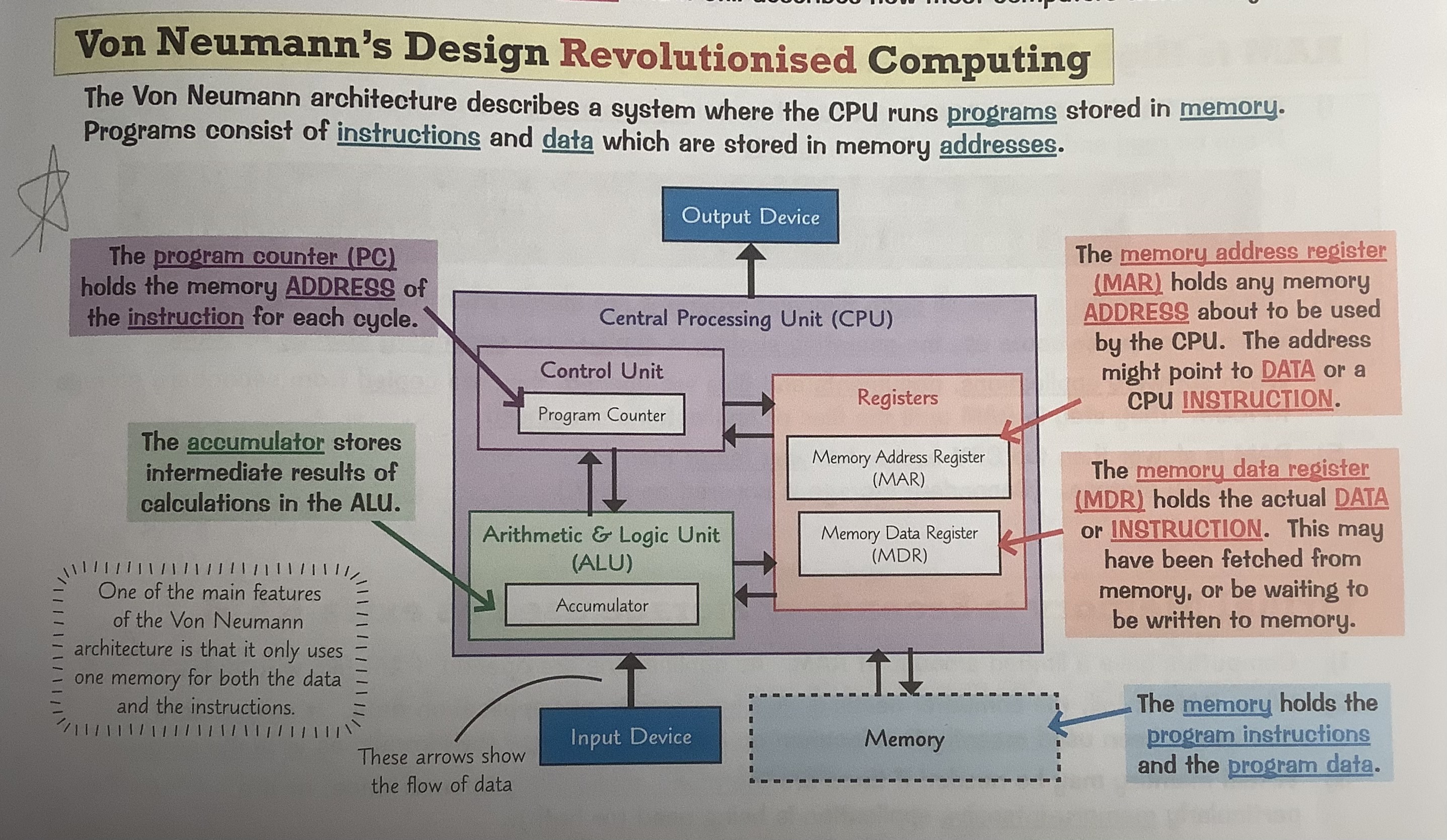
Function & full name of the PC
program counter
Register found in the CU
hold address of the next instruction
Function & full name of the MAR
memory address register
holds address of where data or a CPU function needs to be fetched and stored
Register
Function & full name of the MDR
memory data register
Holds actual data or instruction fetched from or written in memory
Register
Function of the accumulator
A register found in ALU
Stores results of calculations
Explain the fetch-execute cycle
Copy memory address from the program counter to the MAR
Copy the instruction stored in the MAR address to the MDR (instruction gotten from RAM)
Increase the program counter to point to the address of the next instruction ready for next cycle
The instruction in the MDR is decoded by the CU
instruction in executed
what affects CPU performance?
Clock speed
Cache size
Number of cores
What is clock speed?
measured in hertz
Number of cycles per second
(Cycles = how many instructions can be fetched per sec)
What is core size & how does it affect CPU?
Complete copy of CPU (registers, ALU, CU, etc)
E.g Quad-core processor = 4 cores
Doubling a number of course doesn’t double the overall speed (can carry out more instructions)
CPU cores have to communicate with each other → takes time
Many programs are not designed to use multiple cores
Full name & function of GUI
graphics processing unit
Handles graphic and image processing
Integrated onto mother board
(High end graphic card and improve performance in graphics intensive applications)