le chatalier principle + Qc + Solubility
 Call Kai
 Learn
Learn Practice Test
 Spaced Repetition
 Match
Match Flashcards
 Knowt Play
1/10

There's no tags or description
Looks like no tags are added yet.
Name | Mastery | Learn | Test | Matching | Spaced | Call with Kai |
|---|
No analytics yet
Send a link to your students to track their progress
11 Terms
to get maximum amount of products…
dependent of reaction conditions
how can yield of product be changed
changing concentration of products/reactants in reaction vessels
changing the pressure (aka size of vessel)
change temp. More heat on the right = more reactants, vice versa
catalyst in the chatalier
only affects the rate at which equilibrium is reached, NOTTT composition
chatalier’s principle
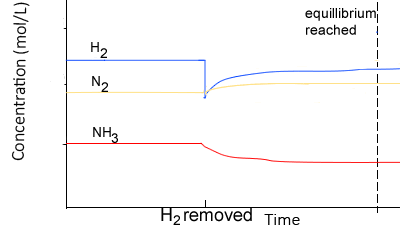
placing a stress on an equilibrium causes the equilibrium to shift so as to reduce the stress
eg. N2 + 3H2 → 2NH3
if more H added at equilibrium, system will react to reduce the change → decrease in reactants, increase in products
reaction quotient (Qc)
calculated the same way as Kc, except Qc is not at equilibrium (uncertainty)
once Qc calculated, it will show which way reaction will go; follows le chatalier
Qc=Kc
equilibrium
Qc > Kc
reaction go left
Qc < Kc
reaction go right
Qsp > Ksp
solution = super saturated. NOT at equilibrium → precipitate forms
Qsp = Ksp
solution = saturated, IS AT equilibrium. no changes visible
Qsp < Ksp
solution = unsaturated, NOT at equilibrium. More solute able to dissolve