Ch 30 - Radiation Oncology - special procedures
 Call Kai
 Learn
Learn Practice Test
 Spaced Repetition
 Match
Match Flashcards
 Knowt Play
1/34

There's no tags or description
Looks like no tags are added yet.
Name | Mastery | Learn | Test | Matching | Spaced | Call with Kai |
|---|
No analytics yet
Send a link to your students to track their progress
35 Terms
what are 3 ways to treat cancer
- surgery
- chemotherapy
- radiation therapy
cancericidal
cancer-killing dose
fractionation
delivery of a small dose daily until the entire treatment dose is reached - reduces toxic effects of radiation
what percent of cancer patients are still being treated with radiation
75%
What is the role of a medical dosimetrist
creates a plan for delivering the treatments in a manner to best meet the physician's goals of irradiating the tumor while protecting normal vital structures
what is the role of a radiation therapist
obtain radiographs or CT to localize area to be treated
keep accurate records of the dose delivered each day
administer the treatments
monitor patient's wellbeing
what are the 3 steps to prepare a patient for treatment
- simulation
- develop an optimal treatment plan in dosimetry
- treatment delivery
cancer
unregulated, uncontrolled replication of cells
metastasis
spread of cancer from the original site to different parts of the body
most common cancers in men
- prostate
- lung
- colorectal
- bladder
- skin
most common cancers in women
- breast
- lung
- colorectal
- uterine
- thyroid
carcinogen
A cancer-causing substance
what is the classification system used for cancer
TNM - tumor, node involvement, metastasis
What are LET and RBE
linear energy transfer
relative biologic involvement
if you increase LET you increase RBE
Linear energy transfer
as radiation goes through the body, some of its energy is transferred
law of bergonie and tribondeau
the effectiveness of radiation depends on the state of the biologic system
cells are most sensitive to radiation when they are immature, undifferentiated, and rapidly dividing (during mitosis)
Why are cancer cells more sensitive to radiaiton
they have a higher metabolic rate
more active = more sensitive
What is CIS
carcinoma in situ
not cancer but abnormalities are present
external beam therapy
patient lies under and external source of radiation - most common form of treatment
brachytherapy
technique where radioactive materials are implanted into the the patient - achieves a higher dose to the tumor
what is the most commonly used machine for cancer treatment
linacs (linear accelerator)
photon beam is produced by accelerating a stream of electrons toward a target
the radiation beam can be composed of what two things
photons or electrons
what is the advantage of using electrons
the are more superficial and deposit their energy at a certain depth and go no deeper
isocentric/isocenter
maintains the same distance from the patient at all times - 360*
isocenter - point of intersection of the three axes of rotation
skin-sparing effect
phenomenon that occurs as the energy of the beam of radiation is increased
the greater the energy of the beam, the more deeply the maximum dose is deposited - sparing the radiosensitive organ of the skin
multileaf collimation
most complex beam-defining system
45 to 80 individual collimator blades that can be adjusted to shape the radiation field to conform to the target
VMAT
IGRT
intensity-modulated gated radiation therapy
tolerance dose
dose each organ can receive and still function normally
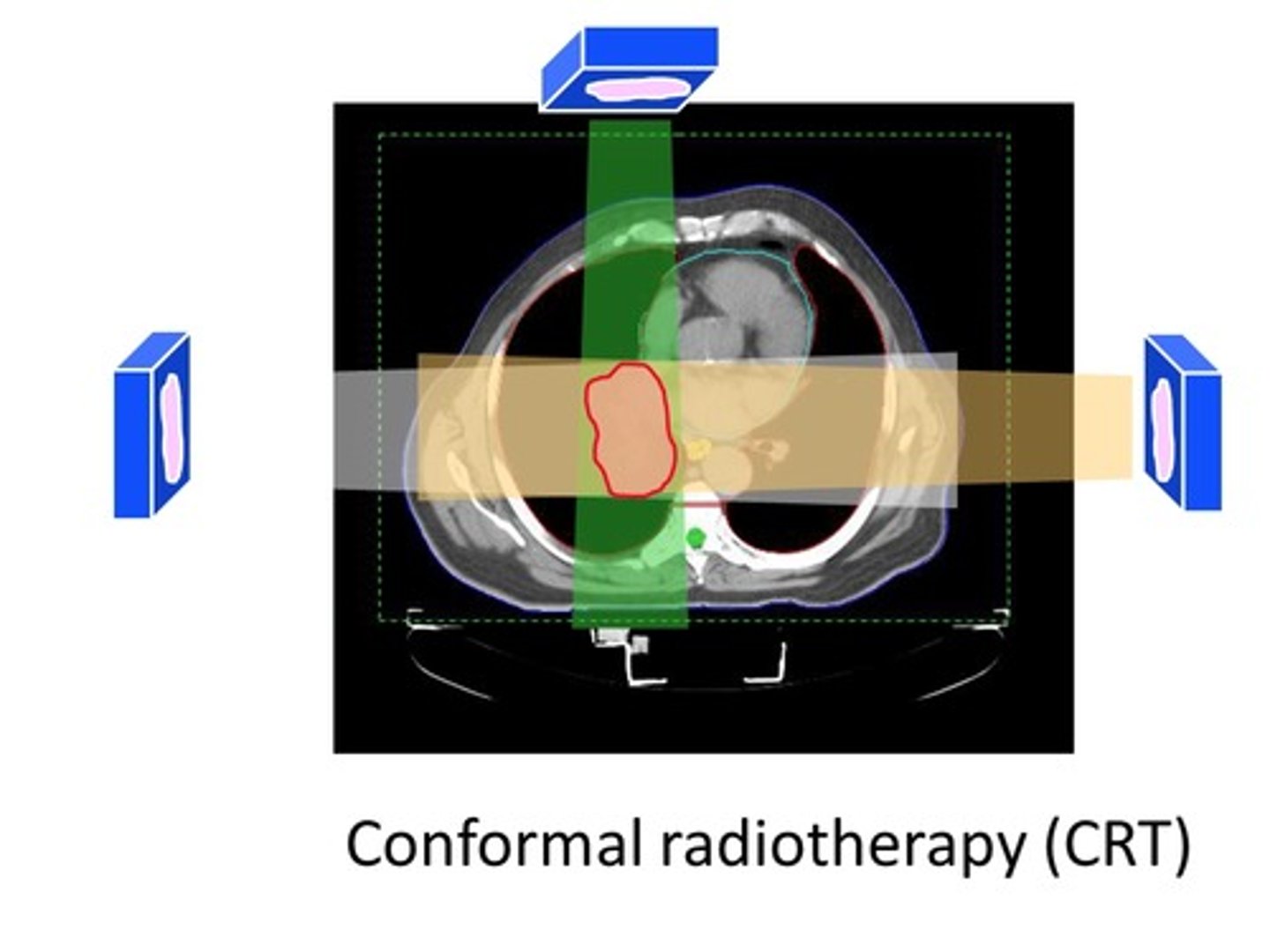
what does three-dimensional conformal radiotherapy allow
allows the dosimetrist to plan and design beams that are coplanar and noncoplanar - tightly conforming to the target/tumor volume
Bragg peak
the burst of energy deposited at a specific depth (80% of energy is deposited into targeted tissue and quickly drops to 0 in mms)
property of a proton beam
can be adjusted by changing the energy of the proton beam and adding beam modifiers
PBS
pencil beam scanning
what is the most current method of proton beam delivery
PBS - pencil beam scanning
delivers a more conformal dose distribution to the tumor than passively scattered particle therapy and allows for modulation of the intensity
what are some advantages of pencil beam scanning
- almost no exit dose - preferred for pediatric imaging
- lower dosage to normal tissues
- less risk of secondary malignancy
Still learning (33)
You've started learning these terms. Keep it up!