Topic 1: Nucleic Acid and Protein Structure
 Call Kai
 Learn
Learn Practice Test
 Spaced Repetition
 Match
Match Flashcards
 Knowt Play
1/61

There's no tags or description
Looks like no tags are added yet.
Name | Mastery | Learn | Test | Matching | Spaced | Call with Kai |
|---|
No analytics yet
Send a link to your students to track their progress
62 Terms
What are the 3 main functions of DNA?
1. Stores information
2. Replicates faithfully (preservation of information)
3. Has ability to mutate (variability of information)
What do we need to make a functional RNA?
4 letters ATGC
So we need 3 or more to make AA
Info carried by base sequence
1 nuc can only make 4 types of AA
2 nucleotides can be 16 types
3 nucs can make 4^3 = 64
4 can make 4^4 = 256.
How do we know we need 3 or bases to make amino acids?
mixed synethic dna w AAA to find out its always 3 or more
What type of info does dna carry?
coding for which proteins/diff rnas like trna/rrna etc
regulatory signals/binding sites
How does DNA’s physical structure allow it to store information?
Base sequence = information
Bases inside protected by backbone
Double helix keeps info stable
How does DNA’s structure let it replicate faithfully?
Complementary pairing (A–T, G–C)
Each strand = template
Hydrogen bonds allow easy separation
How does DNA’s structure let it mutate?
Sequence can change
Replication errors
Damage to bases (UV, chemicals)
Why does the order of bases matter?
Order sets codons
Codons set amino acids
Amino acids set protein function
How do we know DNA is the hereditary material?
DNA transfers traits, stores information, replicates, and directs protein synthesis
What did Avery, MacLeod & McCarty (1944) show?
DNA transforms bacteria
Only DNA (not protein) transferred traits
First strong proof DNA = genetic material
What did Chargaff (1947) discover?
A = T, G = C
Suggested base pairing → DNA has structure suitable for coding
What did Watson, Crick & Franklin (1953) show?
Double helix model
Structure explains information storage + copying
What did Meselson & Stahl (1958) demonstrate?
Semi‑conservative replication
DNA copies itself in a predictable, heritable way
What did Crick, Nirenberg & others (1965) discover?
Genetic code (triplet codons)
Showed how DNA → RNA → protein
What is the central dogma?
info flows from dna → rna → protein.
Why is RNA made?
Rna made to protect dna (original copy)
more copies = more opportunities to replicate.
Can RNA ever synthesize back to DNA?
Yes.
RNA virus (retrovirus, replicate dna) → major issue w rna.
Why can RNA bend but not DNA?
Rna can bend bc ss
Not dna bc dsdna
If there is a knick in rna = dead
if there is a knick in dna = ok bc ds so its more stable
Can protein ever reverse back to RNA?
No.
only rna can reverse back to dna.
What causes cancer from viruses?
retroviruses
What is a gene?
entire DNA sequence necessary for production of functional protein or RNA
What do regulatory sequences do?
act as signals or binding sites
Which strand makes the protein?
Sense/coding/nontemplate strand codes for the protein.
Which strand makes the strand that makes the protein?
antisnense/template/non-coding strand makes the sense strand which makes the proteins.
The DNA strands are…? (3)
have polarity (bc sense antisense go in opp directions)
complementary
antiparallel
How do the 2 original strands make new daughter strands?
two strands of a parental DNA separate and each
template for daughter strands by complementary base pairing
Why is DNA double-stranded?
bc one is an imprint/copy of the other
replicates semiconservatively
What type of information do the strands keep when replicated?
only keeps infor for one strand
the other makes a complementary version of it
What are the 3 models of replication that were proposed?
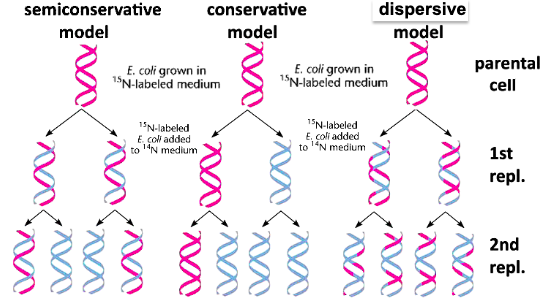
Explain how the Meselson-Stahl experiment was conducted. (9)
Grow E. coli in heavy nitrogen (^15N)
All DNA becomes “heavy” because it contains ^15N atoms.
Move the bacteria to normal nitrogen (^14N)
New DNA strands made now contain ^14N (lighter).
Extract DNA and spin it in CsCl solution
When centrifuged, DNA separates by density:
Heavy DNA (15N–15N) sinks lower.
Light DNA (14N–14N) stays higher.
Hybrid DNA (14N–15N) sits in between.
What were the results of the Meselson-Stahl experiment?
Before transfer: only heavy DNA (15N–15N).
After one generation: all DNA was hybrid (14N–15N)
one old heavy strand + one new light strand.
After two generations: half hybrid (14N–15N), half light (14N–14N).
What did the pattern from the results of the Meselson-Stahl experiment mean?
Each new DNA molecule keeps one old strand and makes one new strand → semiconservative replication.
Information is preserved.
What happens if there is a mutation in ONE of the parental strands?
Would change the information on the strand and the daughter strands would be replicated using the wrong bases/wtv the mutation is.
What are the 4 types of mutations that can arise?
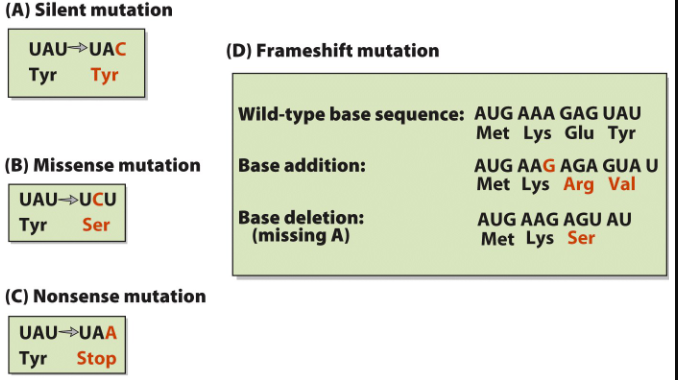
What happens if there is a mutation in the coding sequence?
change in AA —> possible alteration in protein product
What is colinearity of genes?
Sequence of 3 DNA bases (a codon) codes for a single amino acid.
1st codon in the DNA translates to the 1st amino acid in the protein, the 2nd codon to the 2nd amino acid, and so on.
What happens if a promoter is mutated?
Too little transcription
Too much transcription
Gene may turn off or on inappropriately
What happens if UTRs (5’ or 3’) are mutated?
mRNA stability changes
Translation efficiency changes
Protein levels go up or down
What is the overall consequence of regulatory region mutations?
change gene expression, not the protein
Often more harmful than coding mutations
Why are mutations important?
results in formation of new alleles'
Source of genetic variation
What can mutations change?
Altered product (protein/RNA)
No product (knockout)
Altered regulation (regulatory sequence)
How do mutations lead to evolution?
Mutations + selection → evolution
Beneficial changes spread in populations
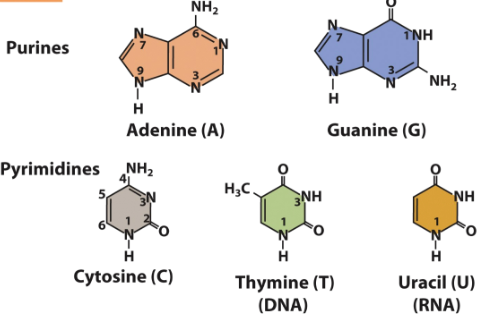
What are the 5 diff nitrogenous bases?
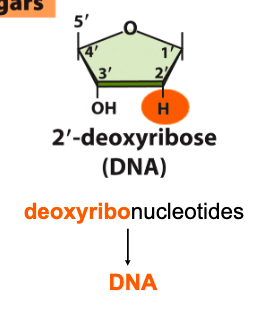
What type of sugar do DNA molecules have?
What type of sugar do RNA molecules have?
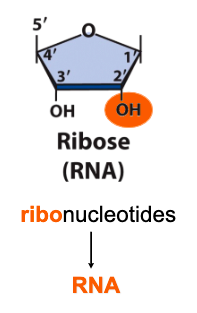
What is a nucleoside?
sugar + base
What is a nucleotide?
sugar + base + phosphate complex
What are the nucleosides called in DNA?
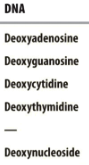
What are the nucleosides called in RNA?
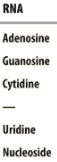
What are covalent bonds?
sharing electrons to become stable
What are non covalent bonds?
ionic (witin molecules),
H-bonds = particle positive charge
LDFs all mols have
hydrophobic (some mols would rather interact with eo and not w the water)
What is uracil?
Uracil is demethylated Thymine.
exists in RNA.
What determined that purines have 2 rings and pyrimidines have single rings?
Width determines # of rings
so can have 3 across (1 purine +. 1 pyrimidine)
What ensures that only A bonds with T/U and G bonds with C?
hydrogen bonds.
CG = TB, AT = DB
What is a polypeptide chain?
nucleotide attaches to eo to make a long chain of nucleotides.
What is chargaffs rule?
#pur is same as #pyr. But (A+T is not equal to G+C)
Which bases are more abundant in the promoter sequence?
more A+T