Microbiology Ch 4. 1-4.6
 Call Kai
 Learn
Learn Practice Test
 Spaced Repetition
 Match
Match Flashcards
 Knowt Play
1/60

There's no tags or description
Looks like no tags are added yet.
Name | Mastery | Learn | Test | Matching | Spaced | Call with Kai |
|---|
No analytics yet
Send a link to your students to track their progress
61 Terms
A cell wall and some form of glycocalyx are found in ___ bacterial cells
most
Three structures of bacterial cells are:
Cell Membrane, cytoplasm, ribosomes
Microbes act as a group when?
When assembled in a biofilm
Which of the following makes bacteria and archae different from eukaryotes?
They lack a nucleus
Size of bacterial cells;
1 um, (micrometer)
Interna structures of bacterial cells
Ribosomes, inclusions, Nucleoid
Common Shapes found in bacteria;
Coccus, rod and spirillum
Mycoplasmas are pleomorphic because they lack cell walls and thus display extreme variations in shape.
True
A complex grouping of cells arranged in a cubical packet of 8,16 or more is called
Sarcina
Choose prefixes that may be used to describe arrangements of bacilli
strepto and diplo
Planktonic bacteria:
Live as single cells, not in biofilm communities
In a stratified biofilm
Aerobes are found NEAR the surface while anaerobes are found near the bottom
A Palisades arrangement
formed when cells of a chain remain partially attached at the ends; folding into side by side rows
Planktonic
Bacteria that live as single cells
Biofilms are stratified meaning that
different microbes occupy spaces that best fit their environmental needs
Fimbriae, flagella and pill are all examples of (blank) structures found in some bacteria
External
Prefixes bacilli;
Diplo and Strepto
Planktonic bacteria
live as single cells, not in biofilm communities
Appendages that propel bacterial cells through aqueous include;
axial filaments and flagella
Appendages provide motility
-Flagellum
-Axial filaments
Biofilms correct statement
DNA Molecules may be present in biofilms as an attractant to more cells
External Structures in bacteria
Extrernal
+ ( chemotaxis)
To move towards a chemical attractant by flagellar motion
Flagellum causes a bacterial cell to swim or (blank) towards a stimulus, interrupted by clockwise rotation in which the cell (blank) and changes its course
run, tumbles
Phototaxis
Some photosynthesis bacteria move by flagellar motion in response to light during this time.
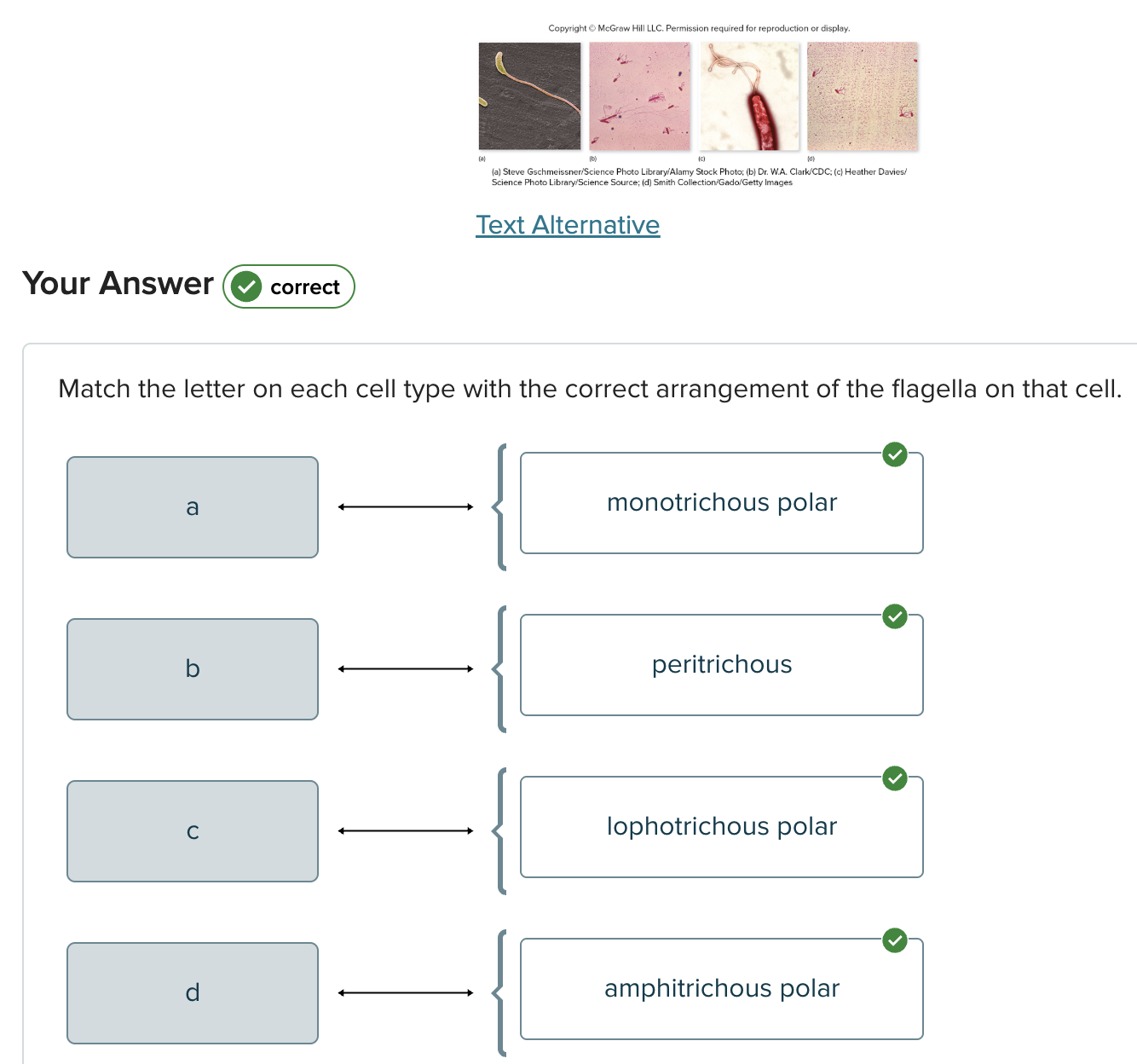
Match the letter on each cell type with the correct arrangement of the flagella on that cell
Nanowires
Very thin, long tubular extensions of the cytoplasmic membrane used by bacteria to transfer food between one another
Phototaxis
When bacteria move in response to a light source
Bacterial S layer
S layer is rarely observed in cell grown in lab rich in medium
S layer consists of thousands of copies of a single protein
Fimbriae Function:
Sticking to cells and other surfaces
Nanowires are used for (blank) between neighboring bacteria cells:
Transferring amino acids
Shuttling electrons
S layer surrounding bacterial cells is comprised of;
protein
Fimbria
Adhesion
Glycocalyx consists of;
Capsules and Slime layers
Cell Envelope;
cell wall, cytoplasmis membrane and the outer membrane
Cell wall in bacteria is composed of
peptidoglycan
Cell wall functions
preventing destruction with changes in osmoric pressure
maintaining the shape of the bacterium
Peptidoglycan is a component of the cell wall in;
bacteria
Teichoic and Lipochoic
Functions for cell wall maintenance and contribute to acidic charge on the cell surface
Teichoic and Lipochoic acids are (blank)
Polysaccharides embedded in the cell wall of gram positive bacteria
Mycolic acid functions
It reinforces the cell wall and makes the bacterium resistant to certain chemical and dyes
Which stain technique allows differentiation of mycobacterial cells
Acid-fast stain
Major structural component of the cell membrane are (blank)which form a bilayer and has 30-40% of membrane mass
Lipids
All bacteria possess a cell (blank) but not all bacteria possess a cell (blank)
membrane, wall
Which is a selective barrier between the internal and external contents of the cell?
Cell membrane
Components of cell membrane
Proteins
Lipids
Which of the following describes the primary function of cell membrane
Form a barrier between the internal and external content of the cell
Only gram (blank) possess an outer membrane
negative
Porins
Control access to the inside of the cell
Which cell structure is responsible for synthesizing protein
Ribosome
Organic and inorganic nutrients can be stored in bacterial cells in cytoplasmic (blank)
Inclusions
Density of the ribosome in bacteria is
70’s
Ribosomes are located where?
In the cytoplasm of bacteria
Plasmids
An extrachromosomal circular piece of DNA that contains genes not essential for cell growth
Metabolocally active and reproducing cells and nutritional shortages are metabollically inactive some bacteria produce
Vegetative cell and an endospore
Extremophiles
Methanogens
can convert CO2 and H2 into methane gas
3 advantages of endospores formation
Highly resistant to radiation and heat
More resistant to antimicrobial agents
Provides protection in dry conditions
Halophiles
Archaea requre high salt concentrations in order to grow
Which group of archaea grow at very low temperatures
Psychrophiles
Gram stain steps in order;
1.) Crystal violet
2.) Gram’s Iodine
3.) Alcohol
4.) Safranin ( red-dye)