Public policy midterm
 Call Kai
 Learn
Learn Practice Test
 Spaced Repetition
 Match
Match Flashcards
 Knowt Play
1/129

There's no tags or description
Looks like no tags are added yet.
Name | Mastery | Learn | Test | Matching | Spaced | Call with Kai |
|---|
No analytics yet
Send a link to your students to track their progress
130 Terms
What is public policy?
“The sum total of government action, from signals of intent to the final outcome”
Why is framing so important?
sets the way that policymakers and constituents look at a certain problem, often done through rhetoric and using language intentionally and selectively to portray issues.
Framing rests on these four factors:
using shortcuts to turn large pieces of info into signals people pay attention to
People value the things they own (losing costs more than not gaining)
People rely on others to make decisions for us
The order in which we process information affects us
Frames are…
structures that hold up the policy world, regular patterns of behaviors
two kinds of framing
Framing to persuade vs. framing for deliberation. The difference is the second one wants to bring people into the conversation.
two types of framing for deliberation
honest vs. dishonest. One presents all the information leading you to make your own decision. The other presents limited information intentionally.
The policy cycle
Problem definition
Agenda setting
Policy formulation
Legitimization/enactment
Implementation
Evaluation
top-down vs. bottom up approaches to policymaking
Top-down: What does a policy need to succeed (start at the top- I want to make this policy)
Bottom-up: How can we address actual issues? (start of bottom- what needs to be solved)
punctured equilibrium theory
policy change doesn’t happen a lot for a long time, followed by little bursts of lots of activity
Policy drift
The existing policy slowly becomes inapt because of social and political changes
Factors associated with policy change
context
Focusing events
Public opinion
learning
diffusion of ideas/laws
champions and political associations
good problem definition…
works to solve problems, not find them
focuses on actual results, not just tangible ones
brings in multiple disciplines
is clear and actually solvable
participatory problem definition
concise and clear statement of problems essence and the people it most effects
five steps for problem definition
What the problem is
When and were it occurs
whom it affects
why it occurs
why it matters
How to articulate problems:
Make sure it is not a solution in disguise
avoid vague generalities
avoid complex jargon
Lasso-ing
Is it Limited?
Can it be Acted on?
Is it Specific?
Will it be Supported?
Who is the problem Owner?
Collective action problems
A problem where individual actions may not produce the best outcome for he or she
Three broad rationals for public problems
Market failure
Social failure
government failure
Two uses of evidence in policy making
Descriptive: using evidence to support policy
Prescriptive: using evidence to solve all issues of policy making, mostly ignoring constituents and focusing only on evidence
Comprehensive rationality/ synoptic rationality
The idea that law-makers will work perfectly together to solve an issue, foreseeing all possible effects of implementing a certain policy
How evidence should be used in policy making and why:
in a bottom-up approach, consulting wide range of interest groups and public bodies, to create a wide “ownership of issue”
Inductive reasoning
using logical assumptions to fill in gaps of information
What are the issues with inductive reasoning?
it leads constituents to think they know more about a policy than they actually do, leaving room for misconceptions
What makes people use inductive reasoning?
informational utility and how it relates to inductive reasoning
people are more likely to engage in a piece of media if it will help them respond to its environment, people are more likely to inductive reason on policy they feel like influences them
How does inductive reasoning form misconceptions?
Want to place blame
partisan rhetoric
“taxonomic similarity”- draw on similar things you know
Elite misinformation
Not only is the public misinformed but the government is also misinformed sometimes
How do we know things? (information ecosystems)
anecdotal evidence- our own lived experience
inductive reasoning
Empirical evidence- evidence from collected facts
Who do we consider policymakers?
elected and unelected people in the government; organizations
System 1 vs. system 2 thinking
system 1: happens instantly and reactionarily, not much voluntary control
system 2: effortful mental activity
conformation bias
the tendence for us to look for evidence to support what we already believe
bias to belief
we are more likely to believe, as unbelief requires system 2 thinking
availability bias
the availibility of information on one subject makes it seem more likely
Halo effect
like one thing about somebody, like everything aabout them
availability cascade
ignoring the likely (safe) outcomes because you are overwhelmed by the less likely (scary) outcomes
WYSIATI ("What You See Is All There Is")
Latching onto the first piece of information and not considering what information we might be lacking
public vs. experts view of risk
The public has deeper consideration for risk, while experts mainly care about numbers or stats.
Engrossment effects our:
Attitudes- What we feel toward a topic
Beliefs- what we believe about a topic
interests- how intensely we focus on a topic
Values- What moral actions look like (jesus and the good samaritan)
3 kinds of interests:
Altruistic interests: Ex. giving when hearing stories of misfortune
Ideological interests: certain preferences about the world
patriotic interests: pro-america
Narratives of Public Policy
Change- stories of decline or progress
Power- stories of control, blame-the-victim stories
look for synecdoche and metaphor
have heros and villians, problems and solutions, tensions and resolutions
How to use art responsibly in public policy
Make art not propaganda
put the numbers in conversation with the story
make sure its a true synecdoche, not a strawman
consider the consequences for the people you highlight
The three streams theory (what are the three streams):
problem stream- attention to the problem
policy stream- a solution can be found
politics stream- policymakers can and want to act
Garbage can model
the mix of problems, solutions, and choices are dumped (similar to streams model)
Where does the garbage can theory apply
ambiguity (many ways to look at public policy)
competition for attention
imperfect selection process (hard to get verifiable data)
no linear process
“softening”- some issues take time to be accepted
Focusing events are:
Sudden
relatively uncommon
harmful or revealing potential for future harms
concentrated in an area
known to policy makers and the public simultaneously
relation between focusing events and pro-change groups
Pro-change groups need focusing events to get attention and a platform for their issues, focusing events need pro-change groups to use their momentum to change into action
3 agendas
systematic agenda
institutional agenda
decision agenda
systematic agenda
whats expressed broadly as a problem (in media/news)
institutional agenda
whats discussed in policymaking agenda
decision agenda
what they’re actually deciding on/voting on
Agenda setting changes:
sometimes happen because of these big events or social pressue, but actually rely a lot on bureaucratic routine in the government
Bounded rationality
people who are designing policy are human beings that can not forsee all possible outcomes of a policy
incrementalism
Not solving big problems all at once, but slowly putting policy together to address a big issue
Policy instruments
Legal coercion
services
economic instruments
suasion (trying to get them to do it of their own accord, or bully)
institutions
“humanly devised constraints that shape human interactions”
path dependence
because a certain issue has had so much policy, we are starting from behind trying to solve the issue
Statistical compassion
Having compassion for the numbers
Blame avoidance chart
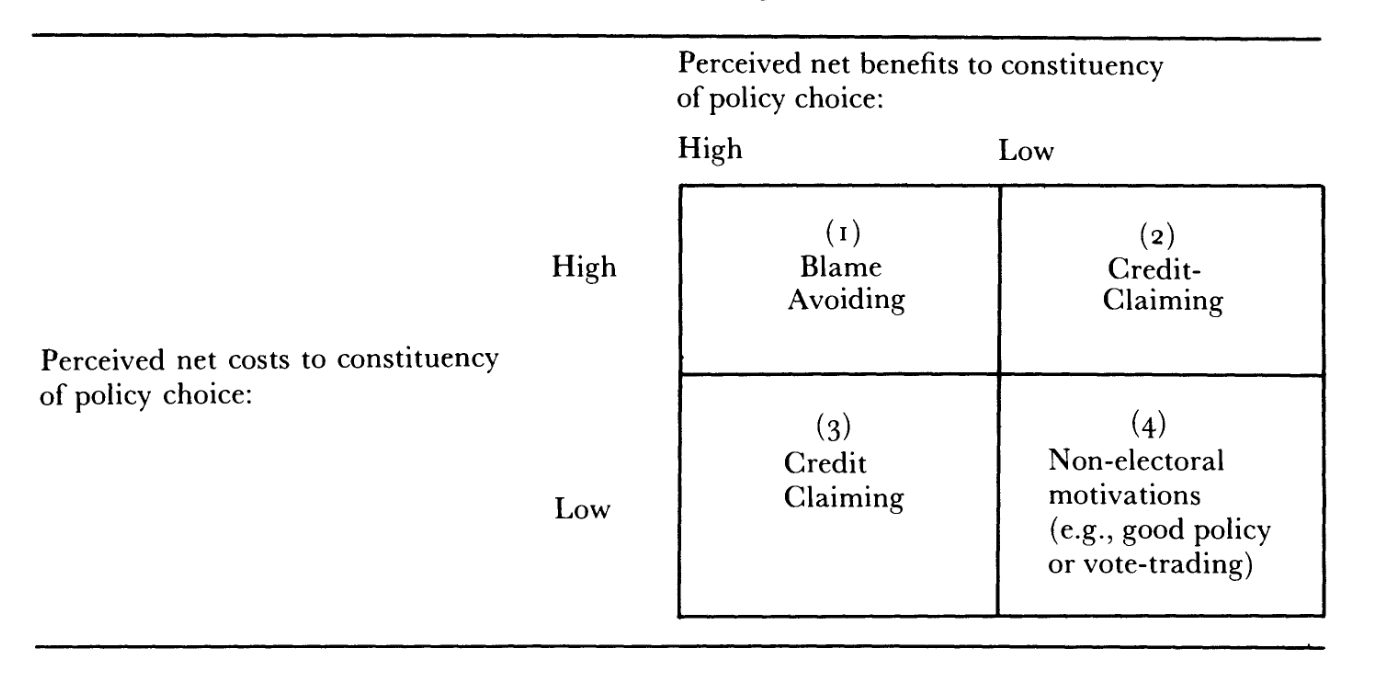
Strategies for Blame Avoidence:
Preventing blame by keeping potentially costly choices from being considered
prevent blame-generation by developing policy that obscures or diffuses loses (when blame-generating policy is already on the table)
prevent/delay blame by preventing constituents from suffering loses
defect blame by making others take the politically costly choices
defect blame by blaming others
defect blame by supporting alternative
diffuse blame spreading it out among policymakers
prevent blame by keeping credit-making opportunites that conflict with policy preferences from being considered
zero-sum conflict
a choice between a policy and the status quo
negative-sum conflict
all alternatives have strong negative consequences for at least some of the policy maker’s constituents
connection between “bounded rationality” and “incrementalism”
because policy-makers have bounded rationality and can’t foresee every outcome to a proposed policy, it is necessary we work through incrementalism to prevent very bad outcomes from major works of policy
Rational- actor model
individuals and states are logical, self-interested agents who make decisions by systematically analyzing all available information to maximize benefits and minimize costs
veto points
points where a certain policy can be killed, represents how easy it is for a policy to be passed
Ways to legitimize public policy
legislatively (through a law)
Administratively (someone passes a rule)
Courts (uphold a law)
popular support
It stops being fought by constituents
social pressure
becomes common sense
Waterfalls
Policy makers design a policy and push it down a cascade. The people at the bottom enact what the policymakers wanted. Leads to a large gap between the policy and implementation.
Bureaucratic anxiety cycle
A way to overcompensate because of fear of misuse or mismanagement by the government. A cycle of 1) Anxiety, 2)inaction and poor service, 3)increased proceduralism.
Discretion
Who has discretion over the implementation of these laws?
Street-level bureaucrats
the people at the street-level who are actually responsible for implementing the rules and make the decisions on how to enforce and carry it out
Capture
when government attempts to help, but is manipulated by special interest groups or private entities to serve their own economic agendas
Ambiguous or vague language in policymaking
Pros: Often helpful with enactment, allows experts to decide the technical questions, punts important decisions that shape overall policy design.
Cons: can introduce competing goals and make implementation confusing
implementation challenges
Coordination and communication problems in the government
Administrative burdens: who bears the burdens of implementing these laws
Technology issues: lots of technical systems that have databases built on them
Distance between the government and the people they govern
Gaps between what they want to happen and the ease and availability of people using them
Modern Administrative power
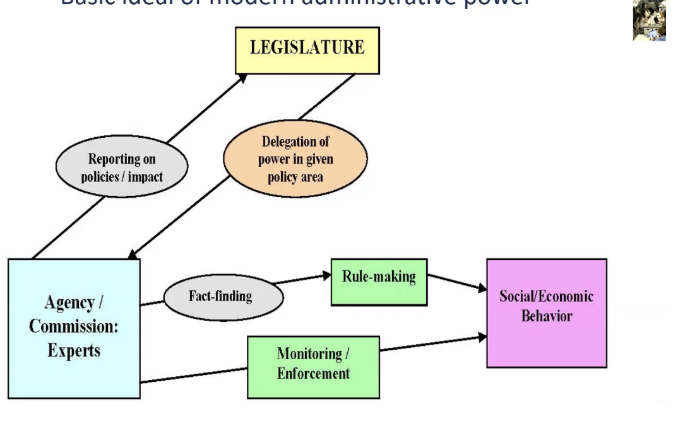
organized interest groups
Formal organizations, based on individual voluntary membership, which seek to influence public policies without assuming governmental responsibility
fog of enactment
how a policy can not truly be seen for its consequences until it is actually enacted
Four factors that influence the fog of enactment
Novel policies
Major reforms
Technical policy
Multiple jurisdictions
Beneficiaries
will support politicians who want to keep or enhance that policy and oppose politicians who want to curtail that policy—this is positive policy feedback, positive because it reinforces & strengthens the policy
Opponents
will fight politicians; this is negative policy feedback, as it is a feedback loop that undermines that policy.
Forms of Retrenchments:
Displacement- laws or rules being rewritten
Layering- adding other laws on top of the law to change implementation
Conversion-use of old rules for new means
indirect vs. direct means of retrenchment
Direct: Lobbying directly to policymakers, either to change laws or make new laws to weaken law
Indirect: working through the public, party, or legal system to undermine law or make it seem unpopular, astroturfing
Technical complexities vs. political complexities
Technical: the actual writing of it
Political: how do we get it passed
Ways we evaluate policy:
How we choose focus on one politician's record (outright)
How long we wait to evaluate (subtle)
How well-resourced our evaluation should be (subtle)
How we measure and explain outcomes (subtle)
What we compare the outcomes too (subtle)
How we differentiate the consequences of this particular policy (subtle)
Rational Actor model
Humans will do whatever is necessary to satisfy their narrowly construed self-interest, to gain the most benefits
Prospect theory
humans fear losses more than they want gains
Why do we evaluate policy?
Want to make program better (want to redirect)
Want to get more generalized knowledge about what policy practices are best
To hold policymakers accountable
To make a political point to voters about success or failure
What is policy success?
The policy is perceived as a success (polling says voters approve)
The policy persists or even grows stronger (becomes entrenched)
It solves the problem it was intended to
The policy addresses the core underlying problem
What is public interest?
Classic utilitarian approach: greatest good for the greatest number of people
Public opinion approach: the collective judgement of the people through elections or polls tells us what the public interest is (what if this is manipulated?)
Scientific approach: based on an accepted theory or a broad band of empirical evidence, a general preference, what is good/right
Public administration approach: a process to understand and balance everyone's preferences
Cynics approach: there is no public interest
Wicked problems
Difficult to define
Multi-causal and interconnected, with many actors split across society
Unstable, rife with possible unintended consequences
No clear solution
Who are members of the policy making community?
Elected officials with key roles
appointed department/agency heads
Top-level career civil servant
economic interest groups/powerful business firms
Policy Advocacy groups
Goals of American public policy (as defined by constitution)
Common defense, domestic tranquility, justice, blessings of liberty, general welfare
Current government revenue and spending
spending= 6.8 trillion, revenue=4.9 trillion (mostly relies on income tax~ 1/2)
Mandatory vs. discretionary spending
Mandatory spending is that which is required by the constitution, not yearly appropriations bills (about 4.1 trillion). Discretionary spending is that which is subject to yearly legislation (about 1.8 trillion)
Examples of mandatory spending
Health Care (Medicare, medicaid), Social security, income security programs (aid-based need like SNAP assistance)
Examples of discretionary spending
Defense (about 45% of discretionary spending), Education, transportation
Biggest Areas of government spending
Healthcare (20%), Pensions (17.9%), education (15%)
What are the goals of American Public Policy?
Why is income inequality a problem?
Highest income inequality (1928 and 2007) creates a speculative bubble and large amounts of debt as those with middle or low incomes are stagnating
America requires a strong middle class to stimulate spending, growing our economy, but the middle-class keep working harder and harder and getting no where
What caused this inequality (grew the most in the 70s)? - growing assault on labor unions, -the technological revolution - the movement of labor overseas
Making upward social mobility harder and harder to climb- those born into poverty are unlikely to get out
Federal Budget process
President sets a budget, congress is supposed to pass a concurrent budget for the next five to ten years that is passed in both house and senate. Recently though, congress has been failing to do so, and frequently violated their budget even when they do pass it.
Major federal revenue sources
Income tax (54%), payroll tax (30%), corporate income tax (9%)
Major state and local revenue sources
State: Transfers from federal gov (37%), income tax (19%), sales tax (14%)
Local: Transfers from state gov (37%), property tax (30%), charges (fees, ect.)(17%)