Biology AP - DNA & Protein Synthesis
 Call Kai
 Learn
Learn Practice Test
 Spaced Repetition
 Match
Match Flashcards
 Knowt Play
1/16

There's no tags or description
Looks like no tags are added yet.
Name | Mastery | Learn | Test | Matching | Spaced | Call with Kai |
|---|
No analytics yet
Send a link to your students to track their progress
17 Terms
RNA Polymerase
catalyzes RNA synthesis which pries the DNA strand apart and joins together the RNA nucleotides
RNA is complementary to the DNA template strand (A-T, U-A, C-G, G-C)
does not need any primer
follows the same base pairing rules as DNA except uracil instead of thymine
Promoters
signal transcription start point
usually extend several dozen nucleotide pairs upstream of the start point
Transcription factors
mediate the binding of RNA polymerase and the initiation of transcription
Transcription initiation complex
completed assembly of transcription factors and RNA polymerase II bound to promoter
TATA box
promoter
crucial in forming the initiation complex in eukaryotes
Elongation of the RNA strand
as RNA polymerase moves along the DNA, it untwists the double helix (10-20 bases at a time)
transcription progresses at a rate of 40 nucleotides per second in eukaryotes
a gene can be transcribed simultaneously by several RNA polymerases
nucleotides are added to the 3’ end of the growing RNA molecule
Termination of transcription
termination is different in bacteria and eukaryotes
Bacteria termination
polymerase stops transcription at the end of the terminator
mRNA can be translated without further modification
Eukaryotes termination
RNA polymerase II transcribes the polyadenylation signal sequence
RNA transcript is released 10-35 nucleotides past this polyadenylation sequence
RNA processing
enzymes in the eukaryotic nucleus modify pre-mRNA before the genetic messages are dispatched to the cytoplasm
during RNA processing, both ends of the primary transcript are usually altered
certain interior sections of the molecule are cut out → remaining parts spliced together
mRNA Alteration Ends
each end of a pre-mRNA molecule is modified in a particular way
5’ end receives a modified nucleotide 5’ cap
3’ end gets a poly-A tail
Function of mRNA Alteration
facilitate the export of mRNA to the cytoplasm
protect mRNA from hydrolytic enzymes
help ribosomes attach to the 5’ end
Introns
noncoding regions
intervening sequences
Exons
eventually expressed
usually translated into amino acid sequences
RNA splicing
removes introns and joins exons → creating an mRNA molecule with a continuous coding sequence
some cases → carried out by spliceosomes
Spliceosomes
consist of a variety of proteins and several small nuclear ribonucleoproteins (snRNPs) that recognize the splice sites
RNAs catalyze the splicing reaction
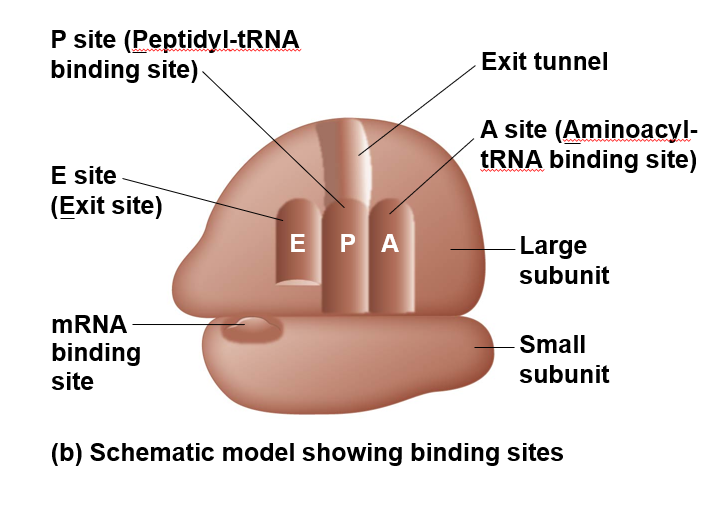
Three binding sites on ribosome
P site → holds the tRNA that carries the growing polypeptide chain
A site → holds the tRNA that carries the next amino acid to be added to the chain
E site → exit site where discharged tRNA leave the ribosome