Research Methods finished fc at 115
 Call Kai
 Learn
Learn Practice Test
 Spaced Repetition
 Match
Match Flashcards
 Knowt Play
1/204

There's no tags or description
Looks like no tags are added yet.
Name | Mastery | Learn | Test | Matching | Spaced | Call with Kai |
|---|
No analytics yet
Send a link to your students to track their progress
205 Terms
What is an Aim?
A general statement on what the researcher intends to investigate
What is a Hypothesis?
A clear, precise, testable statement that states the Relationship between the Variables to be investigated
states the IV and DV
What is a Directional Hypothesis?
A hypothesis that states the direction of the difference or relationship
What is a Non-Directional Hypothesis?
A hypothesis that doesn't state the direction of the difference or relationship
What is the Independent Variable?
The variable which is manipulated by researcher so the effect of it on DV can be measured
What is the Dependent Variable?
The variable is measured. Any effect on the DV should be caused by change in IV
What is Operationalisation?
Making variables measurable
What is an Extraneous Variable?
A nuisance variable which does not vary systematically with the Dependent Variable.
any variable other than the IV that may affect the DV is it is not controlled.
eg: participant reactivity
What is a Confounding Variable?
A variable which varies systematically with the Independent Variable meaning we don't know what caused the change in the Dependent Variable.
What are Demand Characteristics?
When participants are influenced by cues indicating the purpose of the experiment and change their behaviour.
What is the Please-U Effect?
When a participant actin a way they think they are expected to and over-performs to please the experimenter
What is the Screw-U Effect?
When a participant under-performs in an effort to sabotage the study.
What are Investigator Effects?
any effect of the investigators behaviour (conscious or unconscious) on the research outcome. Including everything from the design of the study to the selection of and interaction with ppts during research.
What is Randomisation?
The use of chance when designing materials and deciding the order of conditions to reduce researchers unconscious bias + extraneous + confounding variables
What is Standardisation?
using exactly the same formalised procedures and instructions for all ppts in a research study
What is an Independent Groups design?
Participants are divided into 2 groups. each group experiences a different condition
What are the Strengths of an Independent Groups design?
- Not affected by Order Effects
What are the Weaknesses of an Independent Groups design?
- Differences between the participants could act as an confounding variable, reducing validity, to reduce this researchers use random allocation
- Need twice as many participants, im
What is a Repeated Measures design?
All participants take part in all conditions of the experiment.
What are the Strengths of a Repeated Measures design?
- Need fewer participants
- participant variables are controlled
What are the Weaknesses of a Repeated Measures design?
- Affected by Order Effects ( researchers do counterbalancing to minimize effects)
- More likely to be affected by Demand Characteristics
What is a Matched Pairs design?
Pairs of ppts are first matched on the same variable that may affect the DV. Then one member of the pair is assigned to condition A and the other to condition B
What are the Strengths of a Matched Pairs design?
- Not affected by Order Effects
- Less likely to be affected by Demand Characteristics
- Reduces Participant Variables
What are the Weaknesses of a Matched Pairs design?
-ppts can never be matched exactly
-matching is time consuming and expensive so less economical than other designs
What is a Population?
a group of ppl who are the focus of the researcher’s interest, from which a smaller sample is drawn
What is a Sample?
A smaller number of people drawn from the population and is a representative of that population
What is Random Sampling?
Every member of the target population has an equal chance of being selected
How is Random Sampling conducted?
1) Compile a list of all members of the target population
2) Assign each one a number
3) Use a random number generator to select participants and assign them conditions
What are the Strengths of Random Sampling?
- No Researcher Bias as they have no influence over selection of participants, therefore they can't choose people who may support their hypothesis
What are the Weaknesses of Random Sampling?
- It is Difficult and Time Consuming as a complete list of the target population is often difficult to obtain
- Just because someone is selected, doesn't mean they are obliged to take part, therefore it usually ends up being a volunteer sample
What is Systemic Sampling
Every nth member of the target population is chosen
How is Systemic Sampling conducted?
1) Compile a list of all members of the target population
2) Nominate a sampling system, sampling frame is produced
e.g: every 3rd person or every 5 houses
What are the Strengths of Systemic Sampling?
- No Researcher Bias as they have no influence over selection of participants, therefore they can't choose people who may support their hypothesis
- Usually fairly Representative as long as a big enough sample are selected
What are the Weaknesses of Systemic Sampling?
- It is Difficult and Time Consuming as a complete list of the target population is often difficult to obtain
- Just because someone is selected, doesn't mean they are obliged to take part, therefore it usually ends up being a volunteer sample
What is Stratified Sampling?
The composition of the sample reflects the proportion of subgroups within the target population
How is Stratified Sampling conducted?
1) The researcher identifies the strata that makes up the population
2) Proportions are calculated to allow the sample to represent the population
3) Random Sampling is then used for participants
What are the Strengths of Stratified Sampling?
- No Researcher Bias as they have no influence over selection of participants, therefore they can't choose people who may support their hypothesis
- Highly Representative as it is designed to accurately reflect the composition of the population
What are the Weaknesses of Stratified Sampling?
- Just because someone is selected, doesn't mean they are obliged to take part, therefore it usually ends up being a volunteer sample
- It does not reflect all of the ways that people are different, so not possible to be fully representative
What is Opportunity Sampling?
The researcher selects anyone who happens to be willing and able
How is Opportunity Sampling conducted?
1) The researcher will simply ask anyone who is around at the time of the study
What are the Strengths of Opportunity Sampling?
- Involves minimal Effort, Time and Cost on the part of the researcher
What are the Weaknesses of Opportunity Sampling?
- Usually leads to a very Unrepresentative sample as it tends to be drawn from a small area
- At risk of researcher bias as they have complete control over who is selected
What is Volunteer Sampling?
A Self Selection method where participants select themselves to be in the sample
How is Volunteer Sampling conducted?
1) The researcher could put an ad in the local newspaper, or put up a poster in an appropriate place (e.g: a students union bar)
What are the Strengths of Volunteer Sampling?
- Involves minimal Effort, Time and Cost on the part of the researcher, as they simply wait for the participants to come to them
What are the Weaknesses of Volunteer Sampling?
- Is only going to attract a Certain Type of person (i.e: kind, helpful, curious) so the findings will have limited generalisability
what is a laboratory experiment?
-experiments conducted in a highly controlled environment
-this is not always in a lab
what are the strengths of laboratory experiments?
-have high control over extraneous variables therefore researcher can ensure any effect on DV is only form manipulation of IV, therefore high internal validity
-replication is more possible than other types, this is important to see if the results are valid
what are the weakness of laboratory experiments?
-lack generalizability as it is an artificial environment , therefore lack mundane realism therefore low external validity
-demand characteristics may arise
what is a field experiment?
an experiments where IV is manipulated in a natural more everyday setting
what are the strengths of field experiments?
-high mundane realism , produce behavior that is valid and authentic, ppts may be unaware that they are being studied so high external validity
what are the weaknesses of a field experiment?
-lack of control over extraneous variables so cause and effect between IV ad DV is hard to establish
-precise replication is not possible
-ethical issue: unaware ppts didn’t give consent and therefore is invasion of privacy
what is an natural experiment?
an experiment where the change in IV is not brought by the researcher but would have happened even if the researcher hadn’t been there.( it is the IV that is natura, not necessarily the setting)
what are the strengths of a natural experiment?
- provide opportunities for research that may not be undertaken for practical and ethical reasons( orphan studies)
- involves study of real life issue sand problems as they happen so high external validity
what are the weaknesses of natural experiments?
-a naturally occurring event happen very rarely so reducing opportunities for research so generalizing to similar situations is hard
-ppts are not randomly allocated to experimental conditions so researcher may be less sure if the IV affected the DV
what is a quasi experiment?
- have an IV that is based on an existing difference between people (for instance, age or gender). No one has manipulated this variable, it simply exists
what are the strengths of quasi experiment?
-carried out under controlled conditions and therefore share some strengths of a lab experiment (e.g. replication).
what are the weaknesses of quasi experiment?
-unlike natural , quasi cannot randomly allocate participants to conditions and therefore there may be confounding variables.
-he IV is not deliberately changed by the researcher and therefore we cannot claim that the IV has caused any observed change.
what are naturalistic observations?
Watching and recording behaviour in the setting within which it would normally occur.
what are the strengths and weaknesses of naturalistic observation?
strength: have high external validity as findings can be generalized to everyday life.
limitation: lack of control over research situation so cant replicate + uncontrolled extraneous variables
what are controlled observations?
-Watching and recording behaviour within a structured environment,
-some control over variables, including manipulating variables to observe effects and also control of confounding/extraneous variables.
what are the strengths and limitations of controlled observations?
strength: extraneous variables is less of a factor so replication is possible
limitation: produce findings that cannot be applied to real life setting
what are covert observations?
-those in which the participants are unaware they are the focus of study and their behaviour is observed in secret (covertly),
-Such behaviour must be public and happening anyway if the observation is to be ethical.
what are the strengths and weaknesses of covert observations?
strength: reduced participants reactivity so behavior is natural and so increases validity of data
limitation: not having consent of gathering data of behavior of strangers
what are overt observations?
Participants’ behaviour is watched and recorded with their knowledge and informed consent
what are the strengths and weaknesses of overt observations?
strength: ethics- have informed consent
limitation: consent now affects their natural behavior
what is a participant observation?
The researcher becomes a member of the group whose behaviour he/she is watching and recording.
what are the strengths and weakness of participant observations?
strength: the researcher can experience the situation as the participants do, giving them increased insight into the lives of the people being studied- increased validity
limitation: researcher may come to identify too strongly with those they are studying and lose objectivity. (researchers refer to this as adopting a local lifestyle)
what is a non participant observation?
The researcher remains outside of the group whose behaviour he/she is watching and recording.
what are the strengths and weaknesses of non participant observations?
strength: researcher can maintain an objective psychological distance from their ppts so there is less danger of them adopting a local lifestyle.
limitation: lose valuable insight to be gained in a participant observation.
evaluations points that affect all type of observation
strength - observations of behavior have the benefit of capturing what people actually do, which may be unexpected behavior.
limitation- observer bias: The observer's interpretation situation may be affected by their expectations. This may be reduced by us than one observer.
limitation - Observational studies alone can’t prove cause and effect, but observation can still be used inside experiments to help measure outcomes that may show cause and effect
outline inter-observer reliability
This is done to reduce bias
To make data recording more objective and unbiased, observations should be carried out by at least two researchers.
Then data from different observers is compared to check for consistency i.e. reliability.
outline how we can carry out an inter - observer investigation?
Observers should familiarize themselves with the behavioral categories to be used.
They then observe the same behavior at the same time, perhaps as part of a small-scale pilot study.
Observers should compare the data they have recorded and discuss any differences in interpretations.
Finally observers should analyze the data from the study. Inter-observer reliability is calculated by correlating each pair of observations made and an overall figure is produced.
outlien unstructured observation
Observation where the researcher records all behaviour they see without predetermined categories.
Key Features:
Produces rich, detailed qualitative data
No behavioural categories used
Often used in small-scale studies with few participants
what are the strengths and weakness of unstructured observation?
strength: richness and depth of detail in the data collected.
limitation: produce qualitative data, which may be much more difficult to record and analyze
limitation: risk of observer bias (researcher may only record behavior that catch their eye)
outline structured observation
Observation where the researcher records specific behaviours using predetermined behavioural categories.
Key Features:
Uses a behavioural checklist or coding system
Focuses only on target behaviours
Produces quantitative data
Useful when lots of behaviour occurs at once
what are the strengths and weakness of structured observation?
strength: use of behavioral categories make the recording of data easier and more systematic. Data produced is quantitative, so analyzing and comparing the behavior observed between participants is more straightforward.
What are Behavioural Categories?
In a structured observation, target behaviours are operationalised into behavioural categories (a behaviour checklist) so they can be observed and measured objectively.
Key Points:
Behaviour must be clearly defined, observable, and measurable
Categories should avoid inference to improve reliability
Observers record occurrences of each behaviour
The checklist should include all possible forms of the target behaviour before observation begins
evaluate behavioral categories
strength: clear, observable and measurable categories increase objectivity and reliability
limitation: ambigious or overlapping catergroies and "dustbin categories” reduce inter observer reliabilty and validity
What is Event Sampling?
A behavioural sampling method where the researcher records every time a specific behaviour (event) occurs.
Key Points:
Used mainly in structured observations
Focuses on frequency of a target behaviour
Behaviour is counted whenever it occurs
evaluate event sampling
strength: records every occurrence of the target behavior, so infrequent behaviors are less likely to be missed so increases validity
limitation: complex behaviors may be diff to record accurately so reduces reliability
What is Time Sampling?
A behavioural sampling method where the researcher records behaviour at regular time intervals.
Key Points:
Behaviour recorded within a set time frame
Uses a behavioural checklist
Helps manage large amounts of behaviour
evaluate time sampling
strength: reduces no of observations making data collection more managable and systematic
weakness: behavior recorded at fixed intervals may be unrepresentative , reducing validity
What are Questionnaires?
A pre-set list of written items (usually questions) to which a participant responds used to asses a persons thoughts and experiences.
What are the Strengths and limitations of Questionnaires?
- Low Cost
- Does not require the Researcher to be present
- Can be Distributed to large numbers of people
- Often elicits Untruthful Responses
- Subject to Response Bias (acquiescence bias)
- Subject to Social Desirability Bias
data is easy to analyze
What is an Open Question?
There is no fixed range of answers and participants are free to respond in any way they wish
- Difficult to Analyse
Rich in Detail
e.g: how would you describe your mood on an average day?
What is a Closed Question?
Offers a Fixed number of responses and participants are not free to respond in any way they wish
- Lack in Detail and Depth
e.g: On a scale from 1-10, how would you rate your mood on an average day?
What is an Interview?
Usually involves a face-to-face (but could be conducted by phone) interaction between an interviewer and an interviewee
What is a Structured Interview?
Involves a predetermined set of questions. The interviewer asks the questions in real time and waits for a response
What are the Strengths of a Structured Interview?
- High Replicability due to standardized format
- No deviation may mean important details that arise are not examined
What is an Unstructured Interview?
It is more conversational as there are no set questions. There is a general aim that a certain topic will be discussed, The interviewee is encouraged to elaborate on their answers where appropriate
What are the Strengths and limitations of an Unstructured Interview?
- Allows the interviewer to collect more information as important details emerge
- Difficult to analyze
interviewer bias
- social desirability bias
What is a Semi-Structured Interview?
A mixture of structured and unstructured interviews. There are a set of Predetermined questions but elaboration and Follow up questions from interviewers are likely
what are likert scales?
type of closed question
the respondent indicates their agreement (or otherwise) with a statement using a scale of usually five points. The scale ranges from Strongly agree to Strongly disagree,
what are rating scales?
type of closed questions
respondents identify a value that represents their strength of feeling about a particular topic,
what are fixed choice option items?
type of closed question
includes a list of possible options and respondents are required to indicate those that apply to them,
What should be considered when Designing a good interview?
- The Interview Schedule (list of questions) should be Standardised so there is less risk of interviewer bias
- Information should be recorded in note form by the interviewer or an audio recording can be made and listened to later
- One-to-one interviews should be conducted in a Quiet Setting away from other people to encourage openness and honesty
- The interviewee should be reminded that information they divulge is confidential, especially important in the case of sensitive/personal material
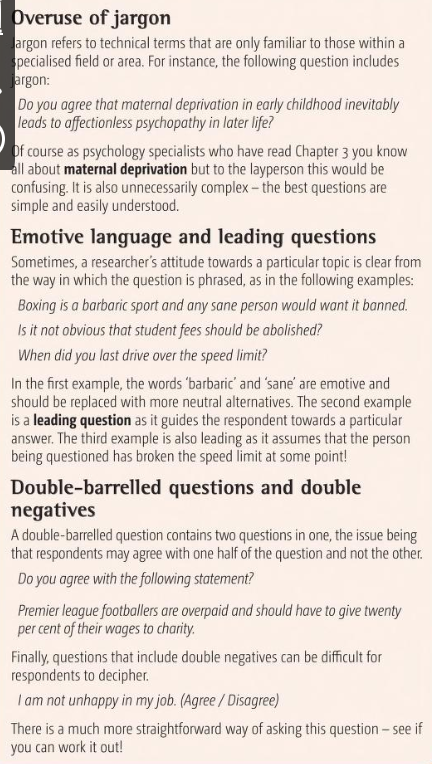
What 5 things should be avoided in order to write good questions?
1) Overuse of Jargon
2) Emotive Language
3) Leading Questions
4) Double-Barreled Questions
5) Double Negatives
What is a Pilot Study?
A small-scale version of an investigation that takes place before the real investigation is conducted
What is the aim of using a pilot study?
To identify any problems that might occur in the real experiment so they can be fixed/altered. This can save a researcher time and money