P6 : Waves
 Call Kai
 Learn
Learn Practice Test
 Spaced Repetition
 Match
Match Flashcards
 Knowt Play
1/182

Earn XP
Description and Tags
Name | Mastery | Learn | Test | Matching | Spaced | Call with Kai | Chat |
|---|
No analytics yet
Send a link to your students to track their progress
183 Terms
What do waves transfer + what do they not?
They transfer energy from one place to another + don’t transfer any matter
What is another word for vibrations?
Oscillations
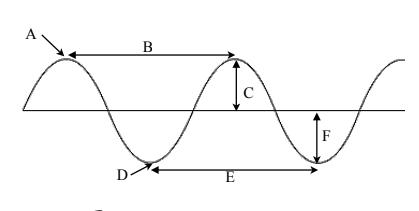
A → Crest
B → Wavelength
C → Amplitude
D → Trough
E → Wavelength
F → Amplitude
What is the amplitude of a wave?
The maximum displacement of a point on a wave away from its undisturbed position
What is the wavelength of a wave?
The distance from a point on one wave to the equivalent point on the adjacent wave
What is the frequency of a wave?
The number of complete waves passing a certain point per second
What is the equation for frequency?
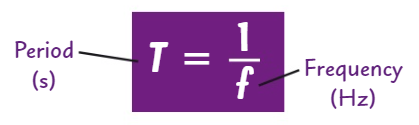
What does 1Hz equal to?
1 wave per second
What is wave speed + what type of wave does it apply to?
The speed at which energy is being transferred or the speed the wave is moving at + it applied to all waves
What is the equation for wave speed?

What are the 2 types of waves?
Transverse
Longitudinal
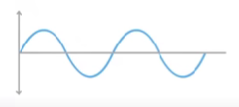
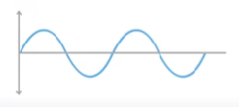
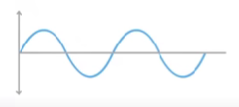
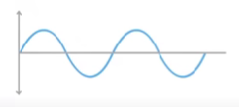
In transverse waves how to the oscillations behave?
The oscillations are perpendicular to the direction of energy transfer
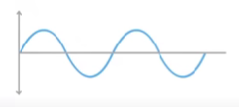
What does a transverse wave look like?
Give examples of transverse waves (3)
Electromagnetic waves
Ripples and waves in water
A wave on a string
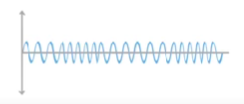
In longitudinal waves how to the oscillations behave?
The oscillations are parallel to the direction of energy transfer
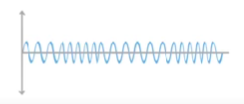
What do longitudinal waves look like?
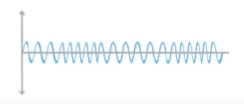
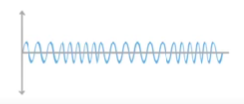
Gives examples of longitudinal waves (2)
Sound waves in air
Shock waves (some seismic waves)
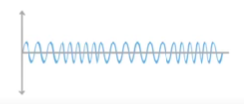
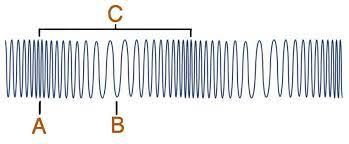
Ignore C
A → Compression
B → Rarefaction
Explain an experiment to find measure the sound of speed waves in air (5)
Get 2 people and distance them by 500 metres
Give person A cymbals and give person B a timer
Person B should start the timer when they see person A clash the cymbals together
Person B should then stop timing when she hears the sound of the cymbals clashing
Then calculate the speed of the sound waves by dividing travelled by the time taken
Explain how to measure the speed of water ripples using a lamp (6)
Fill the ripple tank so the water has a depth of approximately 5mm. Place the ripple tank on top of a piece of white paper or card
Place a wooden rod on the surface of the water and attach it to the low-voltage power supply and motor. Add a lamp to the circuit and hold the lamp above the ripple tank
View the wave pattern from the side of the tank, looking through the water
To measure the wavelength, place the metre ruler perpendicular to the wavefronts on the page. Measure across as many wavefronts as possible and divide by the number of waves
To measure the frequency, count the number of waves passing a particular point in the wave tank over a given time (measure 10 or 20 seconds using a stop clock)
To calculate the wave speed, multiply the wavelength by the frequency
Explain how to find the wave speed of string (4)
Produce a standing wave on the vibrating string by adjusting the frequency or the generator, the position of the wooden bridge and the tension in the string (by adding or removing masses). A standing wave is created when the wave doesn’t appear to move horizontally, instead the string appears to oscillate only vertically.
To measure the wavelength, use a metre ruler to measure across multiple standing waves and divide by the number of total waves. The wavelengths of a standing wave is measured across two halves
To measure the frequency, use a stopwatch to time wave oscillations over ten complete cycles. If the wave is slow enough, time the point at the centre of the half-wavelength, starting at equilibrium and counting every other time the string passes the equilibrium as a complete cycle. Divide this value by 10 to find the time period. Then use the equation, f = 1/T to find the frequency
To calculate the wave speed, multiply the wavelength by the frequency.
When waves are at a boundary what are the 3 things that could happen?
Waves can be absorbed
Waves can be transmitted
Waves can be reflected
What happens when an object absorbs a wave?
The energy from the wave is transferred to the energy stores of the object
What type of diagram is used to show rays?
A ray diagram
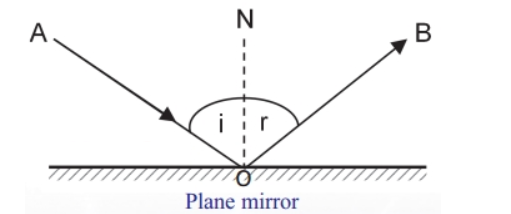
Label
A → Incident ray
B → Reflection ray
N → Normal
I → Angle of incidence
R → Angle of reflection
O → Point of incidence
What is the one simple rule to remember about all waves? (in terms of ray diagrams + angles)
Angle of incidence = Angle of reflection
What are the 2 types of reflections?
Specular reflection
Diffuse reflection
Explain specular reflection (3)
The boundary is flat and smooth
This means that the normals are all in the same direction
Therefore all the reflection rays will be in the same direction
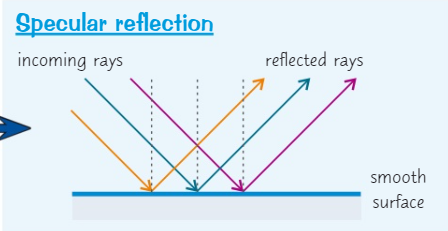
Explain diffuse reflection (3)
The boundary is rough and uneven
This means that all the normals are different
Therefore the reflection rays will be in different directions
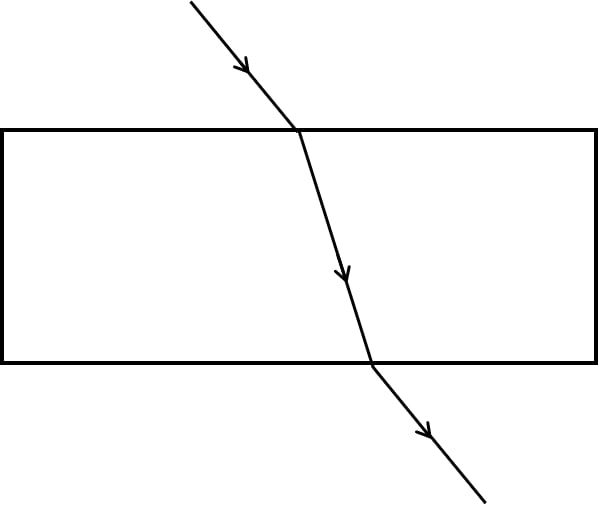
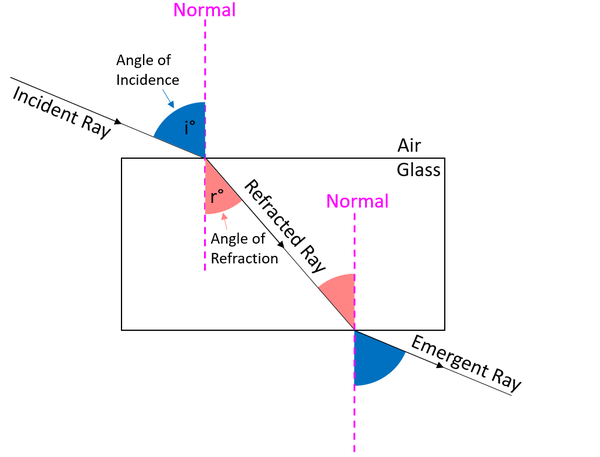
What happens when a ray is refracted?
It changes direction as it passes from 1 material to another as it changes speed
What causes a wave to change its speed?
The density of the material it is travelling through
What is the relationship between the density of a material and the speed of the wave travelling through it?
The higher the density of the material the slower the speed of the wave
What happens when waves change speed in terms of refraction?
They change direction
What happens when a wave slows down?
They bend towards the normal (refraction)
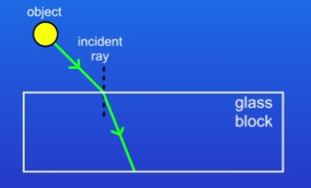
What happens when waves speed up?
They bend away from the normal
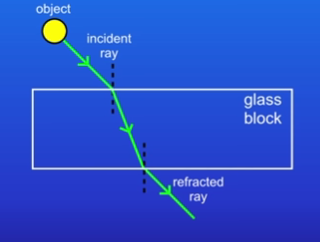
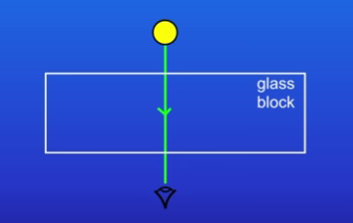
What happens if waves enter or leave the material at right angles to the surface?
They do not change direction
What is a wavefront?
The front of the wave, or the same point on each wave
Explain how wave fronts demonstrate refraction (3)
Different parts of the wavefront enter the object at different times
This causes the wavefront to slow down due to a decrease in speed as there is a change in velocity + de
This means that one part of the wave changes speed before the other part leading to the light ray to be refracted
DELETE
What happens when a ray hits the boundary of a less dense material at an angle and slows down?
The ray bends towards the normal
Draw a ray diagram for reflection and label all the parts (10)
What is the relationship between the speed of the wave changing + the wavelength + the frequency?
As speed increases, wavelength increases but frequency always stays the same
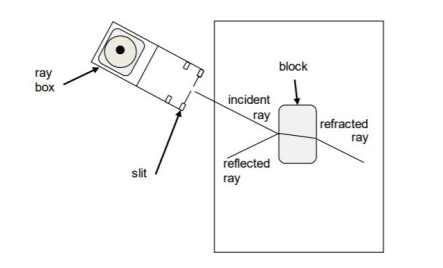
Explain the investigate for the reflection of light by different types of surfaces and the refraction of light by different substances (7)
Make sure the room is dim/dark
Slot the collimating slit into the ray box and turn on, producing a narrow ray of light
Place the first block of material on top of a piece of paper. Trace around the block using a pencil
Draw a normal to the block (a line at 90° to the surface of the block). Align the incident ray of light with the meeting point between the normal and the surface of the block
Draw the reflected ray and refracted ray, remove the block and draw a straight line between the point of reflection and the refracted ray on the other side of the block
Using the protractor, measure:
a. The angle of incidence - The angle between the incident ray and the normal
b. The angle of reflection - The angle between the reflected ray and the normal
c. The angle of refraction - The angle within the material between the normal and the refracted ray
Repeat the experiment, using a new piece of paper for each different material of block
How do sound waves work in solids?
By travelling through mediums causing vibrations
What type of wave is sound?
Longitudinal wave
Why can a sound wave not travel through a vacuum?
Because there are no particles to vibrate through
What is the relationship between the speed of sound waves and how dense a medium is?
The more dense a medium is the faster sound travels
Is frequency affected when sound waves travel through different mediums?
No frequency doesn’t change
When sound waves speed up what happens to wavelength?
In increases
When sound waves slow up what happens to wavelength?
It decreases
What 3 things can happen to sound waves?
It can be refracted
It can be reflected
It can be absorbed
How are echoes created?
When sound is reflected off a surface
What is the sound range for humans?
20Hz - 20000Hz
Explain how humans hear sound (3)
Sound waves that reach your ear drum can cause it to vibrate
These vibrations are passed on to tiny bones in your ear called ossicles, through the semi-circular canals and to the cochlea
The cochlea turns these vibrations into electrical signals which get sent to your brain and allow you to sense (hear) sound
Why is human hearing limited?
By the shape and size of our ear drum
How does the brain interpret higher frequencies?
Higher pitches
How does the brain interpret more intense signals?
Lounder
What is high frequency equal to?
High pitch
What is low frequency equal to?
Low pitch
What is small amplitude equal to?
Quiet sound
What is loud amplitude equal to?
Loud sound
What frequency is ultrasound?
Higher than 20,000 Hz
Can humans hear ultrasound?
No
What happens to ultrasounds at boundaries?
It gets partially reflected
What happens when a wave gets partially reflected?
Some of the wave is reflected of the boundary and some is transmitted and refracted
Why is ultrasound being able to partially reflect useful?
Because the time taken for the reflections to reach a detector can be used to determine how far away a boundary is
What are the 2 used for ultrasound?
Medical and industrial imaging
How does ultrasound work in medical imaging? (2)
Ultrasound waves can pass through the body, but whenever they reach a boundary some of the wave is reflected back and detected
The exact timing and distribution of these echoes are processed by a computer to produce a video image of the foetus
Are ultrasounds more safer than x-rays?
Yes
How does ultrasound work in industrial imaging? (3)
Ultrasound can be used to find flaws in objects such as pipes or materials such as wood or metal
Ultrasound waves entering a material will usually be reflected by the far side of the material
If there is a flaw such as a crack inside the object, the wave will be reflected sooner
How does echo sounding work?
Uses high frequency sound waves to find boats and submarines to find out the depth of the water they are in or to locate objects in deep water
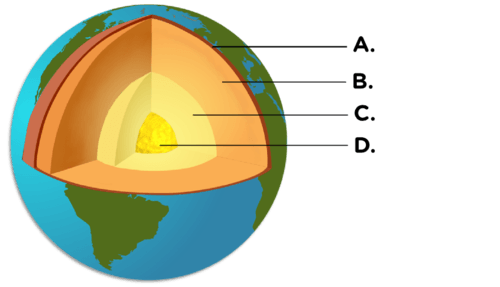
Name the labels and the state of matter in each part
A → Crust → Solid
B → Mantle → Solid
C → Outer core → Liquid
D → Inner core → Solid
What are seismic waves a product of?
Earthquakes
What are seismic waves detected using?
Seismometers
What happens to seismic waves when the reach a boundary?
Some waves are absorbed and some will be refracted
What happens when a seismic wave is refracted?
They change speed gradually and this results in a curved path
What happens to seismic waves when their properties suddenly change?
The wave speed changes abruptly and the path has a kink
What are the 2 types of seismic waves?
S-waves
P-waves
What were scientists able to determine via seismic waves?
The internal structure of the earth
What are the properties of p-waves and s-waves? (4)
P-waves | S-waves |
|---|---|
Inside the earth | Inside the earth |
Are longitudinal | Are transverse |
Travel through solids and liquids | Travel through solids only |
Faster than s-waves | Slower than p-waves |
What does EM stand for?
Electromagnetic
How many waves are there in the EM spectrum?
7
What do EM waves do?
They transfer energy from the source of the waves to an absorber
What type of wave are the waves in the EM spectrum?
Transverse waves
When in a vacuum what speed will the EM waves travel at?
3×10⁸m/s
What wave of the EM spectrum can humans detect?
Visible light
List the order of the electromagnetic waves from longest wavelength to shortest wavelength
Radio waves
Microwaves
Infrared
Visible light
Ultraviolet
X-rays
Gamma rays
List the order of the electromagnetic waves from low frequency to high frequency
Radio waves
Microwaves
Infrared
Visible light
Ultraviolet
X-rays
Gamma rays
Which wave in the electromagnetic has the longest wavelength?
Radio waves
Which wave in the electromagnetic has the shortest wavelength?
Gamma rays
Which wave in the electromagnetic has the highest frequency?
Gamma rays
Which wave in the electromagnetic has the lowest frequency?
Radio waves
What are EM waves made up of?
Oscillating electric and magnetic fields
What are alternating currents made up of?
oscillating charges
What is the relationship between the frequency of waves produced and the frequency of the alternating current (in terms of radio waves)?
The frequency of waves produced is equal to the frequency of the alternating current
How are radio waves produced?
By oscillations in electrical circuits
What is an oscilloscope used for?
Allows people to see the frequency of the current being produced
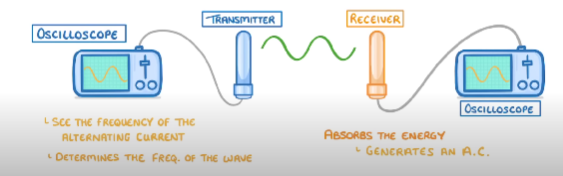
Explain how a radio works (5)
Electrons oscillate and produce an EM waves via an ac current
An ac current is seen on an oscilloscope which is connected to a transmitter
The transmitter emits radio waves which transfer energy to a receiver
The receiver absorbs the EM waves and causes the electrons in the receiver to oscillate
An ac current is produced in the receiver
What happens when radio waves are absorbed? (2)
They may create an alternating current with the same frequency as the radio wave itself
So radio waves can themselves induce oscillations in an electrical circuit
What can happen when electromagnetic waves are generated or absorbed over a wide frequency range?
Changes take place in atoms or in the nuclei of atoms