CRJ 200 Limitations (Official-ish) - MODDED (see Description) questions with 100% correct answers with detailed rationales 2026
 Call Kai
 Learn
Learn Practice Test
 Spaced Repetition
 Match
Match Flashcards
1/96

There's no tags or description
Looks like no tags are added yet.
Name | Mastery | Learn | Test | Matching | Spaced | Call with Kai |
|---|
No analytics yet
Send a link to your students to track their progress
97 Terms
Weight -
Maximum Ramp Weight
_______ lbs.
53,250
Weight -
Maximum Takeoff Weight
_______ lbs.
53,000
Weight -
Maximum Landing Weight
_______ lbs.
47,000
Weight -
Maximum Zero Fuel Weight
_______ lbs.
44,000
Weight -
Minimum Flight Weight
_______ lbs.
30,000
Dimensions -
Wing Span
69ft 8in
Dimensions -
Aircraft Length
87ft 10in
Dimensions -
Tail Height
20ft 8in
Limitation -
Minimum Taxiway Width
_______ ft.
35 (SkyWest)
Limitation -
Minimum Runway Width
_______ ft.
100
Limitation -
Maximum altitude - operation
_______ ft.
37,000 (SkyWest)
Limitation -
Maximum altitude - takeoff and landing
_______ ft.
10,000
Limitation -
Maximum temperature - takeoff or landing
_______ °C
ISA + 35
(ISA - international standard atmosphere)
Limitation -
Minimum temperature - takeoff
_______ °C
-40
Limitation -
Maximum tailwind (speed):
Takeoff or Landing
10 knots
Limitation -
Crosswind (speed):
Takeoff or Landing
27 knots (SkyWest)
(NOTE: actual crosswind number is derived from the Wind Component Conversion Table found in the CRJ Performance Cards.)
Limitation -
Crosswind:
Takeoff or landing with
• RCC 1 or 2 or Poor BA,
• > 1/8" Standing Water,
• > 1/8" Slush, Ice
10 knots (SkyWest)
Limitation -
Crosswind:
Takeoff or Landing with
• Wet ice,
• Slush over Ice,
• Water over Compact Snow,
• Dry Snow over Ice,
• Wet Snow over Ice
Prohibited
Airspeeds -
VMO = _______ KIAS
335
(VMO = knots, maximum, operation)
Airspeeds -
MMO = _______ M
0.85
(MMO = Mach, maximum, operation)
Airspeeds -
VLO EXT = _______ KIAS
220 (SkyWest)
(VLO = knots, landing gear, operation)
Airspeeds -
VLO RET = _______ KIAS
200
(VLO = knots, landing gear, operation)
Airspeeds -
VLE = _______ KIAS
220
(VLE = knots, landing gear, extended)
Airspeeds -
VTire = _______ knots (GS)
182 (ground speed)
Airspeeds -
V ADG DEPLOY MAX (Wet)
_______ KIAS
250
Airspeeds -
V ADG DEPLOY MAX (Dry)
_______
VMO / MMO
(335 KIAS / 0.85 M)
(VMO = knots, maximum, operation)
(MMO = Mach, maximum, operation)
Airspeeds -
VB (turbulence)
_______ KIAS
280
(VB = knots, turbulence penetration)
Airspeeds -
MB (turbulence)
_______ M
0.75
(MB = Mach, turbulence penetration)
Airspeeds -
V WIPER OPS Max
_______ KIAS
220
Airspeeds -
VFO 8
_______ KIAS
200
(VFO = knots, flap, operation)
Airspeeds -
VFO 20
_______ KIAS
200
(VFO = knots, flap, operation)
Airspeeds -
VFE 8
_______ KIAS
215
(VFE = knots, flap, extended)
Airspeeds -
VFE 20
_______ KIAS
215
(VFE = knots, flap, extended)
Airspeeds -
VFE 30
_______ KIAS
185
(VFE = knots, flap, extended)
Airspeeds -
VFE 45
_______ KIAS
170
(VFE = knots, flap, extended)
Flight Controls -
Maximum altitude at which flaps can be used?
_______ ft.
15,000
Flight Controls -
The use of flaps is _______ for enroute operations.
prohibited
Flight Controls -
Minimum speed at which spoiler can be used?
Approach speed + 20 knots
("Approach speed" is flaps maneuvering or straight-in speed)
Flight Controls -
Minimum altitude at which spoilers can be used?
1,000 ft. HAT (SkyWest)
(HAT = height above touchdown)
Flight Controls -
Maximum flap setting at which the use of spoilers are prohibited?
45°
Runway Contamination -
STANDING WATER
Takeoff / Landing
0.50 in. / 0.75 in.
Runway Contamination -
SLUSH
Takeoff / Landing
0.50 in. / 0.88 in.
Runway Contamination -
WET SNOW
Takeoff / Landing
1.00 in. / 1.50 in
Runway Contamination -
DRY SNOW
Takeoff / Landing
3.00 in. / 3.75 in.
Runway Contamination -
When operating on runways contaminated with ice, the dispatching of an aircraft with one thrust reverser is _______.
prohibited
APU -
Minimum start temperature is
_______ °C
-40
APU -
Maximum operating altitude is
_______ ft.
37,000
APU -
Maximum start altitude is
_______ ft.
30,000
APU -
Maximum altitude for bleed use is
_______ ft.
15,000
APU -
Maximum altitude for an engine start is
_______ ft.
13,000
APU -
Maximum speed for DOOR OPEN, when the APU is not being used is _______ KIAS
300
APU -
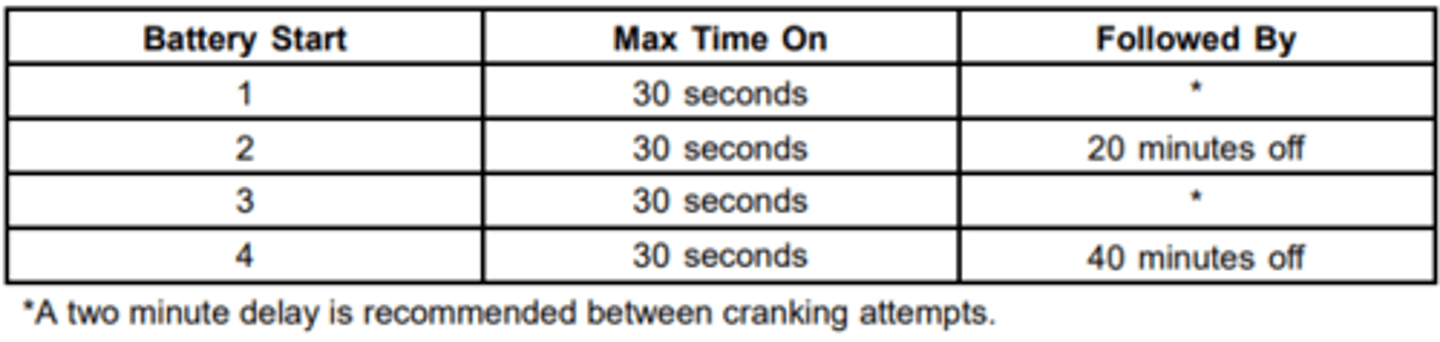
Starter duty cycle
Automatic Flight Control System (AFCS) -
Autopilot must be engaged above _______ unless otherwise permitted by the MEL.
FL 200
(20,000')
Automatic Flight Control System (AFCS) -
IAS MODE is _______ during an approach
prohibited
(IAS = indicated airspeed)
Automatic Flight Control System (AFCS) -
DES MODE (FD or AP coupled) is _______ during an approach
prohibited
(DES = descent)
(FD = flight director)
(AP = autopilot)
Automatic Flight Control System (AFCS) -
APPR MODE is _______ for _______ approaches
prohibited
VOR
(APPR = approach)
(NAV MODE is used for a VOR approach)
Automatic Flight Control System (AFCS) -
When an ADC SOURCE (1 or 2) is coupled to an active autopilot, the ADC source must be _______ to the ATC transponder being used in RVSM airspace.
the same as that coupled
(ADC = air data computer)
(RVSM = reduced vertical separation minimum. Used between FL 290 and FL 410)
Automatic Flight Control System (AFCS) -
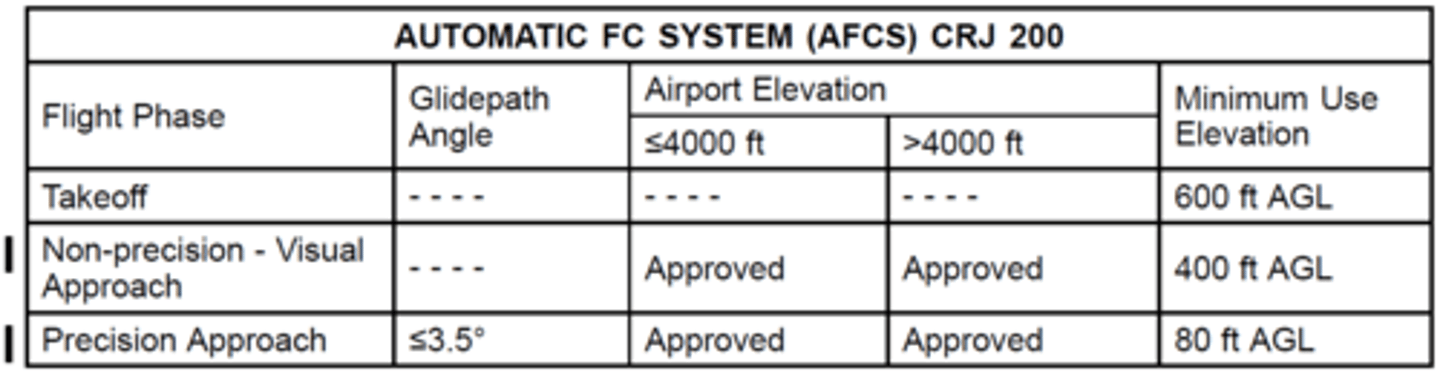
Minimum elevation use (on/off)
• Takeoff
• Non-Precision
• Precision
Electrical -
While on the ground and using only DC power, what is the time limitation in regard to usage?
5 minutes
Electrical -
Maximum continuous output of a DC TRU
100 A
(100 amps)
Electrical -
APU generator (max load)
Up to FL 370, the APU can provide up to 30kVA
(30,000 volt amps)
Fuel -
Pressure refueling (max total)
_______ lbs.
14,518
Fuel -
Gravity Refueling (max total)
_______ lbs.
13,906
Fuel -
What is the maximum fuel imbalance allowable for takeoff?
_______ lbs.
800
Fuel -
If a go-around is required, what is the minimum amount of fuel needed in each wing?
_______ lbs.
500
(Calculation is based on an airplane climb attitude of 10° nose-up)
Fuel -
Regarding bulk fuel at TAKEOFF, what is the minimum allowable temperature?
_______ °C
-30
Fuel -
Regarding bulk fuel while in FLIGHT, what is the minimum allowable temperature?
_______ °C
-40
Fuel -
Takeoff with fuel in excess of _______ lbs. in the center tank is not permitted unless:
• Each main wing tank is above _______ lb., or
• Each main wing tank is above _______ lb., and the allowable zero fuel weight is reduced by the weight of the fuel in the center tank in excess of 500 lb., and the allowable center of gravity (CG) in this configuration is verified to be within allowable CG envelope.
500
4,400
2,000
Fuel -
Powered crossflow (i.e., XFLOW AUTO OVERRIDE) and gravity crossflow (i.e., GRAVITY XFLOW) must be _______ for takeoff.
off
Fuel -
When fuel other than Jet-A is to be used, consult _______ for limitations.
QRH Volume 1
Power Plant -
Minimum reduced thrust - 3A1 Engine:
_______ %
85
Power Plant -
Minimum reduced thrust - 3B1 Engine:
_______ %
83.5
Automatic Performance Reserve (APR) -
Automatic Performance Reserve (APR) must be used when takeoff performance is predicated upon the use of _______.
APR
Automatic Performance Reserve (APR) -
The APR system must be selected to _______ when an APR INOP caution message is displayed on the EICAS.
OFF
(EICAS = Engine Indicating and Crew Alerting System)
Automatic Performance Reserve (APR) -
"APR OFF" performance must be used when an _______ caution message is displayed.
APR INOP
Automatic Performance Reserve (APR) -
The APR system must be selected OFF for takeoff and "APR OFF" performance must be used when the ambient temperature is _______ and below, and pressure altitude is less than _______ ft. (3A1 engines only)
-18°C
1000
Power Plant -
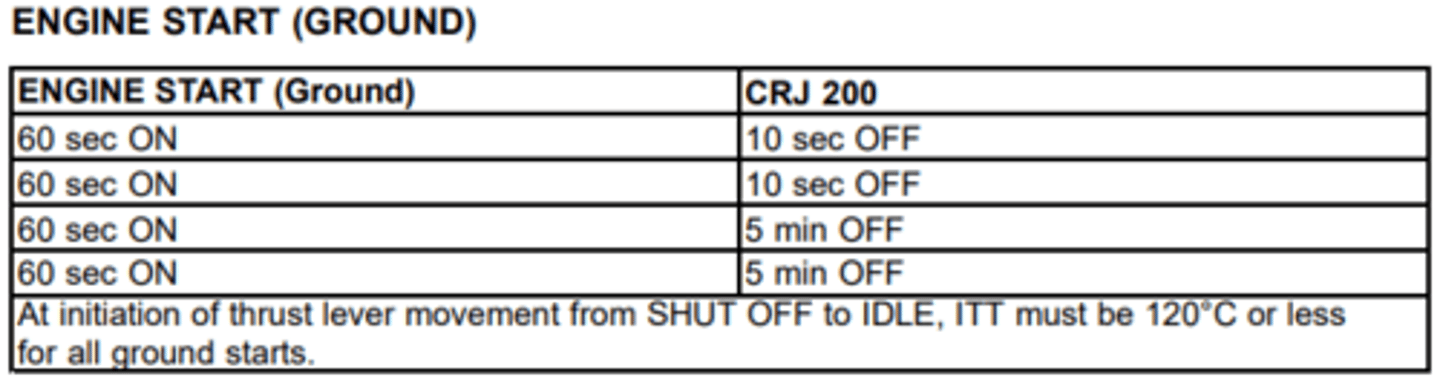
Engine Start (Ground)
Power Plant -
Engine - Dry Motoring (Ground)

Power Plant -
Max windmilling / starter-assisted, cross-bleed relight altitude: _______
FL 210
(21,000')
Power Plant -
Until oil pressure reaches the green band, do not:
_______
exceed idle
Power Plant -
Do not exceed 75% N1 until:
_______ or _______, whichever is longer.
2 minutes, all operating indications in green band
Power Plant -
Ground idle N₂ split:
_______
≤ 2%
Power Plant -
When starting a 2nd engine (1 or 2), the N₂ % on the operational engine must be:
_______
≤ 70% N₂
Power Plant -
With an OAT ≥ -20 °C (and thrust levers at idle), N₂ must read:
_______
> 57%.
If N₂ is ≤ 57% with an OAT of -20 °C or greater, do not advance thrust levers above idle. Contact Maintenance.
Power Plant -
Engines must not be shut down until:
_______
2 minutes at idle/near idle thrust.
(NOTE: Taxi time counts towards this limitation.)
Power Plant -
SkyWest prohibits the use of thrust reversers during _______
taxi operations
Power Plant -
Max OIL PRESSURE after cold start:
_______
Engine must remain at idle until oil psi returns to normal range. Must be in normal range within 10 min.
Misc. -
When operations are prohibited on routes where ozone concentrations exceed limits, this information can be found in the _______.
Quick Reference Handbook (QRH) Volume 1
Misc. -
Single-PACK operations are limited to:
_______ (FL altitude)
FL 250
(25,000')
Misc. -
CPAM passenger (pax) O₂ deployment altitude:
_______ ft.
14,000 ± 500
(CPAM - cabin pressure acquisition module)
Misc. -
The taxi lights must be switched OFF whenever _______.
the airplane is stationary in excess of 10 minutes
Misc. -
CARGO FIREX - When illuminated, how much flight time is allotted in order to land at a "suitable airport"?
45 minutes
Memory Item -
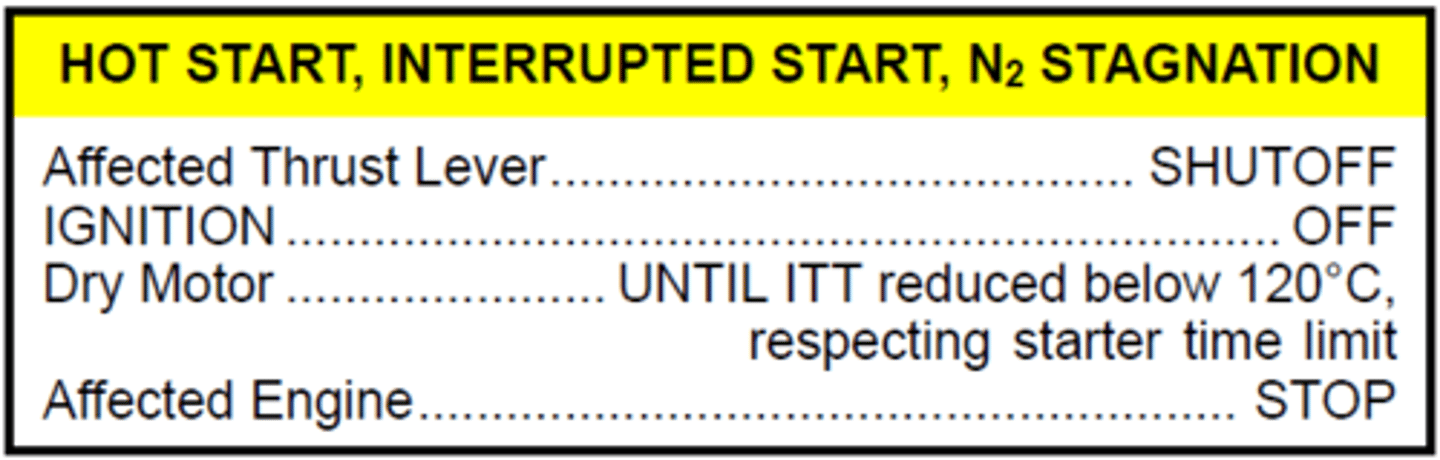
HOT START, INTERRUPTED START, N₂ STAGNATION
Memory Item -
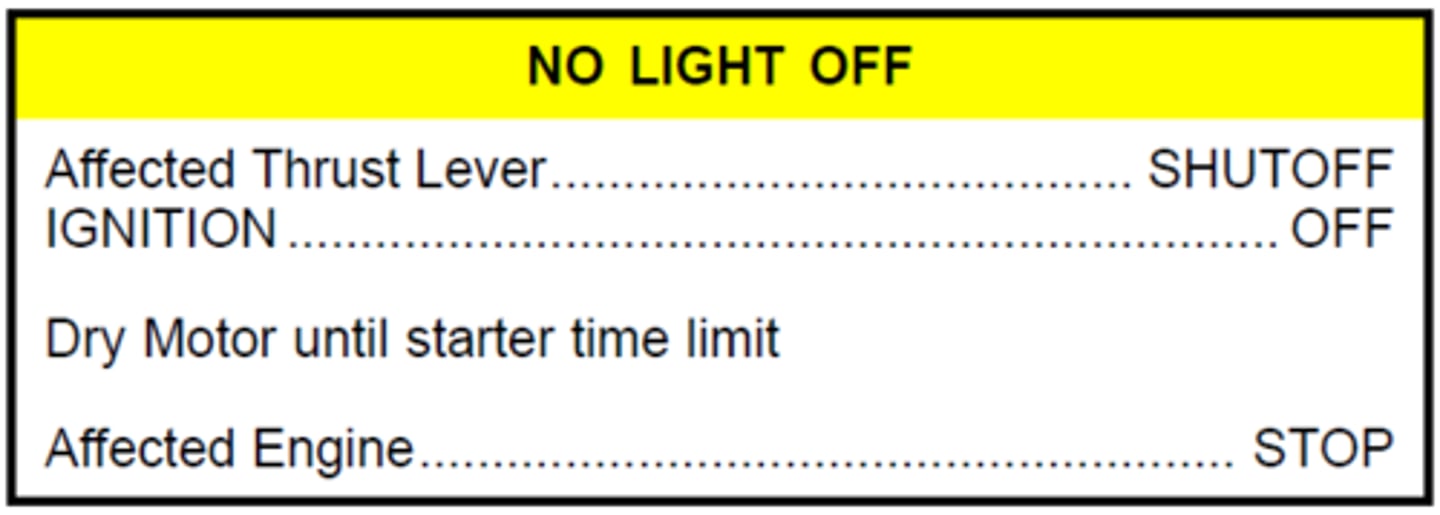
NO LIGHT OFF
Memory Item -
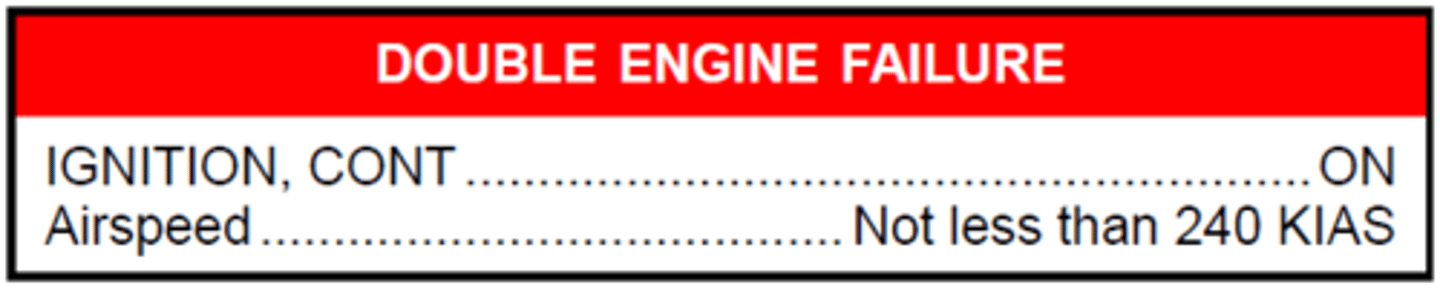
DOUBLE ENGINE FAILURE
Memory Item -
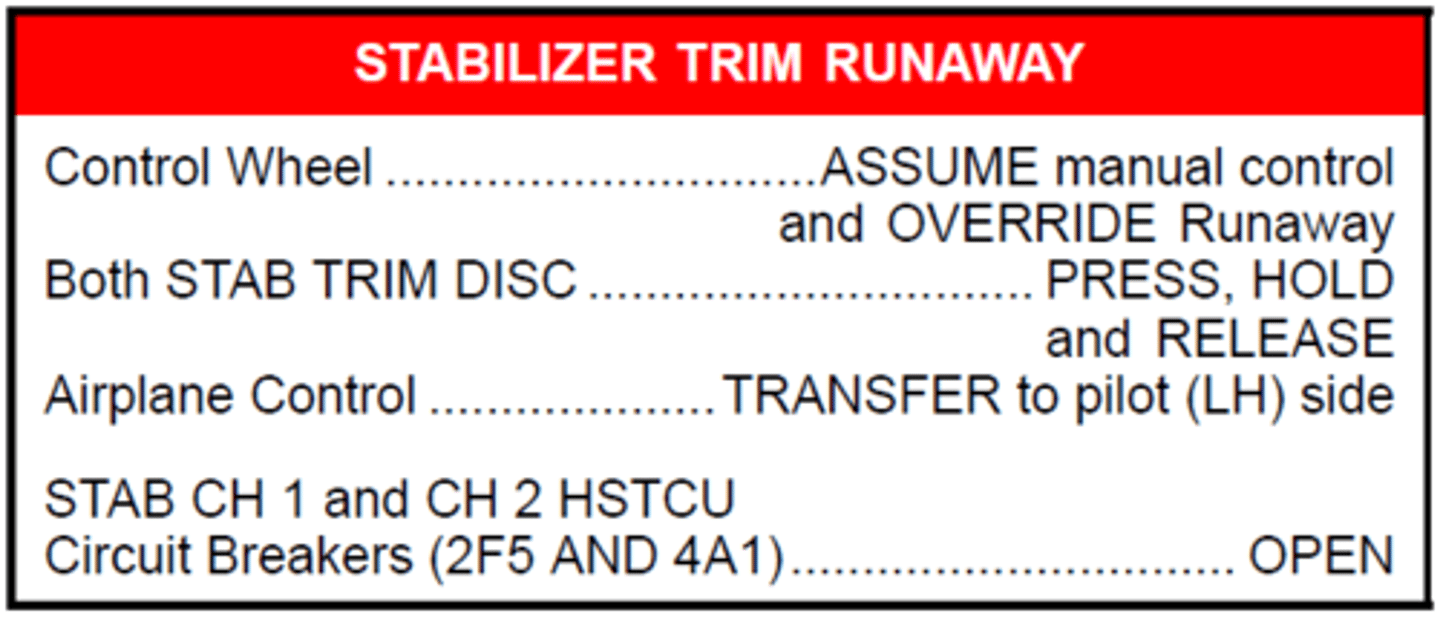
STABILIZER TRIM RUNAWAY
Memory Item -
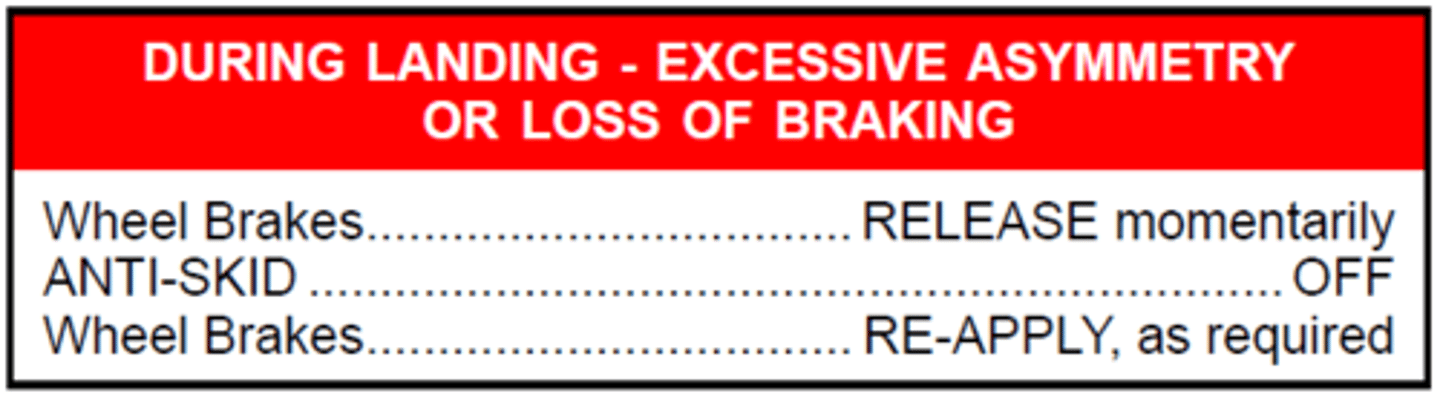
DURING LANDING - EXCESSIVE ASYMMETRY OR LOSS OF BRAKING