Unit 4: Cell Structure
 Call Kai
 Learn
Learn Practice Test
 Spaced Repetition
 Match
Match Flashcards
 Knowt Play
1/70

There's no tags or description
Looks like no tags are added yet.
Name | Mastery | Learn | Test | Matching | Spaced | Call with Kai |
|---|
No analytics yet
Send a link to your students to track their progress
71 Terms
Plasma Membrane
A biological membrane that separates and protects the interior of the cell from its external environment. It regulates the movement of substances in and out of the cell, maintaining homeostasis.
Cytosol
The fluid component of the cytoplasm where organelles are suspended, containing water, salts, and organic molecules essential for cellular processes.
Organelles
Specialized structures within a cell that perform distinct functions, such as energy production, protein synthesis, and waste management.
Nucleus (plural, nuclei)
The control center of the cell that houses the cell's genetic material (DNA) and coordinates activities such as growth, metabolism, and reproduction.
Cytoplasm
The entire contents of a cell within the plasma membrane, excluding the nucleus, including the cytosol and organelles.
Light microscope
An optical instrument that uses visible light and lenses to magnify small objects, allowing for the examination of cellular structures and details.
Microscopes that use ____ light can yield images in which the edges of some structures appear in three-dimensional relief.
polarized
Light micrographs (LM)
Images taken using light microscopes to visualize specimens at cellular or tissue levels, providing details of structures and arrangements.
DAPI 4',6-diamidino-2-phenylindole
A fluorescent stain that binds strongly to A-T rich regions in DNA, commonly used in fluorescence microscopy to label nuclei and visualize cell structures. Glows blue.
Structures smaller than about ___ nanometers appear blurry under light microscopes.
200
Transmission Electron Microscope (TEM)
A type of electron microscope that transmits electrons through a specimen to create highly detailed, two-dimensional images of internal structures.
Scanning electron microscope (SEM)
A type of electron microscope that scans the surface of a specimen coated by a thin layer of gold or other metals with a focused beam of electrons, producing detailed three-dimensional images.
Surface-to-volume ratio
A ratio that compares the surface area of an object to its volume, critical in understanding how cells exchange materials with their environment.
Cell Theory
1) Every living organism consists of one or more cells.
2) The cell is the basic structural and functional unit of life. Cells are individually alive even as part of a multicelled organism.
3) All living cells arise by division of preexisting cells.
4) Cells contain hereditary material (DNA), which they pass to their offspring during processes of reproduction.
Ribosomes
Cellular structures that synthesize proteins by translating messenger RNA into polypeptide chains, found in both prokaryotic and eukaryotic cells.
Plasmids
Small, circular DNA molecules separate from chromosomal DNA, commonly found in bacteria and archaea and used for gene transfer.
Nucleoid
The irregularly shaped region within a prokaryotic cell where the genetic material (DNA) is located, lacking a surrounding membrane.
Biofilm
A complex community of microorganisms encapsulated in a self-produced matrix of polymeric substances, often found on surfaces in wet environments.
Prokaryote cell wall
A rigid outer layer that provides structure and protection to plant cells, fungi, and most bacteria, composed of polysaccharides. It is typically made of peptidoglycan in bacteria, providing shape and preventing osmotic lysis.
Pilus
A hair-like appendage found on the surface of many bacteria that is used for attachment to surfaces, other cells, or for transferring genetic material.
Second membrane of prokaryotes
Prevents the peptidoglycan wall from taking up the Gram stain, making them Gram negative. This membrane provides an additional barrier, often rich in lipopolysaccharides, that enhances protection against antibiotics and detergents.
Bacterial capsule
A protective outer layer found in some bacteria, composed of polysaccharides or proteins, which aids in evading the host immune system and enhances adherence to surfaces. Archaea have a polysaccharide coating that is analogous.
Flagella
Long, whip-like structures that aid in bacterial motility by propelling the cell through liquid environments.
Organelles with membranes
Nucleus, Endoplasmic Reticulum, Golgi Body, Vesicle, Mitochondrion, Chloroplast, Lysosome, Peroxisome, Vacuole
Organisms without membranes
Ribosome, Centriole
Components of the nucleus
Chromatin: DNA and associated proteins in a cell nucleus
Nucleoplasm: Semifluid interior portion of the nucleus
Nuclear Envelope: Double membrane with nuclear pores that control which substances enter and exit
Nucleolus: Dense region of proteins and nucleic acid where ribosomal subunits are produced
The outer layer of nuclear envelope is ____ with the endoplasmic reticulum.
Continuous
Nuclear Lamina
A dense fibrillar network inside the nucleus, composed of intermediate filaments and membrane-associated proteins, providing structural support and regulating important cellular events such as DNA replication and cell division.
Endomembrane system
A network of membranes that divides the cell into functional compartments, including the nuclear envelope, endoplasmic reticulum, Golgi apparatus, lysosomes, and vesicles, involved in protein and lipid synthesis, transport, and degradation.
Vesicles
Small membrane-bound sacs that transport materials within the cell and between the cell and its environment.
Lysosomes
Organelles that contain digestive enzymes to break down waste materials and cellular debris, playing a key role in recycling and cellular maintenance.
Peroxisomes
Organelles that contain enzymes responsible for the oxidation of fatty acids and the detoxification of harmful substances, especially hydrogen peroxide. Also involved in the production of bile acids and cholesterol molecules.
Vacuoles
Large membrane-bound sacs that store nutrients, waste products, and maintain turgor pressure in plant cells, playing a critical role in cell homeostasis.
Central Vacuole
A large, prominent vacuole found in plant cells that stores water, nutrients, and waste products, helping to maintain turgor pressure and support cell structure.
Endoplasmic reticulum
A network of membranes involved in the synthesis of proteins and lipids, and the detoxification of certain chemicals within the cell.
Rough Endoplasmic Reticulum
A type of endoplasmic reticulum studded with ribosomes, responsible for the synthesis and processing of proteins.
Smooth Endoplasmic Reticulum
A type of endoplasmic reticulum that lacks ribosomes, involved in the synthesis of lipids, metabolism of carbohydrates, and detoxification of drugs and poisons. Contains calcium ions for muscle contraction and storage.
Golgi Body
A cell organelle involved in the modification, sorting, and packaging of proteins and lipids for secretion or delivery to other organelles. Attach sugars, oligosaccharides, or phosphate groups to the proteins/lipids. In plant cells. they make pectin (a complex, branched polysaccharide) for the cell wall.
Plastids
Organelles involved in the synthesis and storage of food, containing pigments for photosynthesis or starch storage. Examples include chloroplasts, chromoplasts, and amyloplasts.
Chloroplasts
Organelles found in plant cells that conduct photosynthesis, converting light energy into chemical energy stored as glucose. They contain the green pigment chlorophyll, essential for capturing light energy.
Stroma
The fluid-filled space inside chloroplasts where the Calvin cycle takes place, containing enzymes and other molecules necessary for photosynthesis.
Thylakoid membrane
The internal membrane system in chloroplasts that forms flattened sacs called thylakoids, where the light-dependent reactions of photosynthesis occur, housing chlorophyll and other pigments.
Chromoplasts
Organelles responsible for pigment synthesis and storage in plant cells, giving color to fruits and flowers. They contain carotenoids, which can attract pollinators and aid in seed dispersal.
Amyloplasts
Organelles that store starch in plant cells and convert it to glucose when needed, playing a crucial role in energy storage. They are abundant in the stems, fruits, and seeds. They play a role in gravity sensation.
Cytoskeleton
A network of protein filaments and tubules that provide structural support, shape, and organization to the cell. It also plays a role in cell movement and transport within the cell.
Microtubules
Components of the cytoskeleton, consisting of hollow tubes made of tubulin proteins. They are involved in maintaining cell shape, facilitating cell division, and transporting organelles.
Microfilaments
Thin, thread-like structures in the cytoskeleton made of actin proteins. They are involved in cellular movements, muscle contraction, and maintaining cell shape.
Cell Cortex
A specialized region of the cytoplasm just beneath the plasma membrane, composed mainly of microfilaments and regulatory proteins. It plays a crucial role in maintaining the cell's shape and facilitating cell movement.
Intermediate Filaments
Component of the cytoskeleton that provides mechanical support and stability to cells. They are made of various proteins, including keratins (hair), lamins (nuclear lamina), and vimentin, and help anchor organelles in place.
Motor Proteins
Proteins that convert chemical energy into mechanical work to facilitate movement within cells, including the transport of organelles and muscle contraction.
Myosin
A type of motor protein that interacts with actin filaments to facilitate muscle contraction and other forms of cellular movement.
Dynein
A motor protein that transports cellular cargo along microtubules, moving towards the minus end. It plays a critical role in various cellular processes, including mitosis and ciliary movement.
Cilia
Hair-like structures on the surface of cells that aid in movement and sensory functions. They beat in coordinated waves to propel the cell or move fluids.
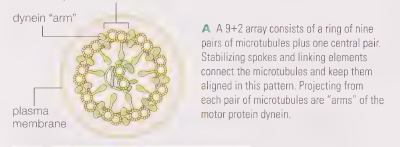
9+2 Array
A structure consisting of nine pairs of microtubules arranged in a circle surrounding two centrally located microtubules. This configuration is characteristic of cilia and flagella, providing them with their motility.
Centriole
A cylindrical organelle found in pairs, consisting of nine triplets of microtubules. Centrioles are critical for cell division as they help organize the mitotic spindle.
Basal Body
The structure that anchors cilia and flagella to the cell, composed of nine triplets of microtubules. It serves as a foundational component for the assembly of these organelles.
Pseudopods
Temporary projections of eukaryotic cells, primarily used for movement and capturing food. They extend and retract to enable motility and facilitate phagocytosis.
Ciliary Movement
At a molecular level, motor proteins called dynein use ATP to "walk" along internal microtubules, causing them to slide and bend. This continuous cycle alternates between a rapid, stiff forward thrust (the power stroke) to push fluid or mucus, and a relaxed, folded return (the recovery stroke) to the starting position. Together, neighboring cilia coordinate these strokes in metachronal waves to propel cells or clear foreign particles across epithelial surfaces
Kartagener Syndrome
A genetic disorder characterized by the abnormal structure and function of cilia and flagella. It results in reduced or absent ciliary movement, leading to chronic respiratory issues and infertility.
Extracellular Matrix (ECM)
A complex network of proteins and carbohydrates that provides structural and biochemical support to surrounding cells. It plays a crucial role in cell adhesion, communication, and regulation of various cellular functions.
Primary Wall
The first layer of a plant cell wall, composed mainly of cellulose, hemicellulose, and pectin. It provides support and defines the shape of the cell, allowing for growth while maintaining flexibility.
Secondary Wall
The inner layer of a plant cell wall, primarily made of cellulose and lignin, which provides additional strength and rigidity, enabling the cell to support more weight and withstand various stresses.
Lignin
Makes up as much as 25% of the cell walls in older stems and roots. This complex organic polymer provides rigidity and resistance to degradation, contributing to the overall structural integrity of plants.
Basement Membrane
A thin layer of extracellular matrix between epithelial tissue and underlying connective tissue, providing structural support and filtration functions. Sheet of fibrous material.
Cuticle
A protective, waxy layer covering the surfaces of leaves and stems in plants that reduces water loss and protects against environmental factors. The cuticle of arthropods consists of chitin.
Cell junctions
Cell junctions are specialized structures that connect adjacent cells in tissues, facilitating communication, adhesion, and the maintenance of tissue integrity.
Tight Junctions
Specialized connections between adjacent epithelial cells that create a barrier to prevent leakage of materials and maintain distinct membrane domains. For example, the lining of the stomach is leak-proof due to these junctions which keep gastric fluid inside the stomach.
Adhering Junctions
A type of cell junction that connects adjacent cells and provides mechanical stability by anchoring the cytoskeletons to one another. These junctions play a crucial role in maintaining the structural integrity of tissues. An example is their presence in contractile tissue.
Gap Junctions
Specialized structures that allow direct communication between adjacent cells by forming channels that permit the passage of ions and small molecules. They are essential for coordinating activities in tissues such as cardiac muscle.
Plasmodesmata
Cellular channels in plant cells that connect the cytoplasm of adjacent cells, allowing for communication and transport of substances like water, nutrients, and signaling molecules.
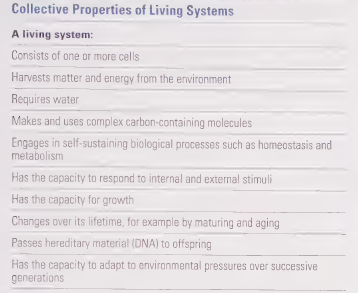
Properties of living systems