Chapter 3.1. The Cell, DNA, and Mendelian Genetics
 Call Kai
 Learn
Learn Practice Test
 Spaced Repetition
 Match
Match Flashcards
 Knowt Play
1/18

Earn XP
Description and Tags
Name | Mastery | Learn | Test | Matching | Spaced | Call with Kai |
|---|
No analytics yet
Send a link to your students to track their progress
19 Terms
Darwin’s Posulates
Individuals compete to survive
Individuals vary in ways that affect their ability to survive
Some variation is heritable
Blending Inheritance
Hereditary substance of both parents mixed/blended; Elimination of Variance
Cell
Basic Unit of Life, where complex life forms are made up of billions of cells
What are cells made up of?
Genetic Material & other Structures
Prokaryotic Cells
Cells with no nucleus that make up Single Celled Organisms. (Bacteria. Blue-green Algae)
Eukaryotic Cells
Complex cells with a nucleus that make up all organisms except Bacteria & Blue-green algae
Common ancestor with Prokaryotic Cells.
What Are The Differences Between Prokaryotic Cells and Eukaryotic Cells?
One has a nucleus, one does not
One makes up single celled organisms, one makes up all organisms
one makes up Bacteria & Blue-green Algae, one does not
What Are The Two Main Types of Cells?
Somatic Cells
Gametes
Somatic Cells
Basic Structure
Makes up tissues, organs, bones, & blood
Gametes
Reproductive Cells
Each holds Half Genetic Make-up
Gametes; Egg
Large egg produced in human females during fetal stage of development
Gametes; Sperm (DNA with a tail)
Small cell
Produced continuously in adult males
Chromosomes
Small linear bodies in a cell’s nucleus
Replicated during cell division
Exists in homologous pairs, in diploid organisms
Humans: 23 Pairs
What Are The Two Types of Cell Division?
Mitosis
Meiosis
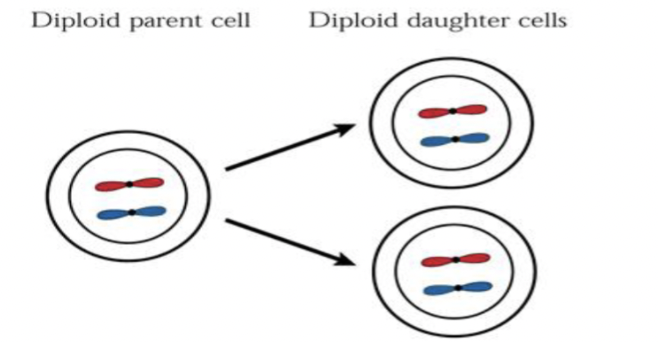
Mitosis
Cell Division for Somatic Cells
Creates 2 EXACT copies of chromosome pairs in each cell
Diploid → 2 Diploids
Meiosis
Cell Division to produce Gametes
Creates 1 SINGLE chromosome in each cell
Diploid → 2 Haploid Gamete
Meiosis & Fertilization
Haploid Sperm + Haploid Ovum Come Together (Through Meiosis)
New Pairs of Chromosomes Form in Diploid Zygote
Zygote Divides Through Mitosis, which Builds Up New Organism
What Did We Know In The 1950s?
Cell Division
Chromosomes contained Protein & Nucleic Acids
DNA contains hereditary information
Francis Crick & James Watson
Deduced the structure of DNA.