WPS 224 Hardwood structure
 Call Kai
 Learn
Learn Practice Test
 Spaced Repetition
 Match
Match Flashcards
 Knowt Play
1/9

There's no tags or description
Looks like no tags are added yet.
Name | Mastery | Learn | Test | Matching | Spaced | Call with Kai |
|---|
No analytics yet
Send a link to your students to track their progress
10 Terms
Hardwood features
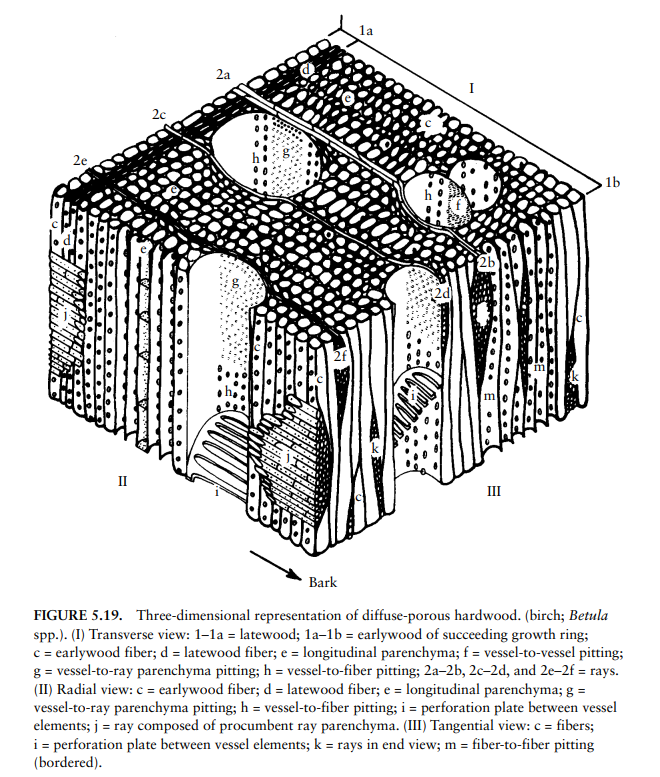
4 major types of cells which each make up about 15+% of total volume.
Vessels are unique to hardwoods.
Wide rays in some species. 17% volume average.
Rays seldom aligned in straight radial rows.
Usually less dense than softwoods.
Longitudinal cells
Produced by fusiform initial division in cambium.
Visual differences & lack in radial alignment only prominent in cell maturation.
Vessels
Made up of vessel elements. Much larger diameter and shorter length than most longitudinal cells. Shorter than HW fibre & SW tracheid.
Vessel elements link end to end to form tube-like structures called vessels, which have considerable tangential variation (not straight). This ensures that each branch of the crown receives water from many different roots. Safety feature against root damage.
Diameter size and arrangement used in identification.
Side-to-side connection by bordered pits. Can be connected to fiber tracheids, longitudinal and ray parenchyma via pits.
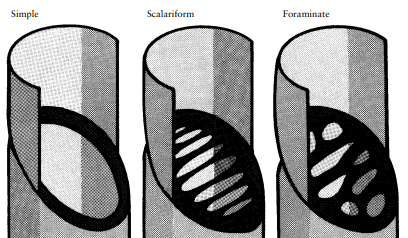
Vessel perforation plates
Are vessel element end walls (end-to-end connections). Holes in plates are called perforations.
Formed at end of cell maturation when enzymes such as cellulase dissolve portions of perforation plates.
Perforation shape used in identification.
Tyloses
Outgrowths of parenchyma cells into the hollow lumens of vessels.
Commonly form in many hardwoods as a result of wounding and effectively act to prevent water loss from the area around damaged tissue.
Block vessels.
Fibres
More specifically called fiber tracheids.
Long, tapered, and usually thick‐walled cells. Much shorter and rounder than SW tracheids.
Primary function is mechanical support.
Bordered pits between fibre tracheids, but half bordered between fibre tracheids and parenchyma.
Libriform fibre has simple pits instead.
Longitudinal parenchyma
Thin walled storage units.
Occur in the form of long, tapered longitudinal cells, short, brick‐shaped epithelium around gum canals (in only a few species), and ray cells.
Can be 24% of total volume.
Unlike in SW, occurs in many HW.
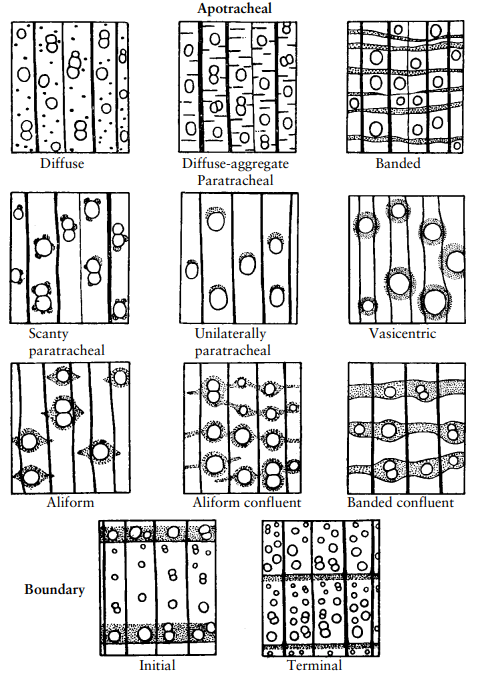
Parenchyma arrangements (transverse view)
Rays
Tangential width of 1-30 cells.
Homogeneous of parenchyma cell type.
Square ray cells are sqaure when viewed radially.
Procumbent ray cells are when the cells’ long dimension is perpendicular to the axes of longitudinal cells.
Upright ray cells are when the cells stand on end with their long axes parallel to the grain direction.
Storied ray cells are arranged into definite tiers as viewed on a tangential surface. Rays in each layer are roughly the same height, and all begin and end at about the same level along the grain.
Identification