1.4 Resource Allocation in Different Economic Systems
 Call Kai
 Learn
Learn Practice Test
 Spaced Repetition
 Match
Match Flashcards
 Knowt Play
1/34

There's no tags or description
Looks like no tags are added yet.
Name | Mastery | Learn | Test | Matching | Spaced | Call with Kai |
|---|
No analytics yet
Send a link to your students to track their progress
35 Terms
What is an economic system
The way a country organises decision‑making by households, firms and government about the three allocation questions: what to produce, how to produce and who should receive the goods and services.
- The way in which production is organised and choices are made in an economy
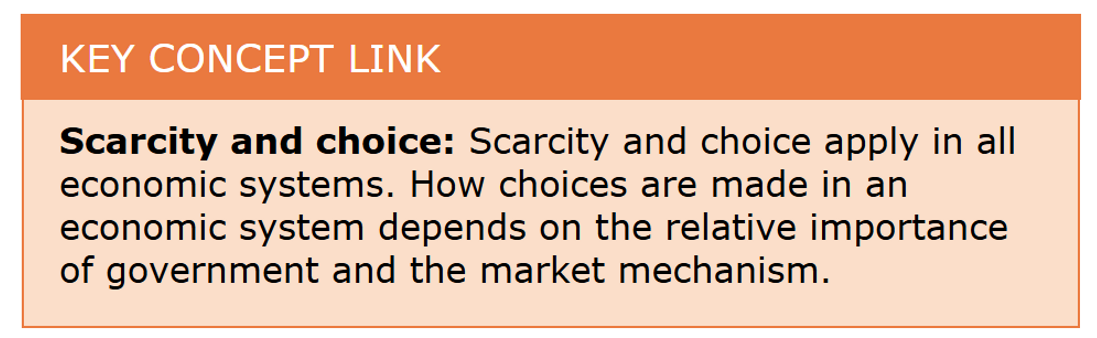
Why is resource allocation a fundamental issue in all economies (low, middle & high income)
Because of scarcity: limited productive resources must be allocated among competing uses, so every system must answer what/how/for whom.
Key concept link
What are the three broad main types of economic system + brief explanation of each
The market economy - an economic system where most decisions are taken through the market mechanism
2. The planned (command) economy - an economic system where resources are state-owned and allocated by a central body
3. The mixed economy - an economic system where both market forces and government are involved in resources allocation decisions
Exam tip – classification
No economy is a pure type; most are mixed systems to different degrees, depending on the relative roles of the market mechanism and government.
What is a market (free‑market) economy
An economy in which resources are allocated mainly by the price mechanism: the interaction of demand and supply by millions of individuals and firms, with little direct government involvement.
Who makes decisions in a market economy
Individuals and firms acting in their self‑interest as buyers and sellers.
How are resources allocated in a market economy
Through prices that adjust when demand or supply changes; prices act as signals and incentives to producers and consumers.
What is the price (market) mechanism
A system in which changes in price—caused by excess demand or excess supply—guide what is produced, how much, and by whom, allocating scarce resources.
- Resource allocation decisions are taken by individual producers and consumers with no government intervention
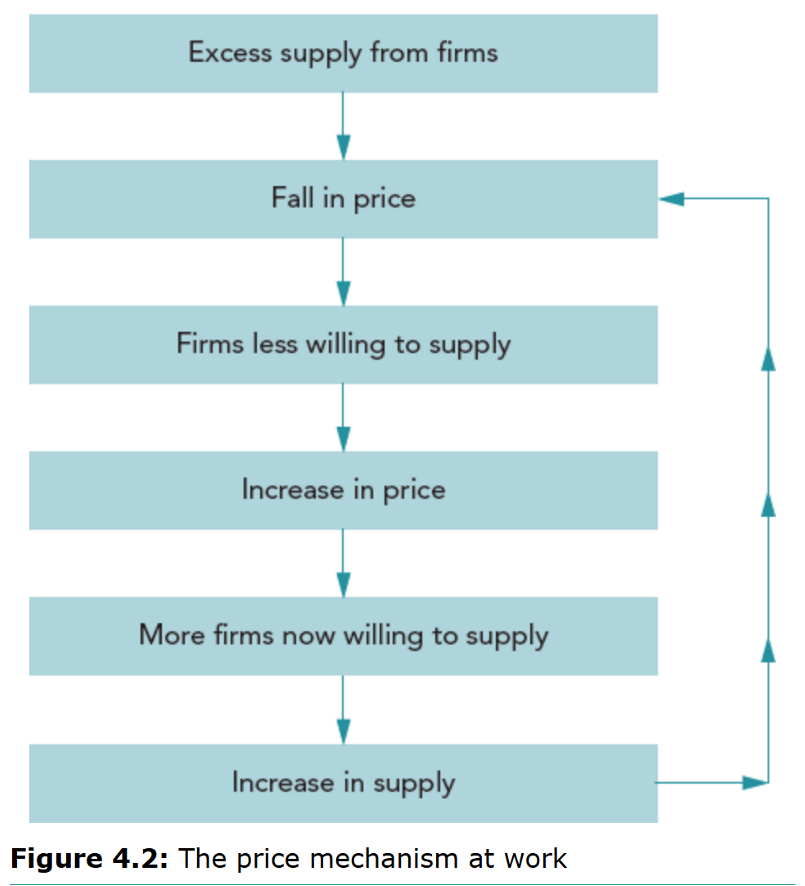
How does the price mechanism work in the textbook diagram (7)
If there is excess supply → price falls → some firms are less willing to supply → supply shifts inwards → price rises → more firms re‑enter, raising supply.
- This continual adjustment clears stocks and allocates resources.
- Assumes no change in demand
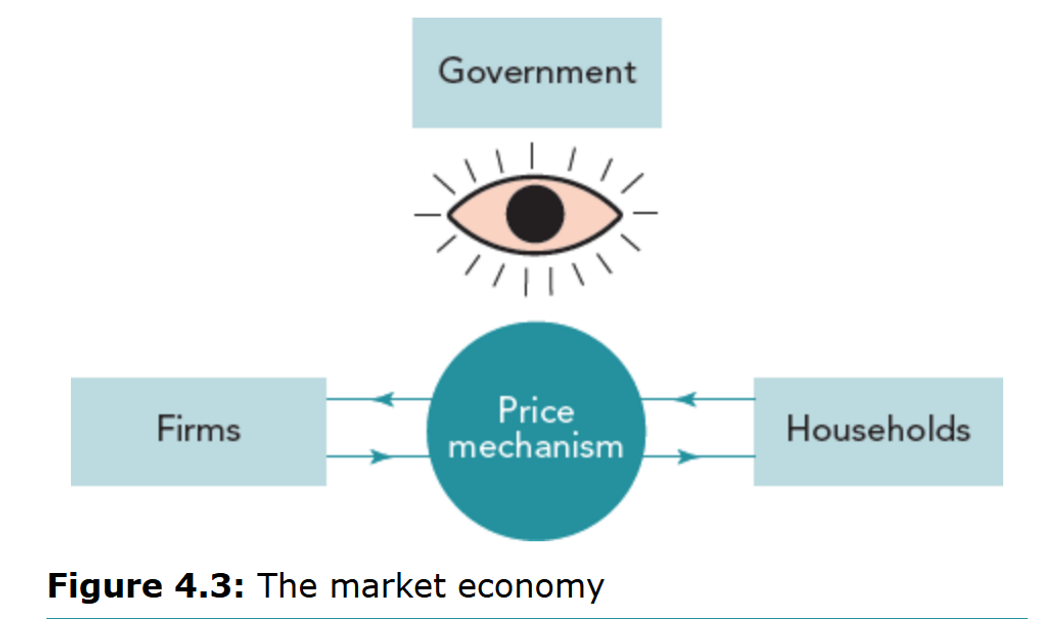
What is the role of government in a market economy, according to the text
In principle, the government should have no direct role if the price mechanism allocates efficiently; the government observes and intervenes only when markets fail (e.g., public goods, under‑provision of healthcare, regulation of monopoly power).
What are the strengths of a market economy (3)
Efficiency: resources tend to flow to where they are most valued
2. Innovation and competition are encouraged
3. Responsive to consumer preferences
What are the weaknesses of a market economy
Can produce inequality of income and wealth
2. Under‑provision of public and merit goods
3. Market failures (e.g., externalities, market power)
What present‑day example does the text use for a near‑market system
Hong Kong SAR is described as a near‑perfect example:
- All businesses are privately owned
- Many services (e.g., transport) are privately provided
- The economy is dominated by local, US- and European-owned multinational companies
- The framework has retained many benefits of a market economy (since 1997)
Why is a ‘true’ free market described as an ideal
Because in practice governments do provide some public services and regulate when markets fail; no economy operates as a completely free market.
What is a planned economy
An economy in which central government and its organisations take the key decisions about what to produce, how to produce and for whom. Production is controlled centrally by the state (government has a central role in ALL decisions)
Who makes decisions and how are resources allocated in a planned economy (3)
Planning boards/ministries set production targets for major sectors (agriculture, manufacturing), often linked to long‑term growth aims;
- prices and wages for essentials are controlled
- the state owns most productive resources.
What are productive resources
Resources that are available to be used
What happens to market signals in a planned economy
The rise and fall of prices plays little role; with administered low prices, excess demand is common, leading to shortages and queues for basic foods and goods.
What are the strengths of a planned economy (2)
• Ability to prioritise basic needs and provide public/merit goods
• Potential for equitable distribution through direct allocation
What are the weaknesses of a planned economy (3)
• Inefficiency from lack of price signals and weak incentives
• Risk of bureaucracy and inflexibility
• Can stifle innovation and enterprise; private ownership is often restricted to small retail/services
Which examples are closest to the textbook’s description of planned economies today
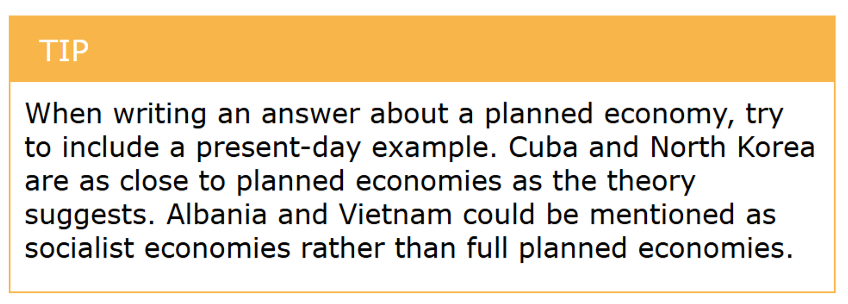
North Korea and Cuba are cited as closest to fully planned systems.
Exam chain – planned economy
Central plans allocate resources → targets replace market prices → basic needs can be met uniformly, but weak profit incentives and price controls reduce efficiency and innovation.
What is a mixed economy
The typical modern system in which both the private sector and the public sector have roles in allocation.
- Decisions involve interaction between firms, labour and government—mainly via the market but with state provision/regulation.
What is the private sector
The part of an economy under private ownership
What is the public sector
The part of an economy under government ownership
Who makes decisions in a mixed economy
Firms and households through markets, and government through taxation, spending, provision and regulation.
How are resources allocated in a mixed economy
Markets allocate most resources, while government provides public/merit goods, corrects market failure, and reduces inequality.
What trends does the textbook highlight about mixed economies
Over the last 30 years, many countries have moved towards markets via privatisation and liberalisation (e.g., in Central/Eastern Europe and parts of South Asia), while others maintain greater planning.
What is privatisation (as used in this chapter)
The transfer of ownership/control of productive resources from the public to the private sector to expand the role of the market mechanism.
What are the strengths of a mixed economy (2)
• Combines market efficiency with social objectives
• Government can remedy market failures and provide key services
What are the weaknesses of a mixed economy (2)
• Public sector production can be inefficient
• Intervention can be costly and may still leave inequality
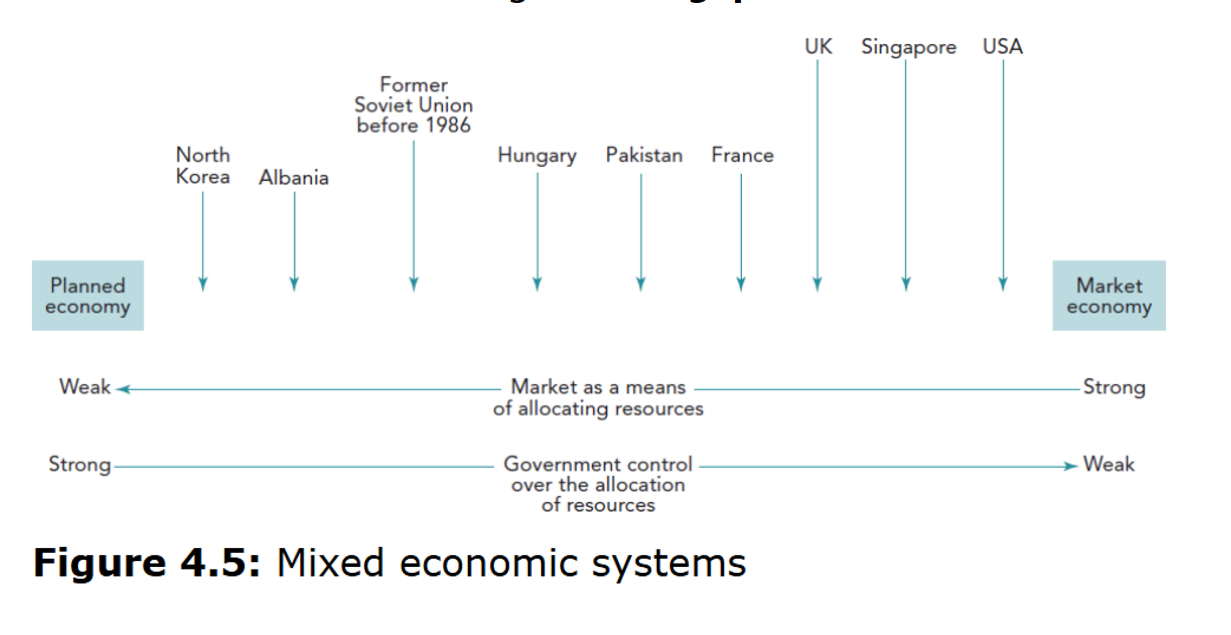
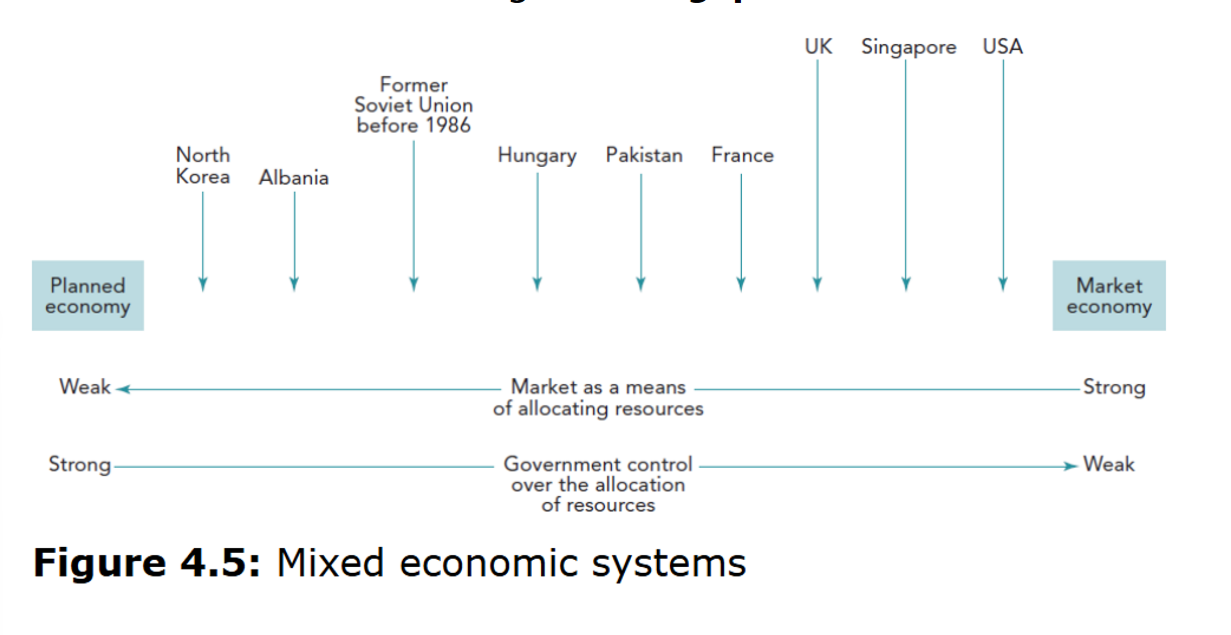
What does the ‘continuum’ diagram (Figure 4.5) show
Countries fall along a spectrum: from planned (e.g., North Korea, Albania) through intermediate mixed economies (e.g., Hungary, Pakistan, France) to more market‑oriented (e.g., UK, Singapore, USA).
How to use Figure 4.5 in an answer
State that all countries are mixed to some degree; use named examples from across the scale to show relative strength of market vs government control.
Key concept link