Solid State Properties FInal
 Call Kai
 Learn
Learn Practice Test
 Spaced Repetition
 Match
Match Flashcards
 Knowt Play
1/16

Earn XP
Description and Tags
questions 7-20
Name | Mastery | Learn | Test | Matching | Spaced | Call with Kai |
|---|
No analytics yet
Send a link to your students to track their progress
17 Terms
Explain dielectric permittivity from an atomic level
An individual atom in the electric field feels some effect of the field, so that its positive (nucleus) and negative (electron cloud) charges don’t cancel out at its center of mass but are shifted by the field. If the center of each electron in the field is moved by a small amount, the effective local electric field is increased by the presence of these local dipoles (induced polarization).
What is meant by dielectric breakdown and explain what intrinsic breakdown is
Dielectric breakdown occurs when dielectric material becomes conductive because applied E-field exceeds its insulating capabilities. Current increases rapidly due to the increased bias.
Intrinsic or avalanche breakdown is when electrons gain enough energy from a strong electric field. When these electron clouds collide, lattice atoms are ionized and electrons can be excited across the band gap, which causes a series of impact ionizations and runaway increase in conduction.
What does the relative permittivity tell us about a Dielectric
Relative permittivity tells us how well a dielectric material polarizes under an electric field, which is directly correlated with the amount of energy it can store.
What is an advantage of semiconducting polymers and organics for opto-electronic devices? Give an example.
Flexible, low-cost and solution-processible, making them useful for opto-electronic devices which require low resistance and high transparency. They can be made very thin, unlike metals which ball up when deposited in atomically thin layers. Examples: OLED displays and flexible solar cells.
What are the three main types or sources of polarization and give a description on each one
Electronic polarization – dipole is formed from the displacement of the center of the electron cloud from the atom. All dielectric materials exhibit this to some extent.
Ionic polarization – In ionic crystals, when an electric field is applied, cations are displaced to one side and anions to the other.
Orientation polarization – when an external electric field is applied on molecules with permanent dipoles, they rotate to align with the field.
Give an example of the use of high k dielectric material using diagram to explain.
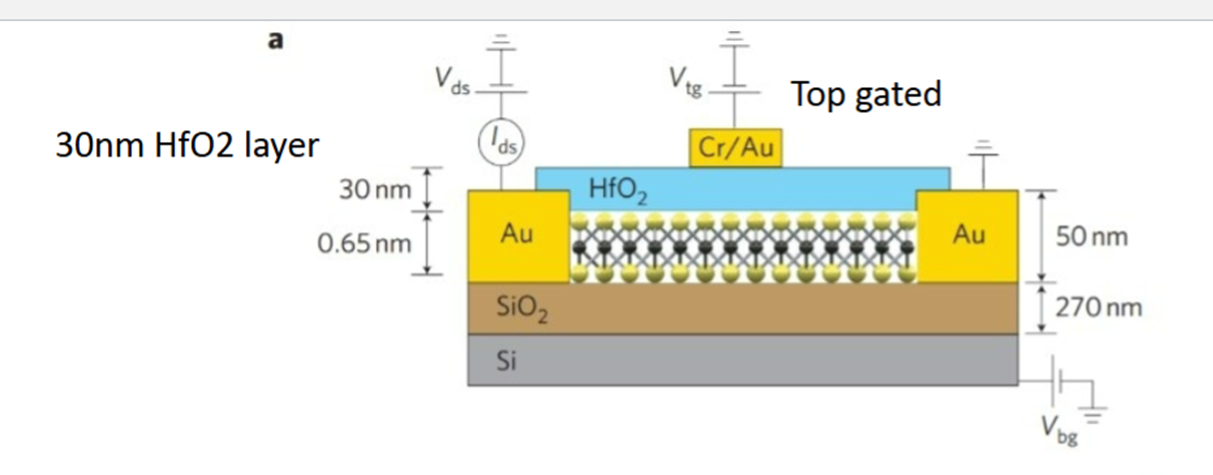
Hafnium dioxide (HfO2) is a high k dielectric material which can be used as a gate oxide in a MOSFET to improve gate control and lower power consumption. This material is good because it can improve capacitance while being thick enough to prevent quantum tunneling.
What requirements does crystal symmetry need to satisfy to be piezo-electric and why does straining it cause an overall dipole moment?
The crystal must not have a center of symmetry in order to be piezoelectric. If it has a center of symmetry, the charges will cancel and no dipole will be generated. When stress is applied in a non-centrosymmetric material, charges accumulate as the lattice elongates, which produces a dipole.
What is a piezoelectric material
A piezoelectric material generates a charge in response to an applied strain, or strains in response to an applied electric field.
What is a Ferroelectric material
Ferroelectrics have spontaneous polarization, meaning their electron clouds are aligned in dipoles even in the absence of an applied electric field. This polarization can be switched by applying an electric field.
What is the difference between an optical band gap and the electronic band gap
The electronic bandgap is the difference between the top of the valence band and the bottom of the conduction band and is based on the band structure and energy levels of the material’s electrons. The optical band-gap is the threshold for photon absorption in direct band gap materials. The optical band gap is the energy required to create an exciton through photon absorption.
What is the binding energy of an exciton a measure of?
The binding energy of an exciton is the energy required to separate the bound electron-hole pair into free charge carriers.
Why do Neodymium compounds give stronger magnets than iron?
Neodymium compounds have 4 unpaired electrons compared to iron (3 unpaired electrons), which have strong spin-orbit coupling that stabilizes magnetic moments.
(a) Explain the definition of (i) paramagnetism, (ii) Ferromagnetism (iii) Anti-ferromagnetism (iv) Ferrimagnetism
Paramagnetism is temporary magnetism that occurs when an external magnetic field is applied to a material and all the magnetic moments of the material align temporarily. Ferromagnetic materials have permanent magnetic dipoles due to spontaneous magnetism (all moments equal and aligned in one direction). Ferrimagnetic materials have an overall magnetic dipole in one direction, but have smaller magnetic moments aligned antiparallel. Antiferromagnetic materials have no net magnetism as their magnetic moments are aligned so that they cancel each other out.
Describe a Frenkel exciton and a Wannier-Mott exciton.
A Frenkel exciton is localized within the lattice structure and has a small dielectric constant (stronger Coulombic interaction). Wannier-Mott excitons are much larger and found in materials with a larger dielectric constant, which causes weak Coulombic interaction. Frenkel excitons are bound more tightly than WM excitons.
What is the physical difference between a single mode and multi-mode fiber. What considerations about size and wavelength need to be made for achieve single mode only
Single-mode fibers only support one kind of propagation as they have very small cores so not a lot of light can get in. Multi-mode fibers can support many kinds of light propagation as they have large cores. Single-mode fibers need to have core size smaller than the wavelength of the light so that only one mode of travel is supported. Generally, single-mode is used with longer wavelength light and smaller cores.
Explain how an optical fiber works to confine light in the core. Use diagrams to explain your answer
Optical fibers work by confining light in a core surrounded by a cladding shell. The core has a higher refractive index than the cladding, so when light strikes the interface, it is refracted back towards the center and travels along the fiber.
Explain how the following stack of high/low alternating refractive index creates a high reflectivity mirror.
Each component has an optical thickness of lambda/4, so combining one pair of H-L reflectors gives lambda/2. Light is thus reflected by each pair in phase so all the reflections are constructively superimposed, giving high reflectivity.