AP Human Geography - Unit 2 Test (Population and Migration)
 Call Kai
 Learn
Learn Practice Test
 Spaced Repetition
 Match
Match Flashcards
 Knowt Play
1/74

There's no tags or description
Looks like no tags are added yet.
Name | Mastery | Learn | Test | Matching | Spaced | Call with Kai |
|---|
No analytics yet
Send a link to your students to track their progress
75 Terms
Arithmetic population density is
the number of people per unit of measurement
Which of the following countries has the lowest arithmetic density?
Canada
Physiological density is
the number of people per square mile of arable land
Which country has a low arithmetic population density, but a high psychological population density?
Egypt
Globally, the three largest population concentrations are located in
Europe, South Asia, and East Asia
The population clusters in Asia
are predominately rural in nature
What region of North America is most densely populated?
Northeast
Under what circumstances could high birth rates pose a challenge for a country?
a) If a country's economy grows at a slower rate than the CBR
b) If a country is unable to provide adequate health care for its citizens
c) If a country's natural resources are depleted in an unsustainable manner
d) If a country's population structure resembles a pyramid
e) ALL OF THE ABOVE
Which population pyramid shows a population that is slowly growing?
Pyramid "B"
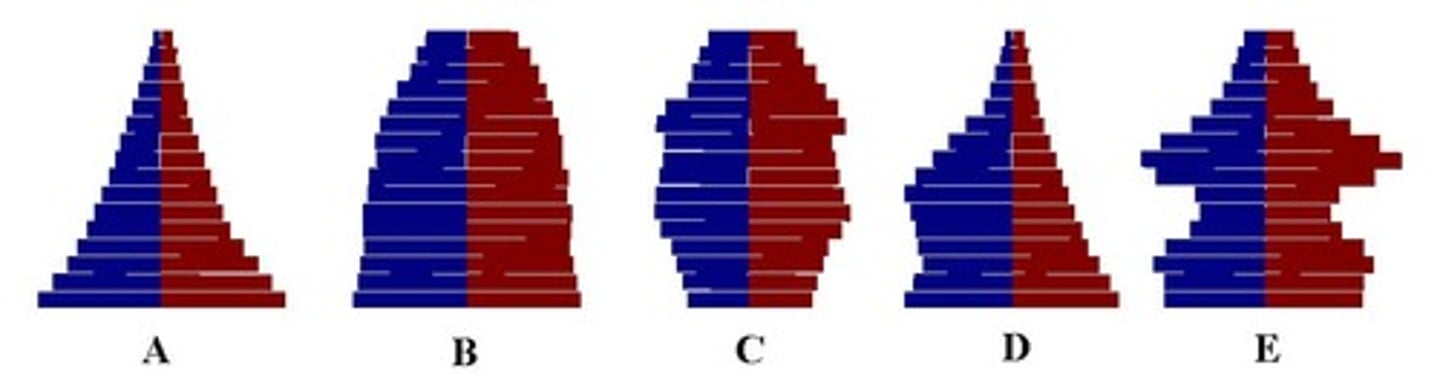
Which population pyramid shows a population whose total numbers is declining?
Pyramid "C"
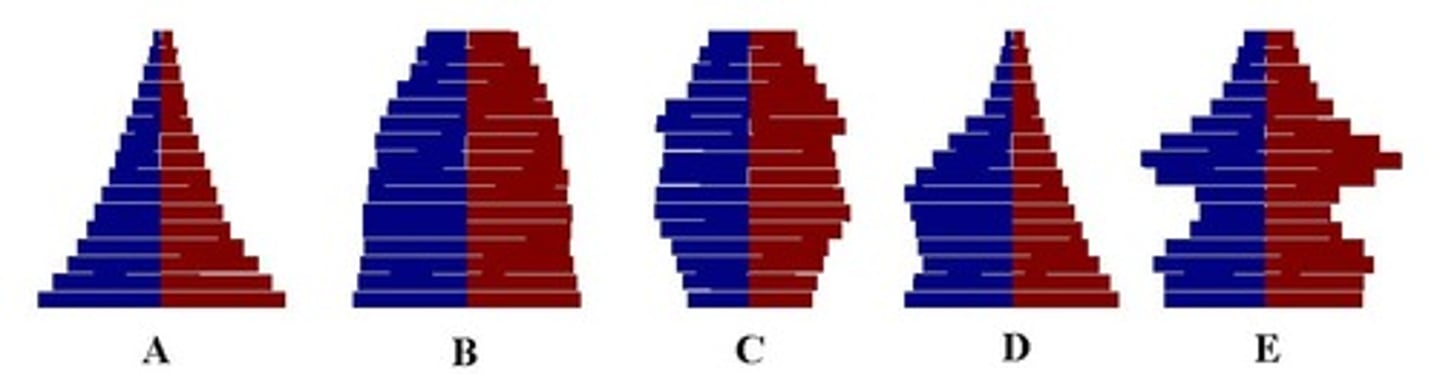
Which population pyramid best reflects the population structure of Germany?
Pyramid "C"
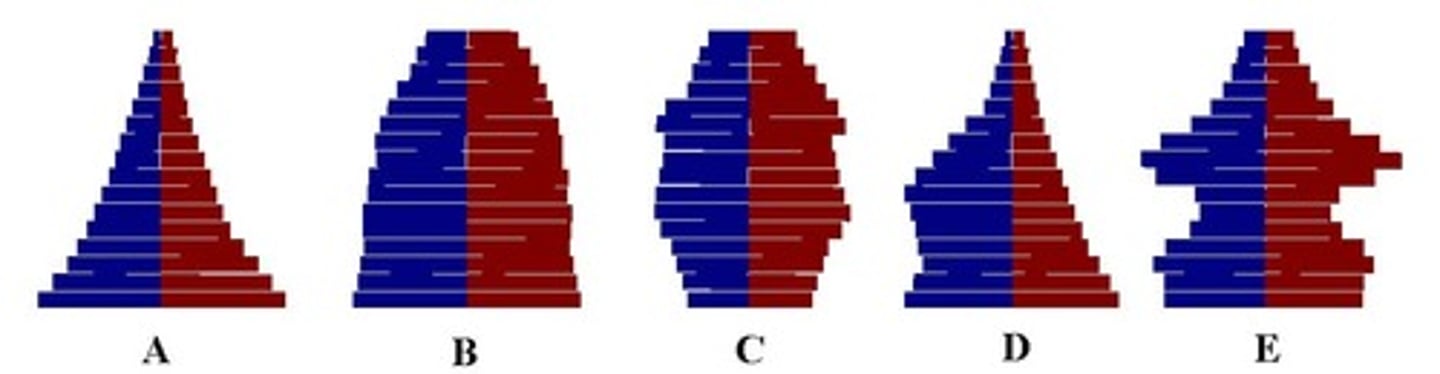
Which population pyramid best reflects the population structure of the Philippines?
Pyramid "A"
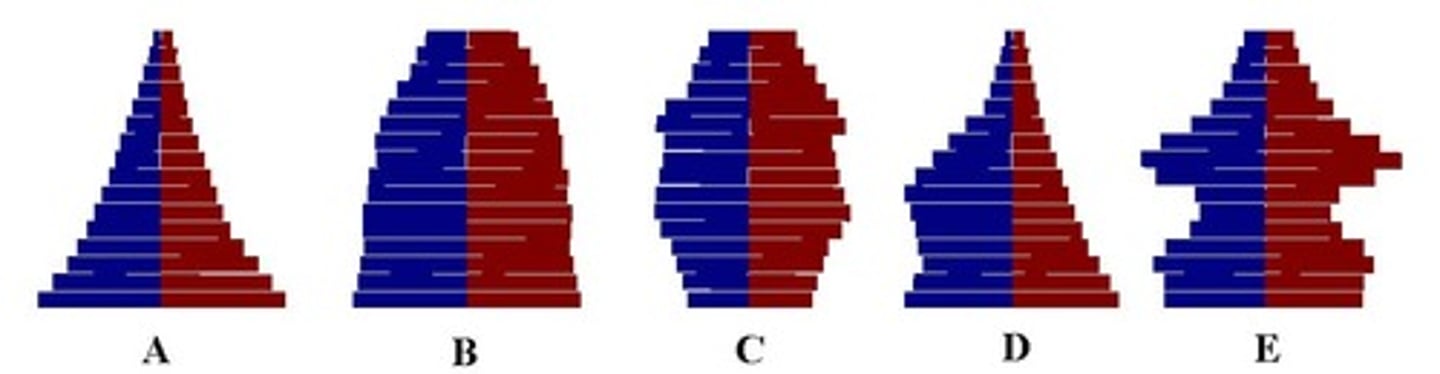
The bulge on the left side of Population Pyramid "D" is most likely caused by
a migrant guest-worker program
Population Pyramid "E" has two bulges in its structure Demographers might call the bottom bulge
an Echo Boom
This is the measurement that shows the average number of people in an area's population who are not economically productive, who must be supported by the area's economically productive population.
Dependency Ratio
What differentiates a natural disaster from a natural hazard?
A natural disaster often includes the loss of property and life
Which area has the greatest arithmetic density?
Area "E"
Which area's population pattern is the most clustered?
Area "A"
Which area's population is distributed in a linear pattern?
Area "C"
Which area's population pattern is the most dispersed?
Area "B"
Historically, the world's population grew
slowly until about 1800 CE, before growing quickly between 1800 CE and the present
Over the past 200 years, the population of the world
has increased by approximately more than 55 billion
In the next 50 years, the population of the world
Is expected to rise to approximately 9 billion
The total change in population of a country's population is represented by which one of the following equations?
Total Population Change = Number of Births - Number of Deaths + Number of Immigrants - Number of Emigrants
A country's Total Fertility Rate is
the average number of children a woman can expect to give birth to during her lifetime
A country's Crude Birth Rate (CBR) is
the total number of children born per 1,000 population
Poland's total fertility rate is 12. What impact will this have on Poland's population?
Poland's population is decreasing
A country's Crude Death Rate (CDR) is
the total number of people who die per 1,000 population
The Natural Increase Rate (NIR) is calculated by
subtracting the Crude Death Rate (CDR) from the Crude Birth Rate (CBR)
The major factor contributing to the explosive population growth in More Developed Countries (MDCs) during the 19th century and early 20th centuries was
the diffusion of the Industrial Revolution
The major reason for high growth rates in Least Developed Countries (LDCs) is
advanced medical practices and drugs have dramatically reduced death rates in Least Developed Countries (LDCs)
Thomas Malthus believed that
the world would soon be overpopulated because population grows at an exponential rate while the food supply increases at an arithmetic rate
life expectancy is
the average number of years a person is expected to live
Which of the following factors does not affect a person's life expectancy?
Parents' ages at the time of the person's birth
Reasons why life expectancy in Africa is so low include all of the following except
the spread of SARS
Which of the following statements about the Demographic Transition Model is TRUE?
Line A (red) represents Total Population, Line B (green) represents Death Rate, Line C (blue) represents Birth Rate
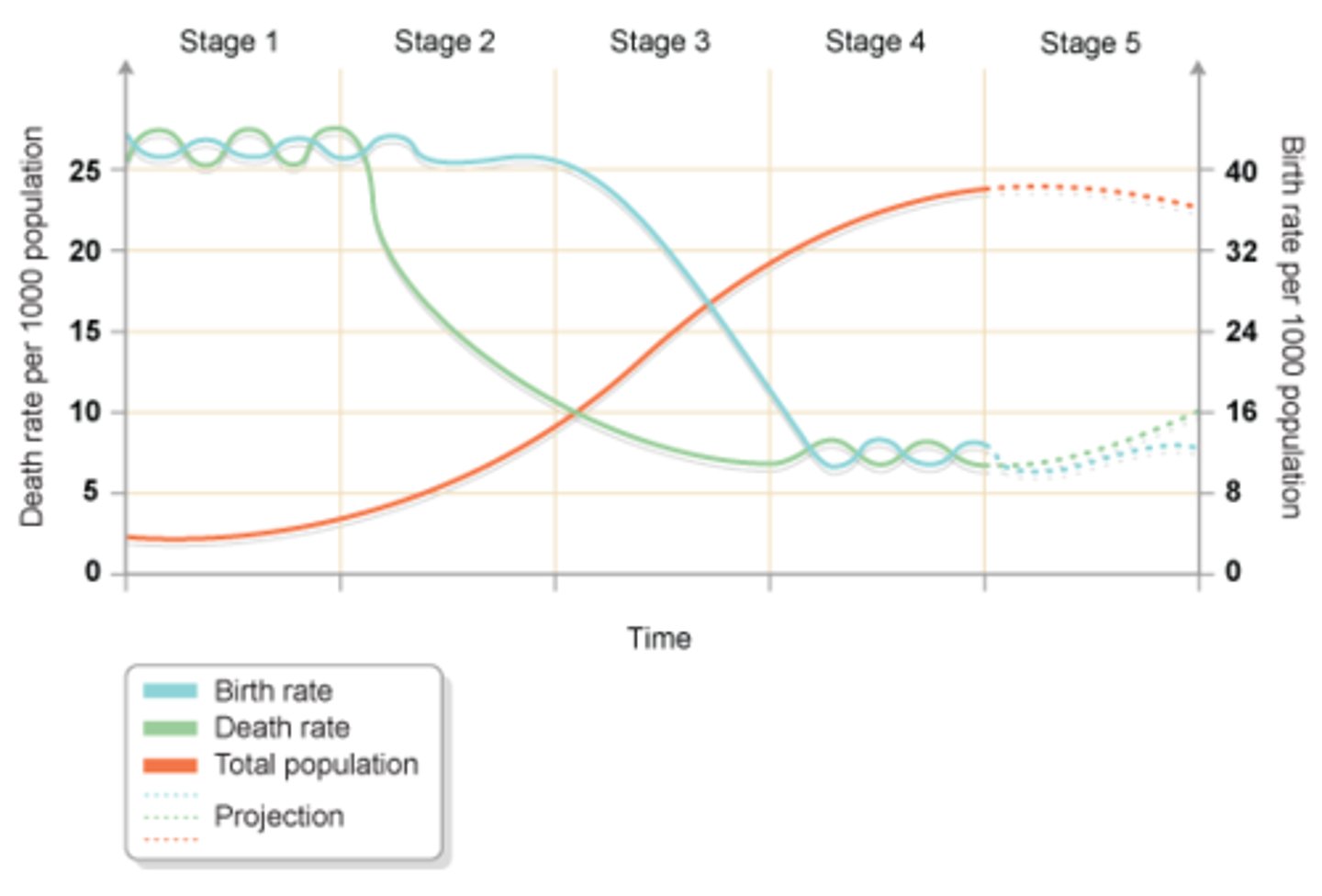
What does the shaded area on the diagram represent?
Natural Increase
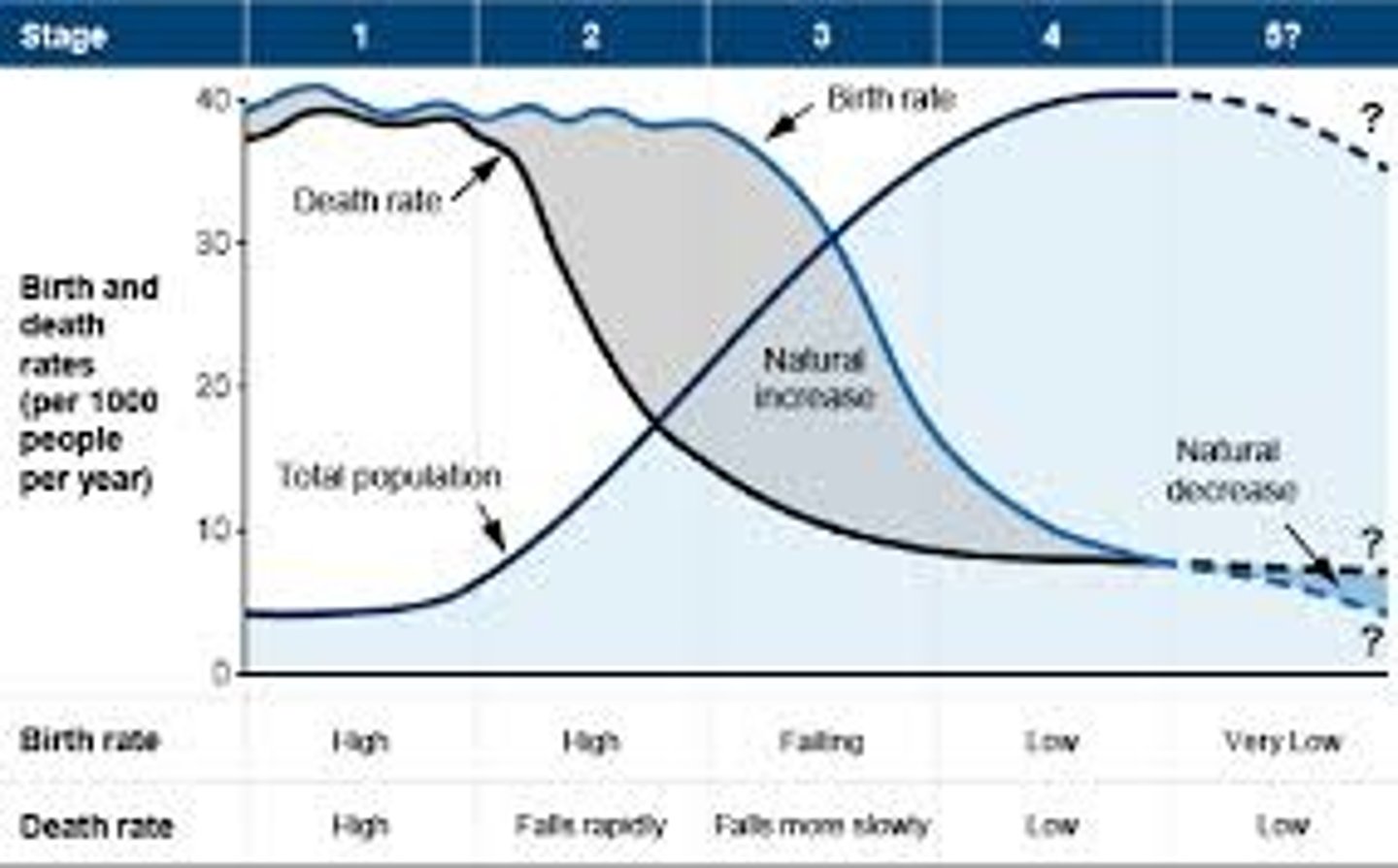
Into which stage of the demographic transition model would Brazil and Mexico fit?
Stage 3
Into which stage of the demographic transition model would Australia and Canada fit?
Stage 4
Into which stage of the demographic transition model would Poland in Japan fit?
Stage 5
How can a country or region slow down its birth rates?
a) keep girls in school longer
b) improve the quality of life for citizens
c) distribute birth control devices
d) fund family planning programs
e) ALL OF THE ABOVE
The phenomenon when a country experiences a decline in the total fertility rate so that it experiences no natural increase is known as
Zero Population Growth
The type of migration in which a person chooses to migrate is called
voluntary migration
According to Ravenstein's Laws of Migration , every migration flow generates a return migration flow. This phenomenon is known as
counter-migration
Which of Ravenstein's Laws of Migration best reflects the Gravity Model?
a) Most migrants are male
b) Most migrants move short distances
c) Most long distances migrants move to large urban areas
d) ALL OF THE ABOVE
According to Ravenstein's Laws of Migration, which group is most likely to move?
Young adults
According to Ravenstein's Laws of Migration, long distance migrants tend to settle
in large cities
Migration from a location is called
emigration
Migration to a location is called
immigration
Reasons why a person feels compelled to leave his or her home area is called
push factors
Reasons why a migrant is attracted to a specific destination is called
pull factors
Which of the following is an example of a push factor
Lack of employment in a migrant's city of residence
Which of the following is an example of a pull factor?
Plentiful jobs in the migrant's chosen destination
All of the following would be considered pull factors except
religious persecution in a migrant's chosen destination
The largest internal migration in history is
the rural to urban migration in China from 1970 to present
Which of the following is an effect of Chain Migration on the area of destination?
urban ethnic enclaves
The process of migrants moving to a specific location because of relatives or members of the same culture have already migrated and settled there is known as
chain migration
A type of migration in which a person migrates in a series of short distance moves is
step migration
Over a period of years, a person moves from his farm to a small town, from his small town to a small city, and finally from his small city to a large city. This is an example of
step migration
A physical landscape feature or political policy that hinders migration
an intervening obstacle
Which of the following is an example of an intervening obstacle?
a) The Demilitarized Zone on Korean Peninsula
b) Laws requiring immigrants to obtain visas before entering a country
c) Laws imposing immigration quotas on the number of immigrants who are allowed to move into a country
d) The wall separating the West Bank from Israel
e) ALL OF THESE INTERVENING OBSTACLES
Which of the following is an example of an intervening opportunity?
Taking a high paying job while in route to your intended destination
According to Wilbur Zelinsky's theory of Migration Transition
a) a person living in a country that is in stage 1 of the DTM is very unlikely to migrate internationally
b) a person living in a country that is in stage 2 of the DTM is most likely to migrate internationally
c) a person living in a country that is in stage 3 or 4 of the DTM is likely to migrate internally
d) ALL OF THE ABOVE
Forced migration is
a migration flow in which the migrants have no choice but to relocate
Which of the following was an example of forced migration?
Trans-Atlantic Slave Trade
An example of forced migration is/was
a) deportation of illegal immigrants out of a country
b) removal of Native Americans to reservations
c) relocation of Japanese-Americans to internment camps during WWII
d) moving Jews to concentration camps in Nazi
Germany
e) ALL OF THE ABOVE
People who quickly flee their country because of violence or fear are considered
refugees
The difference between a migrant and a refugee is
a) migrants seek to move permanently; refugees usually seek to return to their home
b) migrants move to improve their lives; refugees move as a result of a catastrophic events in their homeland
c) migrants carefully plan their move; refugees have to move on a moment's notice
d) migrants are usually young and single; refugees are people of all ages
e) ALL OF THE ABOVE
An obstacle faced by international migrants include
a) difficulty obtaining permission to enter other countries
b) immigration laws limiting the number of migrants who can enter a country
c) citizens of the destination country who are often hostile
d) difficulty in adjusting to the new culture
e) ALL OF THE ABOVE
Undocumented Immigrants
are migrants who circumvent the process to enter the destination country illegally.
A person's activity space includes
geographic movement on a daily basis
The most common reason why illegal immigrants enter a country is because
they are seeking employment
Land suited for agriculture is called
arable land
life expectancy is lowest, on average, in
Africa
The two most populous countries in the world are
China and India