ANS 23- Enzymes as drug targets
 Call Kai
 Learn
Learn Practice Test
 Spaced Repetition
 Match
Match Flashcards
 Knowt Play
1/16

Earn XP
Description and Tags
what enzymes are ,specificity ,enzyme kinetics ,inhibitors vs antagonists,enzyme inhibition
Name | Mastery | Learn | Test | Matching | Spaced | Call with Kai |
|---|
No analytics yet
Send a link to your students to track their progress
17 Terms
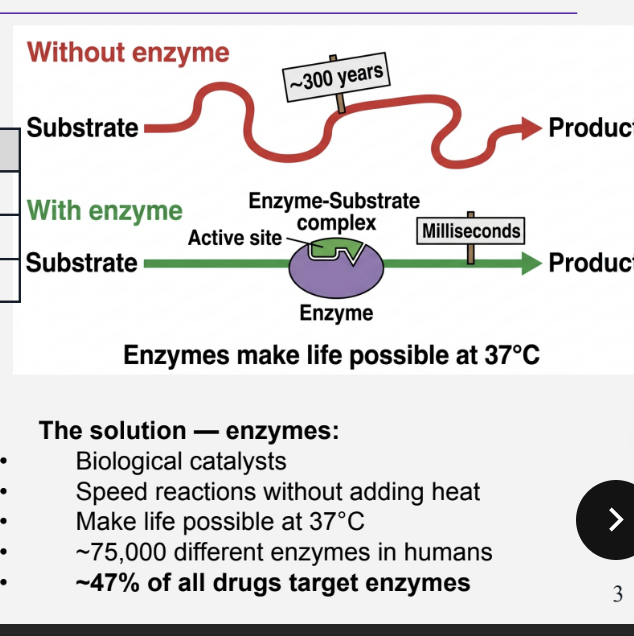
Why we need enzymes ?
Chemical reactions are too slow at body temperature
as above 40 degrees proteins denature - membrane failure so we have enzymes to help
What is an enzyme ?
a protein that speeds up a specific chemical reaction without being consumed
Key features :
made of proteins ( amino acids in 3d shape)
active site ( special pocket where reaction happens )
specificity ( each enzyme only catalyses one type of reaction )
not consumed ( used over , over )
How does an enzyme work?
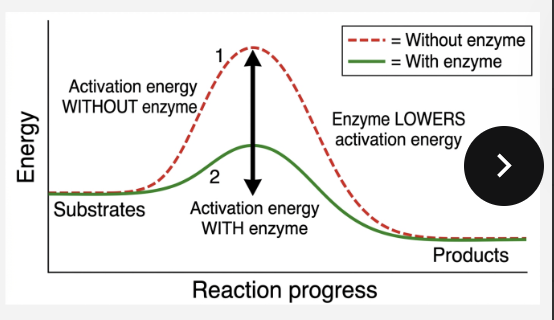
lowers activation energy
reaction can now occur at body temperature
does not change the equilibrium, just lowers where it lies
cycle:
E + S ⇌ ES → E + P
• E = Enzyme, S = Substrate, P = Product
• Substrate binds → reaction happens → product released → enzyme ready again
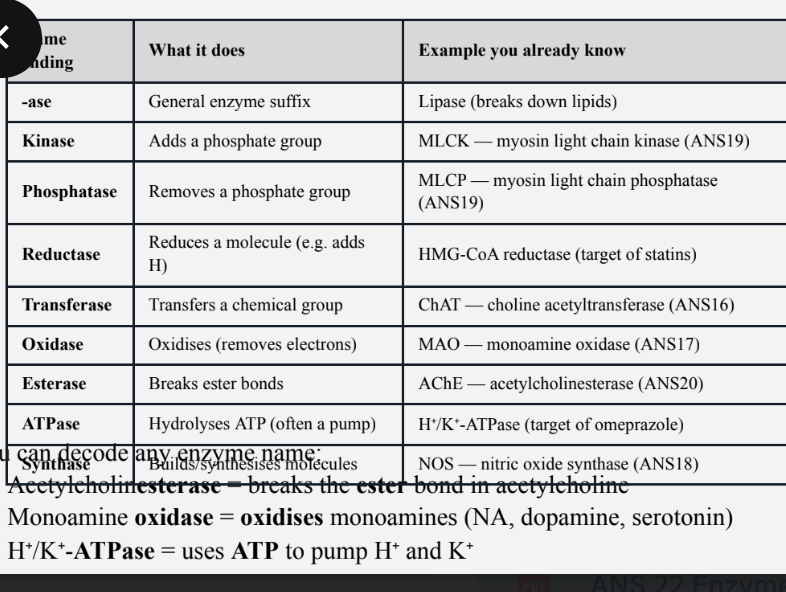
What does each enzyme name do?
all enzymes end with ase
How do enzymes recognise substrates ?
used to have a lock key - enzyme has a specific shape in which only that substrate can fit - explains why each enzyme only catalyses one type of reaction
Now, induced fit:
enzyme is slightly flexible
changes shape when substrate binds
like a glove moulding to your hand
explains how catalysis works
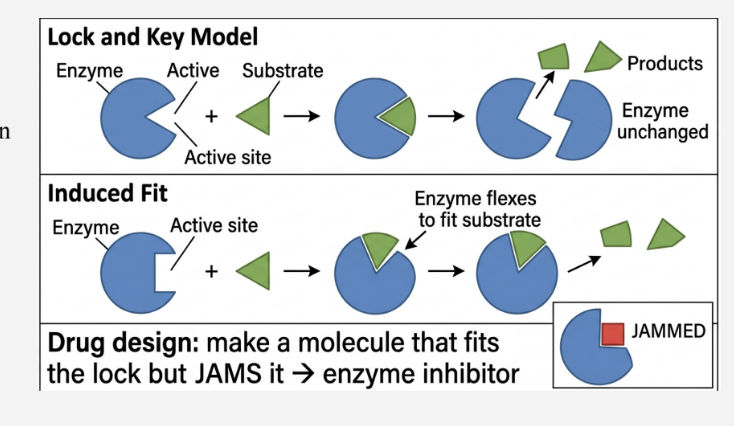
Why does specificity matter for drugs?
active site has a specific shape
design a molecule that fits but cant be processed
it sits in active site and jamms it + enzyme inhibitor
specificity=selectivity = fewer side effects
How do you measure enzyme activity - enzyme kinetics?
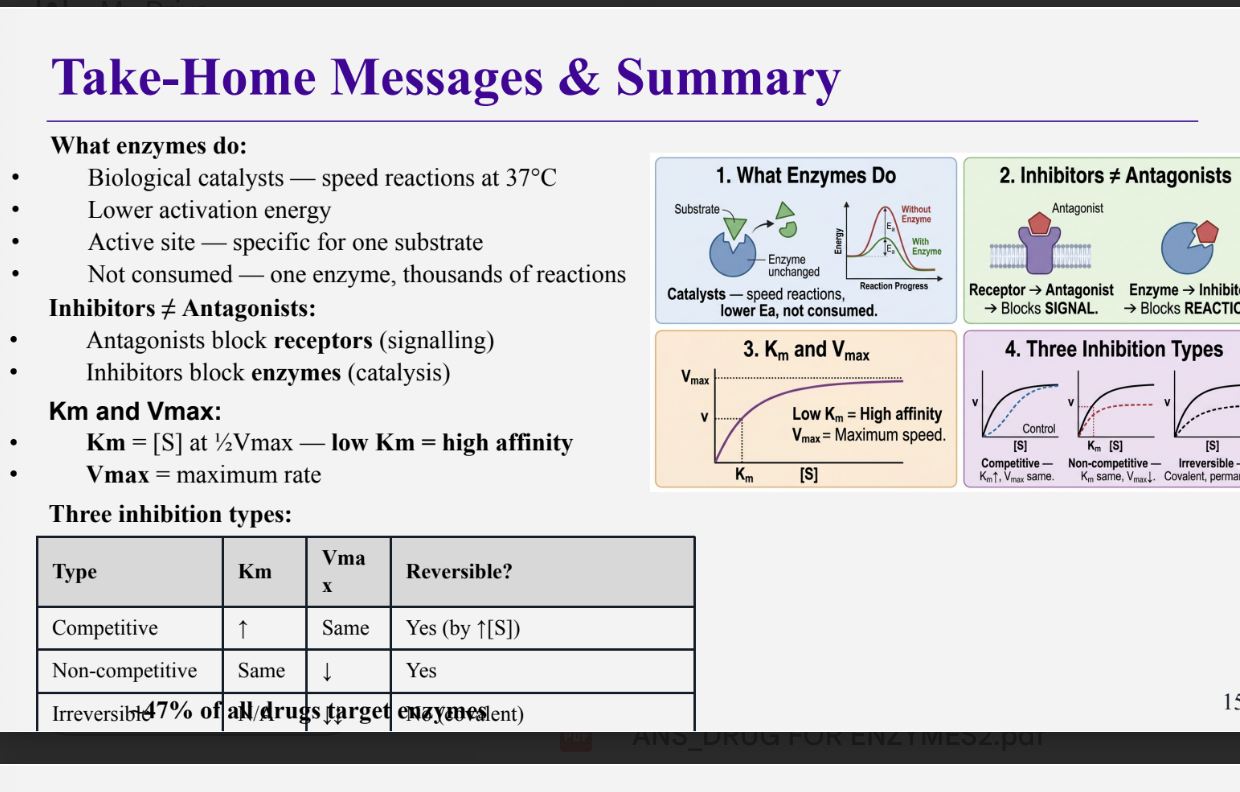
the Michaelis-Menten curve
The experiment :
fixed amount of enzyme
vary substrate conc
measure how fast the product is made - velocity
plot velocity vs ( s)
observations :
Low [S]
• Rate increases as you add more substrate
• Enzyme has spare capacity
High [S]:
• Rate levels off
• Every enzyme molecule is busy
Maximum rate = Vmax= all full
• All enzyme molecules occupied
Shape = hyperbolic curve
![<ul><li><p>the Michaelis-Menten curve </p></li></ul><p><strong>The experiment :</strong></p><ul><li><p>fixed amount of enzyme </p></li><li><p>vary substrate conc</p></li><li><p>measure how fast the product is made - velocity </p></li><li><p>plot velocity vs ( s) </p></li></ul><p></p><p><strong>observations :</strong></p><p>Low [S]</p><p>• Rate increases as you add more substrate</p><p>• Enzyme has spare capacity</p><p>High [S]:</p><p>• Rate levels off</p><p>• Every enzyme molecule is busy</p><p>Maximum rate = Vmax= all full</p><p>• All enzyme molecules occupied</p><p>Shape = hyperbolic curve</p><p></p>](https://assets.knowt.com/user-attachments/79186984-a684-48d5-9d0a-226f0aeca365.png)
What are the two parameters of the graph?
Vmax — Maximum velocity:
• Rate when ALL enzyme molecules have substrate bound
• Depends on: how much enzyme, how fast it works
• Maximum speed of the production line
The equation:
v = (Vmax × [S]) / (Km + [S])
When [S] = Km, then v = 1⁄2Vmax
Km — The Michaelis constant:
it is [S] that gives 1⁄2 Vmax
What it tells You - Enzyme-substrate affinity
Low Km High affinity: Enzyme grabs substrate tightly, works at low [S]
High Km Low affinity: Needs lots of substrate to work
Units Concentration (mM, μM)
![<p><strong>Vmax — Maximum velocity:</strong></p><p>• Rate when ALL enzyme molecules have substrate bound</p><p>• Depends on: how much enzyme, how fast it works</p><p>• Maximum speed of the production line</p><p>The equation:</p><p>v = (Vmax × [S]) / (Km + [S])</p><p>When [S] = Km, then v = 1⁄2Vmax</p><p></p><p><strong>Km — The Michaelis constant:</strong></p><ul><li><p>it is [S] that gives 1⁄2 Vmax</p></li><li><p> What it tells You - Enzyme-substrate affinity</p></li></ul><p>Low Km High affinity: Enzyme grabs substrate tightly, works at low [S]</p><p>High Km Low affinity: Needs lots of substrate to work</p><p>Units Concentration (mM, μM)</p>](https://assets.knowt.com/user-attachments/294217cf-0fc9-433d-bccd-6bd572d20a5d.png)
Why do these parameters matter?
Why this matters for drugs:
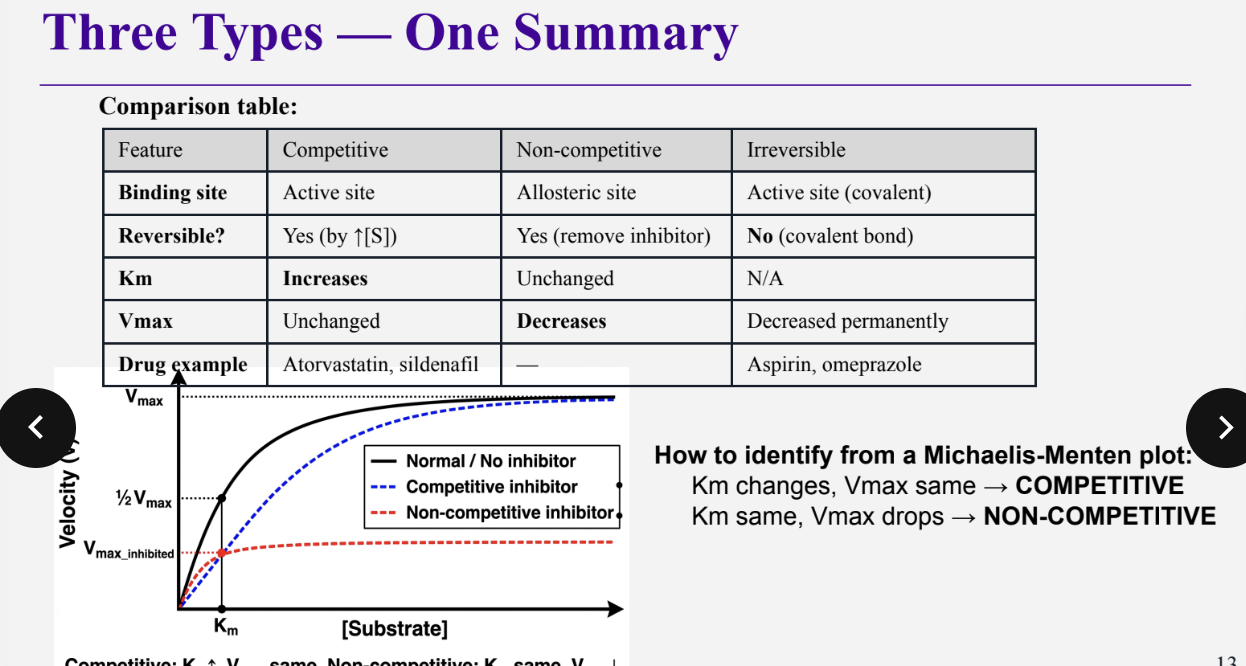
Competitive inhibitors
• Km ↑ (enzyme seems less keen)
vmax unchanged
Non-competitive inhibitors
• Vmax ↓ (capacity reduced)
This is how you tell them apart on the graph.
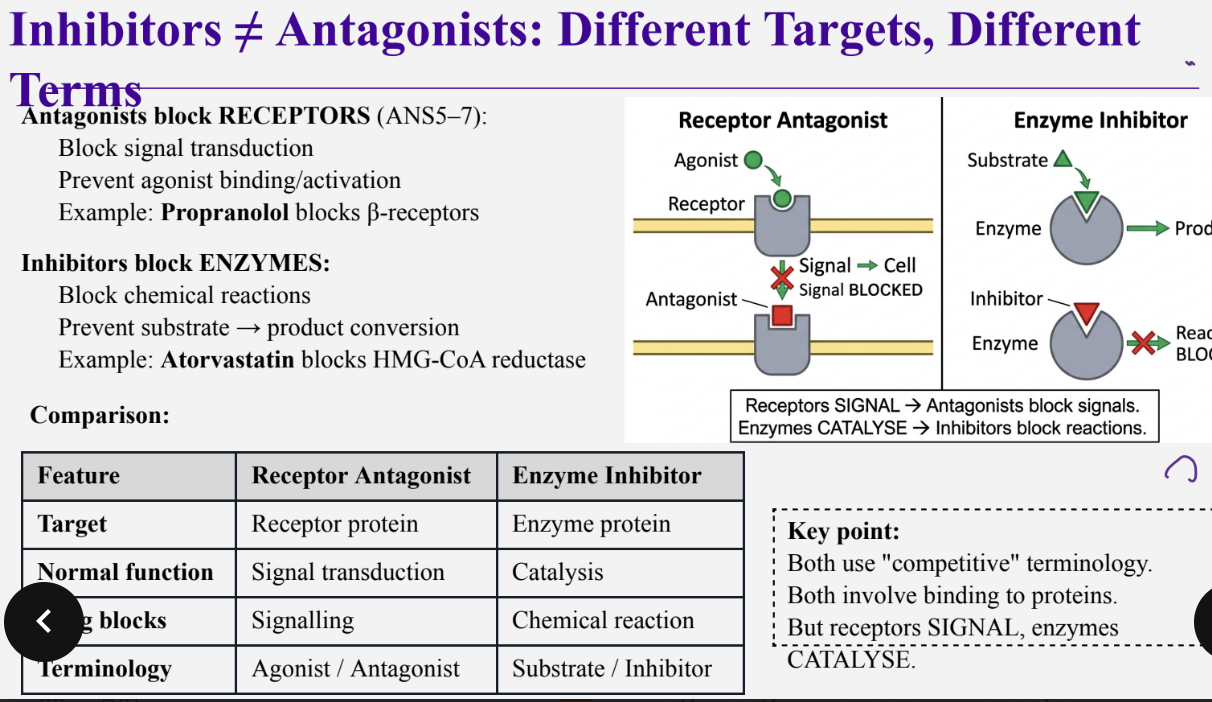
What is an inhibitor?
block enzymes, blocking chemical reactions
prevent substrate to product conversion
comparison of antagonist and inhibitor
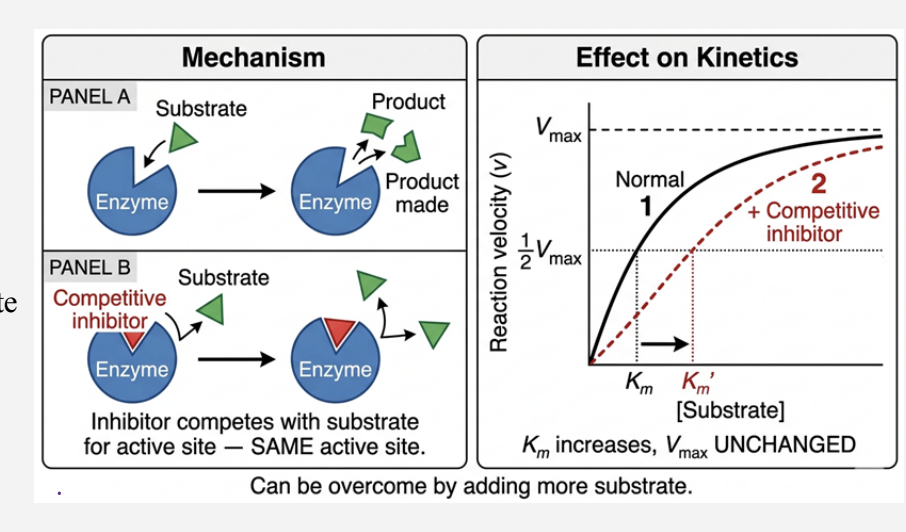
What is competitive inhibition?
Mechanism :
inhibitor resembles substrate
competes for active iste
prevent substrate binding
overcome by adding more substrate
Effects on parameters:
- km increases, decrease affinity for substrate, harder to bind as it is competing
-vmax unchanged, as at a high enough substrate concentration, it can outcompete the inhibitor
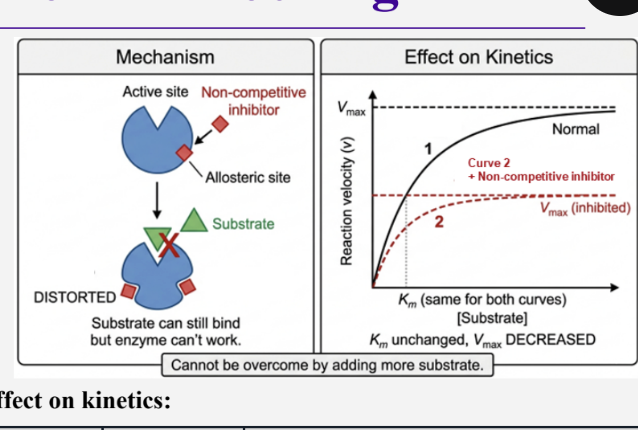
What is non-competetitive inhibition ?
Mechanism :
binds to allosteric site ( not active site )
changes enzyme shape-function
Substrate can still bind, but the enzyme does not work properly
is not overcome by adding more s - maximum capacity permanently reduced
Effect on kinetics/parameters:
km unchanged as substrates still bind to the active site normally
vmax decreases as the enzyme can’t work at full speed
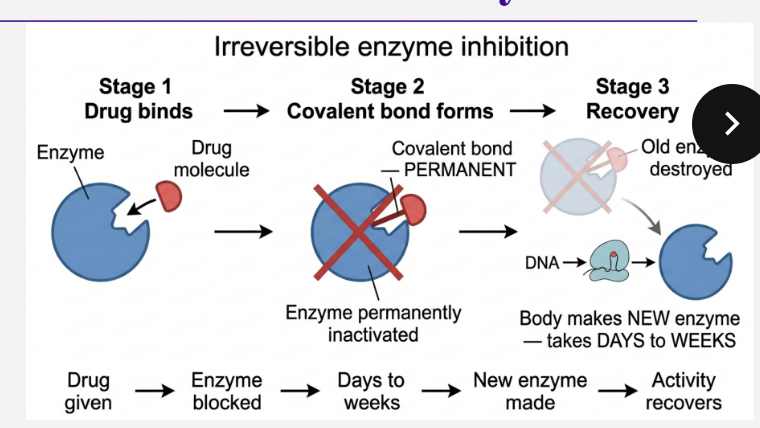
What is irreversible blocking ?
Mechanism :
forms a covalent bond with the enzyme
enzyme permanently inactive
body must synthesise a new enzyme protein
effects last days to weeks
Why irreversible?
can’t outcompete with more substrate
the only recovery would be getting a new protein enzyme
summary of three types of inhibition
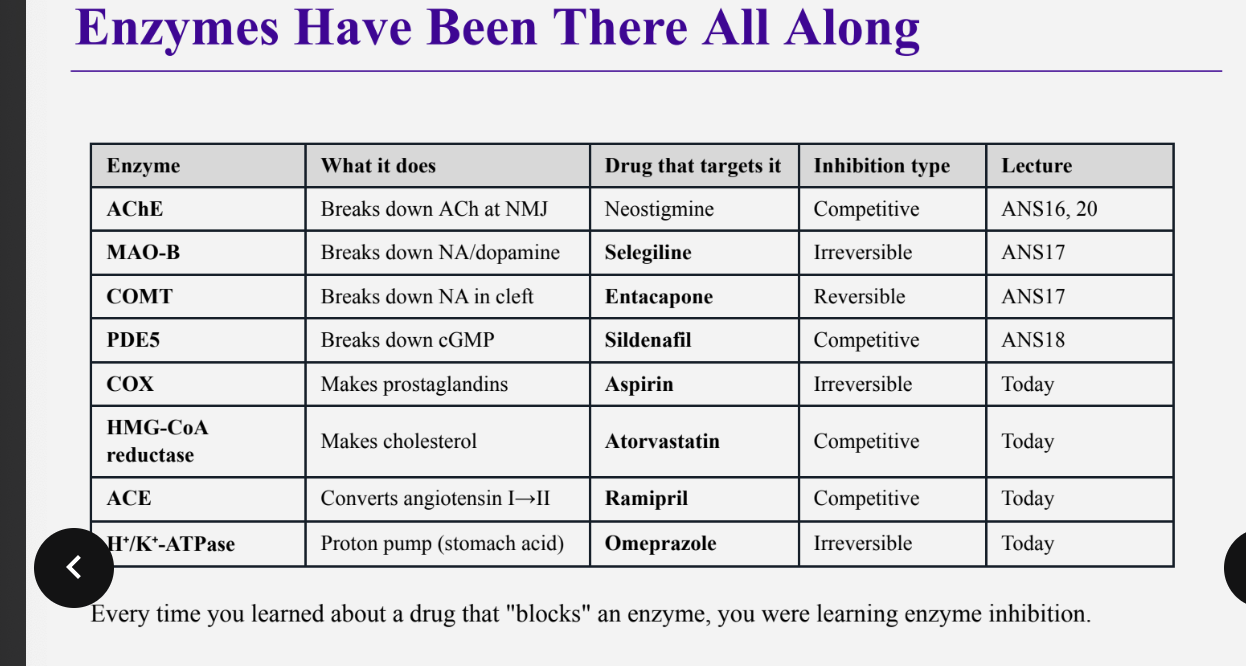
some example of enzymes we know
take home