Hungarian Revolution 1956: Cold War, De-Stalinisation & Soviet Control
 Call Kai
 Learn
Learn Practice Test
 Spaced Repetition
 Match
Match Flashcards
 Knowt Play
1/24

There's no tags or description
Looks like no tags are added yet.
Name | Mastery | Learn | Test | Matching | Spaced | Call with Kai |
|---|
No analytics yet
Send a link to your students to track their progress
25 Terms
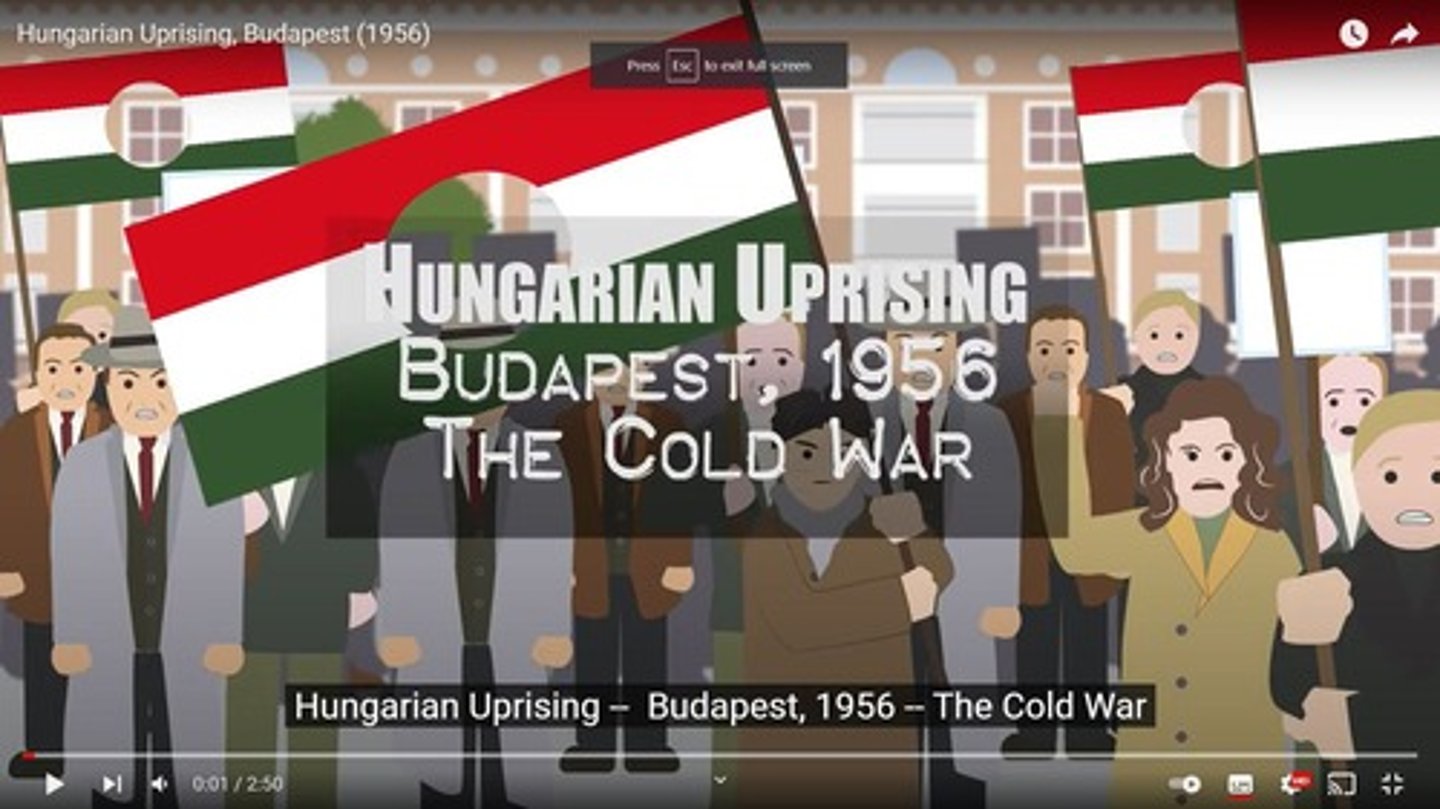
What significant event took place in Hungary in 1956?
The Hungarian Revolution, a nationwide uprising against the Soviet-backed government.
Who was the Communist leader of Hungary after World War II?
Mátyás Rákosi, known as 'Stalin's best pupil' and called the 'Bald Butcher' by the people.
What was the outcome of the Hungarian Revolution?
The revolution was crushed by Soviet forces, leading to thousands of deaths and widespread repression.
What was Nikita Khrushchev's role in the Hungarian Revolution?
He was the leader of the USSR who initially supported the revolution but later sent troops to suppress it.
What reforms did Imre Nagy attempt to implement during the revolution?
He introduced liberal reforms, promised free elections, and declared Hungary's intention to withdraw from the Warsaw Pact.
What was the 'Secret Speech' given by Khrushchev?
A speech where he criticized Stalin's harsh policies and promised more freedoms for Eastern European countries.
What was the immediate reaction of the Soviet Union to the protests in Hungary?
Initially, Soviet troops and Hungarian security forces attempted to suppress the uprising.
What happened to Imre Nagy after the revolution was crushed?
He was arrested and later executed by the Soviet authorities.
What was the significance of the Hungarian Revolution for other Eastern European countries?
It demonstrated that the US would not intervene to support anti-Soviet movements, strengthening Soviet control.
What was the role of the United Nations during the Hungarian Revolution?
The Hungarian government sought help from the UN but received no significant support.
What was the Truman Doctrine in relation to the Hungarian Revolution?
A policy of containment that indicated the US would not intervene in countries already under Communist control.
What were the consequences of the Hungarian Revolution for the Hungarian people?
Widespread repression, imprisonment, and many were forced to flee the country.
How did the Hungarian economy change under Rákosi's leadership?
It was turned into a communist economy with farmers forced into collective housing and work.
What was the public perception of Rákosi in Hungary?
He was viewed negatively, referred to as the 'Bald Butcher' due to his oppressive regime.
What was the role of Radio Free Europe during the Hungarian Revolution?
It broadcast messages of support to Hungarians, hinting at possible US military help.
What did the Hungarian government declare on November 1, 1956?
A declaration of neutrality and renouncement of the Warsaw Treaty.
What led to the escalation of protests in Hungary in 1956?
Public discontent with Rákosi's oppressive regime and the hope for reforms after Khrushchev's speech.
What was the fate of the Hungarian revolutionaries after the Soviet crackdown?
Many were killed, imprisoned, or forced to flee the country.
What was the response of the Soviet Union to the declaration of neutrality by Hungary?
They sent the Red Army to crush the revolution and reassert control.
What was the impact of the Suez Crisis on the West's response to the Hungarian Revolution?
It distracted the West and hindered a unified response to the events in Hungary.
What was the significance of the Hungarian Revolution in the context of the Cold War?
It highlighted the limitations of US support for anti-Communist uprisings in Eastern Europe.
Who succeeded Imre Nagy after the revolution was suppressed?
János Kádár was appointed as the new leader of Hungary.
What was the public's reaction to Khrushchev's initial support for the revolution?
It sparked hope for more freedoms and reforms among the Eastern European populace.
How did the Soviet Union justify their military intervention in Hungary?
They claimed it was necessary to maintain control and prevent counter-revolutionary activities.
What was the long-term effect of the Hungarian Revolution on Soviet satellite states?
It reinforced Soviet dominance and discouraged other countries from attempting similar uprisings.