Cultural Studies
0.0(0)
Studied by 32 people Call Kai
 Learn
Learn Practice Test
 Spaced Repetition
 Match
Match Flashcards
 Knowt Play
Card Sorting
1/281

Earn XP
Description and Tags
Last updated 1:49 PM on 12/6/22
Name | Mastery | Learn | Test | Matching | Spaced | Call with Kai | Chat |
|---|
No analytics yet
Send a link to your students to track their progress
282 Terms
1
New cards
Why culture matters
- It shapes how we think and act
- Global exchanges and communication are reshaping the outline(s) of our culture(s)
- Studying culture allows you to understand globalization, nationalism, customs and rituals of people etc.
- Global exchanges and communication are reshaping the outline(s) of our culture(s)
- Studying culture allows you to understand globalization, nationalism, customs and rituals of people etc.
2
New cards
Raymond Williams - defining culture
- Noun: growing crops
- Expanded: cultivating the mind (Bildung)
- Culture as a ‘lived experience’ connected to a specific group
- Expanded: cultivating the mind (Bildung)
- Culture as a ‘lived experience’ connected to a specific group
3
New cards
‘High culture’
literature, art, ballet, etc.
4
New cards
‘Way of life’/low culture
everyday lived experience of a group… traditions and habits of people
5
New cards
Culturalism
the ordinariness of culture → the active, creative capacity of common people to construct shared meaningful practices
6
New cards
Raymond Williams distinguishes 3 levels of culture:
- The lived culture of a particular time and place
- Accents, dress, ‘moment’ culture, will not be passed on
- Accents, dress, ‘moment’ culture, will not be passed on
7
New cards
- Recorded culture
from art to the most everyday facts, culture that outlives you
- Materialized culture
- Materialized culture
8
New cards
- Selective tradition
the factor connecting lived culture and recorded culture; determines which parts of the lived culture pass on to the next generation through recorded culture
9
New cards
Culture can be understood through the connection of the three levels of culture.
Culture must be understood through the representation and practices of daily life in the context of material condition and their production.
10
New cards
cultural materialism
William says:
-Culture is part of an expressive totality of social relations
-Culture must be understood through the representatives and practices of everyday life and in the context of material conditions of their productions.
-Culture is part of an expressive totality of social relations
-Culture must be understood through the representatives and practices of everyday life and in the context of material conditions of their productions.
11
New cards
Components of Culture
- Institutions of artistic & cultural production; artisanal or market form; it has an impact on the characteristics the culture will have
- Formations on schools, movements and factions of cultural production
- Modes of production i.e. the relation between material means and culture; How is this culture distributed?
- Identifications, the specificity of cultural production; is it specific to a certain group?
- Reproduction in time and space of a selective tradition
- Organization of the selective tradition; Organized by the state?
- Formations on schools, movements and factions of cultural production
- Modes of production i.e. the relation between material means and culture; How is this culture distributed?
- Identifications, the specificity of cultural production; is it specific to a certain group?
- Reproduction in time and space of a selective tradition
- Organization of the selective tradition; Organized by the state?
12
New cards
Williams introduced the “cultural materialism” approach:
Cultural materialism explores how and why cultural meaning is produced and organized. It [i.e. studying culture] involves the exploration of signification in the context of the means and conditions of its production. Cultural materialism is concerned with the connections between cultural practice and political economy.
13
New cards
Unpacking this quote (marxist influence becomes apparent):
● Means of production: these are the factors that are at play in producing something (in our case: cultural meaning) - cultural materialism urges us to ask: what different material and non-material factors are at work in producing cultural meaning?
● Conditions of production: the conditions mean how this cultural meaning relates to other, existing cultural meaning - cultural materialism urges us to ask: how does a (new) cultural meaning relate to other, existing cultural meaning in a society?
● Conditions of production: the conditions mean how this cultural meaning relates to other, existing cultural meaning - cultural materialism urges us to ask: how does a (new) cultural meaning relate to other, existing cultural meaning in a society?
14
New cards
Why call this ‘cultural materialism?’
Williams says:
Williams says:
- Culture is part of an expressive totality of social relations
- Culture must be understood through the representatives and practices of everyday life and in the context of material conditions of their productions
- The Cultural Studies Approach:
- don’t ask what culture is
ask what it does,
how it’s used, for what purpose, etc.
- Culture’s not ‘out there’, it’s created, performed, enacted, transformed... Culture is dynamic, changing, continually contested
- Culture must be understood through the representatives and practices of everyday life and in the context of material conditions of their productions
- The Cultural Studies Approach:
- don’t ask what culture is
ask what it does,
how it’s used, for what purpose, etc.
- Culture’s not ‘out there’, it’s created, performed, enacted, transformed... Culture is dynamic, changing, continually contested
15
New cards
Culture and the Social Formation (Marxism)
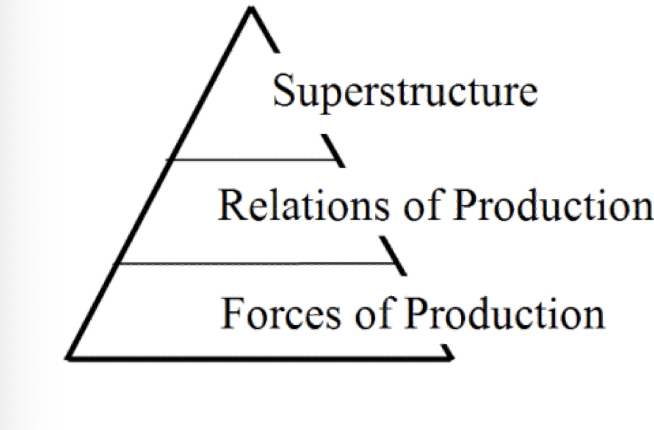
According to Marxist ideology, culture is always connected to/defined by the material conditions (means of production) of life. Claims that your material body creates ‘mindset’ or society.
Superstructure: culture, politics, art
Base: economy
Superstructure: culture, politics, art
Base: economy
16
New cards
For Marxism Culture is Political because
- It is expressive of social relations of class power
- It naturalizes the social order as an inevitable fact
- It obscures the underlying relations of exploitation
- It naturalizes the social order as an inevitable fact
- It obscures the underlying relations of exploitation
17
New cards
How cultural studies approaches culture
Cultural Studies emphasises the importance of ‘ordinary’ culture. It therefore claims to have a democratic edge as it looks at the lives/interests/culture of the masses not just high/elitist culture.
18
New cards
The anthropological approach to culture (47-48)
The concept of culture centres on everyday meanings: values, norms, and material/symbolic goods. Culture is understood as a whole way of life thereby this approach distances itself from the arts and instead focuses on popular and everyday culture.
19
New cards
Culturalism (49)
An anthropological and historically informed understanding of culture, started by Hoggart, Thompson and Raymond Williams. However, all of them put a different emphasis on ordinary culture.
20
New cards
Culture is ordinary (what does cultural studies mean by that?) (46-47)
Culture is not limited to high culture (e.g. art, literature) but refers to culture as a whole way of life. This includes the social norms/values/institutions/behaviours
21
New cards
Cultural Materialism (Raymond Williams)
Williams argues that the means (e.g. factors in production of something (physical and non-physical)) and conditions (e.g. how does it relate to existing cultural meaning) of production directly affect culture as they determine how and why cultural meaning is produced (idea of Marxist super-base structure).
Analysis of all forms of signification of cultural practices
Means and conditions of production of culture are key (recall Marxism)
Institutions, Formations, Modes of production (how it was produced, infrastructure, money involved) , Identifications/forms of culture, Reproduction ( what values and meanings are carried or challenged), Organization
Who created, who funded, beliefs f the institutions and see the connection between cultural phenomenon
Analysis of all forms of signification of cultural practices
Means and conditions of production of culture are key (recall Marxism)
Institutions, Formations, Modes of production (how it was produced, infrastructure, money involved) , Identifications/forms of culture, Reproduction ( what values and meanings are carried or challenged), Organization
Who created, who funded, beliefs f the institutions and see the connection between cultural phenomenon
22
New cards
Three levels of culture according to Raymond Williams (which three?)
1. Lived culture (social, ordinary)
2. Recorded culture/culture of a given period (e.g. arts, news, etc.) (documentary)
3. Culture of selective tradition (ideal)
2. Recorded culture/culture of a given period (e.g. arts, news, etc.) (documentary)
3. Culture of selective tradition (ideal)
23
New cards
Culture as lived experience (how do we define that?)
● The meanings generated by ordinary men and women
● The lived experiences of its participants
● The texts and practices engaged by all people as they conduct their lives
→ culture is what we do, see, feel, think every day
● The lived experiences of its participants
● The texts and practices engaged by all people as they conduct their lives
→ culture is what we do, see, feel, think every day
24
New cards
Creative consumption (59-60)
Consumption is a creative and productive process. Because there are so many polysemic signs it is much harder for a dominant meaning to stick. This and the fact that consumers are discriminating (towards certain meanings) active producers of meaning makes it very hard for companies to get us to consume mass culture. Furthermore, in the case of popular culture, rather than the meanings being inherent in the commodity they are constructed through actual usage.
25
New cards
The foundations of culture according to Marx (65)
According to Marx historical and material conditions are what determine culture. The foundations of culture according to Marx was therefore the economy which produced these material conditions. (see: base-superstructure)
26
New cards
Ideology (as understood by Marx) (71)
For Marx ideology refers to the production of images of social reality. More importantly he believes that ideology is controlled by the ruling elite and is rooted in material conditions. This also refers to the idea of ‘false consciousness’. ‘False consciousness’ suggests that the proletariat (working class people) within capitalist economies are being led to believe certain things about society (e.g. this is how it is) in order to cover up the deep exploitation at the level of production.
Ideology to Marx therefore is a way to control lower classes by making them believe in a certain ‘reality’ that is constructed by the ruling elite (those who control the economy).
Ideology to Marx therefore is a way to control lower classes by making them believe in a certain ‘reality’ that is constructed by the ruling elite (those who control the economy).
27
New cards
Ideology (as understood within cultural studies in general)
The binding and justifying ideas of any social group (but highly influenced by a dominant elite). It is constituted by maps of meaning that are historically specific understandings which obscure and maintain the power of social groups.
→ advertised as universal truths but are highly biased/historically skewd (e.g. history is largely written by privileged white men)
→ advertised as universal truths but are highly biased/historically skewd (e.g. history is largely written by privileged white men)
28
New cards
The metaphors of base and superstructure (do you understand this? Can you distinguish the correct definition from the wrong one?) (65)
Base - the economic mode of production constituted by the means of production (e.g. factories, machinery) and the relations of production (e.g. class). Marx used the term mode of production to refer to the specific organization of economic production in a given society.
Superstructure - the social, political, spiritual → culture
→ the economic mode of production (base) shapes the cultural superstructure
Superstructure - the social, political, spiritual → culture
→ the economic mode of production (base) shapes the cultural superstructure
29
New cards
The mode of production: what is it constituted by according to Marx? (65)
The economic mode of production constituted by the means of production (e.g. factories, machinery) and the relations of production (e.g. class). Marx used the term mode of production to refer to the specific organization of economic production in a given society.
30
New cards
Historical materialism (64)
Historical materialism (Marxism) is a theory that attempts to relate the production and reproduction of culture to the organization of the material conditions of life. Culture is a corporeal force tied into the socially organized production of material conditions of existence.
31
New cards
Marxism and false consciousness (what are the two ideas behind 'false consciousness' in Marxism? (71)
1. The dominant ideas in any society are the ideas of the ruling class
2. What we perceive to be the true character of social relations within capitalism are in fact the mystifications of the market (trying to hide exploitation) → the structure of capitalism lead to inadequate understandings of the social world
2. What we perceive to be the true character of social relations within capitalism are in fact the mystifications of the market (trying to hide exploitation) → the structure of capitalism lead to inadequate understandings of the social world
32
New cards
Why is culture political according to Marx? (66)
1. It is expressive of social relations of class power.
2. It naturalises the social order as an inevitable ‘fact’.
3. It obscures the underlying relations of exploitation.
2. It naturalises the social order as an inevitable ‘fact’.
3. It obscures the underlying relations of exploitation.
33
New cards
Culture as class power (66)
Culture is ideological: the ruling ideas are the ideas of the ruling class.
Seen from a Cultural Studies perspective, this Marxist idea is too simple: everybody contributes to culture and therefore this view is an example of economic determinism. CS tries to move away from economic reductionist models and focus on autonomous structures of language, culture, representation and consumption. → debated within CS
Seen from a Cultural Studies perspective, this Marxist idea is too simple: everybody contributes to culture and therefore this view is an example of economic determinism. CS tries to move away from economic reductionist models and focus on autonomous structures of language, culture, representation and consumption. → debated within CS
34
New cards
The specificity of culture and the relative autonomy of culture (cf. Althusser) (66-67)
Social formation should not be understood as a totality but instead a complex structure of different instances (levels or practices) that are structured in dominance.
35
New cards
Specificity
each level or type of practice within the social formation has their own logic and specificity. It cannot be explained by other levels or practices.
36
New cards
Relative autonomy
each instance only has relative autonomy as the economic level will have determination at the ‘last instance’.
37
New cards
Hegemony (define) (75)
General: Culture is made up of several ideas/ideologies/meanings but there is usually one strand of meaning that is dominant (ascendant).
Gramsci:
● A historical bloc of ruling-class factions exercises social authority and leadership over subordinate classes through a combination of force and consent → hegemony rather than dominance
● Process of maintaining and reproducing the governing set of meanings of a given culture
→ This dominant strand of meaning is maintained and reproduced by the ruling factions through both force and consent (subordinate groups will support the dominant meanings even if it does not benefit them personally)
Gramsci:
● A historical bloc of ruling-class factions exercises social authority and leadership over subordinate classes through a combination of force and consent → hegemony rather than dominance
● Process of maintaining and reproducing the governing set of meanings of a given culture
→ This dominant strand of meaning is maintained and reproduced by the ruling factions through both force and consent (subordinate groups will support the dominant meanings even if it does not benefit them personally)
38
New cards
The inherent instability of hegemony (can you explain why this is?) (77)
Hegemony is a temporary settlement and series of alliances between social groups that is won and not given. It has to be constantly re-won and re-negotiated.
39
New cards
Hegemony has to be seen in relational terms (what does that mean?) (
Has to look at social groups within society and how they interact with each other.
40
New cards
Lecture 2 ch5
Post-Fordism
Post-Fordism
marks the movement away from an economy based to towards a small-scale customised production for niche market.
It is founded on flexibility of Labour and individualisation go consumption patters. Post-Fordism will try to monitor what people want and produce it.
It is founded on flexibility of Labour and individualisation go consumption patters. Post-Fordism will try to monitor what people want and produce it.
41
New cards
Fordism
Is what Post-Fordism moves away from, which is an economy based on mass production of good for an aggregated market.It tried to regulate the time of the workers, everyone had to work at the same pace. The body was conditioned to work like a machine.
The shift from Fordism to Post-Fordism can be aligned with the shift from organized capitalism to disorganized capitalism.
The shift from Fordism to Post-Fordism can be aligned with the shift from organized capitalism to disorganized capitalism.
42
New cards
Criticism from Cultural Studies:
Against Marxism’s Economic determinism
Against Marxism’s Economic determinism
Marxism holds on to the idea that the profit motive and class relations directly and completely determine the form and meaning of cultural production.
But is it always that simple?
No, says cultural studies:
Culture is a site of tension and conflict, it’s too simple to argue that it’s ruled by the dominant class alone.
43
New cards
Louis Althusser on the relative autonomy of culture and how cultural studies picked up on this
Economy is only determining in the ‘last instance’, Althusser says.
“We must think a society or social formation as ever and always constituted by a set of complex practices; each with its
own specificity, its own modes of articulation.”
Stuart Hall
44
New cards
What is a social formation? (Louis Althusser → Stuart Hall)
● A social formation is not a totality of which culture is just an expression.
● A social formation is a complex structure of different instances (levels or
practices) that are ‘structured in dominance’.
● Different instances of politics, economics and ideology are articulated
together to form a unity
● The social formation is not the result of single, one-way,
base-superstructure determination.
● The economic level is determinant only in the last instance (relative
autonomy)
● A social formation is a complex structure of different instances (levels or
practices) that are ‘structured in dominance’.
● Different instances of politics, economics and ideology are articulated
together to form a unity
● The social formation is not the result of single, one-way,
base-superstructure determination.
● The economic level is determinant only in the last instance (relative
autonomy)
45
New cards
This leads to the concept of ideology
First, general definition within Cultural Studies...
First, general definition within Cultural Studies...
the binding and justifying ideas of any social group. It is commonly used to designate the attempt to fix meanings and worldview in support of the powerful.
Here Ideology is said to be constituted by maps of meaning that, while they purport to be universal truths, are historically specific understandings which obscure and maintain the power of social groups (eg. class, gender, race).
Here Ideology is said to be constituted by maps of meaning that, while they purport to be universal truths, are historically specific understandings which obscure and maintain the power of social groups (eg. class, gender, race).
46
New cards
Second, definition of ideology by Karl Marx
The production of ideas, of conceptions, of consciousness, is ... directly interwoven with the material activity of men. If in all ideology men and their circumstances appear upside-down as in a camera obscura, this phenomenon arises just as much from their historical life-process as the inversion of objects on the retina does from their physical life-process.
47
New cards
Antonio Gramsci and Hegemony
For Gramsci, hegemony implies a situation in which an ‘historical bloc’ of ruling-class factions exercises social authority and leadership over the subordinate classes through a combination of force and consent. It is the process of making, maintaining and reproducing the governing set of meanings of a given culture.
48
New cards
How does Cultural Studies understand ‘hegemony'?
Culture is comprised of a multiplicity of streams of meaning and encompasses a range of ideologies and cultural forms. However, there is one strand of meaning that can be called ascendant (or dominant). The process of making, maintaining and reproducing these authoritative sets of meanings and practices is what we call “hegemony”.
49
New cards
Hegemony is inherently unstable
Hegemony must be understood in relational terms (groups within society and how they interact with each other).
● These relations between group, where one group dominates another, is
inherently unstable:
○ It must be won and re-won every time
○ It takes an effort to maintain it
This is why hegemony is not static but dynamic.
● These relations between group, where one group dominates another, is
inherently unstable:
○ It must be won and re-won every time
○ It takes an effort to maintain it
This is why hegemony is not static but dynamic.
50
New cards
Globalization
increasing multi-directional economic, social, cultural and political global connections across the world and our awareness of them.
Globalization is associated with the institutions of modernity and time-space compression or the shrinking world.
Globalization is associated with the institutions of modernity and time-space compression or the shrinking world.
51
New cards
What is globalization exactly
Intensified compression of the world:
○ Economic interactions increasingly take place over the entire globe
○ Communication technologies allow us to communicate with people around the world
○ Transportation technologies allow for easy transportation around the globe
● Increasing consciousness of the world:
○ We are more and more aware of the global economic flows
○ We use global communication technologies daily and interact with different parts of the
world
○ We are able to travel more widely and more easily around the globe
○ Economic interactions increasingly take place over the entire globe
○ Communication technologies allow us to communicate with people around the world
○ Transportation technologies allow for easy transportation around the globe
● Increasing consciousness of the world:
○ We are more and more aware of the global economic flows
○ We use global communication technologies daily and interact with different parts of the
world
○ We are able to travel more widely and more easily around the globe
52
New cards
Many of the central elements of globalization are economic, supported by technologies of transportation and communication,
Our awareness and experience of globalization is a cultural issue
The interconnection of cultures which globalization causes is a cultural issue
The interconnection of cultures which globalization causes is a cultural issue
53
New cards
Lecture 3
Key concepts: Semiotics, Signifier-Signified, Denotation-Connotation, Code, Myths, Symbolic Order, Representation, De Saussure, Barthes
54
New cards
Language is not a neutral medium.
- Language is the privileged medium in which cultural meanings are formed and communicated.
- Language is the medium through which we form knowledge about ourselves and the world.
- We can use words to make sure we grasp things, be precise → words and language are never neutral; language shapes reality.
For example, Doublethink and Newspeak in Orwell’s 1984.
Gaslighting: the action or process of manipulating a person into questioning his/her own sanity.
- Language is the medium through which we form knowledge about ourselves and the world.
- We can use words to make sure we grasp things, be precise → words and language are never neutral; language shapes reality.
For example, Doublethink and Newspeak in Orwell’s 1984.
Gaslighting: the action or process of manipulating a person into questioning his/her own sanity.
55
New cards
Language is constitutive of:
- Values
- Meaning
- Knowledge
- Meaning
- Knowledge
56
New cards
Language gives meaning to:
- Material objects
- Social practices
This it to say that language bring those objects and practices into view. Such objects and practices are made intelligible to us through language.
- Social practices
This it to say that language bring those objects and practices into view. Such objects and practices are made intelligible to us through language.
57
New cards
The founding father of Semiotics and Structuralism:
Ferdinand de Saussure (1857 - 1913)
58
New cards
Key claims:
- We need a general theory of signs, e.g. semiotics
- Language does not reflect a pre-existent and independent objects
- Sign systems construct meaning through a series of conceptual and phonic differences.
- Language does not reflect a pre-existent and independent objects
- Sign systems construct meaning through a series of conceptual and phonic differences.
59
New cards
Semiotics , why is it important
is the study of signs, and the general theory.
Why is this important? Language is a sign system that gives meaning to the world.To figure out how the creation of meaning works, we need to figure out what a sign is.
Why is this important? Language is a sign system that gives meaning to the world.To figure out how the creation of meaning works, we need to figure out what a sign is.
60
New cards
Structuralism
is a body of thought that is concerned with the structures of signs that allow linguistic performances to be possible. A structuralist understanding of culture is concerned with the system of relations of an underlying structure that forms the grammar which makes meaning possible (rather than actual performance in its infinite variation).
When saying you only refer to the actual meaning of the word without any possible interpretation.
When saying you only refer to the actual meaning of the word without any possible interpretation.
61
New cards
For example: the fairy tale and the sonnet
Ever fairy tale is different, but hey all follow a similar pattern, with similar characters
Every sonnet has its own content, but the structure and form of the poem is always the same
Every sonnet has its own content, but the structure and form of the poem is always the same
62
New cards
Langue:
the abstract sign system and rules of language or sign systems
Saussure was interested in langue because he thought it could give systemic insight in the production of meaning
Saussure was interested in langue because he thought it could give systemic insight in the production of meaning
63
New cards
Parole:
individual speech acts and the everyday usage of language by real speakers (with infinite variations)
64
New cards
Sign systems construct meaning through a series of conceptual and phonic differences:
TREE THREE THE HE HEAP HIS HUSH
We distinguish between those words because they differ in sound from each other: a system of phonic differences. → LANGUE
We distinguish between those words because they differ in sound from each other: a system of phonic differences. → LANGUE
65
New cards
The Sign according to Saussure
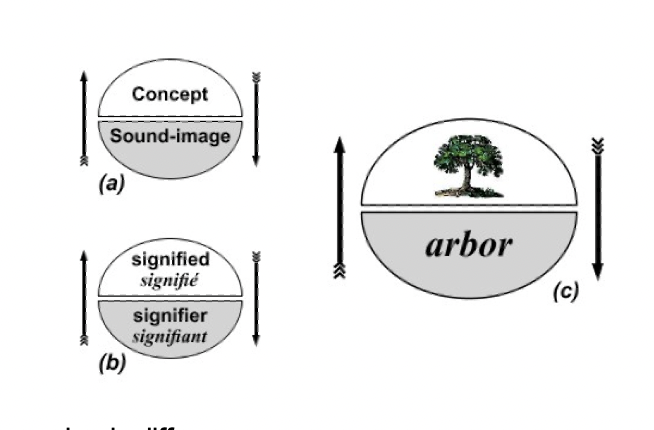
Signifier: the form of the sign, the phonic image (“three” vs “tree”)
Signified: the idea/concept which we associate with the phonic image or sounds
Together these create a sign, which can then be used to refer to an object in reality
In Saussure’s theory, a sign can only exist in relation to other signs because a sign needs to be phonetically differentiated from other sounds to obtain its own identity (e.g. “tree” vs “me”)
Saussure distinguishes between two axes of language, the syntagmatic (horizontal) and the paradigmatic axis (vertical).
Signified: the idea/concept which we associate with the phonic image or sounds
Together these create a sign, which can then be used to refer to an object in reality
In Saussure’s theory, a sign can only exist in relation to other signs because a sign needs to be phonetically differentiated from other sounds to obtain its own identity (e.g. “tree” vs “me”)
Saussure distinguishes between two axes of language, the syntagmatic (horizontal) and the paradigmatic axis (vertical).
66
New cards
Arbitrariness of the sign
Because it is arbitrary, the sign is totally subject to history and the combination at the particular moment of a given signifier and signified is a contingent result of the historical process.
Jonathan Culler, literary critic
Jonathan Culler, literary critic
67
New cards
Cultural Codes
- The relation between the signifier and signified is determined by cultural codes
- Cultural conventions can change over time or between different groups within a culture
This also extends to non-linguistic systems, like color. (e.g. green coke & green McDonalds)
- Cultural conventions can change over time or between different groups within a culture
This also extends to non-linguistic systems, like color. (e.g. green coke & green McDonalds)
68
New cards
Roland Barthes (1915 - 1980)
- French critic and semiotician
- Took De Saussure’s scientific approach to langue and extended it to popular culture.
Barthes analyzed cultural myths through De Saussure’s approach.
Mythologies (1957) collects essays on the cultural sign-system
> For example: He wrote about; the face of Greta Garbo, soap, catch; ordinary/mundane things
- He analyzed them from a semiotic point of view as if all of the cultural events he talks about really are sign systems
- “The starting point of these reflections was usually a feeling of impatience at the sight of the ‘naturalness’ with which newspapers, art and common sense constantly dress up a reality which, even though it is the one we live in, is undoubtedly determined by history.”
- Reality is presented to us as forever, but in reality it is determined by history
- And whatever is determined by history is at the very least conventional and arbitrary
- Barthes wanted to demask the way we understand reality as common and given fact and
show us that there is a more complex historical process
- Took De Saussure’s scientific approach to langue and extended it to popular culture.
Barthes analyzed cultural myths through De Saussure’s approach.
Mythologies (1957) collects essays on the cultural sign-system
> For example: He wrote about; the face of Greta Garbo, soap, catch; ordinary/mundane things
- He analyzed them from a semiotic point of view as if all of the cultural events he talks about really are sign systems
- “The starting point of these reflections was usually a feeling of impatience at the sight of the ‘naturalness’ with which newspapers, art and common sense constantly dress up a reality which, even though it is the one we live in, is undoubtedly determined by history.”
- Reality is presented to us as forever, but in reality it is determined by history
- And whatever is determined by history is at the very least conventional and arbitrary
- Barthes wanted to demask the way we understand reality as common and given fact and
show us that there is a more complex historical process
69
New cards
Barthes presuppositions:
- Cultural objects and practices make use of signs
- They become ‘texts’ to be read and interpreted
- A system of signs can be inferred from this (structuralism)
- They become ‘texts’ to be read and interpreted
- A system of signs can be inferred from this (structuralism)
70
New cards
Barthes distinction of denotation & connotation
Denotation: lexical definition, first level signification. Literal level of meaning shared by virtually all members in a culture.
Connotation: second level significance, meanings generated by connecting signifiers to wider cultural ideas, creating meaning by association of signs with other cultural codes of meaning.
Connotation: second level significance, meanings generated by connecting signifiers to wider cultural ideas, creating meaning by association of signs with other cultural codes of meaning.
71
New cards
Myths according to Barthes
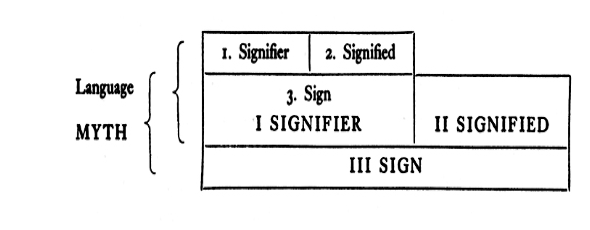
Myth does not deny things, on the contrary, its function is to talk about them; simply, it purifies them, it makes them innocent, it gives them a natural and eternal justification, it gives them a clarity which is not that of an explanation but that of a statement of fact.”
,
pig example young black boy example as signifier and signified as how France is a great empire no discrimination age ethnicity...everyone serves France
myth Is that the first sign (a boy saluting) comes to represent a strong French empire with no discrimination and with people that are proud to be French
,
pig example young black boy example as signifier and signified as how France is a great empire no discrimination age ethnicity...everyone serves France
myth Is that the first sign (a boy saluting) comes to represent a strong French empire with no discrimination and with people that are proud to be French
72
New cards
Polysemic Signs
- Signs do not have singular, fixed meanings but are polysemic → carry many potential meanings
- Texts (aka signs) can be interpreted in many different ways
- Reader fixes meaning of text temporarily, within own background and knowledge of codes
- Differences arise based on gender, class, nationality, age, etc.
- Meaning is by nature ambiguous.
- Texts (aka signs) can be interpreted in many different ways
- Reader fixes meaning of text temporarily, within own background and knowledge of codes
- Differences arise based on gender, class, nationality, age, etc.
- Meaning is by nature ambiguous.
73
New cards
Jacques Derrida
- Language generates meaning through difference
- “From the moment there is meaning there is nothing but signs. We think only in signs.” (différance, as the meaning of the signified is never consistent, as it never actually exists outside of language → we always need language to explain it)
- There is no original meaning outside of signs (we are the ones that assign a meaning to a sign)
- Deconstruction
- It is impossible to explain a meaning without the use of signs, we can only think in signs
- “From the moment there is meaning there is nothing but signs. We think only in signs.” (différance, as the meaning of the signified is never consistent, as it never actually exists outside of language → we always need language to explain it)
- There is no original meaning outside of signs (we are the ones that assign a meaning to a sign)
- Deconstruction
- It is impossible to explain a meaning without the use of signs, we can only think in signs
74
New cards
Derrida
Derrida deconstructs the idea that speech provides an identity between signs and meaning: that is, signs do not possess clear and fixed meanings. There is no original meaning outside of signs. There can be no truth or meaning outside of representation. There is nothing but signs.
75
New cards
Derrida criticizes:
- Logocentrism: reliance on a priori, universal meanings, existing before human reason or linguistic/construction
- Phonocentrism: priority given to sound and speech over writing, as being closer to universal truths
- Phonocentrism: priority given to sound and speech over writing, as being closer to universal truths
76
New cards
Transforming History into Nature:
The very principle of myth: it transforms history into nature.
- Myth does not deny things, on the contrary, its function is to talk about them; simply, it purifies
them, it makes them innocent, it gives them a natural and eternal justification, it gives them a
clarity which is not that of an explanation but that of a statement of fact.
- Myth tells you “this is how things are”, it simplifies things
- Myth does not deny things, on the contrary, its function is to talk about them; simply, it purifies
them, it makes them innocent, it gives them a natural and eternal justification, it gives them a
clarity which is not that of an explanation but that of a statement of fact.
- Myth tells you “this is how things are”, it simplifies things
77
New cards
What do both Key Thinkers Saussure and Barthes have in common?
The works of Barthes and Saussure are among the founding texts of contemporary cultural studies. They represent the move away from culturalism towards structuralism. They helped break the notion that the text is a transparent bearer of meaning and illuminated the argument that all cultural texts are constructed with signs.
78
New cards
Language is not a neutral medium (can you explain this?) (85)
Language is shaped by culture and vice versa.
79
New cards
Saussure's (linguist) definition of semiotics (what is semiotics? Why is Saussure’s approach to it structuralist?) (86)
Semiotics: theory of signs → Saussure wanted a general theory theory of signs
According to him sign systems construct meaning through a series of conceptual and phonetic differences.
Signs are always part of a network/structure (in this case the language) and have to be looked at in relation to other signs. → STRUCTURALIST
He therefore distinguishes between langue and parole:
● Langue - underlying structure of language (e.g. grammar)
● Parole - actual language that is used everyday.
We can approach culture in the same way; there arguably is a structure to culture. Some cultural theorists therefore study those structures rather than specific cultural phenomenons.
According to him sign systems construct meaning through a series of conceptual and phonetic differences.
Signs are always part of a network/structure (in this case the language) and have to be looked at in relation to other signs. → STRUCTURALIST
He therefore distinguishes between langue and parole:
● Langue - underlying structure of language (e.g. grammar)
● Parole - actual language that is used everyday.
We can approach culture in the same way; there arguably is a structure to culture. Some cultural theorists therefore study those structures rather than specific cultural phenomenons.
80
New cards
Saussure's theory of the sign (the different components, how they work, why this is structuralist) (86)
1. Signifier - the sound or image (e.g. tree or an image of a tree)
2. Signified - the concept/idea associated with this sound or image
3. Sign - the combination of 1 and 2 giving you the final word with the relevant meaning
2. Signified - the concept/idea associated with this sound or image
3. Sign - the combination of 1 and 2 giving you the final word with the relevant meaning
81
New cards
What does it mean that the arrangement between signifier and signified is arbitrary? (87)
Arbitrary - based on random choice or personal whim, rather than any reason or system.
It means that signs are subject to history. Which signifiers and signifieds are put together is entirely a result of history.
It means that signs are subject to history. Which signifiers and signifieds are put together is entirely a result of history.
82
New cards
What does the arbitrary relation between signifier and signified imply? (87)
It means that the meanings we attach to words are not necessarily static but can change over time. Meaning is fluid.
83
New cards
Structuralism (define, make sure you can explain the difference between this and poststructuralism) (18-21 & 93-94)
Structuralism - believes that there is an underlying structure/pattern to the way things are and that by studying this pattern one can better understand how things work and why they are the way they are.
Poststructuralism - believes that meanings are not static but are always in process. Meaning originates from intertextuality. Texts can have multiple meanings.
Poststructuralism rejects these ideas of Structuralism
- idea of binary pairs that can easily be kept apart langue vs parole
-idea of a stable structure that underlies all process of signification
-idea of stable meaning / always deferred in process and interdependent
Poststructuralism - believes that meanings are not static but are always in process. Meaning originates from intertextuality. Texts can have multiple meanings.
Poststructuralism rejects these ideas of Structuralism
- idea of binary pairs that can easily be kept apart langue vs parole
-idea of a stable structure that underlies all process of signification
-idea of stable meaning / always deferred in process and interdependent
84
New cards
Cultural code (88)
Signs are commonly organised into a sequence that generates meaning through the cultural conventions of their usage within a particular context. These arrangements are called cultural codes. (see: traffic light example, p. 88)
The relation between signifier and signified is determined by our cultural codes. Cultural conventions can change over time or between different groups within a culture. This extends to non-linguistic sign systems, for instance: color. (see: Green Coke example)
The relation between signifier and signified is determined by our cultural codes. Cultural conventions can change over time or between different groups within a culture. This extends to non-linguistic sign systems, for instance: color. (see: Green Coke example)
85
New cards
How do signs become naturalized codes? (88)
Through cultural habituation. (repetition)
86
New cards
Phonic and conceptual difference (why is this important for Saussure?) (86)
Phonic differences: sounds differ (e.g. tree doesn’t sound the same as egg)
Conceptual differences: concepts/ideas differ (e.g. the concept of a tree if very different from that of an egg)
→ without these differences communication would not be possible (e.g. red can only be understood in relation to the differences between red and green or red and blue, etc.)
Conceptual differences: concepts/ideas differ (e.g. the concept of a tree if very different from that of an egg)
→ without these differences communication would not be possible (e.g. red can only be understood in relation to the differences between red and green or red and blue, etc.)
87
New cards
Two systems of signification: denotation and connotation (89)
Denotation - the literal meaning of a word/sound (e.g. pig - the animal)
Connotation - the implied/related meaning of this word (often culturally specific) (e.g. pig - police officer)
Connotation - the implied/related meaning of this word (often culturally specific) (e.g. pig - police officer)
88
New cards
Barthes definition of myth (and how it builds on Saussure) (89-92)
Barthes took Saussure’s scientific approach to language and applied it to popular culture. He introduced the concept of ‘myths’ which built on Saussure’s theory of signs; once we have a ‘sign’ (see table above) we often attach an additional meaning to it which we believe to be natural. To elaborate: the sign (e.g. pig) has a first level signification (denotation) where pig = the farm animal. However, it also has a second level signification (connotation) where pig = police officer, person with bad table manners, etc.. Many words can have several connotations which are historically and culturally determined.
89
New cards
Why are the work of Saussure and the early Barthes amongst the founding texts of contemporary cultural studies? (86 & 91-92)
Saussure is a founding father of structuralism and Barthes applied this theory to the wider cultural context. The introduction of the idea of structuralism also allowed for other theories such as poststructuralism to emerge. Their work therefore built the foundations for contemporary cultural studies.
90
New cards
What are polysemic signs? (92)
Signs that can be interpreted in multiple ways - they have multiple meanings.
91
New cards
Language generates meaning through difference – what does that mean? (86-88)
We have to differentiate between different sounds and concepts. If all sounds/concepts are the same it is very difficult to give them meaning. (see also: phonetic and conceptual difference)
E.g. tree sounds different to dog allowing us to differentiate between them and consequently allowing us to ascribe meanings to them.
E.g. tree sounds different to dog allowing us to differentiate between them and consequently allowing us to ascribe meanings to them.
92
New cards
Poststructuralism (define, explain how it builds upon structuralism and how it criticizes structuralism) (18-21 & 93-94)
Poststructuralism believes that meanings are not static/fixed/stable but are always in process. Meaning originates from intertextuality. Texts can have multiple meanings.
It criticises the structuralist belief that texts have a single, intended/universal/true meaning which does not change. Instead the focus is shifted to the reader of these texts (rather than the author) and it is argued that the reader will assign his own meanings based on his cultural background/knowledge of codes (differences in e.g. gender, class, nationality, age, etc.). Because the interpretation of the text is dependent on the reader (Barthes: The Death of the Author → shift from encoding to decoding) there is no consistent meaning that can be applied to texts.
It criticises the structuralist belief that texts have a single, intended/universal/true meaning which does not change. Instead the focus is shifted to the reader of these texts (rather than the author) and it is argued that the reader will assign his own meanings based on his cultural background/knowledge of codes (differences in e.g. gender, class, nationality, age, etc.). Because the interpretation of the text is dependent on the reader (Barthes: The Death of the Author → shift from encoding to decoding) there is no consistent meaning that can be applied to texts.
93
New cards
Derrida's definition and critique of logocentrism (95)
Reliance on priori meanings (universal meanings that existed before human reason or linguistic/cultural construction
94
New cards
Derrida's definition and critique of phonocentrism (95)
Priority is given to sound and speech over writing as they are apparently closer to universal truths.
95
New cards
Why is Derrida poststructuralism? Can you explain? (94-96)
Derrida believed that meaning can never be fixed/stable. Instead signs have multiple meanings. (see also: differance)
96
New cards
Différance (definition) (96)
Meaning is only generated through signifiers and the difference between them (not by reference to other objects). Therefore meanings can never be fixed.
97
New cards
Deconstruction (definition) (97-98)
The method of taking apart texts in order to show how a text is trying to fix meaning but is unable to do so. This can also show hidden biases (in particular: gender, race, nationality).
98
New cards
Lecture 4. Approaching Culture like a Language: the concept and method of Post Structuralism
Key terms: différance, deconstruction, propaganda
99
New cards
Post structuralism and Michel Foucault
Foucalt is an anti-essentialist and a poststructuralist thinker and developed the term ‘discourse’ and ‘docile bodies’.
Foucault argues against formalist theories of language that conceive of it as an autonomous system with its own rules and functions(like structuralist semiotics). He also opposes interpretative methods that seek to disclose ‘hidden’ meanings in language. Foucault focuses on the description and analysis of the surfaces of discourse and their text.
- Believes that language develops and generates meaning under specific material and historical conditions.
- Explores the particular and determinate historical conditions under which statements are combined and regulated
- Regulation both forms and defines a specific field of knowledge under which statements are constituted by a particular set of concepts. This domain delimits a ‘regime of truth’(aka what counts as truth)
- Foucault attempts to identify the historical conditions and the determining of rules or the formation of discourses, or regulated ways of speaking about objects.
Foucault argues against formalist theories of language that conceive of it as an autonomous system with its own rules and functions(like structuralist semiotics). He also opposes interpretative methods that seek to disclose ‘hidden’ meanings in language. Foucault focuses on the description and analysis of the surfaces of discourse and their text.
- Believes that language develops and generates meaning under specific material and historical conditions.
- Explores the particular and determinate historical conditions under which statements are combined and regulated
- Regulation both forms and defines a specific field of knowledge under which statements are constituted by a particular set of concepts. This domain delimits a ‘regime of truth’(aka what counts as truth)
- Foucault attempts to identify the historical conditions and the determining of rules or the formation of discourses, or regulated ways of speaking about objects.
100
New cards
Poststructuralism
accepts and absorbs aspects of structuralism while subjecting it to critique. Poststructuralism builds on the foundation of structuralism, but rejects the presupposition of a structured and fixed system of meaning production.
> There can be no denotative meaning which is fixed and stable.
> There can be no denotative meaning which is fixed and stable.