Lecture 1: Free vibrations
 Call Kai
 Learn
Learn Practice Test
 Spaced Repetition
 Match
Match Flashcards
 Knowt Play
1/22

There's no tags or description
Looks like no tags are added yet.
Name | Mastery | Learn | Test | Matching | Spaced | Call with Kai |
|---|
No analytics yet
Send a link to your students to track their progress
23 Terms
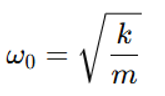
What is natural frequency? what it describes and the formula
System has its own preferred oscillation speed, named as natural frequency. Tells us how fast (rad/s or Hz) the system vibrates naturally when set to motion without damping and without external force. Depends on the ratio between stiffness and mass
What does increase/decrease in stiffness and mass mean for the natural frequency?
High stiffness increases the restoring force and therefore increases the oscillation frequency, while high mass increases inertia and lowers the frequency
What is damping? physical meaning of damping in a structural system
Damping is a mechanism that dissipates mechanical energy from a vibrating system. It acts opposite to the direction of motion and causes the vibration amplitude to decrease over time.
In strucutral systems, what can damping originate from?
internal material friction (energy loss between two surfaces), joints, air resistance (energy loss to air), interaction with the surroundings, internal material damping (energy loss in the material itself)
What is the relation between damping and velocity?
Damping force=-cx (med prikk over), meaning damping is proportional to velocity. higher velocity—>higher damping.
What happens to the energy in a damped vibrating system?
In a damped vibrating system, the mechanical energy is gradually dissipated during motion. The kinetic and potential energy decrease over time because part of the energy is removed from the system by damping forces. Converted to heat.
What would happen to the structure if no damping was present?
Without damping, vibrations would continue indefinitely
What is the damping ratio? and the formula
The damping ratio is a measure of how quickly vibrations decay in a system compared to the amount of damping required for critical damping.
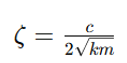
Why is the damping ratio dimensionless? and why is this useful?
The damping ratio is dimensionless because all physical units cancel out in the expression. This makes it useful for comparing damping behavior between different structural systems independently of their size or units.
what types of damped cases do we have? and their “limits”
Underdamped case: 0< ζ<1
Critically damped: ζ=1
Overdamped: ζ>1
What is underdamped case
0< ζ<1: These systems still oscillate, but the amplitude decreases gradually over time due to energy dissipation.
WHat is a critically damped case?
ζ=1: The system returns to equilibrium as quickly as possible without oscillating.
WHat is a overdamped system?
ζ>1: These systems do not oscillate, and they return to equilibrium more slowly than critically damped systems
WHat is the damped natural frequency? and the formula
The actual oscillation frequency for a damped structure. always smaller than natural frequency
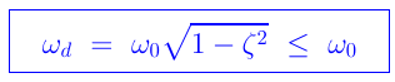
Why is the damped natural frequency lower than the undamped natural frequency?
The damped natural frequency is lower because the damping force affects the dynamic equilibrium of the system and slightly reduces the oscillation frequency. as the damping ratio increases, the damped natural frequency decreases.
for lightly damped structures, what is the difference between natural frequency and damped natural frequency?
usually very small
what is a period of a damped oscillation?
The time it takes to complete a full cycle when damping is present. obs: only for underdamped case
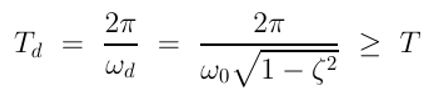
what is the difference between the period of a damped oscillation and undapmed ?
Damped period is longer than undamped period. Damping is slowing down the system—>using longer time to go back and forth
What is the logarithmic decrement? and formula
describes the reduction in vibration amplitude betweeb successive peaks in an underdamped system. measures how quickly the vibrations decay over time (tells us how much the amplitude has decreased)
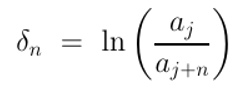
what does large δn tell us? (logarithmic decrement
Amplitude drops quickly, strong damping
what does small δn tell us? (logarithmic decrement
ampllitude decreases slowly, weak damping
What is the relation between logarithmic decrement and damping for lightly damped systems? formula

what decay does damping give?
logarithmic. the amplitude decays exponentially with time