Technological hazards
 Call Kai
 Learn
Learn Practice Test
 Spaced Repetition
 Match
Match Flashcards
 Knowt Play
1/80

There's no tags or description
Looks like no tags are added yet.
Name | Mastery | Learn | Test | Matching | Spaced | Call with Kai |
|---|
No analytics yet
Send a link to your students to track their progress
81 Terms
What is the cause of most technological hazards
Human fallibility in decision making which leads to failures in complex systems and technical and operational defects
How can natural environmental processes influence technological hazards
Can trigger an event, can act as a vector by spreading contaminants
Three categories of technological hazards
Large-scale structures (buildings, bridges, dams), Transport systems (road, air, sea, rail), Industrial processes (manufacturing, production, storage of hazardous materials)
Globally do natural hazards or man-made hazards kill more people per year
Natural (88,900 deaths between 1970-1985 from natural events compared to 5,500 deaths from man-made events)
In MDCs what causes more deaths, natural events or man-made events
Man-made events (not by much thought)
Most deadly transport incident
Philippines 1987 4,386 (passenger ferry sank after hitting an oil tanker)
The high reliability school of thought on how industrial accidents occur
High risk industries seek failure-free operation, Built-in redundancy in complex organizations, a fail-safe environment, delegated local decision making
The normal accidents school of thought on how industrial accidents occur
Safety and reliability are not undisputed priorities, they compete with other objectives, pressures for innovation and operation can lead to design flaws (cut corners), training and local decision making cannot eliminate operation failure
Between these two schools of thought which one is often seen in industry
The normal accidents school
What factors increase the risk of industrial hazards
Rise in petrochemical and nuclear industries, large plants placed adjacent to populations, exploration of resources in increasingly hostile environments (deep sea drilling, arctic drilling/transport of fuels, tech transfers from one country to another, different social and industry practices
What are the riskiest industrial procedures
Manufacturing, storage, and transportation of materials
What is significant about the different social and industrial practices within regions when it comes to industrial disasters
When one country sends new technology to another country that doesn’t have it, that country could use it in an unsafe way or not know what safety precautions to take
How many nuclear power plants are there
about 500 operating or in construction
What percent of nuclear power plants ae over 20 years old
25%
What agencies regulate nuclear energy
USA Nuclear regulatory commission (NRC), UK Office for Nuclear Regulation (ONR), Global International Atomic Energy Agency (IAEA)
Describe public perception of nuclear power
Vary variable with some people in strong support and others very opposed, is influenced by important events such as nuclear disasters
What was the worst nuclear disaster
Chernobyl
When did the Chernobyl disaster occur
April 25th 1986
How many direct deaths were caused by Chernobyl
31
How many indirect deaths were caused by Chernobyl
15
What are the death forecasts caused by Chernobyl
4,000-27,000 (depends on model)
How many people were displaced by Chernobyl
350,000
How much money did the USSR spend to contain and decontaminate after the Chernobyl disaster
Equivalent to $18 billion US dollars (bankrupted itself)
In Ukraine what was the total cost over 30 years for the maintenance of Chernobyl
Equivalent to $235 billion US dollars
What caused the Chernobyl disaster
The event occurred during an experiment; time of experiment was changed leading to untrained staff overseeing it. Power level was allowed to drop below 20% which is unstable for this kind of reactor, steam was allowed to build up, blew the 1,000-ton roof off the building, 5% of the core material escaped to the atmosphere during the explosion and fire
What was the purpose of the experiment at Chernobyl
Operators tried to work out how long the turbine would keep turning from mechanical inertia before the diesel generators would have to be used in the event of a power outage
Describe the impact of the fallout from Chernobyl
Fallout of Cs137 traveled all the way to parts of France, the UK, and Ireland,
What did they do to contain Chernobyl after the disaster
A containment structure was built over the damaged reactor
How many people were estimated to have suffered health disorders as a result of the Chernobyl disaster
2 million
While Chernobyl was not a natural hazard how did natural systems play a role in the disaster
The atmosphere was a vector that spread fallout all over Europe
What is a na-tech hazard
A natural hazard triggered technological accident
Characteristics of na-tech hazards
The natural hazard is a trigger, material is released, the toxic/dangerous material is transported in the environment
Example 1 of na-tech hazards (Tohoku earthquake)
A heavy oil tank at a thermal power plant was destroyed by the tsunami following the Tohoku earthquake in 2011 and released oil
Example 2 of na-tech hazards (Hurricane Katrina)
The storm surge created by hurricane Katrina in 2005 dislodged hydrocarbon storage tanks and created oil spills
Example 1 of natural hazards impacting nuclear power plants (flooding)
In mid-July 1993 the Cooper nuclear power station (built on a 100-year flood plain) encountered rapidly rising flood waters which forced the shutdown of the reactor as dikes and levees collapsed around the site closing many emergency escape routes in the region
Example 2 of natural hazards impacting nuclear power plants (tornado)
On June 24 1998 the Davis-Besse nuclear power station near Toledo Ohio was hit by an MF2 tornado while at 99% power. the tornado destroyed 3 independent power supplies causing the plant to go into shutdown and the diesel generators began to fail. Offsite power was restored as the final diesel was failing
Describe the Tohoku/Fukushima disaster
A Mw 9 earthquake occurred 70Km offshore of Japan in a subduction zone, the earthquake triggered a tsunami that reached 40m high in places and traveled inland for up to 10Km in places, the tsunami flooded the Fukushima I Nuclear power station, the earthquake triggered shutdown of the reactor but backup generators continued to run to keep the core cool. When the plant was struck by a 14m high tsunami the generators failed. As a result there were three nuclear meltdowns, hydrogen-air explosions, and the release of radioactive material from March 12th to 15th
How big was the exclusion zone around the Fukushima disaster
20Km
What did they do to cool the core once the disaster at Fukushima began
Helicopters dropped seawater until the plant was flooded and cool
How much will the clean-up for Fukushima cost and how long will it take
Equivalent to $50 billion US dollars and will take 40 years
How many fatalities were caused by the Fukushima disaster
No fatalities linked to radiation due to the accident, the eventual number of cancer deaths, according to models is expected to be around 130–640
What happened after the Fukushima disaster
In March 2017, a Japanese court ruled that negligence by the Japanese government had led to the Fukushima disaster by failing to use its regulatory power to force TEPCO (Tokyo Electrical Power Company) to take preventative measures (Vulnerability to tsunami was known prior to disaster)
What happened to Japan’s energy regime after the Fukushima disaster
Energy regime has switched to coal with 26% of Japan’s energy coming from coal by 2030 (the previous goal was to reduce coal’s share to 10%)
Environmental impacts of Fukushima disaster
Soil contamination (fallout needed national cleanup) and Water contamination (Washout had translational implications)
What is the Quaternary period
2.58 Mya — present
What is the Pleistocene epoch
2.58 Mya — 11,700 years ago
What is the Holocene epoch
11,700 years ago — present
Why is looking at quaternary environmental change important
Provides background to current environmental systems, shows us that there is global warming context in which to consider when analyzing sudden climate change
Quaternary Environmental Change
The quaternary period spanning approximately 2.58 million years ago to present. It is marked by environmental changes such as expansion and retreat of ice sheets, fluctuation in sea levels, and extinction of many large mammals and birds. (temperature change between ice ages and warm spells appear cyclical and show a pattern)
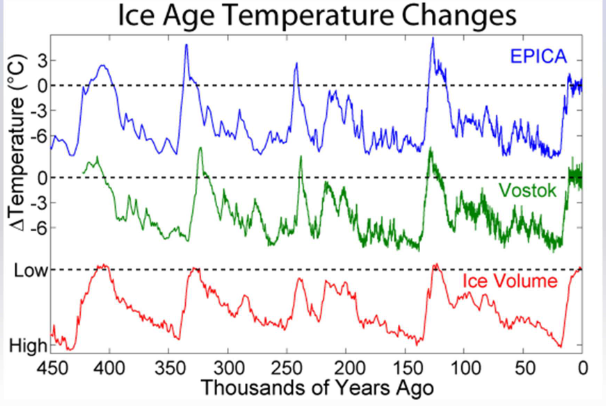
Environmental changes creates
Environmental hazards
What kinds of recent environmental changes are we experiencing
Changes to vegetation, land use, hydrological cycle, resource degradation
What did the Fifth assessment report (2013) find regarding climate change
Warming of the climate system is unequivocal, and since the 1950s, many of the observed changes are unprecedented over decades to millennia, atmospheric concentrations of CO2, methane, and nitrous oxide are higher than in the past 800,000 years
Global surface temperature is how much higher in 2011-2020 than in 1850-1900
1.1ºC
Can we state that a single event was caused by climate change
No, but we can estimate whether climate change altered the likelihood or magnitude of specific events occurring
How much has rainfall increased due to anthropogenic warming
Increased by 10%
If environmental change is slow then…
Species adapt or shift range, we have time to design remediation, politicians have time to understand and provide resources, (disadvantages include: may not develop on human time scale, political agendas)
If environmental change is fast or non-linear then…
Catastrophe theory, threshold or tipping point is reached, transition from one stable state to another stable state
Cusp-catastrophe model
Catastrophe theory describes how small, continuous changes in control parameters can have sudden, discontinuous effects on dependent variables. Such discontinuous, jump-like changes are called phase-transitions or catastrophes. Examples include the sudden collapse of a bridge under slowly mounting pressure, and the freezing of water when temperature is gradually decreased. Can also be seen in climate change where small changes in climate and ecosystem can have sudden and drastic effects. Popularized in the early 1970s
Why is species environmental conditions range important
Because if changes occur (temp, PH, salinity, etc.) that can lead to mass migrations or even large die off events
How does the tolerance of environmental change compare between individual species and ecosystems
Ecosystems have greater tolerance
How does environmental tolerance apply to natural hazards
Communities and individuals have different tolerances to risk and hazard events depending on where they are, socio-economic status, cultural values, etc. Organizations, agencies, and insurance companies have different tolerance risk
How do the effects of climate change impact communities differently
climate change impacts people with lower socio-economic statue disproportionately compared to other groups
Between 2010 and 2020 human mortality from floods, droughts, and storms was how much higher in vulnerable regions
15 times higher compared to regions with low vulnerability (areas that are highly vulnerable tend to be made up of minorities or people with low socio-economic status)
How do we predict environmental change
Monitoring (river flow, temp, aerial photographs, satellite data), establish a pattern from monitoring data, estimate range of change
How do climate models work
Have different differential equations based on different fields (physics, fluid motion, chemistry etc.), to tun the model you must create a 3-D earth and split it up into grids and apply the basic equations
Why does climate change lead to more flooding and rainfall
As the temperature increases more moisture can be held in the air which means more rain can be stored and dropped in rain events
In what region do higher temperatures and higher precipitation lead to increased floods
In regions where floods tend to be generated from heavy rainfall in autum
What regions would have fewer flooding events due to changes in seasonality related to climate change
Regions where floods are generated by spring snowmelt (less snow falls)
What parts of the US are experiencing significant increases and decreases in river flooding
New England and Washington state are experiencing increased instances of floods which makes sense because these places experience heavy rainfall in autumn. Areas around Michigan are experiencing a decrease in flooding because they depend heavily on snowpack which they are experiencing less of
How is climate change increasing the frequency/intensity relationships of hurricanes
As sea surface temp (SST) rises so does the PDI for hurricanes which means they will be more frequent and more intense
Power dissipation index (PDI)
Measure that combines storm intensity, duration, and frequency
As SSTs increase in tropical Atlantic regions (where hurricanes like to form) how much is the PDI of hurricanes expected to increase
Increase by roughly 300% by 2100
As SSTs increase in other oceans besides the tropical Atlantic how much is the PDI of hurricanes in this region expected to increase
Only a modest increase by 2100
Anthropogenic warming by the end of the 21st century will likely cause tropical cyclones globally to be more intense by how much
2-11%
By the end of the 21st century, climate models project approximately what percentage increase in rainfall rates within about 100 km of a storm center?
An increase of approximately 10–15%.
Higher sea levels will result in
Higher storm surges
What is a good example of a “tipping point” hazard
Development of glacial lakes, they can develop slowly as temps warm but can fail suddenly causing glacial lake outburst floods (GLOFs), rockslides, or even tsunamis
Why are rockslides associated with glacial melt
Because glaciers hold rocks in place so when they melt it causes glacial debuttressing and rockslides
When did the Tracy arm tsunami occur
August 10, 2025
What caused the Tracy arm tsunami
An ocean terminating glacier in Tracy Arm Fjord, roughly 4Km of retreat between 2005-2025, roughly 130m of down wasting of the glacier surface between 2013-2022, the debutressing of the slope that failed in July 2025, Failure in August
What was the tallest tsunami recorded
The Tracy arm tsunami (481 meters)