OM Week 1
 Call Kai
 Learn
Learn Practice Test
 Spaced Repetition
 Match
Match Flashcards
 Knowt Play
1/46

There's no tags or description
Looks like no tags are added yet.
Name | Mastery | Learn | Test | Matching | Spaced | Call with Kai |
|---|
No analytics yet
Send a link to your students to track their progress
47 Terms
Operations management
The design and control of business processes that transform inputs into outputs
The Transformation Process
Inputs → Process → Outputs
Inputs
Materials
Labor
Energy
Capital
Process
Collection of activities connected by flows
Outputs
Goods
Services
Information
Process
A collection of activities (or tasks) connected by a flow of goods and information that transforms various inputs into useful outputs
Process Components
Activities
Flows
Storage/Delays
Decisions
Activities
Tasks performed
Add value (or not)
Flows
Materials
Information
People
Storage/Delays
Inventory
Waiting queues
Buffers
Decisions
Branch Points
Routing Logic
Quality Checks
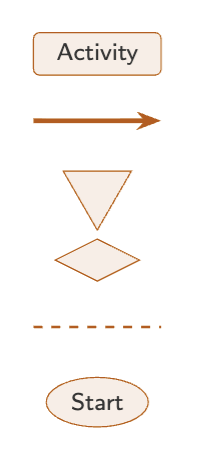
Process Flow Diagram Building Blocks
Activity
Flow
Storage
Decision
Swim Lane
Start/End
Activity (Process Flow Diagram)
Include what the shape is as well
A task that transforms inputs - where work happens
Flow (Process Flow Diagram)
Include what the shape is as well
Movement of materials, information, or people between activities
Storage (Process Flow Diagram)
Include what the shape is as well
Inventory, buffer, or queue where items wait
Decision (Process Flow Diagram)
Include what the shape is as well
A branch point based on a condition
Ex: approved? yes/no
Swim Lane (Process Flow Diagram)
Include what the shape is as well
Divider separating responsibilities by department or role
Start/End (Process Flow Diagram)
Include what the shape is as well
Marks where the process begins or terminates
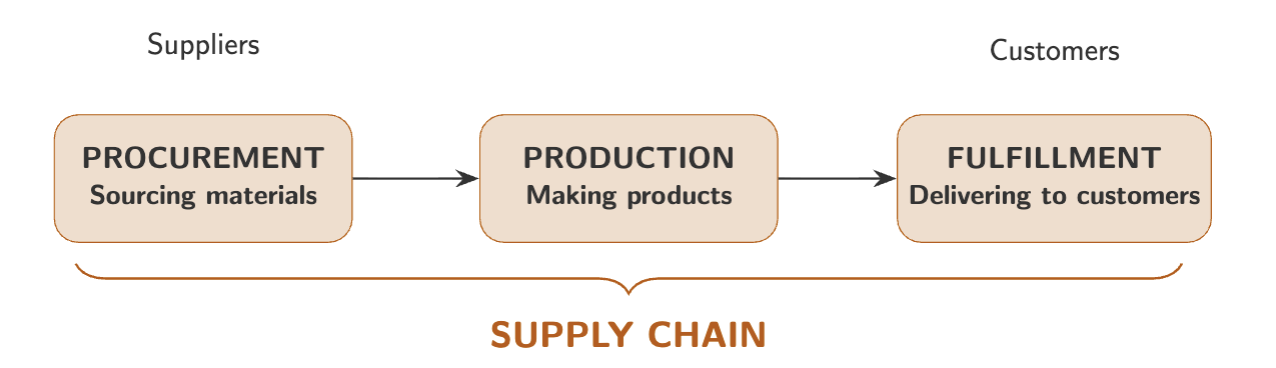
Three Core Business Processes
(Suppliers)
Procurement
Production
Fulfillment
(Customers)
Procurement
Sourcing materials
Create purchase requisition
Send purchase order
Receive materials
Process invoice/payment
Production
Making products
Authorize production
Issue raw materials
Create product
Store finished goods
Fulfillment
Delivering to customers
Receive customer order
Pick and pack
Ship order
Invoice and collect
Value-Adding Activities
Activities that the customer is willing to pay for
Manufacturing the product
Assembling components
Customizing to specifications
Quality inspection
Delivering to customer
Non-Value Adding Activities
Activities that consume resources but don’t add value
Waiting in queue
Moving materials. between locations
Rework due to defects
Excessive inventory storage
Unnecessary approval steps
Goal of Operations Management
Maximize value-adding activities, minimize waste
What drove Dell’s supply chain transformation?
Changing customer expectations for better speed, reliability, customization, and price
More competitive landscape in all markets
Managing a global footprint (increases complexity and risk)
The need to leverage data and generate insights from this asset for competitive advantage using AI, advanced analytics, and other emerging technologies
Merger of Dell/EMC opening a new market segment (storage and virtualization) but requiring integration of different cultures and supply chains
Why was it important that Dell shifted its focus from digital technologies to stakeholder experiences?
Who were the stakeholders and what were the five stakeholder experiences?
Which were the first two stakeholder experiences prioritized? Why?
Digitization needed to be linked to Dell’s value proposition, rather than simply “providing a solution in search of a problem.” Instead, Dell focused on transforming stakeholder experiences through digitization and became more value chain/supply chain oriented.
Stakeholders:
Customer
Supplier
Dell Workforce
Five Stakeholder experiences:
Make the right commitments
Ensure parts supply
Keep the customer informed
Manage the supply ecosystem
Drive operational efficiency
“Make the right commitments” and “Ensure parts supply” were prioritized because they focused on the customer and were necessary for the other experiences. Additionally, these two experiences were synergistic and supported each other.
What was a prerequisite to digital transformation?
What impediments did Dell face in this regard?
How were these impediments addressed?
A prerequisite to digital transformation was a solid data layer.
Dell had disparate data in sepertae systems and lacked a “single point of truth.”
As a result, Dell GO instituted two data foundations for all the stakeholders' experiences to harmonize and visualize data. It was managed by a dedicated data analytics group that worked cross-functionally to break down silos and transform the culture toward managing and maintaining data as a single point of truth.
What role did supply chain processes play in making digital transformation a reality?
At first, what mistake was the planning team making in digitizing the process?
What did they decide to do instead?
Using the 5 stakeholder experiences, the Dell GO team mapped, analyzed, and redesigned processes for digital transformation.
At first, the planning team made the mistake of digitizing existing processes
Later, they realized that they had an opportunity to redesign processes for improvement that took full advantage of the opportunities afforded by digital transformation
To address the unavailability of storage devices at Dell, which process (procurement, production, or fulfillment) is used at Dell and which resources are involved?
Process: procurement
Resources: warehouse, purchasing, accounting
To address the unavailability of storage at Dell, which process (procurement, production, or fulfillment) is used at Samsung and which resources are involved?
Process: fulfillment
Resources: sales, warehouse, accounting
The original Dell model":
Customer calls Dell directly
Specifies exactly what they want
Dell build the PC to order
Ships directly to customer
Dell’s Traditional Supply Chain Flow
Dell’s New Supply Chain Flow

What did Dell’s new supply chain method eliminate?
What was the result?
Middlemen and the inventory
Lower prices, faster delivery, and exactly what the customer wanted
Cash Conversion Cycle (CCC)
Net days your cash is stuck in the business
Days between cash OUT and cash IN
Cash Conversion Cycle Equation
CCC = DIO + DSO - DPO
DIO: Days Inventory Outstanding - How long inventory sits before you sell it
DSO: Days Sales Outstanding - How long until customers pay you
DPO: Days Payables Outstanding - How long until you pay your suppliers
What does the following formula intuitively mean?
DIO + DSO
How long until cash comes in?
What does the following intuitively mean?
DPO
How long until cash goes out?
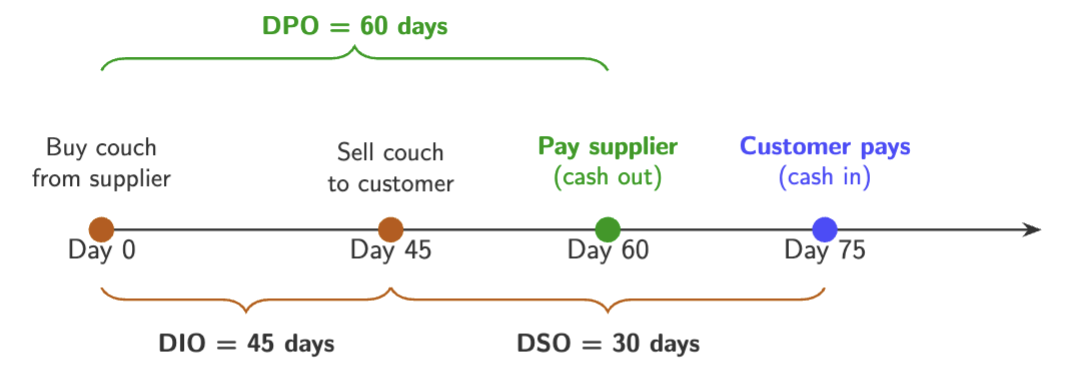
What is the CCC?
CCC = 45 + 30 - 60 = 15 days
You pay on Day 60 but don’t get paid until Day 75
What does it mean to have a positive CCC?
Your cash is locked in inventory and receivables
What does it mean to have a negative CCC?
Suppliers finance your operations
What does a high/positive CCC entail?
Growth consumes cash → Need banks to grow
The faster you grow, the more cash you burn.
Many profitable businesses fail because they grow too fast and run out of cash.
What does a low/negative CCC entail?
Growth generates cash → Customers fund your growth
More sales = More cash collected upfront = More free cash
Who is financing your operations?
You, your customer, or your suppliers
Someone always pays to keep goods moving
Smart operations shift that burden to others
What technology did Dell implement first, and how much labor did it save per year?
Robotic Process Automation (RPA)
200K hours of manual work saved per year
How many different systems was Dell using to track supplier data?
6 different systems tracking supplier data