Management Principles: Leadership Theories and Decision-Making Strategies
 Call Kai
 Learn
Learn Practice Test
 Spaced Repetition
 Match
Match Flashcards
 Knowt Play
1/47

There's no tags or description
Looks like no tags are added yet.
Name | Mastery | Learn | Test | Matching | Spaced | Call with Kai |
|---|
No analytics yet
Send a link to your students to track their progress
48 Terms
What is the Path-Goal Theory?
A leadership theory that holds that leaders can increase subordinate satisfaction and performance by managing goals.
What are the conditions for path clarification and rewards in Path-Goal Theory?
Leader behavior must be a source of immediate or future satisfaction for followers and offer something unique and valuable while providing coaching, guidance, support, and rewards.
What is Directive Leadership?
A leadership style where the leader specifies what is expected, provides guidelines, schedules work, sets performance standards, and ensures compliance with rules.
What is Supportive Leadership?
A leadership style where the leader is friendly, approachable, shows concern for employee welfare, treats them as equals, and creates a friendly climate.
What is Participative Leadership?
A leadership style where the leader consults employees for their suggestions and input before making decisions.
What is Achievement-Oriented Leadership?
A leadership style where the leader sets challenging goals, has high expectations, and displays confidence that employees will take responsibility and put forth extraordinary effort.
When should Directive Leadership be used?
In complex tasks and when workers have an external locus of control.
When should Supportive Leadership be used?
In unchallenging tasks and when workers lack confidence.
When should Participative Leadership be used?
In unstructured tasks and when workers have an internal locus of control.
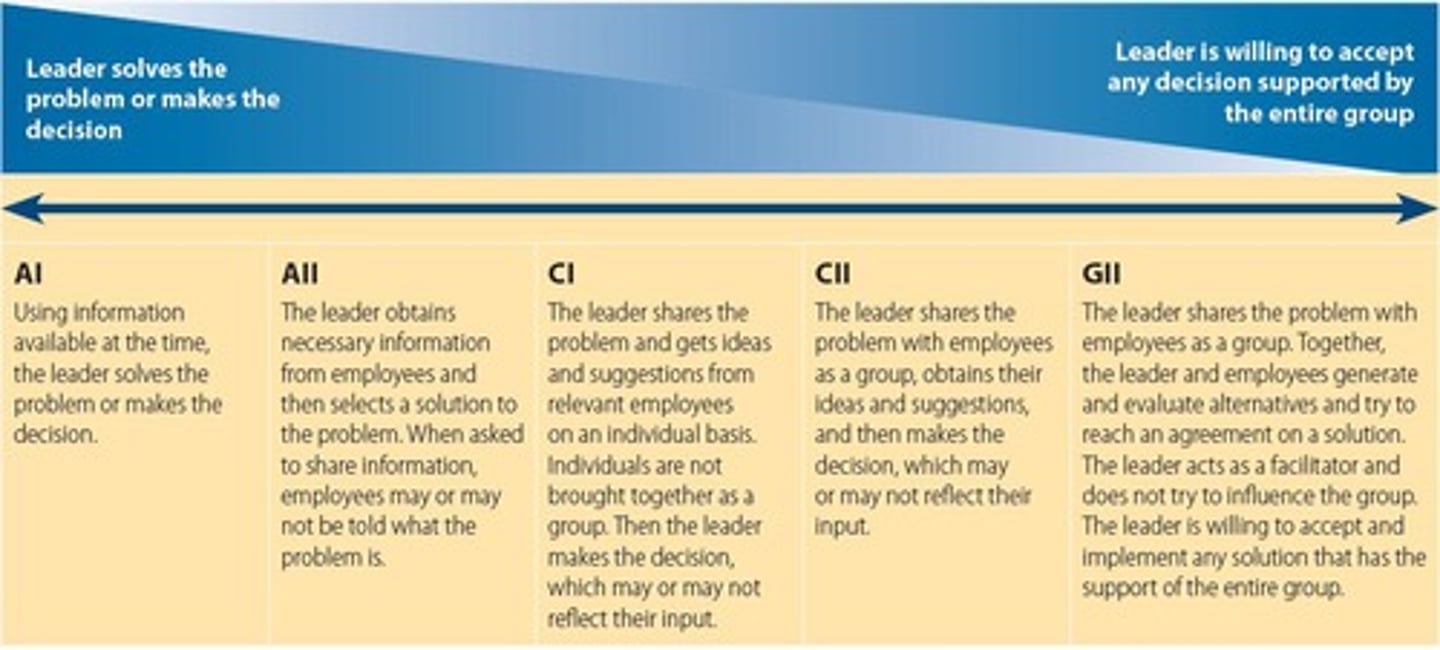
What is Normative Decision Theory?
A theory that suggests how leaders can determine the appropriate amount of employee participation when making decisions.
What are the decision styles in Normative Decision Theory?
Autocratic (AI or AII), Consultative (CI or CII), and Group (GII) decisions.
What is the Quality Rule in Normative Decision Theory?
If the quality of the decision is important, then don't use an autocratic decision style.
What is the Leader Information Rule?
If the quality of the decision is important and the leader lacks sufficient information, then don't use an autocratic decision style.
What is the Subordinate Information Rule?
If the quality of the decision is important and subordinates lack sufficient information, then don't use a group decision style.
What is the Goal Congruence Rule?
If the quality of the decision is important and subordinates' goals differ from the organization's goals, then don't use a group decision style.
What is the Commitment Probability Rule?
If having subordinates accept and commit to the decision is important, then don't use an autocratic decision style.
What is Visionary Leadership?
Leadership that creates a positive image of the future, motivating organizational members and providing direction for planning and goal setting.
What is Charismatic Leadership?
The behavioral tendencies and personal characteristics of leaders that create a strong relationship with their followers.
What distinguishes Ethical Charismatics from Unethical Charismatics?
Ethical Charismatics use power to serve others, while Unethical Charismatics use power to dominate or manipulate others for personal gain.
What are the components of Transformational Leadership?
Charismatic leadership, inspirational motivation, intellectual stimulation, and individualized consideration.
What is the role of feedback in Ethical Charismatic Leadership?
Ethical Charismatics are open to feedback and willing to learn from criticism, unlike Unethical Charismatics who avoid candid feedback.
What is the impact of Visionary Leadership on organizational members?
It generates awareness and acceptance of a group's purpose and mission, encouraging employees to see beyond their own needs.
What is the significance of two-way communication in Ethical Charismatic Leadership?
It allows for engagement and seeking out viewpoints on critical issues, fostering a collaborative environment.
How do Ethical Charismatics develop their followers?
They focus on developing people, express confidence in them, and share recognition with others.
What are the three virtues of Ethical Charismatics?
Courage, a sense of fairness or justice, and integrity.
What is the difference between Charismatic and Transformational Leadership?
Charismatic leadership focuses on the leader's personal characteristics, while transformational leadership emphasizes generating awareness and acceptance of a group's purpose.
What is the importance of commitment in decision-making according to Normative Decision Theory?
Having subordinates accept and commit to the decision is crucial for successful implementation.
What is leadership?
The process of influencing others to achieve group or organizational goals.
How do leaders differ from managers?
Leaders focus on vision and long-term goals, while managers focus on productivity and efficiency.
What is Trait Theory in leadership?
A theory that holds effective leaders possess a similar set of traits or characteristics.
Name three traits that differentiate leaders from non-leaders.
Drive, desire to lead, and honesty & integrity.
What does initiating structure refer to in leadership behaviors?
The degree to which a leader structures the roles of followers by setting goals, giving directions, and assigning tasks.
What is consideration in leadership behaviors?
The extent to which a leader is friendly, approachable, and supportive, showing concern for employees.
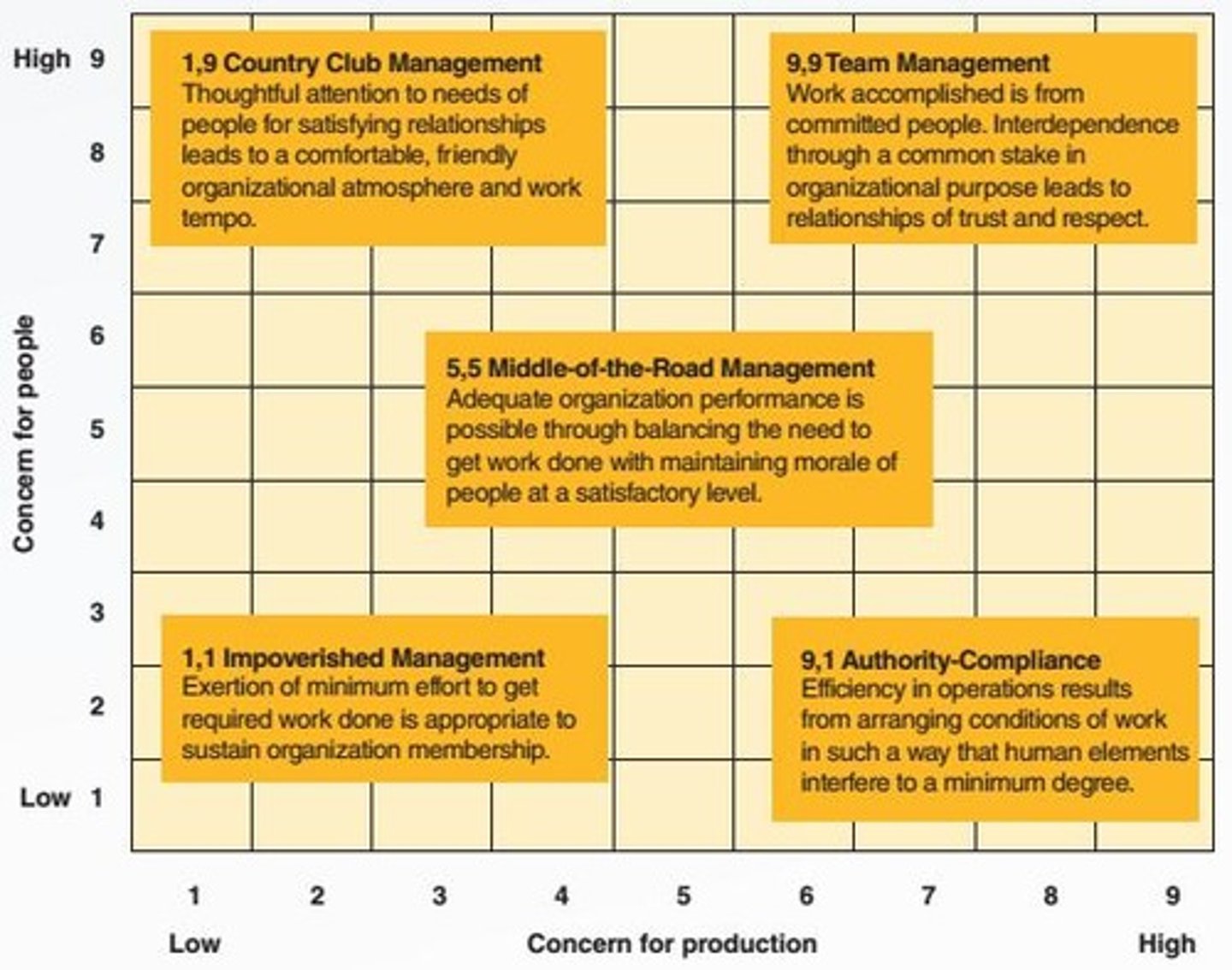
What does the Blake/Mouton Leadership Grid assess?
The level of concern for people versus the level of concern for production.
What is the situational approach to leadership?
A perspective that assumes the effectiveness of any leadership style depends on the situation.
What is Fiedler's Contingency Theory?
A theory stating that to maximize work group performance, leaders must be matched to the situation that best fits their leadership style.
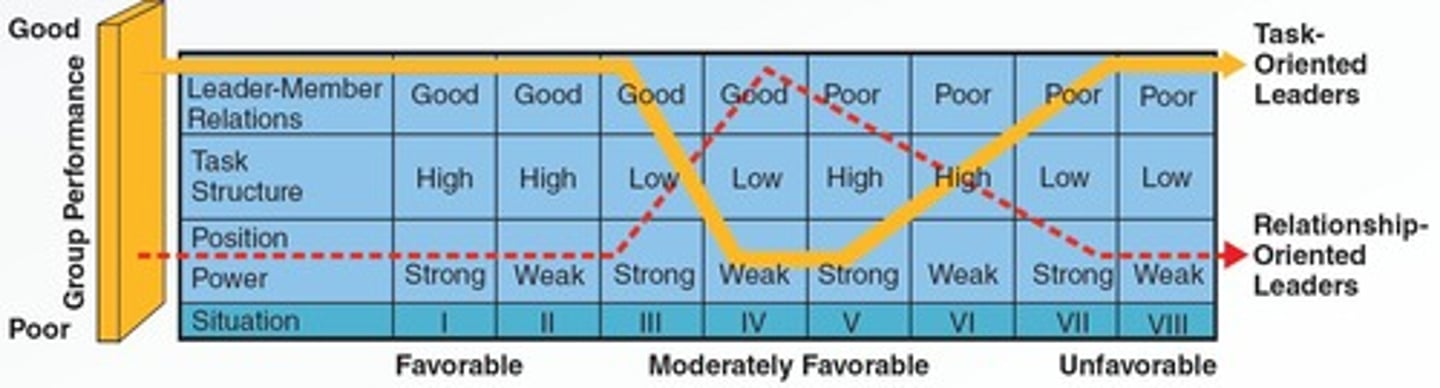
What does the Least Preferred Coworker (LPC) questionnaire measure?
It measures leadership style, indicating if a leader is relationship-oriented or task-oriented.
What are the three factors determining situational favorableness?
Leader-member relations, task structure, and position power.
What is performance readiness in Hersey & Blanchard's Situational Leadership Theory?
The ability and willingness to take responsibility for directing one's behavior at work.
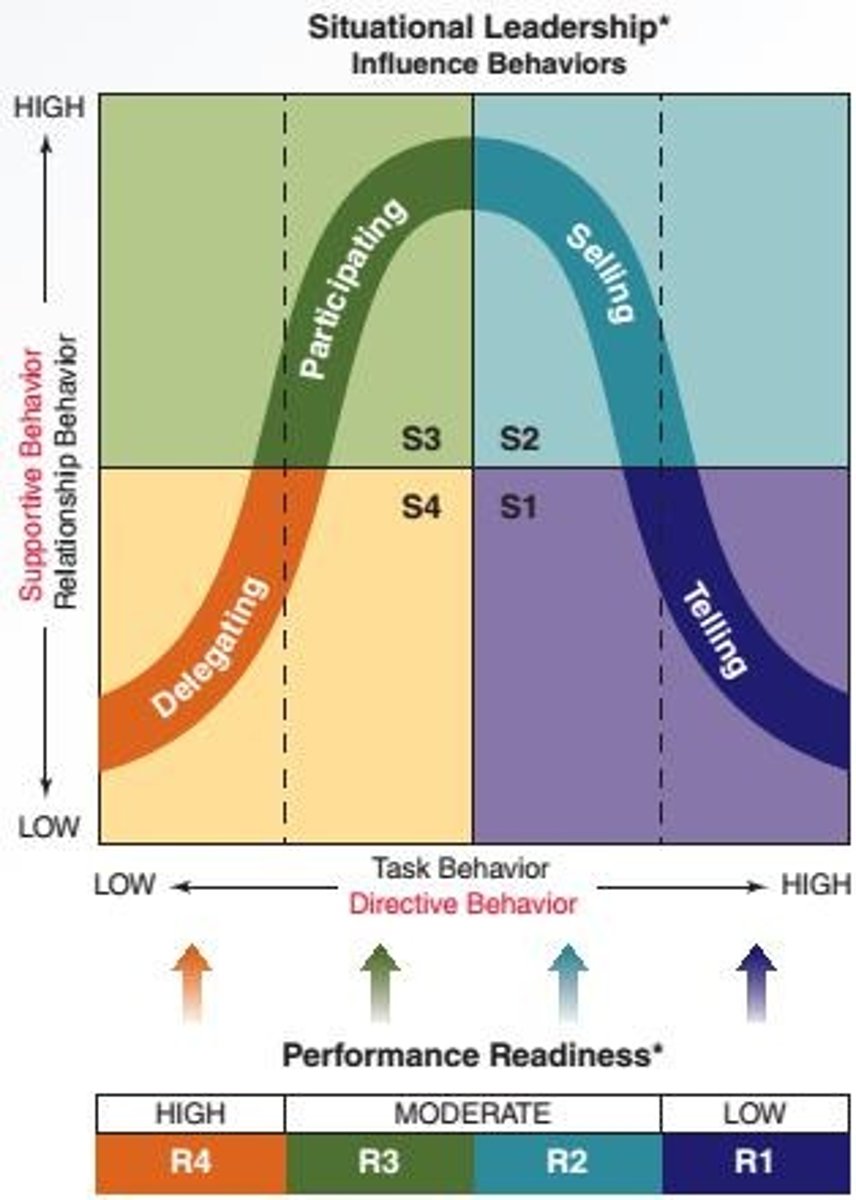
What are the four levels of performance readiness according to Hersey & Blanchard?
R1: Insecure and unable; R2: Confident but not able; R3: Insecure but able; R4: Confident and able.
What does a high task structure indicate?
The requirements of a subordinate's tasks are clearly specified.
What is the significance of leader-member relations?
It reflects the degree to which followers respect, trust, and like their leaders.
What does position power refer to in leadership?
The degree to which leaders can hire, fire, reward, and punish workers.
What is the main focus of leaders?
To encourage creativity and risk-taking while preserving the status quo.
What is the difference between short-term and long-term views in leadership?
Short-term views focus on immediate results, while long-term views focus on sustainable growth and vision.
What is the role of emotional stability in leadership traits?
It helps leaders maintain composure and make rational decisions under pressure.
How does cognitive ability impact leadership?
It affects a leader's capacity to analyze situations and make informed decisions.
What is the relationship between structure and consideration in leadership?
Both affect job performance and satisfaction among employees.