Unit 1: Economic Foundations
 Call Kai
 Learn
Learn Practice Test
 Spaced Repetition
 Match
Match Flashcards
 Knowt Play
1/16

There's no tags or description
Looks like no tags are added yet.
Name | Mastery | Learn | Test | Matching | Spaced | Call with Kai |
|---|
No analytics yet
Send a link to your students to track their progress
17 Terms
What is a business?
A business is an organization that produces or sells goods/services to consumers in order to satisfy their needs, demands, and wants.
What is an entrepreneur?
Someone who starts and runs a business enterprise, taking all the associated risks.
How to calculate profit (or loss)?
Profit (or loss) = revenue - expenses and costs
What does breaking even refer to in terms of profit?
Breaking even refers to the point at which total revenue equals total expenses, resulting in neither profit nor loss.
What are the 6 CSR principles?
Provide a safe and healthy work environment
Fair labour policies
Truthful advertising
Protecting the environment
Donating to charity
Avoiding price discrimination
Need versus want
Needs are things that are necessary for survival. Wants are things not necessary for survival, but add comfort and pleasure into our lives.
What are the give Maslow’s hierarchy of needs?
Self Actualization
Now that core needs are met, we’re ready to pursue our deepest desire to fulfill our potential. Are self-aware and concerned with personal growth rather than the opinions of others.
Esteem
Desires of status and self-esteem. We want to feel “part of a group” but an admired and respected part
Social
Belonging, love, acceptance and affection. Feel secure when part of a social community we can trust.
Safety
Needs for security, stability, and safety. Things like steady employment and safe neighbourhoods.
Physiological
Essential survival requirements like food, water, air, sleep, and shelter
What are the 3 types of economic resources?
Capital resources: goods, tools, machinery, facilities, etc. used by business to produce other goods and services. They usually cost a lot but last a long time.
Natural resources: Material that come form the Earth.
Human resources: Labour, people who work to create the goods and services.
What is interdependence?
All the resources are connected. It refers to how a business uses the different types of resources to come up with a final product / service.
Example:
A fast-food restaurant relies on materials that they get from a wholesale business such as beef, tomatoes, and potatoes (natural resources), they have to purchase the building or lease in which they operate and they would have had to purchase grills and refrigerators (capital resources) from a company that sells restaurant equipment. They will also need cooks, managers, and servers (human resources) acquired perhaps through an employment agency in order to produce fast-food for consumers.
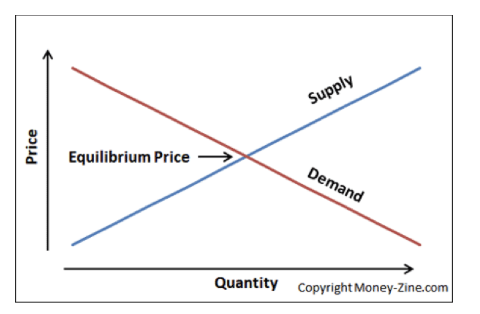
What is equilibrium price?
The specific point on the graph where the line of demand and the line of supply intersect. If we combine the demand and supply needs we can see where the most number of buyers and sellers are satisfied.
Factors that increase/decrease demand (4)
Changing consumer income
Changing consumer tastes
Changing expectations for the future
Changes in population
Factors that increase/decrease supply
Change in the number of producers
Change in the price
Changes in technology
Changing expectation for the future
Changing production costs
Forms of business onwership
Sole prop
Partnership
Co-operative
Corporation
Franchise
Crown and municipal corporation
What is the difference between a public and a private corporation?
A public corporation is a corporation where their ownership is divided into shares called stocks and these are traded/exchanged on the stock market, available to the public. A person who owns stock is called a shareholder.
On the other hand, a private corporation is one where their ownership is closely held and limited to certain people (workers, family, and executives)—it is not available to the public. + and not exchanged on a public stock market.
International business structures
Join venture, international franchise, strategic alliance, merger, off-shoring, multinational corporation
What are the 6 CSR principles?
Provide a safe and healthy work environment
Fair labour policies
Truthful advertising
Protecting the environment
Donating to charity
Avoiding price discrimination
What is a shareholder?
A shareholder is somebody who owns at least one share of a business stock (in other words, part ownership). For example, if a business’s ownership was a pie and the pie was cut into slices, a share is like a slice of pie (a piece of ownership).