A&P 1 Cytology
 Call Kai
 Learn
Learn Practice Test
 Spaced Repetition
 Match
Match Flashcards
 Knowt Play
1/34

There's no tags or description
Looks like no tags are added yet.
Name | Mastery | Learn | Test | Matching | Spaced | Call with Kai |
|---|
No analytics yet
Send a link to your students to track their progress
35 Terms
Cytoplasm
the substance that surrounds organelles and is located between between the nucleus and the plasma membrane.
Organelles
permanent structures with characteristic morphology, specialized for specific cellular activities
Inclusions
secretions and storage products of cells
Hypertrophy
increase in the size of cells without division the opposite of this is atrophy. Muscles increase in size by hypertrophy (not by making new muscles cells)
Hyperplasia
increase in the number of cells due to an increase in cell division
Cancer
also known as a malignant tumor or malignant neoplasm, is a group of diseases involving abnormal cell growth with the potential to invade or spread to other parts of the body. Not all tumors are cancerous; benign tumors do not spread to other parts of the body. Possible signs and symptoms include: a new lump, abnormal bleeding, a prolonged cough, unexplained weight loss, and a change in bowel movements, among others. There are over 100 different known cancers that affect humans. The great majority of cancers, some 90–95% of cases, are due to environmental factors. The remaining 5–10% are due to inherited genetics. Tobacco use is the cause of about 22% of cancer deaths Another 10% is due to obesity, a poor diet, lack of physical activity, and drinking alcohol. Other factors include certain infections, exposure to ionizing radiation, and environmental pollutants.
Plasma Membrane
The outer boundary of a cell that regulates the movement of substances in and out, maintaining homeostasis and protecting cellular integrity.
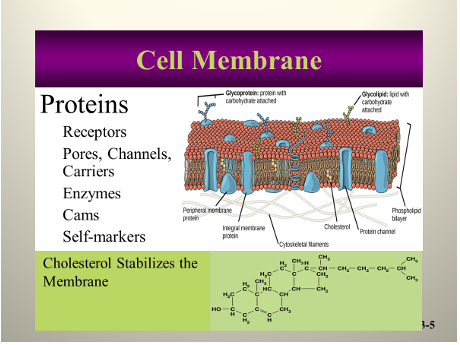
Amphipathic phospholipids (have hydrophobic & hydrophilic regions)
prevent free diffusions of ions and molecules, much like your skin prevents free diffusion of your guts.
cholesterol
interspersed in membrane and provide strength
Proteins (also amphipathic)
channels allow control of what enters and leaves the cell. act as receptor sites for hormones, neurotransmitters, etc. used for recognition (Rh protein) so your immune system recognizes the body’s components and doesn’t attack.
Carbohydrate Chains
found on both proteins and lipids. also used for cell recognition (IE ABO blood sugars)
Endoplasmic Reticulum
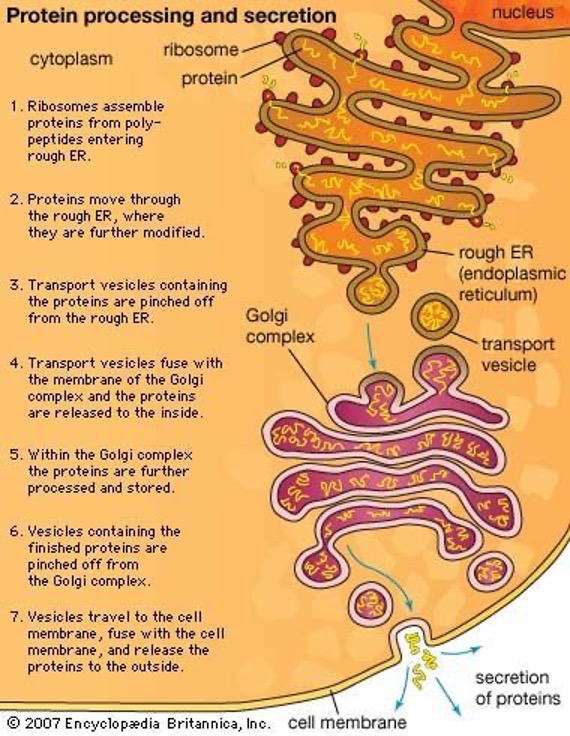
double lipid layer w/ surface enzymes. may have ribosomes (rough) or not (smooth).
channels for protein secretion. divides cell into components. provide surface for enzymes.
SER involved in lipid synthesis (ie steroids)
testes - lipid (testosterone synthesis)
intetsine - triglycerol sythesis
liver - detoxification
Ribosomes
aggregates of protein and RNA
one large and one small subunit. hydrophilic core. made of rRNA. site of translation (making proteins)
Golgi Apparatus
Folds proteins or adds suagrs for cell recognition. Also secretion.
Forms lysosomes (sacs filled with digestive enzymes)
Nucleus
mass of DNA associated with RNA and nuclear proteins. have octagonal-shaped nuclear pores
Mitochondia
Composed of two membranes; both are phospholipid
bilayers like the membrane around the cell.
The outer membrane is a selectively permeable membrane that surrounds the mitochondria.
The inner membrane is folded into inward folds called cristae. Most ATP production in the cell takes place across the cristae. The more cristae present in a mitochondrion, the larger the surface area of its inner membrane – which increases its capacity for energy production. Typically, the more metabolically active a cell, the more mitochondria it will have, and with more cristae per mitochondrion.
The fluid around the cristae is known as the mitochondrial matrix. The Kreb’s cycle takes place in the matrix.
Mitochondria are responsible for creating more than 90% of the energy
needed by the body to sustain life and support growth.
Contain their own DNA (but are incapable of replication w/o
nuclear help).
reduce in number with age and specific diseases
Lysosomes
membranes containing digetsive enzymes (proteinases, nucleases, etc)
prominent in macrophages
functions:
autolysis - destroys whole cell
autophagy - destroy old cell
phagocytes - destroy foreign material brought in
lysosomes enzymes are used in meat tenderizers
Microfilaments and Microtubules
compose cytoskeleton
b. form conducting channels for substances in the cytoplasm
c. microfilaments contain actin
1. nonmuscle cell movement (white blood cells can move by themselves
to migrate to sites of tissue injury to attack bacteria)
2. moving things inside cells (IE. pushing a virus after phagocytosis into
the cell’s lysosome for digestion)
d. microtubules contain tubulin
1. conducting channels in nerve cells
2. form structure of flagella (sperm tails) and cilia (respiratory hairs)
3. allow movement of centrioles during replication
Centrosomes and Centrioles
centrosome contains two centrioles which are made of microtubules
b. serve as centers about which mictrotubules involved in chromosome movement (during replication) are organized
c. cells without a centrosome (mature nerve cell) cannot reproduce [and therefore cannot be replaced]
d. involved in the production of cilia and flagella
Vesicles
a. membranous sacs
b. much smaller than those found in plants
Cilia
hair-like extensions of the cell membrane used for filtration. They
are found lining the trachea and brochi
Passive Movement
depend on kinetic energy of individual molecules
Diffusion
scattering of molecules or ions from regions of high concertration to regions of low concentration.
responsible for exchanges of oxygen and carbon dioxide
factors affecting: distance, concentration, molecular weight, temperature.
Facilitated Diffusion
involves use of carrier molecules. only move substances from regions of higher concentrations to lower concentrations.
responsible for movement of glucose across phospholipid bilayer
Osmosis
movement of water across a selectively permeable membrane from an area of higher water conc. to an area of lower water conc.
c. RBC lose water in a hypertonic solution (crenation), gain water in hypotonic (hemolysis), and are normal in an isotonic solution
Filtration
movement of water and dissolved substances across a selectively permeable membrane by pressure
Dialysis
seperation of large and small molecules by diffusion across a selectively permeable membrane.
used clinically
Active Transport
movement of ions and molecules from regions of low conc. to regions of high conc. It requires energy to be expended (ATP) and involves the action of carrier molecules in the cell membrane
phagocytosis
process by which the cell membrane engulfs solid particles
2. membrane surrounds, encloses, and brings into cell
3. important in cellular immunity
Pinocytosis
1. process by which cell membrane engulfs tiny droplets
2. the liquid becomes surrounded by a vacuole
Receptor-Mediated Endocytosis
receptor molecules on cell surface combine with specific molecules, combinations are ingested
Exocytosis
Export of substances by reverse endocytosis
Gap Junction
1. allow small, water-soluble substances to pass directly from the cytoplasm of one cell to the cytoplasm of another
2. connect cells electrically and metabolically
3. plants have special junctions called plasmodesma (ta)
Flagella
Tails. The only example in humans are sperm tails