First Quiz Module 1
 Call Kai
 Learn
Learn Practice Test
 Spaced Repetition
 Match
Match Flashcards
 Knowt Play
1/33

There's no tags or description
Looks like no tags are added yet.
Name | Mastery | Learn | Test | Matching | Spaced | Call with Kai |
|---|
No analytics yet
Send a link to your students to track their progress
34 Terms
Model to Access to Information
A network with two clients and one server.
Client-Server
This model involves requests and replies.
Peer-to-Peer Model
In this system, there are no fixed clients and servers.
Uses of Computer Networks
•Access to Information
•Person-to-Person Communication
•Electronic Commerce
•Entertainment
•The Internet of Things
Home Network Applications
•Access to remote information
•Person-to-person communication
•Interactive entertainment
•Electronic commerce
Business-to-Consumer
B2C (e.g., ordering books online)
Business-to-Business
B2B (e.g., Car manufacturer ordering tires from a supplier)
Government-to-Consumer
G2C (e.g., Government distributing tax forms electronically)
Consumer-to-Consumer
C2C (e.g., Ordering second hand products online)
Peer-to-Peer
(e.g., file sharing)
TYPES OF COMPUTER NETWORKS
•Broadband Access Networks
•Mobile and Wireless Access Networks
•Content Provider Networks
•Transit Networks
•Enterprise Network
Network Technology
Various networking technologies that implement networks at different sizes and scales
•Personal Area Networks
•Local Area Networks
•Home Networks
•Metropolitan Area Networks
•Wide Area Networks
•Internetworks
Personal Area Networks
Let devices communicate over the range of a person
Can also be built with a variety of other technologies that communicate over short ranges.
Bluetooth
Local Area Networks
• 802.3 standard
• 802.11 standard
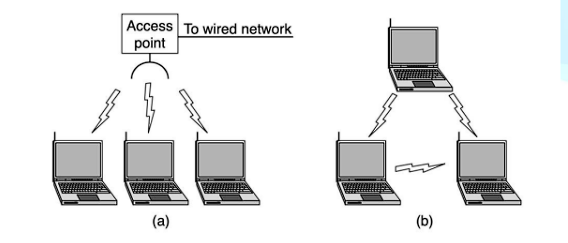
• Access Points + Routers + Mesh Networks + Switches
Home Networks
have a broad, diverse range of Internet-connected devices, and must be particularly easy to manage, dependable, and secure, especially in the hands of nontechnical users
Metropolitan Area Networks
Covers a city
Based on cable TV.
Wide Area Networks
Spans a large geographical area, often a country, a continent, or even multiple continents
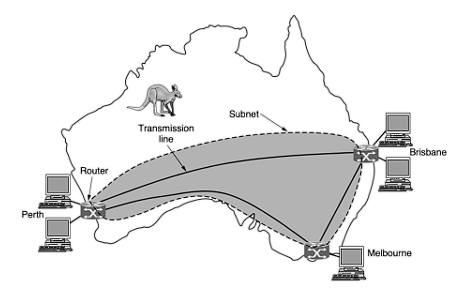
Relation between hosts on LANs and the subnet.
Wide Area Networks
A stream of packets from sender to receiver.
Typical WAN Connection
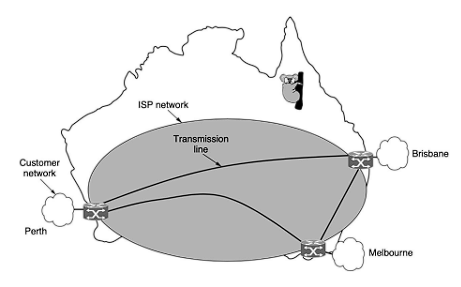
Virtual Private Networks
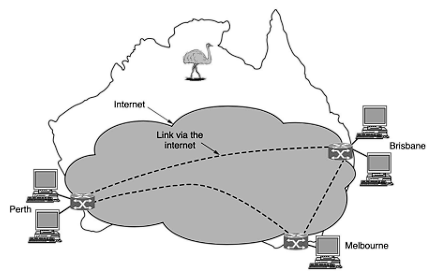
WAN Connected through the INTERNET
Internetworks
A collection of interconnected networks
Internet and internet: are they the same?
Gateways are vital
EXAMPLES OF NETWORKS
•The Internet
•The ARPANET
•The NSFNet
•Internet Architecture
•Mobile Networks
•Wireless Networks (WiFi)
ARPANET
• Late 1950s
• height of the Cold War
• US DOD and RAND Corp
• Paul Baran x DOD x AT&T
• USSR’s SPUTNIK
ARPANET Design
subnet would consist of minicomputers called IMPs (Interface Message Processors) connected by the then-state-of-the-art 56-kbps transmission lines
BBN’s role (implementation of subnet + SW inside the subnet)
Outside the subnet (Researchers @Universities)
Growth of ARPANET
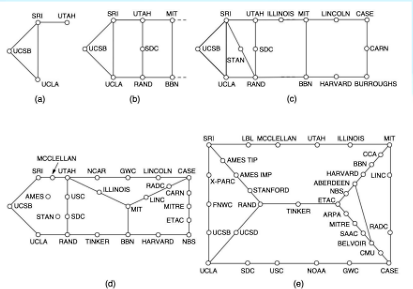
NSFNET
U.S. National Science Foundation
• To get on the ARPANET, a university had to have a research contract with the DoD
• Backdoor to join ARPANET
• Creation of the CSNET (Computer Science Network)
• Creation of backbone (six supercomputer centers + accompanying fuzzball)
• The complete network, including backbone and the regional networks, was called NSFNET (National Science Foundation Network).
• As growth continued, NSF realized that the government could not continue financing networking forever.
• Role of ANS (Advanced Networks and Services)
• During the 1990s, many other countries and regions also built national research networks ( EuropaNET & EBONE)
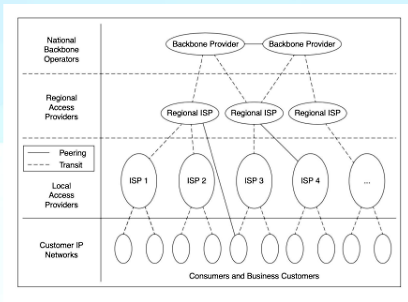
Internet Archive
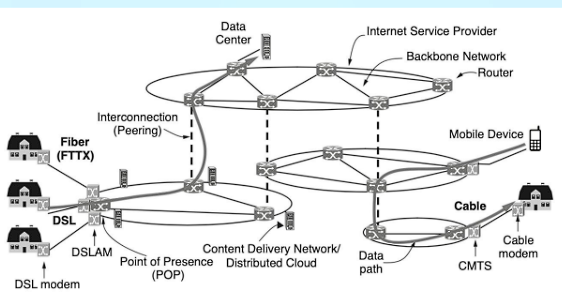
Internet Structure in the 90s
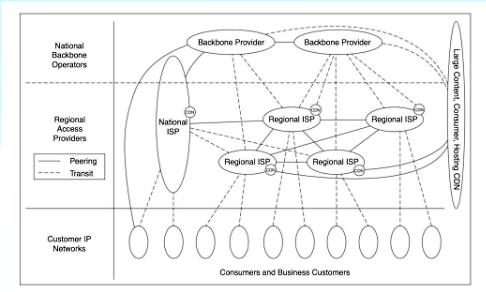
Internet Structure TODAY
Mobile Networks
• have more than five billion subscribers worldwide, which is roughly 65% of the world’s population
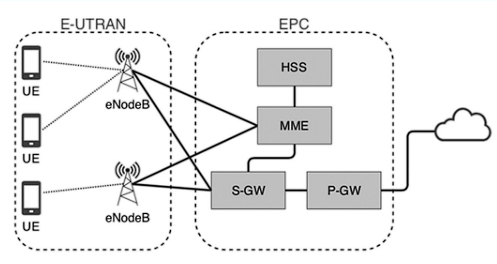
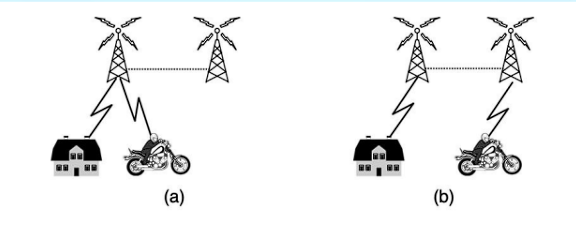
Handoff Concept
Wireless Networks (WiFi)
Extend portability
• Started with companies following standards
• IEEE came up with a wireless LAN standard as part of the IEEE 802.3 standards
• Operate in unlicensed bands such as the ISM (Industrial, Scientific, and Medical) bands defined by ITU-R (e.g., 902-928 MHz, 2.4-2.5 GHz, 5.725-5.825 GHz)
• This means that 802.11 radios may find themselves competing with cordless phones, garage door openers, and microwave ovens. So unless designers think people want to call to their garage doors, it is important to get this right.
Architecture of a Wireless LAN