Unit 8, Chapter 8: Teaching Students with Autism and Fetal Alcohol Spectrum Disorders
 Call Kai
 Learn
Learn Practice Test
 Spaced Repetition
 Match
Match Flashcards
 Knowt Play
1/17

There's no tags or description
Looks like no tags are added yet.
Name | Mastery | Learn | Test | Matching | Spaced | Call with Kai |
|---|
No analytics yet
Send a link to your students to track their progress
18 Terms
Autism Spectrum Disorder
pervasive developmental disorders that primarily affect social interactions, language, and behavior; characteristics displayed by individuals with autism vary significantly (appears during the first 3 years of life)
1980s, autism was found to be an organic disorder, eliminating much of this speculation (disorder due to poor mother-child bonding, or hostile environment/household)
some cases, children with autism display unique splinter skills, or islands of precocity where they display areas of giftedness
new diagnostic criteria have been rearranged into two areas: 1) social communication/interaction, and 2) restricted and repetitive behaviors. The diagnosis will be based on symptoms, currently or by history, in these two areas.
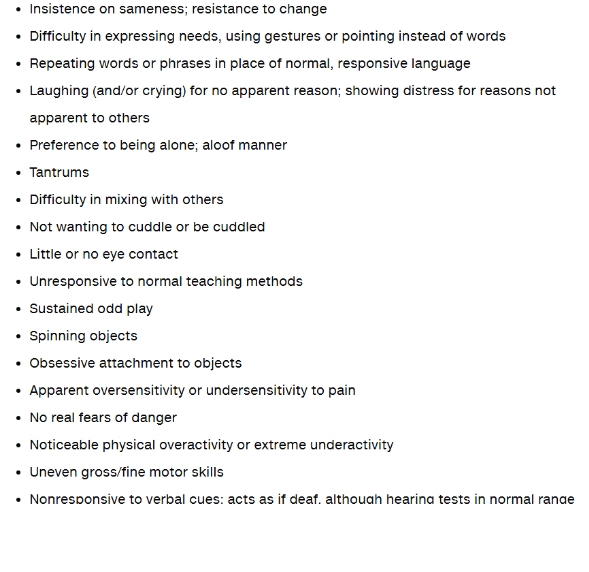
Common characteristics of ASD
verbal and nonverbal communication impairments, auditory-based sensory impairments, and problems relating to other individuals
can be classified into (1) behavioral deficits (inability to relate to others, cognitive deficits, or (2) behavioral excesses (self-stim, resistance to change, self-injurious behaviors
Causes of Autism
Although (1) organic factors such as brain damage, genetic links, and complications during pregnancy, or (2) environmental factors (toxins etc..), may cause this condition, in most cases, no cause can be confirmed.
common assumption is that autism is related to abnormalities in brain structure or function
Most accepted models suggest a combination of a genetic base influenced by environmental events.
Processes of identifying children with Autism
early identification/symptoms from early childhood, value of multiple sources of assessment info
for earliest detection include: lack of eye contact and limited social skills; differences in postural and motoric characteristics; a lack of responsiveness to others’ and to one’s own name; a pattern of solitary or unusual play; marked passivity; fixation on objects in the environment; delayed expressive and receptive language, including gestural communication; and difficulties in self-regulation that may be reflected in, for example, impulsivity, irritability, and interference with the formation of attachments
Issues in identifying children with Autism (co-morbidities, no stable classification system, group of professionals responsible for eval and diagnosis)
Strategies and interventions for students with autism
placing children with autism with their achieving peers in general education settings, approaptate supports, educational (evidence-based) interventions
Educational interventions, 4 key educational goals for students with ASD
to develop basic language and social skills
to provide academic instruction consistent with cognitive level
to teach functional skills for postschool success
to tie instruction to parental education, such as to encompass behavioral interventions to enhance social and functional skills
Recent research also indicates that behavioral treatment of children with autism, especially young children, may result in significant long-term gains in intellectual and adaptive behaviour areas. Social skills training has also been shown to be effective.
Medical Interventions for behaviors that have an impact on quality of life (aggression, self-injurious behavior, obsessions/compulsions, unsafe impulsivity), yet the usage with a treatment plan (other interventions as well)
Programs for students with autism should also be age appropriate and developmentally appropriate
No single method is effective with all children who have autism, partly because, as mentioned, these children display widely variable characteristics.
Difference between Autism and Asperger’s
Although many of the behavioral characteristics (challenges with social interaction and communication skills) displayed by children with Asperger syndrome are similar to those displayed by children with autism, the former generally have higher cognitive development and more typical communication skills.
areas of strength of students with Asperger syndrome include oral expression and reading recognition, while difficulties can include oral comprehension, written expression, and mathematics, particularly in the area of problem solving
Organic disorder
a mental or behavioral health issue resulting from a specific physical cause
Splinter skills
Skills that an individual with a severe disability, such as autism, possesses that are beyond explanation.
characteristics of students with fetal alcohol spectrum disorders (FASD).
students with FASD demonstrate diverse physical, health, academic, and learning characteristics, certain patterns or common characteristics that can be associated with these disorders are described as primary and secondary disabilities
Primary disabilities: result of the damage done to the brain by alcohol. They reflect differences in brain structure and function
Secondary disabilities: disabilities that the individual was not born with, and which may be ameliorated through better understanding and appropriate early interventions
Fetal alcohol spectrum disorders (FASD)
An umbrella term (not a diagnostic term) used to refer to the damage or range of disabilities caused by alcohol consumption during pregnancy.
Fetal alcohol syndrome (FAS), partial fetal alcohol syndrome (pFAS), alcohol-related birth defects (ARBD), and alcohol-related neurodevelopmental disorder (ARND) are all disorders that may be included under the umbrella term of fetal alcohol spectrum disorder (FASD).
Causes of FASD
effects of prenatal exposure to alcohol on an unborn child are influenced by the pattern of alcohol exposure, other factors, such as maternal health and nutrition, genetic susceptibility, and use of other psychoactive substances” can also affect an unborn child
Process of identifying children with FASD
diagnosed “by a medical practitioner when there is known, significant prenatal exposure to alcohol and the child exhibits three main characteristics: evidence of growth retardation; evidence of central nervous system damage; and evidence of facial abnormalities”
Identified by individuals working in a variety of settings and referred for diagnosis,
Once referred, a comprehensive, multidisciplinary assessment is recommended in making a diagnosis
Strategies and interventions for students with FASD
structuring the learning environment, developing effective routines, teaching social and adaptive skills, and helping students generalize new skills and concepts
Structuring the learning environment: students with FASD benefit from a structured, supportive approach to creating and modifying the learning environment
students’ organizational skills and independent work habits can be developed by teaching them to use a daybook to keep track of assignments and school events
Developing effective routines: Establishing classroom routines can also assist in organizing the classroom environment
Can help students develop (academic and real life) expectations
Teaching social and adaptive skills: practical strategies for addressing adaptive and social skill deficits include providing supervision and support throughout the school day, preparing students for changes in classroom routine (i.e., giving advance notice of transitions), teaching social skills (i.e., using role plays and social stories), and teaching functional life skills
educators can encourage peer acceptance and support for the inclusion of students identified with exceptionalities in our schools and communities, such as students with fetal alcohol spectrum disorders, is to expose them to classroom literature that reflects students with diverse needs.
Helping students generalize new skills and concepts: may also demonstrate difficulties generalizing new skills and concepts to a variety of settings.
Educators can enhance a student’s ability to generalize new skills and concepts by selecting skills for generalization that are likely to increase a student’s independence, to be reinforced in the natural environment, and to be used frequently in a variety of settings
partial fetal alcohol syndrome (pFAS)
maternal alcohol exposure confirmed and individual has some not all physical signs of FAS and also has learning and behavioral difficulties (imply central nervous system damage)
alcohol-related birth defects (ARBD)
displays some physical anomalies resulting from conformed prenatal alcohol exposure (heart, skeletal, vision, hearing, and fine/gross motor problems)
birth defects include abnormal facial features (small eyes, smooth philtrum), small head size, growth deficiencies, and severe central nervous system dysfunction
alcohol-related neurodevelopmental disorder (ARND)
central nervous system damage resulting from a confirmed history of prenatal alcohol exposure (learning difficulties, poor impulse control, poor social skills, and problems with memory, attention and judgement)
ndividuals with ARND present with central nervous system dysfunction—such as cognitive and behavioral deficits—but do not exhibit the characteristic facial features or growth deficiencies associated with Fetal Alcohol Syndrome (FAS)
Fetal alcohol syndrome (FAS)
A combination of physical and central nervous system abnormalities caused by maternal consumption of alcohol during pregnancy.
partial fetal alcohol syndrome (pFAS)
a confirmed history of alcohol consumption during pregnancy, combined with some, but not all, facial features of FAS, along with growth restriction or central nervous system (CNS) abnormalities
still experience significant neurodevelopmental issues