3. Irreversible Cell Injury
 Call Kai
 Learn
Learn Practice Test
 Spaced Repetition
 Match
Match Flashcards
 Knowt Play
1/9

There's no tags or description
Looks like no tags are added yet.
Name | Mastery | Learn | Test | Matching | Spaced | Call with Kai |
|---|
No analytics yet
Send a link to your students to track their progress
10 Terms
Define irreversible injury → ‘point of no return’
When a stressor is too severe or prolonged, the cell passes a "point of no return" and undergoes cell death. Two critical events define this transition:
Irreversible Mitochondrial Dysfunction:
Profound, permanent loss of oxidative phosphorylation and ATP generation.
Release of pro-apoptotic proteins (e.g., Cytochrome c) into the cytosol.
Profound Membrane Damage:
Plasma Membrane: Loss of cellular contents and severe disruption of osmotic balance.
Lysosomal Membrane: Leakage of highly destructive enzymes (RNases, DNases, proteases) into the cytoplasm, leading to enzymatic digestion of the cell components.
Accidental vs regulated cell death?
Accidental Cell Death (ACD): Uncontrolled, unprogrammed death in response to severe injury (e.g., severe ischemia, burns, toxins). Necrosis is the primary morphological manifestation.
Regulated Cell Death (RCD): A genetically and biochemically programmed process executed by specific signaling pathways. Examples include Apoptosis, Necroptosis, and Pyroptosis.
Explain necrosis
Definition: The morphological manifestation of unprogrammed, accidental cell death (ACD) in living tissue. Always pathologic.
Key Features:
Cell swelling (Oncosis).
Loss of membrane integrity → cellular contents leak out.
Elicits a prominent inflammatory response (due to leaked Damage-Associated Molecular Patterns - DAMPs).
Enzymatic digestion of the cell (via autolysis from its own lysosomes or heterolysis from invading neutrophils).
Nuclear Changes (Hallmarks):
Pyknosis: Nuclear shrinkage and increased basophilia (dark staining).
Karyorrhexis: Fragmentation of the pyknotic nucleus.
Karyolysis: Fading/dissolution of the nucleus (due to DNAse activity).
Note on Oncosis: Oncosis (ischemic cell swelling) is technically the pre-lethal pathway leading to necrosis; "necrosis" refers to the dead tissue left behind.
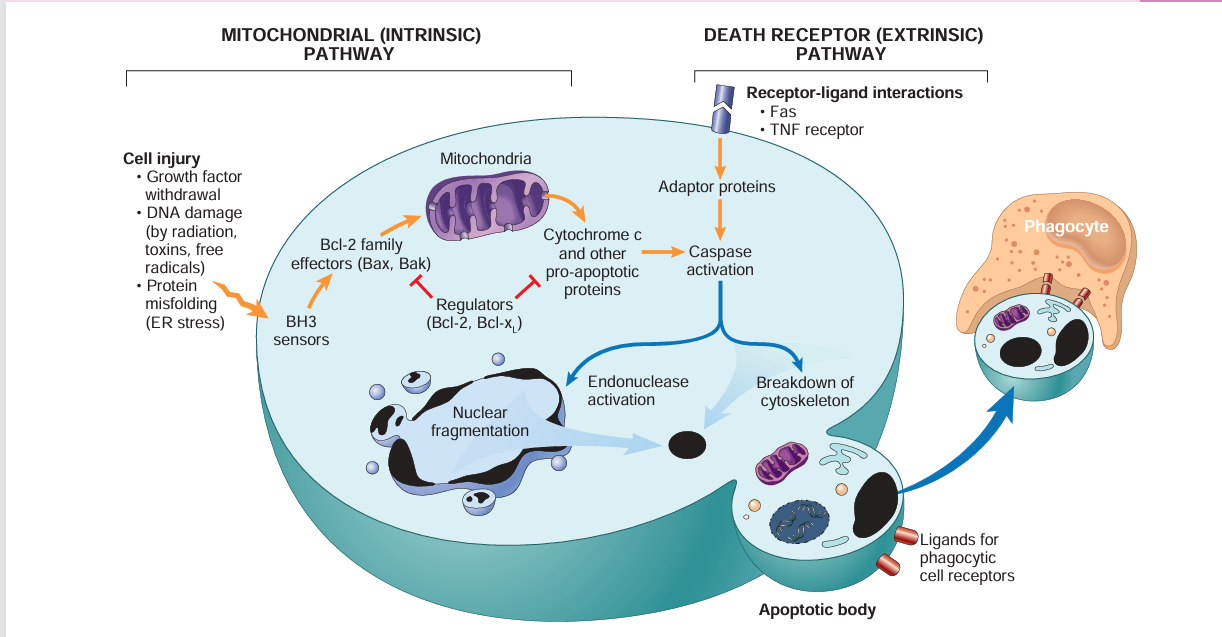
Explain apoptosis
Definition: Regulated cell death (RCD) driven by the activation of caspases. Can be physiologic or pathologic.
Key Features:
Cell shrinkage.
Chromatin condensation and fragmentation.
Plasma membrane remains intact (but forms blebs).
Formation of apoptotic bodies (membrane-bound fragments containing organelles).
NO inflammation. (Apoptotic bodies are rapidly phagocytosed by macrophages before contents leak).
Pathways:
Intrinsic (Mitochondrial) Pathway: Triggered by cellular stress/DNA damage. Cytochrome c leaks from mitochondria → activates Caspase-9. (Regulated by Bcl-2 family proteins).
Extrinsic (Death Receptor) Pathway: Triggered by external signals (e.g., FasL binding to Fas receptor, or TNF binding to TNFR). Activates Caspase-8.
Explain necroptosis
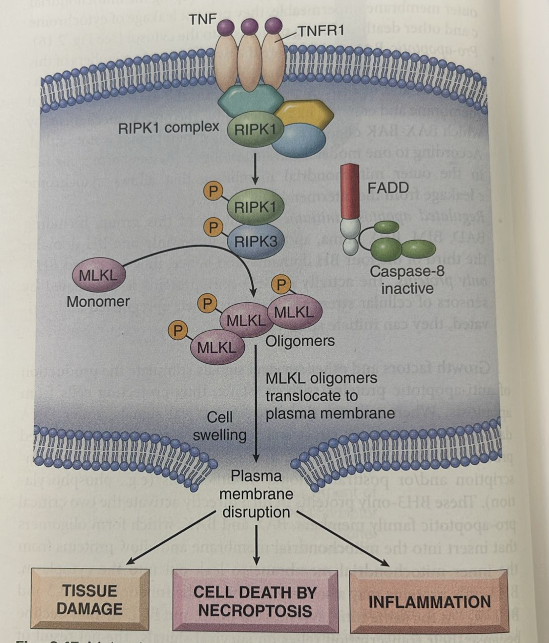
Definition: A hybrid form of cell death. It is programmed/regulated (like apoptosis) but morphologically resembles necrosis (cell swelling, membrane rupture, inflammation).
Mechanism:
Triggered by death receptors (e.g., TNFR1) when Caspase-8 is inhibited or deficient.
Depends on the activation of kinases RIPK1 and RIPK3.
RIPK1/3 form a complex (the necrosome), which phosphorylates MLKL.
MLKL oligomerizes, inserts into the plasma membrane, and causes fatal pores/rupture.
Clinical Significance: Prominent in ischemia-reperfusion injury, viral infections (where viruses block caspases), and inflammatory bowel disease.
Explain pyroptosis
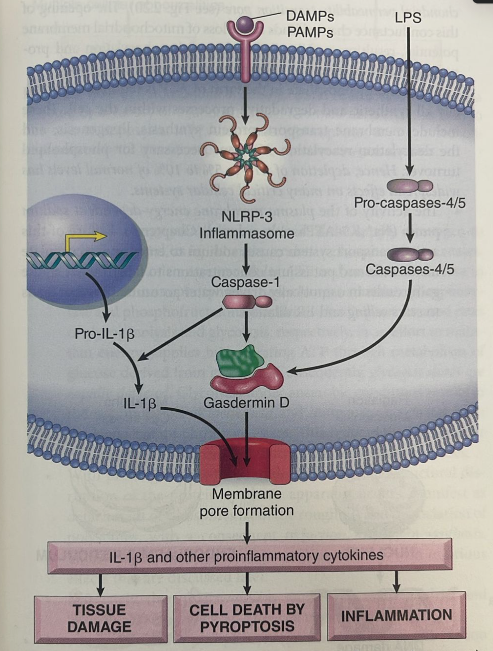
Definition: A highly inflammatory form of regulated cell death, typically triggered by intracellular microbial infections.
Mechanism:
Microbial products activate the inflammasome (a cytosolic multi-protein complex).
Inflammasome activates Caspase-1.
Caspase-1 does two things:
Cleaves and activates pro-inflammatory cytokines (IL-1β and IL-18).
Cleaves Gasdermin D.
Gasdermin D inserts into the plasma membrane, forming pores that lead to cell swelling, membrane rupture, and massive release of cytokines.
Explain autophagy ‘self-eating’
Definition: A survival mechanism during nutrient deprivation where the cell digests its own organelles for energy. If stress is too severe, it culminates in cell death.
Mechanism:
Intracellular organelles are enclosed in a double-membrane vacuole (autophagosome).
The autophagosome fuses with a lysosome to form an autophagolysosome.
Lysosomal enzymes degrade the contents, recycling metabolites for cell survival.
Which forms of cell death are inflammatory?
necrosis
necroptosis
pyroptosis
Which forms of cell death involve swelling vs shrinkage?
Swelling = necrosis, necroptosis, pyroptosis, oncosis
Shrinkage = apoptosis
What caspase is unique to pyroptosis?
Caspase-1 (activated by inflammasome)