Topic 3 Electricity
 Call Kai
 Learn
Learn Practice Test
 Spaced Repetition
 Match
Match Flashcards
 Knowt Play
1/21

There's no tags or description
Looks like no tags are added yet.
Name | Mastery | Learn | Test | Matching | Spaced | Call with Kai |
|---|
No analytics yet
Send a link to your students to track their progress
22 Terms
Mains electricity
The standard alternating current (AC) that is supplied from public electric grids to homes.
2.6 Difference between AC(alternating current) and DC (direct current)
In an alternating current(AC) the current continuously changes direction. It is supplied by electric generators (electromagnetic induction, coil rotating in a magnetic field, with the split commutator reversing the direction of current every half turn)
In a direct current (DC), the current only flows in one direction. It is supplied by a cell or battery.
Hazards of mains electricity
high voltage (230 V)(can drive large current through human body)
Contact with the wire without insulation/damaged insulation/ frayed cables can cause an electric shock or a fire due to short circuit
Overheating wires due to short circuit could melt the insulation and cause fire
Overloaded plugs/ sockets causes the current to increase, increasing the temperature which could melt the insulation and cause fire.
wet electrical equipment(sockets or plugs) can cause electric shock because water conducts current/electricity
Fuses
A fuse is a thin piece of wire that overheats and melts when there's an excessive current.
It breaks the circuit and stops the current.
It protects the appliances and wires from being damaged and prevents a potential fire due to a short circuit (by breaking the circuit).
Circuit breaker
A circuit breaker consists of an automatic electromagnet switch that breaks the circuit when the current rises over a certain value. This prevents 1. fire due to a short circuit and 2. damage to the appliances due to overheating.
This is better than a fuse because 1. it can be reset and 2. it acts faster (it takes longer for the fuse to melt completely and break the circuit)
Earth wire
The earth wire is connected to the metal casing of an appliance(which is an electrical conductor that could cause electric shock).
Normally, no current flows in the earth wire.
If the live wire touches the metal casing :
The earth wire provides a low-resistance path for the current to the earth.
Therefore a large current flows into the earth wire.
causing the fuse to melt(or trips circuit breaker), which breaks the circuit, stopping the current, and disconnects the appliance.
The fault current is also led to the earth, away from the user and the appliance, preventing electrical shock.
Double insulation
Appliances that have double insulation have two layers of plastic coverings, preventing them from giving an electric shock. (since plastic is an electrical insulator)
2.3 Current in a resistor
A current in a resistor causes electrical energy to transfer into thermal energy
because the electrons in the current collide with the atoms in the resistor, increasing their vibration and leading to an increase in temperature.
This is used in many domestic appliances such as kettle, hairdryer, toaster
2.4 Formulae of power
Power = Current x Voltage
P= IV
Power is measured in Watts.(W)
Since power is the amount of energy used per unit time, Power = Energy/time.
P = E/t
Therefore 1 watt = 1 joule per second
(Current is the rate of flow of charge, measured in Amps)
(Voltage is the energy transferred per unit charge passed, measured in volts)
2.5 Formula of energy
Since Energy = Power x time
and Power = Current x Voltage (IV)
Energy = IxVxt
Energy is measured in Joules (J).
2.14-2.17 Current
Current(I) is the rate of flow of charge at a point in a circuit and it’s measured in Amperes (A).
Current can be calculated using Q/t (original formula : Q = I x t)
Current in metals is due to flow of negatively charged electrons, (in solutions it’s the flow of ions)
Conventional current is the rate of flow of positive charge, it is in the opposite direction of the flow of electrons since they are negatively charged.
Current is measured using an Ammeter connected in a series with a component.
Current is conserved (split) at a junction in a circuit because charge is conserved(split).
2.13, 2.20, 2.21 Voltage
Voltage(potential difference) is the energy transferred per unit charge.(between two points in a circuit). It is measured in Volts.
Therefore Voltage = Energy /Charge (V= E/Q). A volt is a Joule per Coulomb.
Voltage is measured with a Voltmeter in parallel across the component.
The higher the voltage, the greater the current (V = I x R)
Resistance
Resistance (R) is measured in Ohms.
It can be calculated using R = V/I
If the resistance increases, the current decreases.
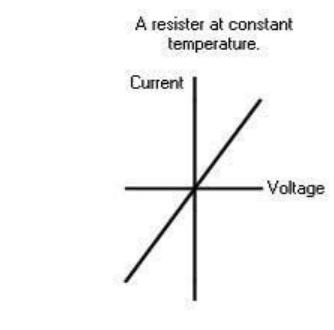
2.7 Resistance(how current varies with voltage) in an ohmic conductor/wire
The resistance is constant.
Current (y-axis) is directly proportional to voltage(x-axis). If voltage increases, current increases.
straight, diagonal line though origin
If concrete numbers of voltage and current are given, don't forget to calculate some points!
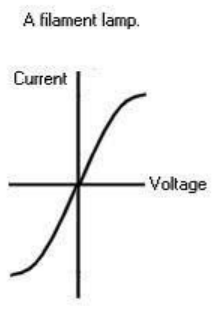
2.7 Resistance(how current varies with voltage) in a filament lamp
The resistance varies.
When the current increases, the temperature increases, so the resistance increases as the electrons and the atoms in the resistor collide and vibrate more.
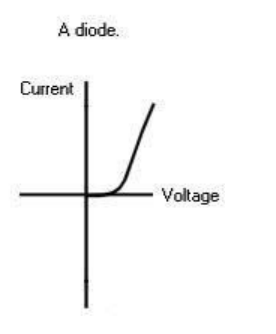
2.7 Resistance(how current varies with voltage) in a diode
As a diode only allows the current to flow in one direction, there will be no current when the voltage is a negative.
The current only begins to increase at 0.6-0.7 V. Diode has a low resistance so current flows easily.
2.11 Resistance in a thermistor
TURD - temperature up, resistance down
If temperature increases, the resistance decreases. This is because heat frees more electrons in a thermistor.
2.11 Resistance in a LDR (light dependent resistor)
LURD - Light intensity up, resistance down. The resistance chage with light intensity.
If light intensity increases, the resistance decreases as light frees more electrons in the LDR.
Series
Current is the same at all points in a series circuit.
Voltage is shared between components in a series circuit.
Total Voltage = sum of voltages of each component
Total resistance = sum of resistances of each component
Parallel
Voltage across each branch in a parallel circuit is the same.
Current is shared between each branch. Total current = sum of the currents of each branch
If more branches with resistors are added, the total resistance decreases (since there are more paths for the current to flow), so the total current increases.
Series and parallel circuits in domestic lightning
Series:
If one bulb breaks, the other bulbs will all go out.
If more bulbs are added, there will be more resistance in the circuit, so the bulbs get dimmer.
bulbs cannot be controlled independently by switches
Parallel:
If one bulb breaks, the others can still work
the voltage is the same across each branch so the brightness of the bulbs will all be the same
bulbs can be independently controlled by switches
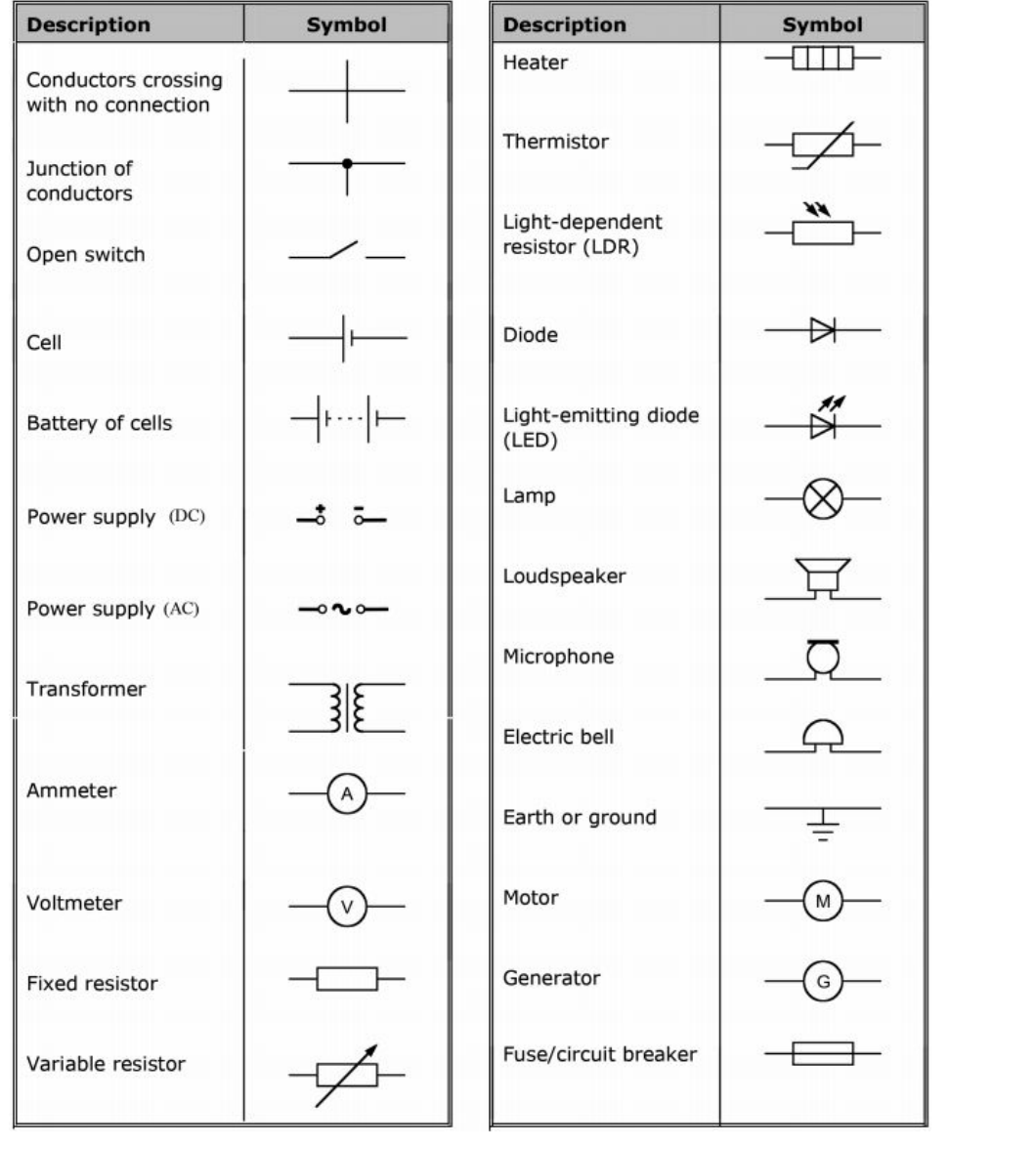
Circuit symbols