A level Bio 1.4 Proteins& Enzymes Part II
 Call Kai
 Learn
Learn Practice Test
 Spaced Repetition
 Match
Match Flashcards
 Knowt Play
1/21

Earn XP
Description and Tags
Name | Mastery | Learn | Test | Matching | Spaced | Call with Kai | Chat |
|---|
No analytics yet
Send a link to your students to track their progress
22 Terms
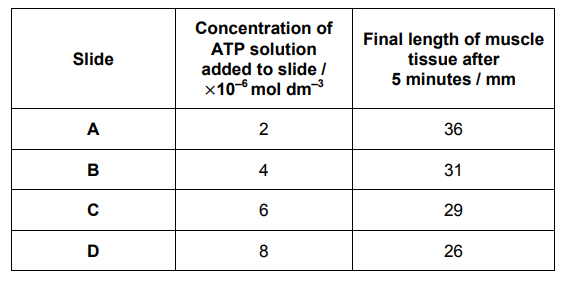
Hydrolysis of ATP is catalysed by the enzyme ATP hydrolase. box A student investigated the effect of ATP concentration on the activity of ATP hydrolase. She used shortening of strips of muscle tissue caused by contraction as evidence that ATP was being hydrolysed.
• She took four slides A, B, C and D, and added strips of muscle tissue of the same length to each slide.
• She then added the same volume of ATP solutions of different concentrations to the four slides and left each slide for five minutes.
• She then recorded the final length of each strip of muscle tissue. Her results can be seen in Table 1.
Other than those given, name two variables the student should have controlled. (2)
Species/organism the muscle tissue came from (1)
Temperature of the muscle tissue (1)
Suggest and explain why the combined actions of endopeptidases and exopeptidases are more efficient than exopeptidases on their own. (2)
Endopeptidases hydrolyse internal (peptide bonds) (1)
More ends or increase in surface area (for exopeptidases) (1)
Scientists have investigated the effects of competitive and non-competitive inhibitors of the enzyme maltase.
Describe competitive and non-competitive inhibition of an enzyme. (6)
Inhibitors reduce binding of enzyme to substrate / prevent formation of ES complex (1)
(Competitive inhibition)
Inhibitor has a similar shape to substrate (1)
It binds into active site (of enzyme) (1)
(Inhibition) can be overcome by more substrate (1)
(Non-competitive inhibition)
Inhibitor binds to the allosteric site of an enzyme (1)
enzyme’s active site changes (1)
The scientist used the same concentration of endocellulase and exocellulase in the mixtues. The rate of digestion of cellulose is greatest when both enzymes are present. Suggest why (2)
Endocellulose creates more ends/increases surface area (1)
for exocellulose to act on (1)
Yarrow is a herbaceous plant which grows in California at altitudes from 1500 m to 3000 m. The mean height of the stems of plants growing at 3000 m is smaller than that of plants growing at 1500 m.
The higher the altitude, the lower the mean temperature. Explain how the lower temperature at high altitude reduces the growth of plants. (4)
lower enzyme activity (1)
decrease in rate of photosynthesis so less carbohydrate formed (1)
less respiration (1)
lower rate of protein synthesis (1)
The relative contribution of environmental and genetic factors on the growth of the plants was investigated. Samples of young plants were taken and grown outdoors in prepared plots at altitudes of 1500 m and 3000 m.
Altitude at which young | Mean maximum height of stems of plants / cm | |
plants were collected / m | Grown at 1500 m | Grown at 3000 m |
1500 | 80.4 | 35.3 |
3000 | 31.5 | 24.7 |
Describe the evidence from the table that the variation in height is partly genetically determined (1)
differ in height when plants from different altitudes grown
in same environment (1)
The relative contribution of environmental and genetic factors on the growth of the plants was investigated. Samples of young plants were taken and grown outdoors in prepared plots at altitudes of 1500 m and 3000 m.
Altitude at which young | Mean maximum height of stems of plants / cm | |
plants were collected / m | Grown at 1500 m | Grown at 3000 m |
1500 | 80.4 | 35.3 |
3000 | 31.5 | 24.7 |
Describe the evidence from the table that the variation in height is partly environmentally determined (1)
plants from 1500 / 3000m differ in height when grown at different
altitudes
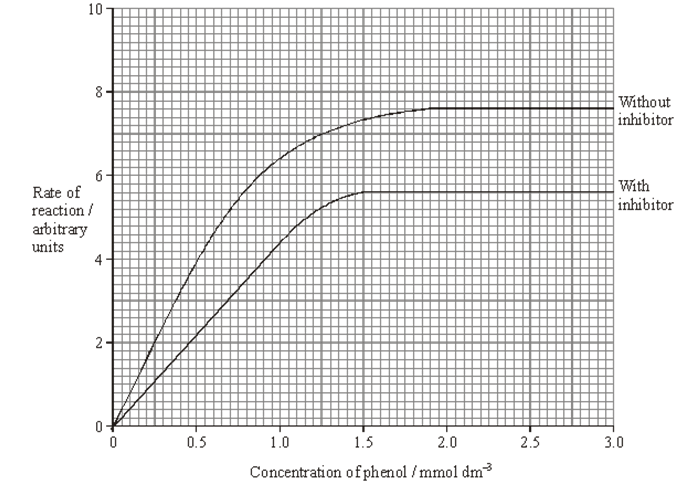
In an investigation, the rate at which phenol was broken down by the enzyme phenol oxidase was measured in solutions with different concentrations of phenol. The experiment was then repeated with a non-competitive inhibitor added to the phenol solutions. The graph shows the results.
Explain why an increase in concentration of phenol solution from 2.0 to 2.5 mmol dm-3 has no effect on the rate of reaction without inhibitor (2)
maximum rate at which enzyme can combine with substrate / form enzyme-substrate complexes (1)
(active site of) enzyme saturated with substrate (1)
Doctors investigated babies who were bottle-fed with baby-formula milk and suffered from colic. Colic is a condition that affects the gut and makes babies cry.
Each mother was given two solutions to add to her baby’s milk. One solution contained the enzyme lactase, the other did not. The mother did not know which solution contained lactase. The mother added one of the solutions to her baby’s milk for a week and recorded how long it cried each day. The mother then used the other solution for the second week.
| Mean crying time / hours day–1 |
Milk with lactase | 1.43 |
Milk without lactase | 2.57 |
Suggest an explanation for the results (2)
Babies may have lactose intolerance (1)
Lactose (in milk) causes colic/crying/discomfort (1)
Doctors investigated babies who were bottle-fed with baby-formula milk and suffered from colic. Colic is a condition that affects the gut and makes babies cry.
Each mother was given two solutions to add to her baby’s milk. One solution contained the enzyme lactase, the other did not. The mother did not know which solution contained lactase. The mother added one of the solutions to her baby’s milk for a week and recorded how long it cried each day. The mother then used the other solution for the second week.
The table shows the results.
| Mean crying time / hours day–1 |
Milk with lactase | 1.43 |
Milk without lactase | 2.57 |
Suggest one variable the doctors would have to control in this study to make it a fair test. Explain your answer. (2)
Same age of children (1)
as there’s a change in enzyme production with age (1)
Doctors investigated babies who were bottle-fed with baby-formula milk and suffered from colic. Colic is a condition that affects the gut and makes babies cry.
Each mother was given two solutions to add to her baby’s milk. One solution contained the enzyme lactase, the other did not. The mother did not know which solution contained lactase. The mother added one of the solutions to her baby’s milk for a week and recorded how long it cried each day. The mother then used the other solution for the second week.
The table shows the results.
| Mean crying time / hours day–1 |
Milk with lactase | 1.43 |
Milk without lactase | 2.57 |
The doctors concluded that adding lactase to milk was, ‘A major breakthrough for babies with colic.’
Evaluate the evidence for this conclusion. (3)
Could be other causes/symptoms of colic (1)
Babies might cry for reasons besides colic (1)
Don’t know number of babies in trial/need a larger study
So don’t know how reliable mean is (1)
Gelatine is a protein. When a warm gelatine solution cools, it sets to form a jelly.
Fresh pineapple juice contains an enzyme that digests protein.
A student investigated the effect of pineapple juice on the setting of jelly.
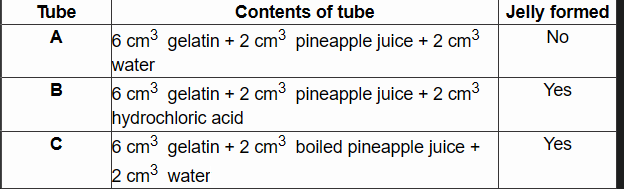
He set up three different tubes of warm gelatine solution and recorded which had set after three hours. The contents of each tube and his results are shown in the table.
Tube | Contents of tube | Jelly formed |
A | 6 cm3 gelatin + 2 cm3 pineapple juice + 2 cm3 water | No |
B | 6 cm3 gelatin + 2 cm3 pineapple juice + 2 cm3 hydrochloric acid | Yes |
C | 6 cm3 gelatin + 2 cm3 boiled pineapple juice + 2 cm3 water | Yes |
Explain why 2 cm3 of water was added to tubes A and C. (2)
To keep concentrations of gelatine constant (1)
To keep concentration of pineapple extract constant (1)
Gelatine is a protein. When a warm gelatine solution cools, it sets to form a jelly.
Fresh pineapple juice contains an enzyme that digests protein.
A student investigated the effect of pineapple juice on the setting of jelly.
He set up three different tubes of warm gelatine solution and recorded which had set after three hours. The contents of each tube and his results are shown in the table.
Explain the results of tube A and B (4)
Tube A
Enzyme (in pineapple) has digested gelatin (1)
so no gelatin/ protein to form a jelly (1)
Tube B
Enzyme denatured/inhibited/change of tertiary structure (1)
by change of pH (1)
Methotrexate is a drug used in the treatment of cancer. It is a competitive inhibitor and affects the enzyme folate reductase
Explain how the drug lowers the rate of reaction controlled by folate reductase. (1)
Methotrexate / drug is only similar shape to specific substrate / only fits this active site (1)
Many animals are adapted to their environments by having different types of haemoglobin with different tertiary structure
Use your knowledge of the structure of proteins, explain how different types of haemoglobin can have different tertiary structures (3)
(Polypeptides have) different sequences of amino acids/different primary structures (1)
(so different) secondary structure determined by (position of) hydrogen bonds (1)
Different hydrogen/ionic/disulfide bonds (in tertiary structure) (1)
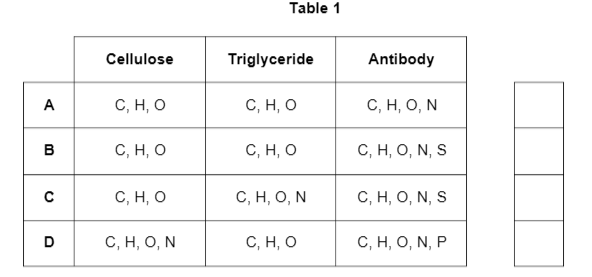
Table 1 shows the names of three biological molecules and different combinations of elements
Which row identifies the correct elements in each molecule? (1)
B (rmb the disulfide bonds) (1)

The reaction is catalysed by the enzyme catalase is shown below.
Use your knowledge of the induced-fit model to explain how catalase breaks down hydrogen peroxide (3)
The shape of the active site becomes complementary (to the hydrogen peroxide/substrate) (1)
(so) bending of bond(s) (in hydrogen peroxide) (1)
(so) less energy needed to break the bond/lowers activation energy (1)
The student uses the following method.
1) Cut a 75mm long cylinder of potato into 5 discs of equal size
2) Arrange the discs on a large pin in a boiling tube
3) Add 40 cm3 of 1.0moldm-3 hydrogen peroxide
4) Record the volume of oxygen collected in 2 minutes
5) Repeat steps 1-4 with an uncut cylinder of potato 75mm long
The rate of reaction is faster with the five discs of potato than with the uncut
potato cylinder.
Explain why. (1)
(Total surface area greater so) more enzymesubstrate complexes (1)
What is an enzyme? (2)
any two points from :
tertiary protein
catalyst
Binds with specific substrate
lowers activation energy
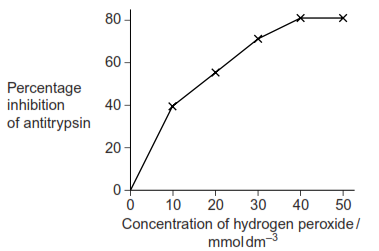
Alpha-1-antitrypsin is a protein that reduces the activity of enzymes that can damage lung tissue.
Cigarette smoke contains hydrogen peroxide. Hydrogen peroxide reduces the activity of alpha-1-antitrypsin. Scientists investigated the effect of different concentrations of hydrogen peroxide on the activity of alpha-1-antitrypsin. The graph shows their results.
Hydrogen peroxide reacts with two amino acids in alpha-1-antitrypsin. Explain how this reduces activity of the protein. (2)
Changes shape of antitrypsin (1)
hydrogen/ionic/disulfide bonds are affected(1)
No longer attaches to/interacts/reacts with trypsin (1)
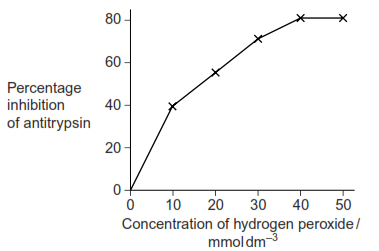
Alpha-1-antitrypsin is a protein that reduces the activity of enzymes that can damage lung tissue.
Cigarette smoke contains hydrogen peroxide. Hydrogen peroxide reduces the activity of alpha-1-antitrypsin. Scientists investigated the effect of different concentrations of hydrogen peroxide on the activity of alpha-1-antitrypsin. The graph shows their results.
Explain the results shown in the graph. (2)
Higher the concentration of hydrogen peroxide, more amino acids/proteins affected (1)
More antitrypsin molecules change shape (1)
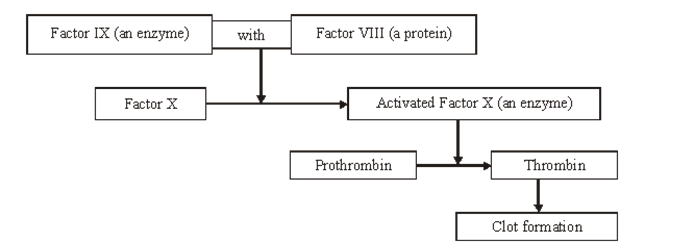
The diagram shows part of the metabolic pathway involved in the clotting of blood in response to an injury.
Haemophilia is a condition in which blood fails to clot. This is usually because of a mutant allele of the gene for Factor VIII.
A boy had haemophilia caused by faulty Factor IX. When his blood was mixed with blood from a haemophiliac with faulty Factor VIII, the mixture clotted. Suggest an explanation for clotting of the mixture. (2)
Factor VIII haemophiliac’s blood contains (active) Factor IX (1)
the mixture has both Factors and so the pathway can
complete / blood clots (1)