Genetics Units 1-4
 Call Kai
 Learn
Learn Practice Test
 Spaced Repetition
 Match
Match Flashcards
 Knowt Play
1/140

There's no tags or description
Looks like no tags are added yet.
Name | Mastery | Learn | Test | Matching | Spaced | Call with Kai |
|---|
No analytics yet
Send a link to your students to track their progress
141 Terms
Nuclear DNA is present as
linear chromosomes inside the nucleus at interphase
nuclear envelope
a distinguishing feature of eukaryotes
Organelle DNA
present as circular chromosomes in the mitochondria and chloroplasts.
G1 (gap 1)
cell growth
S-Phase
synthesis, DNA replication
G2 (Gap 2)
cell growth pt2
M-Phase
mitosis + cytokinesis. Eukaryotic cell division
Interphase
Contains G1, S, and G2
quiescence
Known as G0. The cell may exits the division cycle during G1 and become a non-dividing cell.
checkpoints
steps at which the progression through the cell division cycle is monitored and regulated
During G1 or G0
each chromosome consists of a single DNA molecule
After S-Phase and during G2
each chromosome consists of two DNA molecules (two identical sister chromatids)
Telomeres
stable ends of linear chromosomes
centromere
the defined region of a chromosome at which sister chromatids are joined following DNA replication
decondensed interphase chromosomes
occupy their own distinct territories within the nucleus
Prior to cell division
the chromatin condenses into visible chromosomes due to the tightening of interactions between DNA and chromatin proteins
histones
chromatin proteins
gene
sequence that encodes a trait. A unit of heredity that is transferred from a parent to offspring and is held to determine some characteristic
chromatin
fibers of decondensed DNA chromosomes. occurs during the non-divisional phases of the cell cycle
p arm
“petite”, the short arm of the chromosome
q arm
the longer arm of the chromosome, typically bellow the centromere
Chromosome
Before DNA replication: A single molecule of DNA
After DNA replication in preparation for cell division: Chromosomes consist of two sister chromatids
metacentric
the centromere is at the center of the chromosome
submetacentric
the centromere is near the center of the chromosome
acrocentric
the centromere is near the telomere of the chromosome
telocentric
the centromere is at the telomere of the chromosome
haploid (N)
one copy of genetic material subdivided into chromosomes
Diploid (2N)
Two copies of genetic material subdivided into chromosomes
A diploid organism has
two sets of chromosomes organized as homologous pairs
Alleles
alternative forms of a gene found on the same position (locus) of homologous chromosomes
homologous chromosomes
chromosomes with the same length and centromere location. Contain the same linear sequence of loci but not necessarily identical DNA sequences. Some of the genes may be allelic, but they are not sister chromatids.
transmission genetics
a unit of heredity that is transferred from parent to offspring
molecular genetics
a region of a chromosome that codes for a functional product
locus
a specific location on a chromosome
all genes are in loci, but
not all loci contain genes
Karyotype
a visual representation of the complete set of chromosomes in an individual organism
normal human karyotype
shows 22 homologous pairs of autosomal chromosomes and 1 pair of sex chromosomes
Ploidy
the number of sets of chromosomes in an organism
polyploid
3n, 4n, 5n, etc
Polyploid
none of the above (EX humans not having 46 chromosomes)
kinetochore
protein structure that is assembled on the centromere
spindle microtubules
attach to the kinetochore and mediate the disjunction of the sister chromatids
centrosome
a pair of centrioles. It is the microtubule-organizing center of animal cells. Replicated before the beginning of mitosis.
prophase
the chromatin condenses into the visible chromosomes. The centromeres move away from each other to become poles of the mitotic spindles made of microtubles.
prophase/metaphase
the nuclear envelope breaks down, the mitotic spindles attach to the centromeres of the chromosomes, and the chromosomes line up at the metaphase plate.
anaphase
the chromatids are pulled apart by the spindles and are disjoined. They are now individual chromosomes
Telophase
the chromosomes are segregated and their DNA decondenses. They become the chromosomes of the daughter cells. The nuclear envelopes reassemble.
Mitosis in diploid cells
Number of chromosomes and DNA per cell
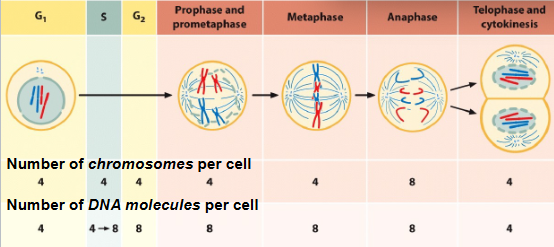
mitosis of a diploid cell
two diploid (2n) daughter cells with the same chromosomal content of the original cell. Each chromosome consists of a single DNA molecule
Meiosis
a special type of eukaryotic cell division cycle that occurs during the generation of gametes and spores. Creates four haploid (1n) cells.
Meiosis I
1st division of meiosis, also known as the reduction division. The tetrads are disjoined, the separated homologous chromosomes with two chromatids each are segregated into daughter cells.
synaptonemal complex
an ordered protein structure that forms between homologous chromosomes during meiotic prophase 1. Mediates the pairing of the chromosomes and facilitates crossing over between non-sister chromatids.
Leptotene
DNA begins to partially condense
zygotene
homologous chromosomes pair to form tetrads (Also known as bivalents)
pachytene
condensation continues and the individual chromatids become more visible. Crossing over occurs
Diplotene
the homologous chromosomes begin to partially separate. The chiasmata become visible
chiasmata
points at which crossing over has already occurred
diakinesis
the homologous chromosomes pull further apart (but remain together). Further condensation occurs in preparation for metaphase.
meiosis 2
2nd division, the equational division. The chromatids are disjoined and become individual chromosomes. They are segregated into daughter cells
mitosis events
homologous chromosomes do not pair at any time
during anaphase, the chromosomes are disjoined and the chromatids become individual chromosomes, which are segregated into daughter cells
meiosis events
homologous chromosomes pair to form tetrads during prophase 1
in anaphase 1, the tetrads are disjoined and the homologous chromosomes are segregated into daughter cells
in anaphase 2, the chromosomes are disjoined and the chromatids become individual chromosomes, which are segregated into daughter cells.
spermatogenesis
equal cytokinesis, results in four gametes. EX Sperm
Oogenesis
unequal cytokinesis, one cell receives all the cytoplasm. The rest of the cells become polar bodies. Only results in one gamete (EX Egg)
Ferritization
produces a diploid (2n) zygote
miotic cell division outcome (redefined)
a cell divides to generate two daughter cells with the same chromosomal content of the original cell. The dividing cell may have any chromosomal content
meiotic cell division outcome (redefined)
a cell undergoes two rounds of division, and generates 4 daughter cells with half the chromosomal content of the parent cell. The dividing cell must have an even number of chromosomes.
meiosis fails when
organisms do not contain chromosome compliments in an even number, unbalanced gametes.
nondisjunction
occurs if chromosomes or chromatids do not separate during anaphase 1 or 2. Both chromosomes migrate to the same gamete, and after fusion trisomic, monosomic aneuplodies may occur
trisomy
three copies of a chromosome are present
monosomy
only one copy of a chromosome is present
partial monosomy
the loss of a piece of one of the two copies of a chromosome
complete autosomal monosomies
are not viable in humans
Pisum sativum
garden pea plant
Pea plants are
self-fertilizing in nature, therefore their traits remain pure in the wild, but they can also be cross-fertilized easily
The character _____ exhibits only two contrasting traits: _____ and _____
seed color; green, yellow
characters studied by Mendel
seed color
2. seed shape
3. seed coat
4. pod color
5. pod shape
6. flower position
7. stem length
monohybrid cross
the experimental mating of two individuals with contrasting forms of a character, but only one character is studied in the experiment.
Each trait studied by Mendel is determined by
a unit factor. EX) R and r are both unit factors
Mendel’s first three postulates
Unit factors in pairs
Dominance/Recessiveness
Segregation
Unit factors in pairs
Genetic characters are controlled by unit factors that exist in pairs in individual organisms
Dominance/Recessiveness
When two unlike unit factors responsible for a single character are present in a single individual, one unit factor is dominant to the other, which is said to be recessive.
Segregation
During the formation of gametes, the paired unit factors separate randomly so that each gamete receives one or the other with equal likelihood.
Genes considered allelic
they must be different variants of a gene and must map to the same locus on both homologous chromosomes
genes
units of inheritance (Mendel’s unit factors)
Alleles
alternative variants of a gene, resulting in contrasting traits for a character
polymorphic
genes and loci with multiple versions
genotype
the genetic makeup of an individual (the alleles present in an individual)
homozygote (homozygous)
an individual with two copies of the same variant (allele) of a gene
heterozygote (heterozygous, hybrid)
an individual with two different variants (alleles) of a gene
phenotype
the physical expression of a trait (the consequence of the individuals genotype)
locus (or loci plural)
the exact location a gene is on the chromosome
segregation occurs
in anaphase 1 of meiosis
A heterozygote cross results in
two different types of gametes
testcross (Tt x tt)
a cross of an individual showing a dominant trait(s) and an individual that is homozygous recessive for the same character(s). It is a mating experiment to determine the genotype of an individual that exhibits the dominant phenotypes. The ratio for this cross is 1:1
dihybrid cross
two independent characters are studied at the same time. The characters behave as in two separate monohybrid crosses. Ratio is 9:3:3:1
product rule
when two independent events occur simultaneously, the combined probability of the two outcomes is equal to the product of their individual probabilities of occurrence
Mendel’s fourth postulate: independent assortment
during the formation of gametes, segregating pairs of unit factors assort independently from each other.
How to make a branch diagram
don’t forget your fractions
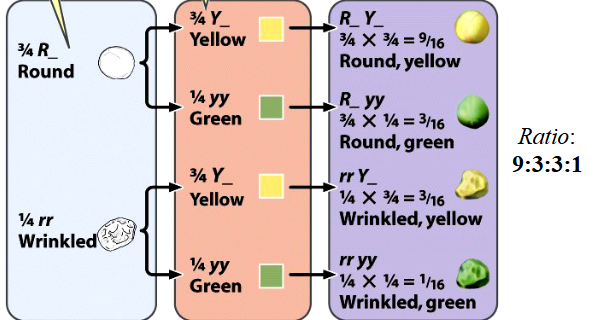
Mendel’s law of independent assortment applies to
characters controlled by loci on separate chromosomes, and the events that occur in metaphase and anaphase of meiosis 1.
an individual with the genotype RrYr
produces four different types of gametes (Ry, rY, ry & RY) with equal probability due to independent assortment. he gametic combinations depend on the orientation of the homologous chromosomes in the tetrads of metaphase I of meiosis, and their disjunction in anaphase 1