Topic 4 Materials definitons and questions
 Call Kai
 Learn
Learn Practice Test
 Spaced Repetition
 Match
Match Flashcards
 Knowt Play
1/50

There's no tags or description
Looks like no tags are added yet.
Name | Mastery | Learn | Test | Matching | Spaced | Call with Kai |
|---|
No analytics yet
Send a link to your students to track their progress
51 Terms
Archimedes’ Principle
When a body is fully or partially submerged in a fluid, it experiences an upthrust equal to the weight of the fluid it has displaced.
Breaking Stress
The maximum stress a material can withstand without fracturing.
Brittle
A material that fractures without plastic deformation first.
Density
Mass per unit volume, with units kgm-3 .
Ductile
A material that produces a large plastic deformation, under tension, this allows these materials to be stretched into thin wires.
Elastic Deformation
When a material can return to its original shape, after an applied stress, without a permanent change to its shape. Any work done in elastically deforming an object is stored as elastic strain energy.
Elastic Limit
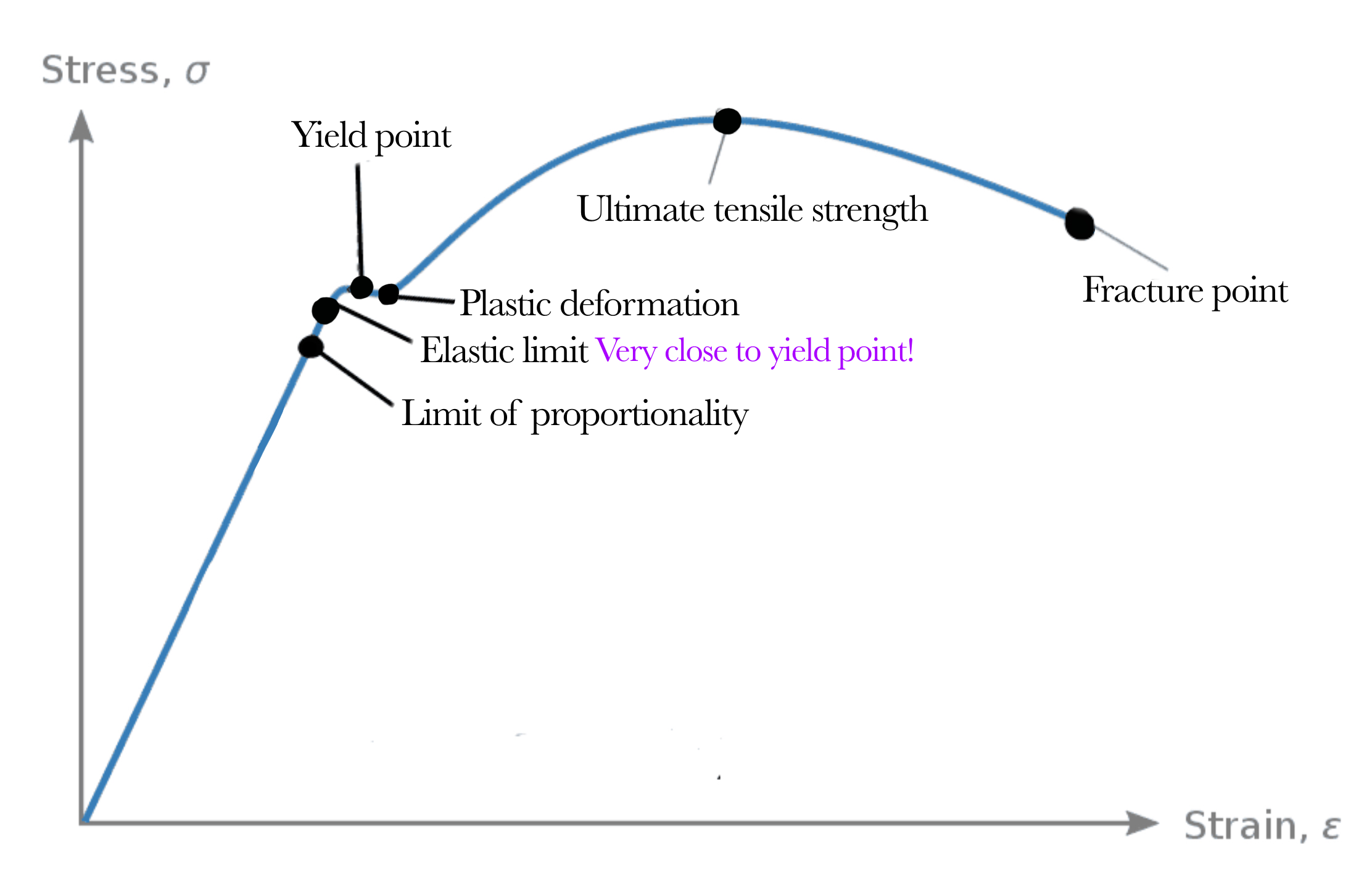
The maximum stress that can be applied to an object without plastic deformation.
Hooke’s Law
The extension of an object is directly proportional to the force being applied to the object.
Hard
resistant to indentation
Laminar Flow
A state of flow where layers of fluid move together in parallel with no mixing between layers.
Limit of Proportionality
The point at which the stress on an object is so great that Hooke’s law no longer applies to an object.
Malleable
A material that is able to undergo plastic deformation under compression. And form thin sheets
Plastic Deformation
When a material is permanently deformed after an applied stress due to the atoms moving relative to one another in the material. Work is done in plastically deforming the material and is dissipated as heat.
Stoke’s Law
The magnitude of the force of viscosity acting on a spherical body as it moves through a fluid is proportional to its radius, its velocity and the fluid’s viscosity. This only applies to spherical bodies travelling in laminar, non-turbulent, flow.
Stiff
high Young’s Modulus
Tensile Strain
The extension of an object divided by its original length.
Tensile Stress
The internal resistance of an object against a force that acts to deform it. It is the force applied per unit cross-sectional area.
High Tensile strength
a material which can withstand a large stress before breaking
Turbulent Flow
A state of flow where layers of fluid mix together unpredictably causing a chaotic state.
Viscosity
A quantity measuring the internal friction of a fluid, it acts to reduce the flow of a fluid. It is temperature dependent.
Upthrust
The force felt against the weight of an object when fully or partially submerged in a fluid. It is equal to the weight of the fluid displaced by the object.
Yield Point
The point on a force-extension graph at which a material begins to rapidly extend without any additional stress.
Young’s Modulus
The ratio of stress to strain of an object. It is a measure of how stiff a material is.
what does k represent in ∆F = k∆x
the stiffness or spring constant of an object
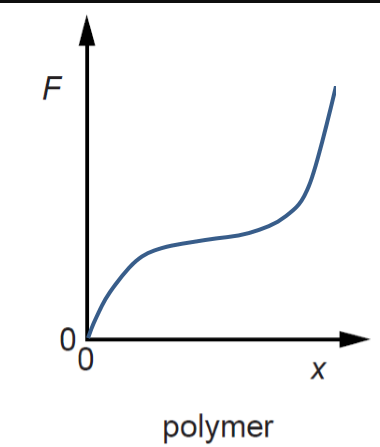
the graph represents a force extension graph of a polymer, suggest 2 differences between that of a graph of a metal
larger and steeper gradient
clear yield point
suggest one property of a material with a high youngs modulus
very stiff
how do you find the elastic strain energy in a force extension graph?
area under force extension graph where the line is straight
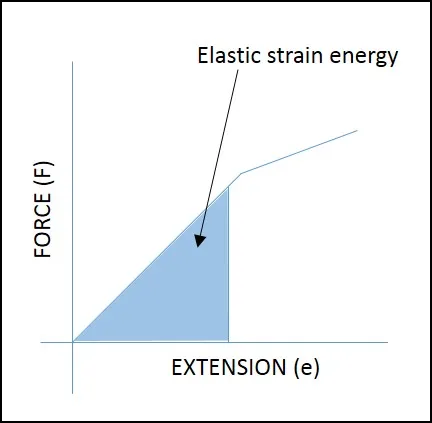
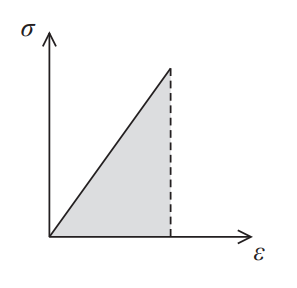
What does the area of a stress against strain graph represent?
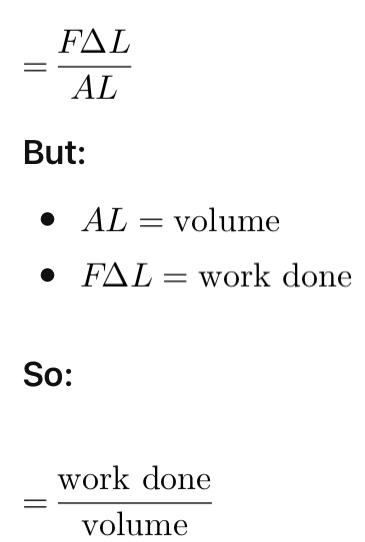
work done or elastic strain energy per unit volume
area=stress x strain
A second wire of the same material and cross-sectional area is stretched by the same force. If it has twice the length of the first wire its extension will be
young modulus and stress is constant
so the extension must double if the length doubled
A material which can be drawn into a wire is described as being
ductile
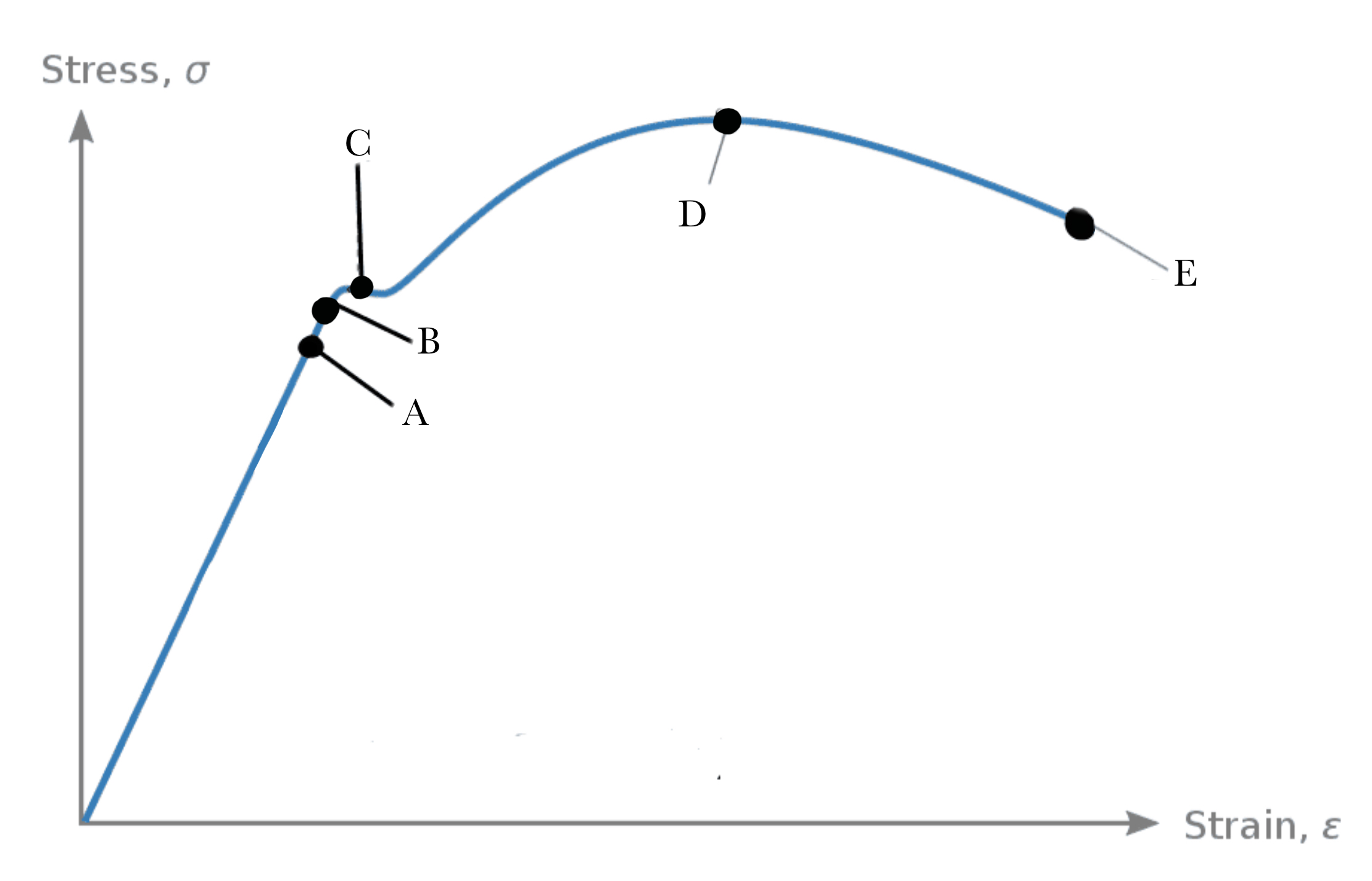
What does each point represent?
maximum tensile stress
area of a force extension graph represents
elastic strain energy or work done
area of a stress strain graph
elastic strain energy or work done per unit volume
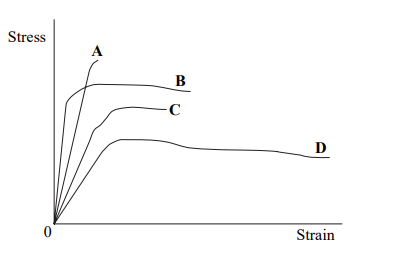
Which material has the greatest strength?
A- highest point for ultimate tensile strength
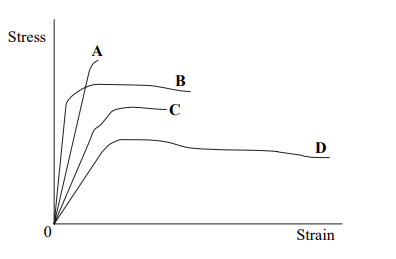
Which material has the greatest value for the Young modulus?
B-steepest gradient
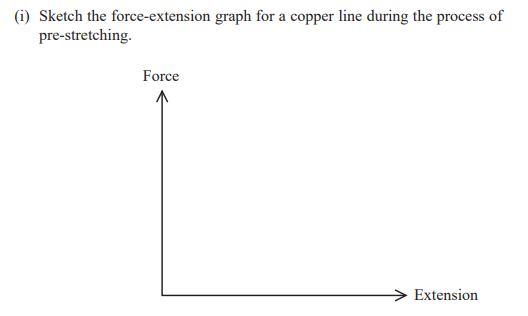
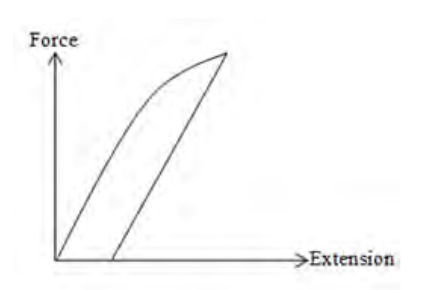
Suggest a reason why some people prefer to use this type of line that have been pre-stretched by loading and unloading.
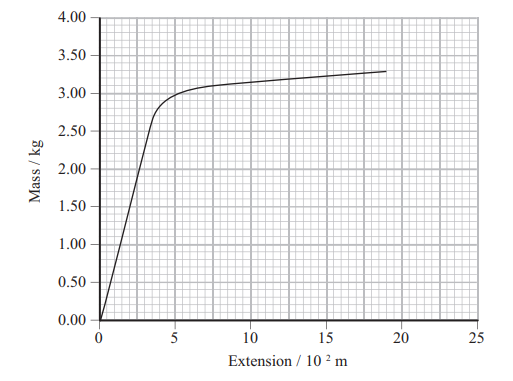
Initially the extension of the graph increased linearly, State what is meant by increased linearly and what can be concluded about the wire
mass is directly proportional to extension
wire obeys Hooke’s Law
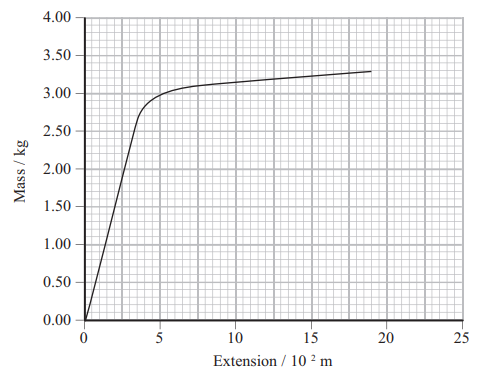
How do you find the maximum energy the wire can store while behaving linearly?
area underneath the straight line
then multiply by gravity (9.81)
to find the elastic potential energy
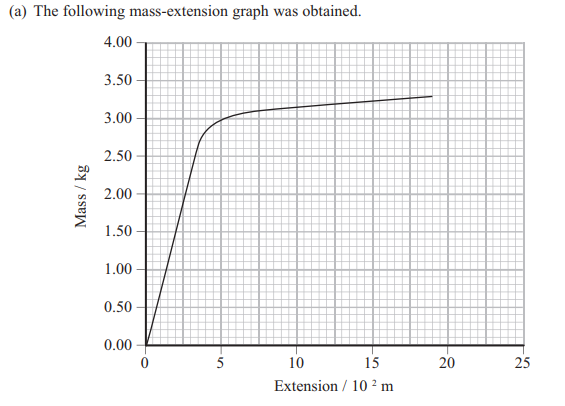
Describe the behaviour of the wire when a mass greater than 2.9kg is added (2 marks)
there is a large increase in extension for a small increase in applied mass
the wire is permanently deformed
Describe 4 modifications that would produce a greater extension for a given mass of a wire
Use a wire with a smaller cross sectional area
Use longer wire
Use wire with a lower spring constant
Or use a wire with a lower young’s modulus
If a ball is moving upwards through a fluid.
Upthrust=
Upthrust= weight + drag
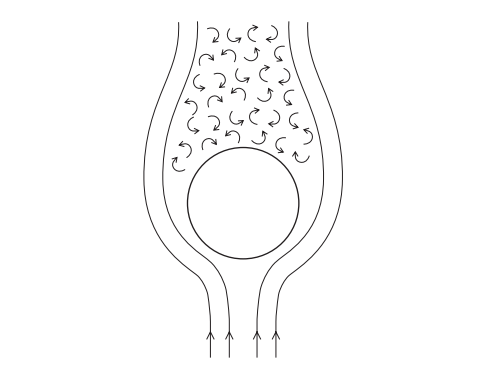
explain 3 resaons why the ball does not obey Stoke’s Law (3 marks)
there is turbulent flow
it is a large sphere
it is moving quickly
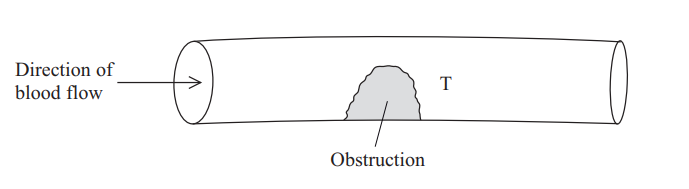
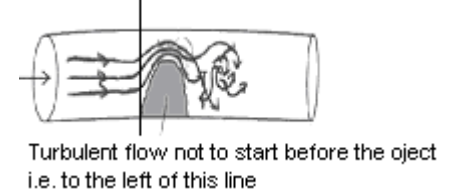
add flow lines to indicate laminar and turbulent flow
How does velocity of a fluid vary with it’s viscosity (1 mark)
if viscosity of the fluid increases, the velocity of the fluid decreases
If the temperature of a fluid increases. How would it affect it’s velocity? (2 marks)
increase viscosity of the fluid, which therefore decreases the velocity of the fluid
Viscosity is sometimes given the units kg m-1 s-1 and Pa s-1
Show how these are equivalent
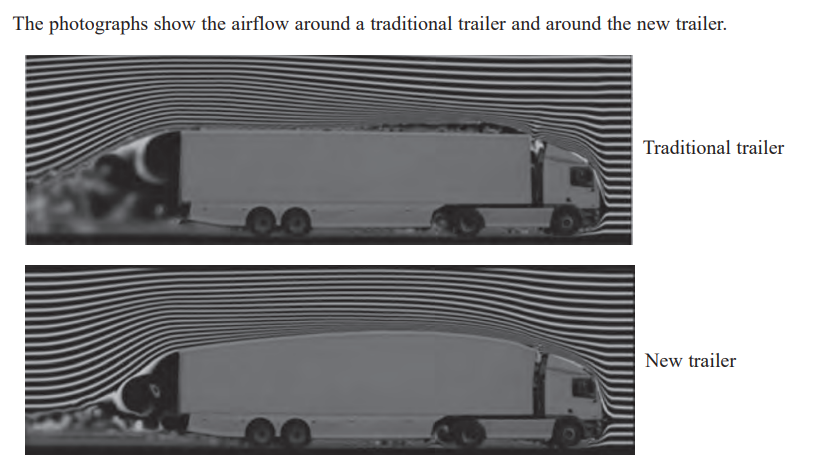
explain why the new trailer uses less fuel than the old one (4 marks)
New design is more streamlined
reducing turbulent flow
less air resistance
less energy transferred to the air from the trailer
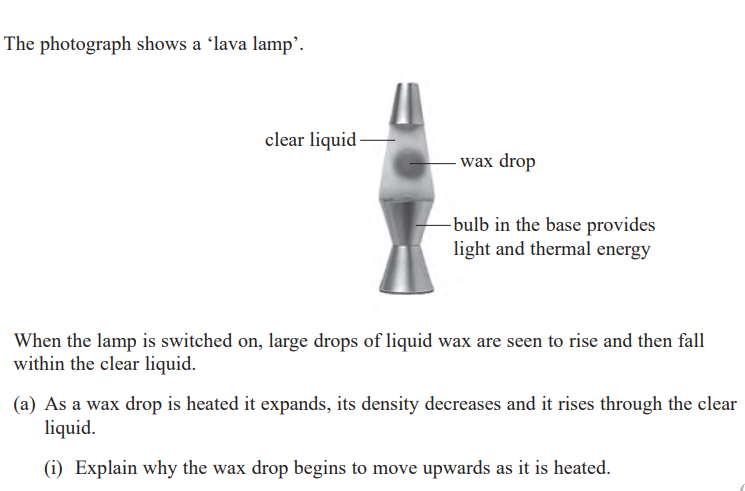
(3 marks)
there is a resultant upward force
there is a greater volume of fluid displaced
So upthrust increases

Initially Upthrust = weight+ drag
Upthrust - (weight + drag)= 0

temperature decreases
so the density of the drop decreases
so the upthrust reduces