Topic 3 - Perceptual Development
 Call Kai
 Learn
Learn Practice Test
 Spaced Repetition
 Match
Match Flashcards
 Knowt Play
1/26

There's no tags or description
Looks like no tags are added yet.
Name | Mastery | Learn | Test | Matching | Spaced | Call with Kai |
|---|
No analytics yet
Send a link to your students to track their progress
27 Terms
What does perception mean?
The process by which our minds organise, process and make sense of sensory data
How does perception in children develop?
Most perceptual abilities emerge in the first year of life
The development of perception is an interaction between a child’s sensory experiences and their biological programming
Our auditory, olfaction (smell) and tactile systems are fairly well developed at birth while the visual system is still immature
What does vestibular mean?
Refers to balance
What does proprioception mean?
Refers to movement and motor coordination
Why is investigating perception in infants difficult and what 2 techniques can we use to study perception in infants?
Very difficult to do - unable to communicate, follow, and respondto instructions
2 techniques used for studying perception in infants:
Habituation
Preferential looking
What is habituation and why is it important for researchers?
The idea that infants will get used to (and bored of) looking at familiar stimuli, but will show interest in novel stimuli
Allows researchers to investigate whether infants can discriminate between two different stimuli
For example one object is shown until an infant’s heart rate or visual fixation drops to a stable level before another object is introduced
What is preferential looking and why is it useful for researchers studying infants?
The tendency of babies to prefer to look at new things
Two objects can be presented at once, and the researcher can record which, if either, the infant attends to more (focuses on/pays more attention to)
This allows researchers to identify what stimuli babies prefer, e.g. in tests of facial recognition
Outline Goren’s background research
Forty newborn infants, median age 9 minutes
Turned their eyes and heads to follow a series of moving stimuli.
Responsiveness was significantly greater to a proper face pattern than to either of two scrambled versions of the same stimulus or to a blank
How and why do we use animals to study perception in infant mammals?
Studying perception in human infants is practically difficult and is generally unethical
Therefore, a number of studies into perception have involved animals, including the key research by Gibson & Walk (1960)
One method used by psychologists is known as ‘selective rearing’, which involves raising an animal from birth under controlled conditions to observe the outcome
Outline Blakemoore and Cooper’s background research?
Raised kittens from birth to five months of age in an environment containing either only vertical or only horizontal stripes
Kittens were ‘blind’ to the stimuli they had never experienced before – if they were reared with horizontal stripes, they were blind to vertical stripes and vice versa
Evaluation of Goren’s research
Nature – preferential looking for faces must be innate – able to show preference for faces over a scrambled image even at 9 mins old
Reductionism – only examines preferential looking for faces
Situation – faces present in the situation stimulates looking in that direction
Evaluation of Blakemore and Copper’s research
Scientific – C+E established –condition that the cats were reared in affected whether they were able to acknowledge hor/ver stripes, controls in place – all in darkroom from 2 weeks-5 months
Nurture – the environment that the kittens were raised in determines how they are able to perceive their env
Reductionism – only looks at visual field
Holistic – looks at neurological and behavioural deficits in kittens
Determinism – environment determines the neuronal activity – neurones were not present in the vertical condition when raised in the horizontal condition and vice versa (int force) –cannot change this
What does motion parallax mean?
Monocular depth cue where closer objects move faster across visual field
What does pattern density mean?
Monocular depth cue where closer patterns are larger and less densely packed
What is the aim of Gibson and Walk’s study?
To find evidence to support the theory that both human’s and other species’ depth perception (and therefore avoidance of falling from heights) is innate
What is the sample for Gibson and Walk’s study?
36 babies aged 6-14 months – just able to crawl
Human babies were compared to other infant animals such as chicks, turtles, rats, lambs and kittens
Why were animals studied in Gibson and Walk’s study?
Studied animals as some animals have independence very shortly after being born which would give a better understanding of whether depth perception is innate
How were controls used in Gibson and Walk’s study?
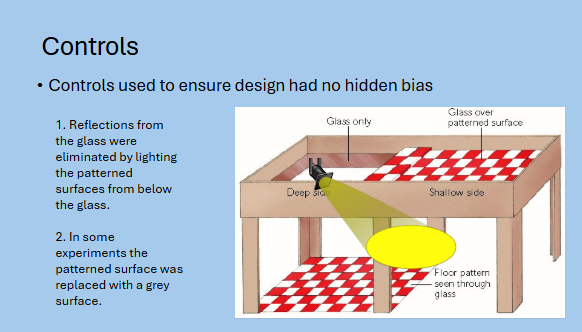
Outline the procedure for Gibson and Walk’s study?
Each child was placed upon the centreboard, and his mother called him to her from the cliff side and the shallow side successively. 2 minutes each side
On one side, there was a checkerboard pattern right against the glass, on the other side, the checkboard pattern was on the floor and appeared as a steep drop but there was a glass platform covering the top of this side
The babies were tasked with crawling towards their mothers
What results were found from Gibson and Walk’s study
27 infants crawled onto the shallow side, 3 crawled onto the deep side, 6 did nothing
Chicks and goats made no mistakes even at one day old (they did not go onto the deep side)
Turtles had the poorest performance with 76% of them crawling off of the board
Infant rats, adult rats and day-old chicks seem to use motion parallax as their depth cue by preferring the shallow side even when the retinal image was the same size. Motion parallax is innate
What conclusions can be made from Gibson and Walk’s study?
Most human infants can discriminate depth as soon as they can crawl. Babies were 6 -14 months so did have opportunity to gain experience in depth perception so difficult to establish just how much is down to nature and nurture
Humans and other animals have developed some depth perception by the time of the onset of mobility, which is specifically suited to the habitat and behaviour of their species
Animal studies support nature – certain visual cues are pre-programmed for survival purposes. (e.g. not falling from a great height)
Some support nurture
What are some applications for perceptual development in infants?
Sensory integration therapy (SIT)
Developing form constancy
How can we apply SIT to develop tactile perception in infants?
Touch
They can develop understanding of different textures by feeling different materials through colourful sensory books for example
This would also help them to differentiate between colours
It develops depth perception due to the 3D natureof the book. The child can develop binocular visionby using both eyes to look at the pictures
Glue, playdough, stickers, rubber toys all developtouch perception
How can we apply SIT to develop auditory perception in infants?
Talking toys, games on computers, instruments, squeaky toys, rhymes, tongue twisters – all develop perception for hearing new sounds, tones and pitches
How can we apply SIT to develop visual perception in infants?
Mobiles
A mobile has brightly coloured moving objects and can help to stimulate visual perception.
Through the movement of the mobile babies will start to co-ordinate their eye movements i.e. binocular vision.
The child will try to reach out for the objects and grab the toys on the mobile. This develops their understanding of distance
What is form constancy?
Child’s ability to identify an object (through colour, shape and size) and to understand that the object is constant even in different conditions (different lightings, different sizes, altered shapes)
How can we apply form constancy to develop perception in infants?
Shape sorters – child must push shaped objects through holes –child learns to realise that a triangle shaped object (for eg) continues to be a triangle regardless of the direction/angle they rotate it
Auditory perceptual constancy – teaches the child that sound remains constant under changing conditions – saying the same words to children in a different accent or pitch/volume teaches the child that the word and meaning are the same regardless of who might say it